
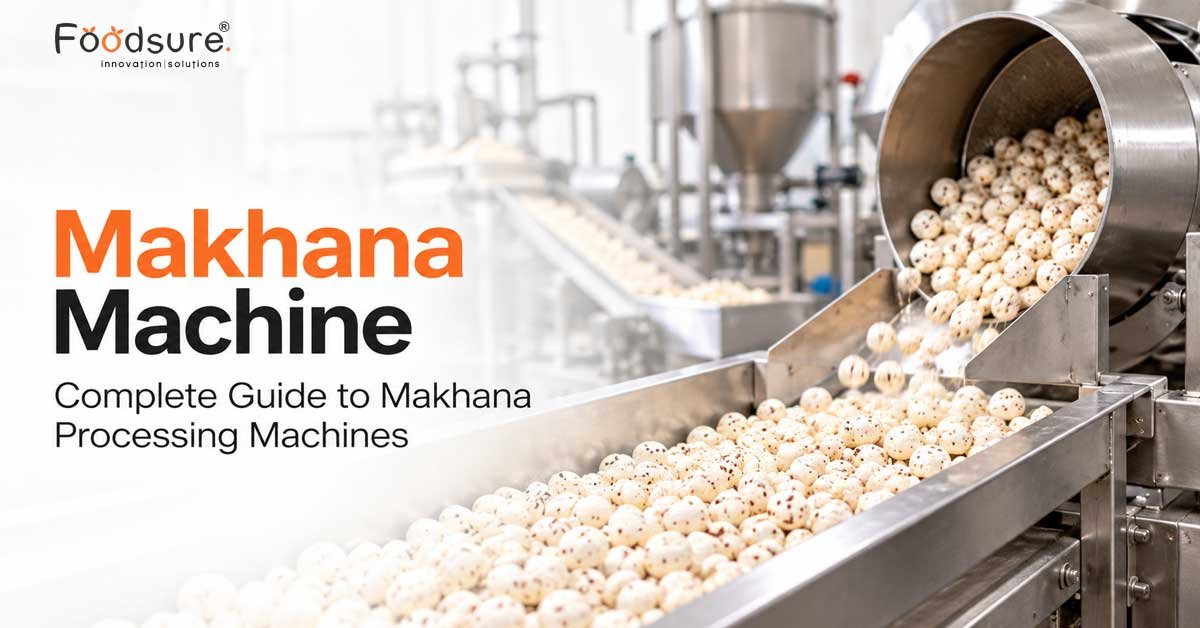
Makhana, or what is popularly known among people as fox nut and lotus seed, has now become more than just a healthy traditional snack. Today, the various forms of makhana, like roasted, flavored, and packed varieties are being marketed through modern retail channels, online stores, as gifts, and by people looking for a good balance between flavor and health. Consistency is paramount to manufacturers with every batch having the desired crunchiness, right appearance, uniform flavor coverage, and shelf life stability. Makhana machines, because of this, play an irreplaceable role in this scenario.
With a fully automated commercial makhana processing unit it is quite less time-consuming and it is better to achieve the same or better results with more work done than before. One has to be able to select a makhana making machine as a single unit or one can also opt for the whole processing line from grading to packaging at various levels of a manufacturing facility given what the company needs to produce. Packaging companies can choose from a range of machines offered by Foodsure Machines with capacities varying from 50 kg/hr to 500 kg/hr according to the configuration and type of operations they would require.
What Is a Makhana Machine?
Makhana processing machine is a food-processing equipment that can be used to carry out one or several steps of fox nut processing. The precise understanding could differ from one context to another. It might be considered a roasting machine for making tasty, ready-to-eat makhana only for some industries but for others, a line that includes the equipment for grading roasting puffing flavoring cooling and packaging will be referred to by that name.
The main objective but is to be able to run the production on a more controlled base. Rather than based on manual sorting, roasting and flavor application, with machines help, processors can have a better hand on temperature control, consistent batch time, and product flow.
A commercial makhana processing machine can help businesses:
- Improve roasting uniformity across batches.
- Reduce manual handling and associated hygiene risks.
- Increase production capacity.
- Support standardised flavouring and seasoning.
- Reduce process losses caused by inconsistent roasting or grading.
- Build a scalable production system for packaged snack brands.
Foodsure Machines describes its makhana equipment as a solution for industrial-scale roasted fox nut production, with stainless-steel construction and capacities suited to different business scales.
Why Makhana Processing Needs Machinery
Makhana is delicate and irregular in size. If the raw material is not graded properly, smaller pieces may over-roast while larger ones remain under-processed. Similarly, uneven heating can affect crunch, colour, flavour absorption, and perceived product quality.
A makhana making machine addresses this challenge through controlled movement and heating. Rather than leaving the process dependent on operator judgment alone, machinery can provide repeatable conditions for each batch.
For a growing snack business, this consistency matters for three reasons:
- Consumer experience: Customers expect every pack to deliver the same crunch, taste, and appearance.
- Brand reputation: Inconsistent quality can lead to repeat-purchase loss, retailer complaints, and negative reviews.
- Operational efficiency: Standardised processes make it easier to train teams, plan output, and monitor production costs.
Automated processing systems can also integrate cleaning, grading, roasting, puffing, seasoning, and packaging stages into one production flow.
Main Types of Makhana Machines
A complete makhana processing unit may contain several machines. The right combination depends on whether the business is selling plain roasted makhana, flavoured makhana, bulk material, or retail-ready packs.
Makhana Grading Machine
Grading is one of the first and most important stages. A grader separates makhana based on size and quality so that similar-sized pieces can be processed together.
Uniform grading supports more even roasting because pieces of similar size respond similarly to heat. It also improves the visual consistency of the finished pack, which is especially important for premium branded products.
Grading equipment may help remove unwanted particles and separate raw makhana into categories suitable for further processing. In a fully automatic makhana line, the cleaning and grading stage is used to remove dust and stones while sorting product by size.
Makhana Roasting Machine
The roasting machine is central to making ready-to-eat makhana. It applies controlled heat to develop the crisp texture consumers expect. Depending on the design, a roaster may use rotating drums or other controlled roasting arrangements to move the makhana during heating.
A roasting machine should be selected based on:
- Required production capacity.
- Heating method and power availability.
- Product type and recipe requirements.
- Temperature control.
- Ease of cleaning.
- Food-contact material.
- Integration with cooling and flavouring equipment.
For example, Foodsure Machines lists a 50 kg-per-hour configuration with 12 kW power and SS 304 material of construction, while larger configurations are listed up to 500 kg per hour.
Makhana Puffing Machine
For operations that begin with raw fox nuts and carry out full conversion, puffing is a critical stage. A puffing machine supports the transformation of processed seeds into the familiar expanded makhana form.
This stage requires close control because expansion, texture, breakage, and yield can be affected by raw-material quality, moisture level, heat treatment, and operating conditions. Businesses entering this segment should validate the process on their own raw material before finalising equipment capacity or production claims.
Flavouring and Seasoning Machine
It seems that flavoured makhana is one of the leading products in the healthy-snacking segment. Some popular variants offered by the brands are peri-peri cheese cream and onion pudina Himalayan salt caramel chocolate and regional spice blends.
A machine to apply seasonings and coatings can do better job than manual ones. This helps in in reality sometimes people taste a very salted piece while others taste an insipid one.
An efficient flavouring system could be beneficial for:
- Better application of seasonings.
- Better-looking final product.
- Less seasoning waste.
- Speeding the batches
- Reproduction of the recipes.
Design and manufacturing of this stage is very critical when formulation is done. Particle size of the ingredient, quantity of oil, intensity of the seasoning, temperature of the product and time of mixing are all factors that determine how the coating sticks to the product.
Cooling Conveyor or Cooling System
After roasting and seasoning, makhana needs controlled cooling before packaging. If warm product is packed too soon, trapped heat and moisture can affect crispness and may create condensation inside the pouch.
A cooling conveyor allows product to cool while moving toward the packaging stage. This supports handling efficiency and helps maintain the texture expected in a finished snack product.
Makhana Packaging Machine
Packaging is not simply the final step; it is a quality-preservation step. Since makhana is valued for its crispness, the packaging format must protect it from moisture, oxygen exposure, crushing, and flavour loss.
A packaging machine can be configured for different pouch formats and pack sizes. Businesses should choose packaging based on their target channel:
- Small trial packs for impulse purchase.
- Single-serve packs for on-the-go consumption.
- Family packs for modern trade and e-commerce.
- Bulk packs for institutional or B2B buyers.
- Premium jars or pouches for gifting and high-value positioning.
A complete automatic line may include packaging alongside grading, roasting, puffing, polishing, and flavouring functions.
Typical Makhana Processing Flow
The precise procedure will change based on the initial ingredient and the final output. To demonstrate, a typical roasted and flavoured makhana processing sequence goes through these major steps:
Raw-material inspection: Look at the received makhana to find out whether the size differs, whether foreign material is present, whether breakage happened, whether there is any moisture concerns or overall quality.
- Cleaning and grading: Eliminate impurities and sort the size for uniformity and ease in processing.
- Roasting or puffing: Employ a temperature controlled process to get the desired crunch and expansion (for puffed type). Cooling: reduce product temperature down to the required level for flavouring or packaging, as is suitable for a product.
- Seasoning: Mix the product with oil spices cheese powder, sugar or other flavouring systems as and when required. Final cooling: the product needs stability of the ingredients, their physical properties etc. and That’s why a stable environment after sealing. So a final cooling is carried out.
- Packaging: Close the pack with the product in a packaging material which offers protection against humidity. Quality checks: the parameters to be monitored, such as net weight, seal integrity, flavour consistency, crunch, and appearance.
The biggest advantage of connecting an entire makhana processing machine line is that the transfer of product between phases can be more organized, and less reliant on manual handling which has to be done multiple times.
Choosing the Right Makhana Machine Capacity
Capacity should be selected based on realistic demand, not only future ambition. Buying a machine that is too small may create production bottlenecks. Buying a very large system without consistent demand can increase capital cost, electricity load, space requirements, and under-utilisation.
Foodsure Machines lists the following capacity-related specifications for its makhana machine configurations.
| Capacity per hour | Power | Approx. area required | Approx. machine size |
| 50 kg | 12 kW | 800 sq. ft. | 8 x 4 ft. |
| 100 kg | 26–27 kW | 3,500 sq. ft. | 75 x 8 ft. |
| 200 kg | 60 kW | 5,500 sq. ft. | 100 x 8 ft. |
| 500 kg | 75 kW | 10,000 sq. ft. | 200 x 12 ft. |
Before investing, estimate daily sales volume, planned shift hours, expected wastage, SKU count, and seasonal demand. A brand selling multiple flavours may need more flexibility in batch scheduling than a bulk supplier producing only plain roasted makhana.
Semi-Automatic vs Fully Automatic Makhana Making Machine
A semi-automatic production line might be the way to go if you are setting up the company, launching the product for the first time, or you want to run a small-sized commercial unit. In such cases, the operator will have to handle feeding, material movement, seasoning, and packing to some degree.
In contrast, a fully automatic setup is ideal if you are dealing with very high volume production, want to keep everything running without stopping the process and do not want manual handling as something important in the operation. Foodsure Machines classifies starters’ machines as being 10-50 kg-per-hour and those used in commerce as being 50-500 kg-per-hour. These vary about automation, space, and electrical needs.
The right choice depends on business priorities:
- Choose semi-automatic when capital is limited, product volumes are moderate, or the brand is still testing the market.
- Choose fully automatic when demand is stable, consistency is critical, labour reduction is a priority, and the facility can support the required utilities and floor space.
Key Buying Checklist
Before purchasing a makhana machine, evaluate more than price. The machine must fit the product, factory, and business model.
Consider these questions:
- What is the required output per hour and per shift?
- What form of makhana will be processed: raw, puffed, roasted, plain, or flavoured?
- Is the equipment made from food-grade stainless steel, preferably SS 304 for food-contact areas?
- What power load and electrical setup are required?
- How much floor space is available for processing, storage, movement, and packaging?
- Can the machine handle different product sizes without excessive breakage?
- Is cleaning practical between flavour changes?
- What after-sales service, installation, training, and spare support are available?
- Can the line be expanded later with flavouring, cooling, or packaging modules?
Food-contact material is especially important. Foodsure’s listed makhana machine configurations use SS 304 material, which is widely preferred in food-processing environments for durability and easier cleaning.
Final Thoughts
A makhana machine is, of course, a production equipment, but above anything else, it’s an effective way to control the quality of your snack business. Choosing the right makhana producing machine will definitely ensure that your product has consistent quality and you are able to avoid variations in the process, while making an environment-friendly and hygienic food factory.
There is no doubt that choosing the best configuration is going to be a challenging task for a brand. It’s going to depend on the starting point of the business, the capacity needed, the size of the factory or the workspace, the diversity of your range of products or flavors and your packaging objectives. You can plan on starting with a layout of your processes and then doing equipment trials with authentic raw materials to choose a machine that would continuously produce a texture and quality you expect your customers to love.
FAQS
- What is a makhana machine?
A makhana machine can work in a number of ways when it comes to makhana processing. It may be the machine that grades the makhana or the one that roasts it; the one that puffs it up or the one that seasons it. It can even be the machine that cools down or is packaging makhana.
- What types of makhana machines are available?
In order of their functioning, there are: grading machine for grading makhana, roasting machine for roasting makhana, puffing machine for puffing makhana, seasoning machine for seasoning makhana, cooling machine for cooling makhana, and packaging machine for packaging makhana.
- What is the capacity of makhana machines?
As the manufacturers, makhana machines are being manufactured with the different ranges of capacities and the minimum size they have is at 50 kg per hour and the maximum size is 500 kg per hour. There will also be a size at 250 kg/hr which is the midsize one. This will give the option for the buyer of makhana machines to be able to select the machines of their own size and need.
- What are the benefits of a makhana machine?
A makhana machine will ensure that you are producing makhana at the rate and to a level of consistency that you require. If there are any issues with the size of makhana, that will also be taken care of with the assistance of the machine. In effect, you will only be doing work on a small part of the process.
- Should I choose a semi-automatic or fully automatic machine?
If you are thinking about purchasing a semi-automatic machine you are probably thinking about medium scale production. The same way as if you think about purchasing a fully automatic one, you probably have in view a major scale production.
- What should I consider before buying a makhana machine?
Buyer should assess capacity required, available area where the equipment will be placed, materials of construction, electricity or other power supplies, ease of cleaning, and availability of after-sales support among others.
- What types of materials are using Foodsure makhana machines?
Foodsure Machines makes use of SS 304 grades of stainless steel in all listed configurations of Foodsure makhana machines.