
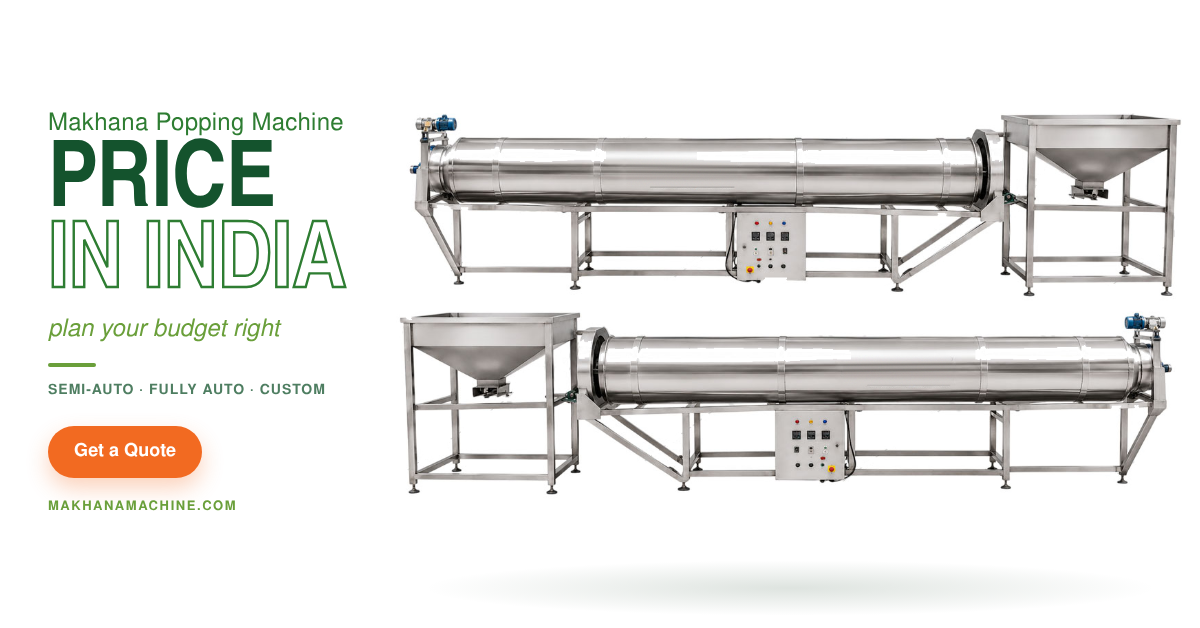
In India, cost of a makhana popping machine is determined by capacity, level of automation, type of heating source, material of construction and whether you are purchasing an individual popping machine or a complete processing line. This makhana popping machine price guide covers these typical price ranges, factors affecting the price, hidden costs, capacity wise selection and calculating investment in commercial makhana popping machinery.
Price Ranges at a Glance
Prices are highly variable since “makhana popping machine” can refer to a small-scale puffing unit, a small puffing and roasting unit, or an integrated processing line. What comes next pricing quotations are only indicative of current market prices, and should be verified by the vendor through trial and written quotation.
| Machine category | Typical capacity | Estimated price range | Best suited for |
| Basic semi-automatic popping/puffing unit | 50 kg/hr claimed capacity | ₹1.3–1.5 lakh | Startups, small processors, trial production |
| Mechanised popping machine | Varies by model | ₹1.8–2 lakh | Small commercial units |
| Low-budget roaster | 10 kg/batch | ₹75,000–1 lakh | Small-batch roasting, not full popping lines |
| Mid-range roasting/popping machine | 25–50 kg/hr | ₹2.5–6 lakh | Growing processors and snack brands |
| Commercial popping machine | 20–25 kg/hr | ₹12–13.5 lakh | Dedicated popping operations |
| Automatic fox-nut snack processing plant | 100 kg/hr | ₹13.5–14.5 lakh | Large processors and packaged-snack brands |
| Complete makhana processing line | Multiple capacities | ₹3–27 lakh+ | Integrated processing plants |
These figures are based on publicly listed supplier prices and should be treated as budgeting estimates, not fixed market rates.
Small Makhana Popping Machine Price
Small machines tend to be semi-automatic, single-phase, and ideal for start-ups FPOs small processors, and companies testing the makhana snack product.
Estimated price band
- INR 1.31.5 lakh: small electric semi-automatic popping machines around 2ft in length, the props of which often just say 50kg/hr.
- 1.82 lakh: Mechanized makhana popping machines available from Indian domestic suppliers.
- 1.5 3 lakh: small popping machine or other machines used on a shared or FPO basis. Based on makhana business cost calculations.
- Semi-automatic electric popping machine (top rated semi-auto electric popping machine listed at ~ 1.30 lakh, capacity stated as 50 kg/hr with 1 hp power requirement). Another seller lists a 50kg/hr electric semi-auto at around 1.40 lakh.
What can you expect to receive if you order them
- Dense footprint.
- Single phase power
- Electric heating.
- Provision of simple temperature and speed controls
- Apprpriate for small scale popping or pilot production
One very prudent caution to an is the excess of caution on use of variables in the model. Us variables in model is supposed to be related to the price. The problem is, even if we do not join the items, the variables should be the components of price. Besides, not having the appropriate variables will bias the model. Because of this we should consider more on reasonable variables.
Claims of capacity for a process need to be checked. The claim for “50 kg/hr” may be an input rate, an output rate or a theoretical maximum for the process. Actual output rate varies as seed grade, moisture, pre-heating, and operator set.
Mid-Range Commercial Machine Price
Mid-range machines are appropriate for processors that need more consistent output, better build quality, and higher daily production. They may include roasting, popping, grading, or flavouring functions.
Estimated price band
- ₹2.5–3 lakh: Makhana roaster machines, including a 100 kg/hr automatic roaster listed at ₹2.75 lakh.
- ₹3–4 lakh: Makhana processing machines with roasting and grading functions; one 100 kg/hr electric machine is listed at ₹3 lakh.
- ₹4–6 lakh: Higher-capacity processing machines; a 300 kg/hr makhana processing machine is listed at approximately ₹5.5 lakh.
- ₹5.85–6 lakh: Automatic 50 kg/hr gas-based makhana-making machines.
Suitable business models
Mid-range machines work well for:
- Makhana snack manufacturers
- Private-label suppliers
- Local processors supplying wholesalers
- Businesses adding roasting or flavouring capacity
- Units producing plain and flavoured makhana
At this level, buyers should compare not just machine price but also energy consumption, spare-part availability, and whether the machine can maintain quality over continuous operation.
High-Capacity Commercial Popping Machine Price
High-capacity popping machines are designed for dedicated commercial operations. They generally include better controls, stronger construction, higher power requirements, and more consistent popping performance.
Estimated price band
- ₹12.5 lakh: A 20–25 kg/hr makhana popping machine listed by Blacknut Agrifood Machinery.
- ₹12.5 lakh: A 25 kg/hr electric makhana processing/popping machine listed on IndiaMART.
- ₹13.5 lakh: An automatic makhana popping machine listed on TradeIndia.
- ₹13.5 lakh: A 100 kg/hr automatic fox-nut snack processing plant listed by Kalyan Machines.
- ₹14.5 lakh: An automatic makhana processing line listed by the same supplier.
These machines are more expensive than small units because they may include automated feeding, controlled heating, popping mechanisms, discharge systems, and integration options for grading or flavouring.
Complete Makhana Processing Line Price
A popping machine alone may not be enough for a commercial makhana brand. A full processing line may include washing, drying, grading, roasting, popping, polishing, flavouring, cooling, and packaging equipment.
Estimated investment
| Setup type | Estimated cost |
| Basic popping-only setup | ₹1.3–2 lakh |
| Roaster plus popping setup | ₹2.5–6 lakh |
| Semi-integrated processing setup | ₹6–12 lakh |
| Automatic 100 kg/hr processing plant | ₹13.5–14.5 lakh |
| Large or custom processing line | ₹15–27 lakh+ |
A complete fox-nut processing machine package is listed at around ₹14 lakh, while some larger processing systems are listed at ₹27 lakh. These are equipment prices only; installation, utilities, civil work, and packaging machinery can increase the total project cost.
What Determines Makhana Popping Machine Price?
- Capacity
Capacity will be the most important factor in price. You might need a 5 kg/hr machine to start with, or a 100kg/hr automatic plant would need higher power motors, more capable heating equipment, better controls and a more robust build.
- Automation level
Lower costs for manual and semi-automatic machines but require more operator monitoring. Higher costs for automatic machines than have controls sensors feed system, and some are equipped with discharge or grading control.
- Heating source
Electric machines are widely used in small models; other options for larger or continuous workings include gas LPG wood-fired or thermic-oil systems. Cost of the heating can influence purchase as well as operating costs.
- Construction material
With chemical composition, stainless steel (for eg. SS 304) is normally priced at a higher rate than mild steel. Though it is easier to wash and more suitable for a food-processing setting. (A seller’s listed cost for an SS 304 50kg/hr machine is about Rs.3.6 Lakhs.)
- Machine scope
Popping-only machine is cheaper than machine having another operations like roasting/ grade/ polishing/ Flavouring makhana. This is costs higher for complete line as its having few units of equipments stages.
- Brand, service, and warranty
Existing suppliers can also provide higher prices but with improved installation support training spare parts and service arrangements. A commercial machine can have a better (value for money) service support than a modest price reduction.
Hidden Costs to Budget For
The quoted machine price is rarely the full project cost. Before finalising a purchase, budget for these additional expenses.
| Cost head | Why it matters |
| GST and freight | Machine prices are often listed excluding taxes and delivery |
| Installation and commissioning | May require technician travel, alignment, and trial runs |
| Electrical work | Wiring, stabilisers, earthing, panels, and phase conversion |
| Gas or fuel infrastructure | Regulators, pipelines, cylinders, burners, and safety fittings |
| Pre-processing equipment | Cleaning, drying, grading, and pre-heating machines |
| Post-popping equipment | Sieves, graders, polishers, de-stoners, and packing machines |
| Spare parts | Heaters, belts, motors, impellers, thermocouples, and bearings |
| Operator training | Needed for temperature control, feeding rate, and quality checks |
| Working capital | Raw makhana, packaging material, labour, and utilities |
| Compliance and licensing | FSSAI registration or licence, depending on business scale |
A 100 kg/hr makhana roaster listed at ₹2.75 lakh requires 12 kW power, showing why electrical infrastructure must be assessed before purchase.
Price by Business Scale
Startup or home-scale processor
Estimated machine investment: ₹1.3–2 lakh
A compact semi-automatic popping machine can be suitable for testing demand, supplying local retailers, or producing small batches. However, buyers should confirm real output, popping efficiency, and whether the machine can handle continuous operation.
Small commercial processor
Estimated machine investment: ₹2.5–6 lakh
This range suits businesses that want to process regularly and supply wholesalers, local brands, or regional retail chains. It may include a roaster, popping unit, and basic grading or cleaning support.
Medium-scale manufacturer
Estimated machine investment: ₹6–14 lakh
At this level, buyers typically need better automation, higher uptime, and integration with roasting, grading, flavouring, and packaging. A 25 kg/hr popping machine is listed at ₹12.5 lakh, while a 100 kg/hr automatic snack processing plant is listed at ₹13.5 lakh.
Large processor or packaged-snack brand
Estimated investment: ₹14 lakh and above
Large operations may require a complete processing line, multiple machines, higher-capacity roasters, flavouring systems, and automated packaging. Supplier listings for complete processing lines range from around ₹14 lakh to ₹27 lakh or more.
How to Compare Quotations Correctly
Do not compare machines only on the printed price. Two machines with similar capacity can have very different real-world costs.
Ask every supplier for
- Exact input and output capacity
- Popping efficiency percentage
- Seed size and moisture requirements
- Power load and phase requirement
- Heating source and fuel consumption
- Machine dimensions and installation space
- Material of construction
- Warranty terms
- Spare-part price list
- Installation and training charges
- Delivery timeline
- Trial-run report using your own makhana seeds
- Total landed cost, including GST, freight, and installation
A machine listed at ₹1.85 lakh may be a mechanised popping unit, while a 25 kg/hr popping machine may cost ₹12.5 lakh; the difference usually reflects capacity, automation, construction, and process integration.
Should You Buy a Popping Machine or a Full Line?
Buy a popping-only machine if:
- You already have reliable raw-seed cleaning, drying, and grading arrangements.
- You want to test a makhana product or supply popped makhana to another processor.
- Your budget is limited.
- Your daily production requirement is small.
- You can manage manual sorting and polishing.
Buy a roasting-plus-popping machine if:
- You process makhana regularly.
- You need better control over roasting and popping.
- You want to reduce dependence on manual labour.
- You supply wholesalers or local retail brands.
Buy a complete processing line if:
- You plan to launch a packaged makhana brand.
- You need consistent quality for retail, modern trade, or export.
- You want integrated grading, flavouring, cooling, and packing.
- Your production volume justifies higher capital investment.
For a single farmer or very small operator, shared or FPO-owned popping equipment may be more practical than owning a large machine. Industry cost estimates place small shared popping machines at ₹1.5–3 lakh, while mid-size processing units may require ₹8–15 lakh.
ROI: How to Judge Whether the Price Is Worth It
A makhana popping machine should be evaluated as a profit-generating asset, not just a purchase.
Calculate simple payback
Use this formula:
Payback Period = (Total Machine Investment) / (Monthly Net Savings or Profit)
Include the following in monthly savings:
- Labour cost saved versus manual popping
- Reduction in unpopped or burnt makhana
- Higher share of premium-grade output
- Increased daily output
- Lower rejection rate
- Better selling price for uniform makhana
Manual popping labour is estimated at ₹20–25 per kg of raw seed in some makhana business cost analyses, which is why mechanisation can become attractive once processing volume is high enough.
Example
If a processor invests ₹2 lakh in a small popping machine and saves ₹25,000 per month through labour reduction, lower wastage, and better output, the simple payback period would be:
Payback Period = ₹2,00,000 / ₹25,000 = 8 months
This is only an illustration. Actual payback depends on machine utilisation, seed quality, energy cost, labour rates, and selling price.
Questions to Ask Before Paying
Before finalising a commercial makhana popping machine price, ask the supplier:
- Is the quoted capacity based on raw seed input or popped makhana output?
- What popping efficiency can the machine achieve with my seed grade?
- What moisture level and tempering time does the machine require?
- Is the price inclusive of GST, freight, installation, and commissioning?
- What is the connected power load and recommended phase?
- What heating source is included, and what is its fuel consumption?
- Which parts are covered under warranty, and for how long?
- What is the cost and availability of critical spares?
- Can I see a live trial using my own raw makhana?
- Can the machine be upgraded or integrated with grading, roasting, or packaging equipment?
Conclusion
Popping systems from small semi-automatic to commercial systems are available in India. For pilot scale and FPOs small semi-automatic units are suitable where larger systems are appropriate for continuous high-volume processing. Economical performance can be achieved with medium sized systems that enable more control over temperature and more uniform puffing at much higher throughputs. For entire production systems, commercial machines, processing plants with or without pre-cleaning can be designed to integrate whole process for a minimum of manual handling. Make sure to select a system based on verified throughput per hour, popping efficiency and the power consumption needs. The build quality, after sale support besides the project cost constitute the decision criteria for a particular system.
FAQs
What is the price of a makhana popping machine in India?
Popping machines for semi-automatic makhanas come in the range of 1.3-1.5 lakh in India.
What is the price of commercial makhana popping machine?
The price of commercial makhana popping machine is normally in the range of Rs. 2.5 lakh to 13.5 lakh.
What are the costs connected to a 25 kg/hr makhana popping machine?
Generally, the cost of an electric popping machine, with the capacity of 25 kg/hr is about Rs.12.5 lakh.
Is it costly for a makhana processing plant of 100 kg/hr processing capacity?
Auto 100kg/hr processing plant generally price about 13.514.5 lakh or more.
Does the price of the machine include GST and the cost of installation?
All the quotes will not include GST freight, installation, and commissioning and operator training.
Gas or electricwhat is the more economical to use makhana popping machine?
Electric and gas machines vary. Compare purchase price plus fuel and maintenance.
Is a makhana popping machine viable for small business?
Stocks can be profitable if the rates of utilisation and yield are high, as well as the amount of labour saved.