
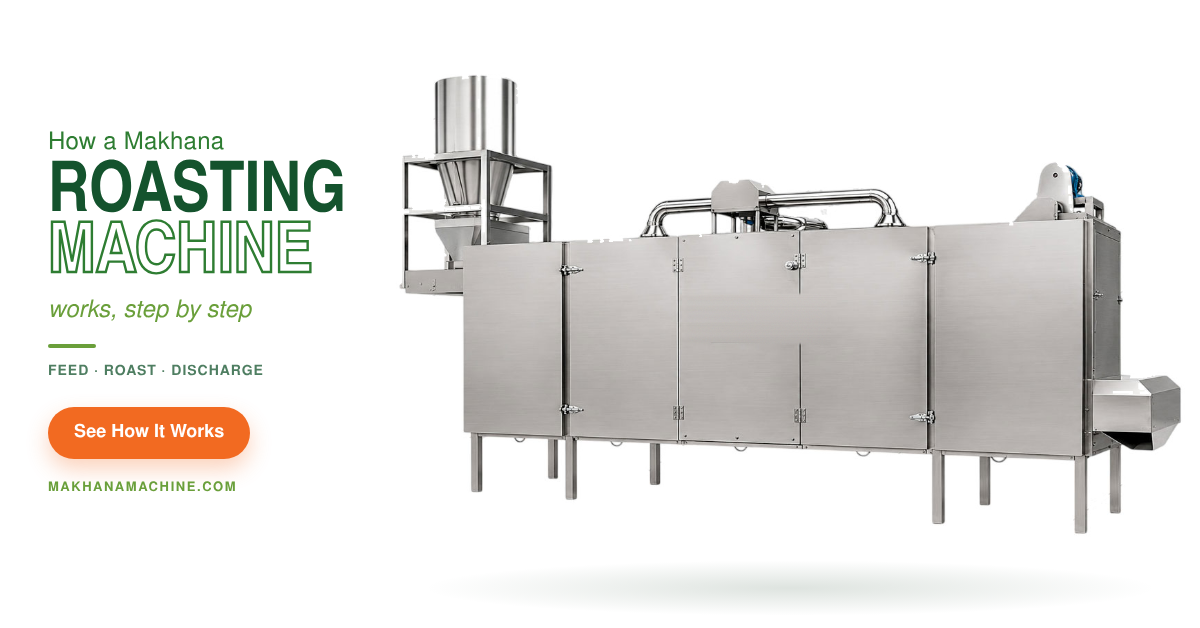
A makhana (fox nut) roasting machine applies heat and thermally remixes the makhana to eliminate excess moisture, improve crispness, and ready the fox nuts for flavoring and packaging. When prepping the snack at a commercial level, a roasting machine offers the snack processor a more even roasting than pan roasting does with manual production, with less handling and batch variability.
This makhana roasting machine manual describes the functioning, key features, heating types operation controls, safety procedures and choosing criteria for the machinery for enterprises in India.
What Is a Makhana Roasting Machine?
Makhana roasting machine makhana processing machine is a type of food processing equipment that heats plain popped makhana. It typically consists of a rotating drum, pan, conveyor, or chamber. Its primary task is removing remaining moisture to give the dry, crispy texture consumers demand from ready-to-eat makhana snacks.
Commercial machines are both batch-controlled and continuous. Batch-controlled machines would process a certain quantity of makhana at a time, whereas continuously controlled systems feed makhana through a hopper or conveyor at a convenient rate of speed and temperature.
Roaster is available as individual equipment or in a combination roasterflavouring drum. In combinations it roasts the makhana in roaster and in flavouring drum the roasted makhana tumbles with oil, flavour powder or seasoning.
Why Roasting Is Important
Popped makhana can absorb moisture during storage, handling, transport, and sorting. Roasting removes this moisture and restores crispness before the product is packed or coated with flavouring.
The process also creates a more uniform texture and improves flavour adhesion. Once roasted, makhana can hold salt, spices, peri-peri seasoning, cheese powder, herbs, chocolate coating, or other permitted ingredients more evenly.
For a snack brand, roasting is a quality-control stage. Under-roasted makhana may feel chewy or stale, while over-roasted makhana can become brown, bitter, or fragile.
How a Makhana Roasting Machine Works
The core working principle is controlled heating plus continuous movement. Makhana enters a heated drum or chamber and keeps tumbling, rotating, or moving along a conveyor so all pieces receive similar heat exposure.
Step 1: Loading the makhana
Plain popped makhana is loaded into the hopper, roasting pan, rotary drum, or feed conveyor. It should be pre-cleaned and graded as far as possible, because dust, shells, broken pieces, and very small kernels can roast faster than larger kernels.
Batch machines are loaded manually or through a hopper. Continuous roasters use controlled feeding so the machine receives a steady and manageable flow of makhana.
Step 2: Heating begins
The drum, pan, or roasting chamber is heated using electricity, LPG, PNG, diesel, induction, or another model-specific heat source. The heating system transfers heat to the product directly, indirectly through a jacket, or through controlled hot-air circulation.
The correct temperature depends on product moisture, batch size, drum design, heating source, and desired output. Some commercial systems specify roasting temperatures up to 200°C, while industrial systems may offer higher operating ranges.
Step 3: Tumbling creates uniform exposure
The motor rotates the drum or operates paddles, agitators, or a conveyor. This continuous movement prevents makhana from sitting in one hot spot for too long and improves overall heat distribution.
In a rotary drum roaster, makhana repeatedly lifts and falls as the drum turns. In a pan roaster, paddles stir the product. In a continuous hot-air system, the product travels through a heated zone at a controlled speed.
Step 4: Moisture is reduced
As makhana heats, residual moisture moves from the kernel to the surface and escapes as vapour. Some machines use exhaust systems to remove warm, humid air and help prevent condensation inside the machine.
Reducing moisture is the main reason roasted makhana becomes crisp. Proper roasting gives the product a dry bite without scorching its surface.
Step 5: Temperature is monitored
Commercial machines use a thermostat, digital controller, PID controller, or PLC-based system to monitor and maintain the selected heat level. Stable temperature management improves batch consistency and reduces the chance of burning.
Electric systems commonly offer more precise digital temperature control. One industry guide notes that electric roasters can use PID control to maintain temperature within a narrow range, while gas systems may have greater temperature variation across the drum.
Step 6: Optional oil and seasoning application
In roasting-and-flavouring systems, lightly roasted makhana moves into a flavouring drum or remains in the same rotating drum. A controlled quantity of oil, slurry, dry seasoning, or flavour powder is sprayed or sprinkled while the product continues tumbling.
Continuous tumbling helps distribute the coating across the surface of the makhana. The aim is even coverage without excessive oil, seasoning clumps, or broken kernels.
Step 7: Cooling and discharge
After roasting or flavouring, the product is discharged manually, semi-automatically, or automatically. Some machines use reverse drum rotation or a tilting mechanism to empty the batch.
Makhana should be cooled fully before packing. Warm product can create condensation inside the pouch, reducing crispness and shortening shelf stability.
Main Components of a Commercial Roasting Machine
The exact design varies by supplier, but a commercial makhana roasting machine typically contains these parts:
| Component | Function |
| Feed hopper or loading opening | Receives popped makhana before roasting |
| Rotary drum, pan, or roasting chamber | Holds product during heating and tumbling |
| Heating system | Generates heat using electricity, LPG, PNG, diesel, or other fuel |
| Motor and gearbox | Rotates the drum or powers agitation |
| Paddles or internal baffles | Improve product movement and uniform roasting |
| Temperature controller | Sets and maintains operating temperature |
| Control panel | Controls heat, motor speed, timers, and safety functions |
| Exhaust outlet | Helps remove moisture-laden air and heat |
| Discharge gate or tilting system | Releases roasted makhana after the cycle |
| Flavouring system, if included | Sprays oil or distributes seasoning evenly |
| Cooling system, if included | Helps stabilise texture before packing |
Food-contact parts are commonly made from food-grade stainless steel, such as SS 304, to support hygiene and easier cleaning.
Roasting Machine Types
Rotary drum roaster
A rotary drum roaster has a cylindrical drum that rotates continuously. Makhana tumbles inside the drum, receiving even heat from the heating system below, around, or outside the chamber.
This is one of the most common machine types for commercial roasted and flavoured makhana because it can combine roasting and seasoning in one controlled process.
Pan roaster
A pan roaster uses a heated pan with stirring paddles or a mechanical agitator. It is often used for small and medium batches where operators need direct control over roasting.
Pan roasters can be electric or gas-fired and may be suitable for products beyond makhana, including seeds, spices, pulses, dry fruits, and grains.
Double-jacket roaster
A double-jacket roaster uses an outer heating jacket around the product chamber. This indirect heating arrangement can distribute heat more evenly and lower the risk of localised burning.
It is useful when processors want controlled roasting for delicate products, particularly where direct flame contact could damage the makhana.
Continuous roaster
A continuous roaster uses a conveyor, rotating system, or continuous feed arrangement. Product enters one end and exits after a controlled residence time.
Continuous systems are designed for larger commercial operations requiring uninterrupted throughput, reduced manual handling, and consistent production.
Roasting and flavouring machine
This machine combines roasting with seasoning. After moisture reduction, oil and flavour powder are applied while makhana tumbles, allowing the processor to make ready-to-pack flavoured products in the same system.
Heating Options in India
Makhana roasting machines in India are available with electric, LPG, PNG, diesel, and model-specific heating arrangements. The best option depends on production scale, energy access, installation requirements, and operating budget.
| Heating type | How it works | Advantages | Considerations |
| Electric | Heaters warm the drum, jacket, or air system | Precise control, cleaner operation, lower fire risk | Requires adequate electrical load and usually three-phase supply |
| LPG gas | Burner heats the roasting chamber or drum | Often lower initial equipment cost | Requires cylinder storage, ventilation, and leak-prevention systems |
| PNG gas | Pipeline-fed burner provides heat | Continuous gas supply where pipeline is available | Site must have PNG connection |
| Diesel burner | Burner provides high heat for larger machinery | Can support industrial installations | Requires fuel storage and emission management |
| Induction or infrared | Heat is created through specialised electric systems | Fast response and controlled heating | Availability varies by manufacturer |
Electric systems may use infrared, coil, or ceramic heating elements, while gas-based systems commonly use LPG or PNG burners below or around a rotating drum.
Electric vs Gas Roasting Machines
The choice between electric and gas machines is important for a commercial setup.
| Factor | Electric roaster | Gas roaster |
| Temperature precision | Generally high with digital controllers | Can vary more depending on burner control |
| Initial setup | Requires suitable electrical infrastructure | Usually easier where LPG is available |
| Safety risks | No fuel storage or gas leakage concern | Needs ventilation, leak detection, and safe cylinder handling |
| Operating efficiency | Often higher energy efficiency | Heat loss can be greater through flue gases |
| Best fit | Medium and larger units with stable power | Small units or locations with unreliable power |
One industry comparison estimates electric roasters at 85–92% energy efficiency and gas units at approximately 50–60%, though actual performance depends on machine design, insulation, maintenance, fuel rate, and production conditions.
For a small rural unit without dependable three-phase power, LPG-based roasting can be easier to install. For higher-volume plants, electric machines can offer more repeatable heat control and lower running costs over time.
Capacity Options for Commercial Use
Makhana roasting machines are available in capacities ranging from small 3 kg batch units to large continuous systems producing hundreds of kilograms per hour.
| Business scale | Typical capacity | Suitable application |
| Micro unit | 3–10 kg per batch | Product trials, local sales, home-scale operations |
| Small commercial unit | 10–30 kg per batch or hour | Local retailers, startup brands |
| Medium unit | 25–100 kg/hr | Regular B2B or D2C snack production |
| Large commercial unit | 100–200 kg/hr | Regional distribution and private-label supply |
| Industrial line | 200–500 kg/hr | Large snack manufacturers and contract processors |
Manufacturers offer continuous roasting systems from approximately 10–20 kg/hr to 500 kg/hr, depending on drum size, conveyor design, heating arrangement, and level of automation.
Operating a Makhana Roasting Machine
A standard operating procedure helps produce repeatable quality.
Pre-start checks
- Inspect the drum, pan, chamber, and discharge gate for leftover product.
- Verify that food-contact surfaces are clean and dry.
- Check motor, gearbox, belts, bearings, and electrical connections.
- Confirm the temperature controller and sensor are functioning.
- For gas units, inspect burners, regulators, hoses, ventilation, and leak-detection arrangements.
- Ensure the exhaust system is open and clear.
- Keep fire safety equipment accessible.
During roasting
- Preheat the machine according to supplier instructions.
- Load the recommended batch quantity only.
- Set the appropriate temperature and drum speed.
- Observe colour, aroma, crispness, and breakage during the first batches.
- Avoid overloading, which can reduce tumbling and create uneven roasting.
- Add oil and seasoning gradually, if making flavoured makhana.
- Record batch time, settings, output weight, and quality observations.
After roasting
- Discharge product onto clean trays, a cooling conveyor, or food-grade containers.
- Cool fully before packing.
- Remove crumbs and seasoning residues after the machine cools.
- Clean and sanitise as per the unit’s hygiene procedure.
- Record any maintenance issue before the next shift.
How to Achieve Uniform Roasting
Consistency is the most important quality objective. Every field should be crunch, bright, and uniformly-flavored, without looking charred, greasy, or powdery.
- Use repeating input text: Size of Makhana Sizing will impact the speed of roasting. A mixture of size can cause a product where smaller pieces will turn dark earlier than larger pieces. Grade the material before roasting (if possible). There’s no point in sinking the drum too quickly.
- Too much loading on the drum: This will hinder free tumbling and only some of the kernels are in contact with the heat. Refer to the instructions of the manufacturer for recommended load limits.
- Control heat and timetogether: Excess heat and over-resting time will enable brown or scorch makers. Insufficient heat and extremely short time will just roast them to be soft. Standardise heat, drum velocity, and roasting time for every product size and for every recipe.
- Manage the application of seasonings: If possible use oil judiciously and apply while the drum is rotating and apply the seasoning on it. This is important as excess quantity of oil may make the makana viscous and excessive powder may deposit at the bottom of the pouch instead of coating the makanki. Each layer should be allowed to cool fully before you pack it away.
- Cooling: prevents condensation of moisture in the pouch. Use clean trays or a cooling conveyor to prevent the product from being exposed to humid air.
Common Problems and Solutions
| Problem | Likely cause | Solution |
| Makhana is soft after packing | Under-roasting, inadequate cooling, or poor pouch seal | Adjust roasting time, cool fully, and check packaging integrity |
| Kernels are brown or bitter | Excessive temperature or roasting duration | Lower heat, shorten cycle, and verify temperature calibration |
| Uneven roasting | Mixed sizes, overloaded drum, poor drum speed | Grade product, reduce load, and optimise rotation |
| Too many broken kernels | Rough handling, excessive drum speed, or over-dry product | Reduce speed and handle cooled product gently |
| Flavour is uneven | Poor oil distribution or insufficient tumbling | Add coating gradually and extend mixing time |
| Product feels oily | Excess oil or incorrect seasoning method | Standardise oil dosage and use calibrated spray systems |
| Powder settles in the pack | Too much seasoning or inadequate adhesion | Optimise oil-to-seasoning ratio and tumbling time |
Food Safety and Hygiene
A roasting machine operates at high heat, but food safety still depends on good manufacturing practices.
- Use clean, food-grade contact surfaces.
- Keep raw ingredients, cleaning chemicals, and packed products separate.
- Store seasoning powders in sealed containers.
- Prevent pest entry in the processing and packing areas.
- Use potable water if liquid ingredients are used.
- Maintain batch and cleaning records.
- Keep workers trained in hand hygiene and protective clothing.
- Check packaging seals, weights, labels, and best-before details before dispatch.
A clean, dry roasting and packing environment is essential because makhana quickly absorbs moisture and odours.
Choosing a Commercial Makhana Roasting Machine
Before buying, compare machine performance and support—not only the purchase price.
Ask suppliers these questions
- Is the machine batch or continuous?
- What is the actual output capacity for makhana, not other products?
- Is capacity measured per batch, raw input, or finished output?
- Which heating source does the model use?
- What are the connected power load and phase requirements?
- What is the maximum and recommended operating temperature?
- Does it include a digital temperature controller?
- Are food-contact parts SS 304?
- Can it roast and flavour in the same drum?
- Is an exhaust system included?
- What are the cleaning, maintenance, and spare-part requirements?
- Does the supplier provide installation, training, and service support?
- Can you conduct a live trial using your own makhana?
A 100 kg/hr commercial machine may feature automatic operation, stainless-steel construction, and PLC control, while other products are smaller batch drum roasters. Comparing specifications is therefore more useful than comparing capacity claims alone.
Conclusion
Makhana roasting machine is used for roasting makhana. Roasting is done by heat with tumbling, agitation, or conveyor traveling, to remove any remaining moisture, boost the crunchiness, promote even coating of flavor and makhana ready for tough retail packing. Identify a suitable roaster for your commercial venture by considering your desired throughput, availability of heat, batch, or continuous operation, temperature characteristics, hygienic process, packaging after roasting. If used efficiently a roaster can efficiently convert isodimproved makhana into a uniform, high quality snack product.
FAQs
How does a makhana roasting machine work?
Heats and tumbles popped makhanas. It removes the moisture and cause each one of them to be equally crisp.
What is the ideal temperature for roasting makhana?
Temperature (batch size, moisture): within the operating range of the machine.
Can a roasting machine flavor makhana too?
Yes, roasting cum flavouring machines put the coating on makhana in a tumbled manner.
Which is better: electric or gas makhana roaster?
Electric reduces nothing; but, it gives a great control. Gas is good for a not so precise place of work with few local points of limited three-phase power.
What capacity should a startup roasting unit have?
Batch or hourly capacity of 1030kg fits most startup.
Why does roasted makhana become soft after packaging?
Floppiness is due to under roasting, incomplete cooling, ingress of moisture or poor seals to pouches.
Can one roaster process other food products?
Yes, many roasteries also roast nuts, seeds, pulses, spices, grains, and snacks.