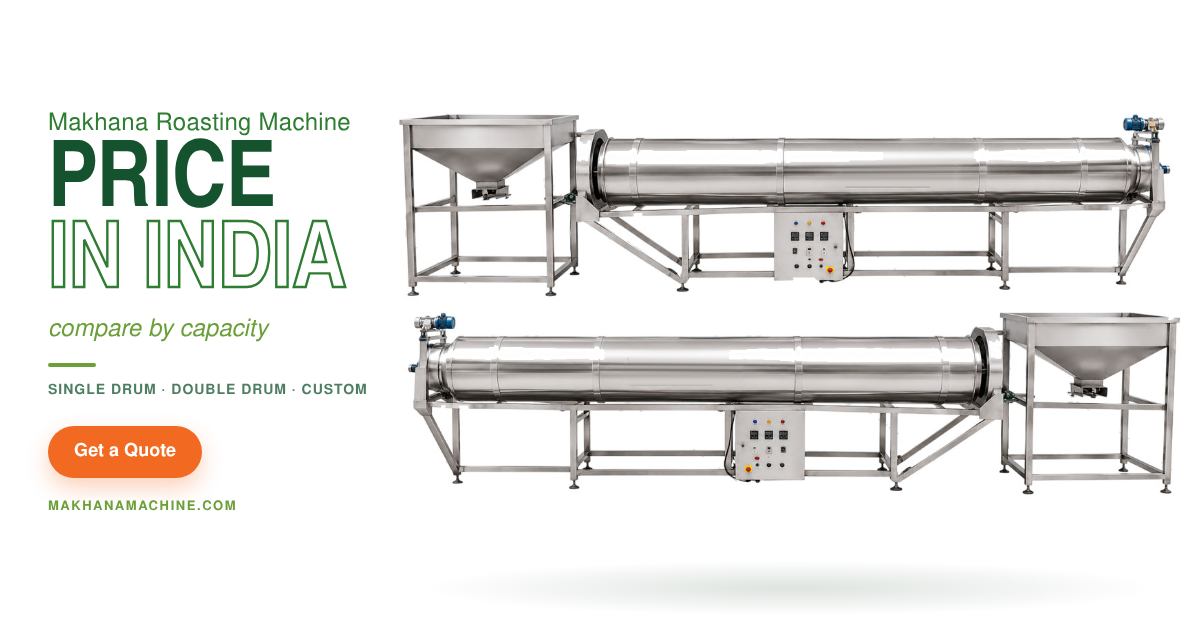
The specifications of makhana roasting machine price in India is determined by processing capacity, heating element used, Degree of automation, construction material, system with/without seasoning/ flavouring system. This makhana roasting machine introduced the significant characteristics, machine structure, capacity factors, operational needs and some other installation factors that should be taken into account when choosing a commercial makhana roaster equipment to make your product. It also helps companies understand what kind of roasting system can meet their requirements of production volume, product demand and automation.
Estimated Price Ranges
A “makhana roasting machine” can mean a compact batch roaster, a semi-automatic drum roaster, a roasting-and-flavouring machine, or a fully automatic industrial line. Because of this, prices should always be compared along with capacity, power load, controls, material grade, and included accessories.
| Machine type | Estimated capacity | Estimated price range | Best suited for |
| Basic compact roaster | Small batch | ₹50,000–₹1 lakh | Trials, home-scale units, small local supply |
| Small electric roaster | 10–100 kg/batch | ₹75,000–₹1.25 lakh | Startups and micro processors |
| Semi-automatic roasting machine | 10–100 kg/batch | ₹1–₹3 lakh | Small commercial snack brands |
| Rotary drum roaster | Around 50 kg/batch | ₹1.45–₹2 lakh | Local retail and wholesale supply |
| Commercial roasting-and-flavouring machine | 50–100 kg/hr | ₹3–₹8 lakh | Growing snack brands and processors |
| Automatic roasting and flavouring system | 100 kg/hr or above | ₹8–₹18 lakh | Large D2C brands and private-label units |
| Integrated industrial processing line | 100 kg/hr or more | ₹14.5–₹25 lakh+ | Industrial manufacturers and contract processors |
These figures are estimated market prices based on publicly listed equipment and should be confirmed through supplier quotations and a live trial using your own makhana.
Small Makhana Roasting Machine Price
Small machines are suitable for entrepreneurs entering the makhana snack category, local processors, cloud kitchens, and businesses testing multiple flavours before scaling.
Estimated cost
- ₹50,000–₹1 lakh: Basic compact or manual-assisted roasting machines with limited automation.
- ₹75,000–₹1.25 lakh: Small electric makhana roaster models offered by equipment suppliers.
- ₹1–₹1.5 lakh: Semi-automatic roasting and flavouring machines with basic commercial features.
A listed electric makhana roasting and flavouring machine is priced around ₹1 lakh, with a stated 10–100 kg per batch capacity and estimated power consumption of 6–9 kW.
Who should buy a small machine?
- New D2C makhana brands
- Local retail suppliers
- Startups producing limited daily batches
- Small private-label snack makers
- Businesses testing recipes and seasoning combinations
Small machines are useful for market validation, but they may require more manual monitoring and can have less precise temperature uniformity than larger commercial systems.
Semi-Automatic Roasting Machine Price
Semi-automatic machines offer better control than basic manual roasters. They usually include a rotating drum, motor, heating arrangement, digital controls, and a discharge system.
Estimated cost
- ₹1.45 lakh: Roasting-and-flavouring machines with stated capacities from 10–500 kg/hr.
- ₹1.53 lakh: A 50 kg electric rotary drum roaster with stainless-steel construction, digital control, and three-phase power requirement.
- ₹1.5–₹8 lakh: Estimated range for small and mid-scale production, depending on capacity, heating type, and features.
A 50 kg semi-automatic electric rotary drum roaster is listed at ₹1,53,400 and includes stainless-steel construction, digital control, three-phase power, and batch operation.
What is usually included?
- Rotary drum or roasting pan
- Electric or gas heating system
- Motor and gearbox
- Basic temperature controller
- Manual or semi-automatic discharge
- Optional flavouring attachment
- Standard control panel
Before buying, ask whether the quoted price includes the flavouring system, oil sprayer, seasoning feeder, cooling conveyor, and exhaust arrangement. These may be offered as paid upgrades.
Commercial Makhana Roasting Machine Price
Commercial machines are designed for brands that need repeatable daily output, standardised roasting, and faster turnaround. They are generally more durable, more automated, and easier to integrate with packaging equipment.
Estimated cost
- ₹3–₹5 lakh: Recommended starting investment range for consistent commercial-quality roasted makhana production.
- ₹5.4 lakh: Estimated price for a commercial makhana roaster and flavouring machine listing from Ambala, Haryana.
- ₹3–₹8 lakh: Estimated range for mid-scale roasting equipment, depending on capacity, heating type, and control system.
- ₹8–₹18 lakh: Estimated range for fully automatic commercial roasting and flavouring machines.
Commercial equipment is suitable for:
- D2C snack brands with rising order volumes
- Wholesale suppliers
- Private-label manufacturers
- Regional distributors
- Food-processing units serving modern retail
- Contract manufacturers handling multiple brands
At this level, focus on output stability rather than headline capacity. A 100 kg/hr machine that produces evenly roasted makhana with low breakage can be more profitable than a larger machine with poor temperature control.
Automatic Industrial Roaster Price
Fully automatic roasting and flavouring systems are built for high-volume operations. They may include automatic feeding, controlled heating, drum rotation, oil spraying, seasoning application, cooling, and discharge.
Estimated cost
- ₹8–₹18 lakh: Estimated range for fully automatic roasting and flavouring machines for commercial-scale production.
- ₹14.5 lakh: Estimated price for automatic 100 kg/hr roasting and flavouring machines listed by suppliers in New Delhi.
- ₹14.5–₹25 lakh+: Estimated range for high-capacity automatic lines with integrated handling, flavouring, and process controls.
One 100 kg/hr automatic machine listing is priced at ₹14.5 lakh and specifies 40 kW power consumption, 440 V operation, approximately 1,200 kg machine weight, and stainless-steel construction.
These systems are best for manufacturers that need continuous production, multiple shifts, branded retail supply, or large private-label orders.
Price by Capacity
Capacity is one of the strongest drivers of makhana roasting machine price.
| Capacity | Estimated price range | Typical business need |
| 3–10 kg/batch | ₹50,000–₹1 lakh | Trials and micro-scale production |
| 10–30 kg/batch | ₹75,000–₹1.5 lakh | Startup production |
| 30–50 kg/batch | ₹1.45–₹3 lakh | Local retail and wholesale supply |
| 50–100 kg/hr | ₹3–₹8 lakh | Commercial snack manufacturing |
| 100 kg/hr automatic | ₹8–₹14.5 lakh | Large D2C, private-label, and regional supply |
| 100 kg/hr integrated line | ₹14.5–₹25 lakh+ | Industrial snack processing |
Capacity claims should be checked carefully. Some suppliers state capacity per batch, while others state capacity per hour. A 50 kg batch machine may not produce 50 kg of finished product every hour because loading, pre-heating, roasting, cooling, flavouring, and cleaning time must also be considered.
Factors That Affect Price
Capacity and throughput
Larger machines require bigger drums, stronger motors, higher-power heaters, more insulation, and better material handling. This increases the purchase price but may reduce processing cost per kilogram at high utilisation.
Automation level
Manual and basic semi-automatic machines cost less. Automatic systems cost more because they use sensors, automatic feeders, programmable controls, oil-spraying systems, discharge mechanisms, and sometimes cooling or packing integration.
Heating source
Electric units are often selected for cleaner operation and better temperature control. LPG, PNG, or gas-fired units may have different purchase and operating costs based on fuel availability.
Construction material
SS 304 food-grade stainless steel usually increases initial machine cost but improves hygiene, cleaning, corrosion resistance, and long-term durability. The ₹1.53 lakh rotary drum roaster listing specifies stainless-steel construction, while larger industrial units also specify SS 304 bodies.
Roasting-only versus roasting-plus-flavouring
A roasting-only machine is generally less expensive. A combined roasting and flavouring system costs more because it may include oil spraying, seasoning feeders, coating drums, mixing control, and discharge mechanisms.
Controls and safety features
Digital temperature control, PLC panels, variable-frequency drives, safety cut-offs, heat insulation, exhaust arrangements, and automatic discharge systems add to machine cost but can reduce burnt batches and product rejection.
Additional Costs Beyond Machine Price
Your equipment quotation is not your complete project budget. Plan for the full installed cost.
| Cost item | Why it matters |
|---|---|
| GST | Supplier quotations may exclude tax |
| Freight | Large roasting machines need protected transport |
| Installation | Equipment may require assembly, alignment, and commissioning |
| Electrical work | Three-phase wiring, control panels, earthing, and stabilisers |
| Gas infrastructure | Regulators, pipelines, burners, ventilation, and safety fittings |
| Cooling equipment | Needed before packing to retain crispness |
| Flavouring accessories | Oil sprayer, seasoning feeder, coating drum, or mixer |
| Packaging machine | Necessary for retail-ready products |
| Exhaust and ventilation | Important for heat and moisture management |
| Operator training | Required for standardised production |
| Spare parts | Heaters, sensors, belts, motors, bearings, and controllers |
| Working capital | Raw makhana, seasonings, pouches, labels, labour, and utilities |
A 100 kg/hr automatic industrial machine may need 40 kW power and 440 V supply, which can require significant electrical planning beyond the machine purchase.
How to Compare Supplier Quotes
Do not choose a supplier only because the quoted number is low. Request a standard quotation format from every vendor and compare the same technical details.
Ask for these details
- Exact machine capacity for makhana
- Batch capacity versus hourly output
- Heating type and fuel consumption
- Connected power load and electrical phase
- Food-contact material grade
- Temperature range and controller type
- Drum dimensions and machine footprint
- Roasting uniformity and expected breakage percentage
- Included flavouring components
- Cooling conveyor or cooling arrangement
- Installation, commissioning, and operator training terms
- Warranty coverage and service response time
- Availability and price of critical spare parts
- GST, freight, packaging, and delivery charges
- Live trial using your own makhana sample
A 50 kg semi-automatic electric rotary drum roaster may cost about ₹1.53 lakh, whereas a 100 kg/hr fully automatic unit is listed at ₹14.5 lakh. The price difference reflects automation, power requirement, throughput, and industrial-grade integration—not capacity alone.
Choose by Business Stage
For startups
Choose a 10–30 kg/batch semi-automatic roaster if you are still validating demand. A small system gives you flexibility to test recipes, revise seasoning levels, and learn your actual daily sales volume.
Estimated budget: ₹75,000–₹1.5 lakh.
For small commercial brands
Choose a 30–50 kg batch machine with reliable temperature control and optional flavouring. It is suitable for retail supply, local distributors, and online sales.
Estimated budget: ₹1.45–₹3 lakh.
For growing brands
Choose a commercial roasting-and-flavouring unit with larger capacity, stronger build quality, and easier integration with packaging equipment.
Estimated budget: ₹3–₹8 lakh.
For industrial production
Choose an automatic or continuous system if your business needs regular high-volume output, consistent quality, and lower labour dependence.
Estimated budget: ₹8–₹18 lakh, with integrated lines reaching ₹14.5–₹25 lakh or more.
ROI: Calculate Before Buying
A roasting machine should be evaluated based on cost per kilogram, not just purchase price.
Use this basic formula:
Processing Cost per kg = (Monthly Fixed Costs + Monthly Variable Costs) ÷ Monthly Finished Output (kg)
Include:
- Electricity or fuel expense
- Labour
- Machine depreciation
- Repairs and maintenance
- Raw makhana losses and breakage
- Seasoning and oil
- Packaging material
- Rent and overheads
- Transport and distribution costs
For simple payback:
Payback Period = Total Installed Investment ÷ Monthly Additional Profit or Savings
Example
Suppose you invest ₹3 lakh in a commercial roasting machine and increase monthly profit by ₹50,000 through higher output, reduced wastage, and better flavour consistency:
3,00,000/50,000 = 6 months
This is an illustration only. Your actual payback depends on capacity utilisation, machine uptime, raw-material cost, energy tariff, market price, and sales volume.
Common Buying Mistakes
- Buying on advertised capacity without a live product trial.
- Confusing batch capacity with continuous hourly output.
- Ignoring connected load and three-phase power requirements.
- Selecting mild-steel food-contact areas to reduce upfront cost.
- Forgetting cooling, packing, and ventilation requirements.
- Buying roasting-only equipment when your business needs flavouring.
- Underestimating freight, GST, installation, and civil work.
- Not asking for a spare-parts list and service commitment.
- Overbuying capacity before proving market demand.
- Underbuying capacity when large retail or private-label orders are already confirmed.
Conclusion
The right makhana roasting machine price depends on the production scale you genuinely need. Focus on verified makhana output, temperature control, food-grade construction, utility requirements, after-sales service, and the total installed cost. A properly matched roaster can deliver better crispness, uniform flavour coverage, lower product rejection, and stronger margins for a growing makhana business.
FAQs
What is the starting price of a makhana roasting machine?
Basic small roasting machines generally start at an estimated ₹50,000 in India.
What does a commercial makhana roasting machine cost?
Commercial roasting machines are estimated to cost around ₹3–₹8 lakh.
How much does an automatic roasting and flavouring machine cost?
Automatic commercial systems are estimated at ₹8–₹18 lakh, depending on capacity and features.
What is the estimated price of a 50 kg makhana roaster?
A 50 kg electric rotary drum roaster is estimated around ₹1.53 lakh.
Does the quoted roaster price include installation charges?
Usually not; verify GST, freight, installation, training, and electrical work separately.
Which roaster is suitable for a new makhana brand?
A 10–30 kg semi-automatic roaster suits product trials and early retail demand.
Why are industrial makhana roasting machines more expensive?
They include higher capacity, automation, controls, durable materials, safety systems, and integration options.