
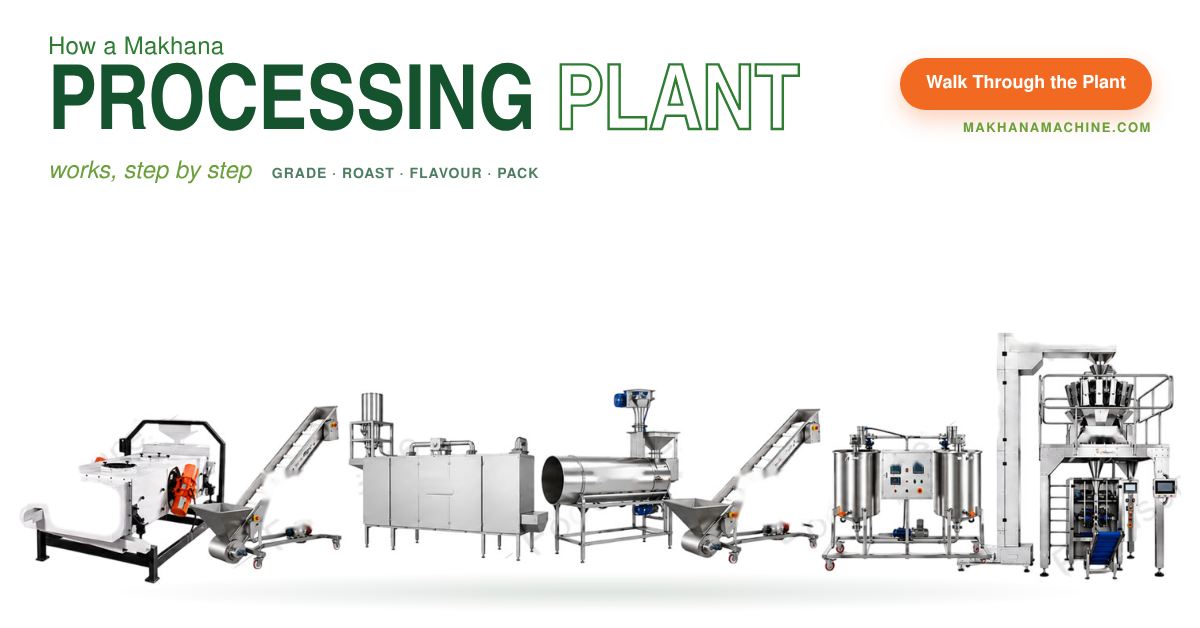
Makhana processing plant definition a makhana processing plant is a system of equipment designed to wash dry grade roast pack and flavour the makhana for bulk or retail use. Makhana, also called fox nuts, gorgon nuts or phool makhana, is currently a popular snack as it is a simple light versatile snack and comes in different flavours. But for processors, makhana is not an easy product to deal with. It is fragile, and shape irregular and perishable to moisture, rough handling, improper roasting, and sub-standard packaging. A mixed lot is made up of big and small kernels, broken, and flat kernels, un-popped product, dust, and foreign matter. Without a systematic process for its processing, uniform quality is challenging to ensure.
A commercial makhana manufacturing unit organizes the entire process of makhana from fresh raw material to packaged finished goods. Based on the business model, the unit may process raw makhana seeds, popped makhana, or already popped makhana purchased from suppliers. The final product can be plain makhana, roasted makhana, flavoured snacks, bulk-grade material, or private-label items. In this guide, the author explains the makhana processing plant India setup, the main machinery required for makhana processing, the process flow in a makhana plant, quality control measures, the makhana processing output types, and the factors to keep in mind before starting an industrial unit.
What Is a Makhana Processing Plant?
A makhana processing plant is a group of machines and work areas designed to process makhana in a hygienic and controlled manner. The exact plant design depends on the stage of product handling and the final product requirement.
Some units purchase popped makhana and focus on cleaning, grading, roasting, seasoning, cooling, and packing. This is common for snack brands, contract manufacturers, bulk suppliers, and food entrepreneurs.
Other units may start with raw makhana seeds and include additional operations such as seed cleaning, conditioning, roasting, popping, polishing, grading, and packing. Such plants require more specialised handling and trained workers because raw makhana processing involves several traditional and technical steps.
A basic commercial setup may include:
- Raw-material receiving section.
- Cleaning and inspection system.
- Makhana grading machine.
- Roasting machine.
- Seasoning or flavouring system.
- Cooling arrangement.
- Weighing and packing machine.
- Sealing and coding equipment.
- Finished-goods storage area.
- Quality-control area.
A larger plant can include conveyors, automatic feeding systems, dust collection, metal detection, nitrogen flushing, batch coding, and automated packing lines.
The goal is not only to increase production speed. A good plant also improves hygiene, reduces unnecessary handling, lowers breakage, creates uniform product grades, and supports repeatable quality.
Types of Makhana Processing Plants
Before discussing the process, it is useful to understand the common plant types.
Raw Makhana Processing Plant
This setup handles raw makhana seeds and converts them into popped makhana. It may involve cleaning, drying, roasting, tempering, popping, polishing, grading, and packing.
Raw seed processing requires specialised knowledge because temperature, moisture, roasting time, cooling, and popping technique can strongly affect expansion and yield. Poor control can lead to dark colour, low expansion, hard kernels, and material loss.
Popped Makhana Processing Plant
This setup purchases popped makhana from suppliers and turns it into a market-ready product. It is often preferred by new snack brands because it removes the complexity of raw seed popping.
The plant may handle cleaning, grading, roasting, flavouring, cooling, packing, and dispatch. This is a practical model for businesses entering the ready-to-eat snack market.
Bulk Grading and Supply Plant
This type of unit focuses mainly on sorting and supplying makhana according to size and quality. The graded product may be sold to snack brands, wholesalers, exporters, dry-fruit traders, and packaging companies.
A bulk supply unit may not need full roasting or retail packing equipment. However, it still requires careful cleaning, grading, storage, batch management, and moisture protection.
Integrated Commercial Makhana Processing Plant
An integrated plant combines multiple operations in one production facility. It may include raw material handling, cleaning, grading, roasting, seasoning, cooling, packing, storage, and quality control.
This model gives the processor greater control over final quality. It is suitable for established brands, contract manufacturers, larger distributors, and businesses planning to serve multiple markets.
Step 1: Raw Material Receiving
Every successful makhana processing plant begins with careful raw-material selection. The final product cannot be better than the incoming makhana.
Raw material may arrive in bags, cartons, or bulk packaging. At this stage, the team should inspect the lot before accepting it into the plant.
Important incoming checks include:
- Kernel size and size variation.
- Colour and visual appearance.
- Expansion quality.
- Broken-piece percentage.
- Flat or poorly popped material.
- Unpopped kernels.
- Dust and foreign matter.
- Moisture condition.
- Odour and freshness.
- Signs of pests, mould, or storage damage.
For popped makhana, large, well-expanded, clean, and low-breakage material is generally more suitable for premium retail products. Smaller but acceptable kernels may be useful for regular or value packs.
The receiving team should assign a batch number to each lot. This helps track supplier details, processing date, quantity used, output produced, and any complaints later linked to a particular batch.
Raw material should be stored in a clean, dry area on pallets or racks. Bags should not be placed directly on the floor because they can absorb moisture or attract pests.
Step 2: Pre-Cleaning and Manual Inspection
Before makhana enters the machine line, it should go through basic pre-cleaning. This removes visible impurities and prepares the material for grading.
Pre-cleaning can involve manual inspection tables, mesh screens, air blowers, or simple cleaning equipment. Workers can remove stones, threads, bag fibres, excess dust, damaged pieces, and other foreign material.
Manual inspection is particularly useful for premium makhana because visual defects can affect retail pack appearance. The inspection team should be trained to identify unacceptable material without removing too much usable product.
At this stage, separate collection bins should be used for:
- Good-quality makhana.
- Broken material.
- Flat or defective kernels.
- Foreign matter.
- Rework material, where permitted.
- Rejected product.
Do not mix rejected material with usable product. Clear identification helps maintain food safety and avoids accidental use during later processing stages.
Step 3: Makhana Grading
Grading is one of the most important stages in a commercial makhana processing plant. It separates makhana into uniform size categories and helps create different marketable product grades.
A makhana grading machine may use vibrating screens, perforated sieves, or rotary screening systems. The product moves over screens with selected openings. Smaller kernels pass through certain screens, while larger kernels remain on top and move to separate outlets.
The plant can create grades such as:
- Large makhana.
- Medium makhana.
- Small makhana.
- Broken makhana.
- Fine particles and dust.
- Flat or reject material.
Uniform grades are valuable because they improve visual consistency and help later processing stages. For example, large and small kernels roast at different speeds. If they are roasted together, smaller kernels may burn while larger kernels remain under-roasted.
Grading also helps create different product positions. Large and clean kernels may be sold as premium makhana. Medium grades may be used for mainstream retail packs. Small pieces may be used in value packs, mixtures, or ingredient-based applications.
The machine should handle makhana gently. Excessive vibration, rough transfer points, sharp edges, and fast feeding can increase breakage. The screen size, feed rate, and vibration settings should be adjusted according to the material.
Step 4: Roasting
Roasting gives makhana its crisp texture, light flavour, and ready-to-eat quality. It also prepares the product for seasoning and packaging.
The roasting method may vary by plant type. Some units use batch roasting systems, while others use continuous roasting equipment. The choice depends on production capacity, product range, labour availability, and desired consistency.
During roasting, several points need attention:
- Temperature control.
- Roasting time.
- Batch size.
- Product movement.
- Heating uniformity.
- Oil application, if used.
- Cooling after roasting.
Too much heat can darken the makhana, create burnt flavour, or make the product hard. Too little heat can leave it soft or reduce crispness. Uniformly graded makhana gives better roasting results because similar-sized kernels respond more consistently to heat.
A good roasting process should produce makhana that is crisp, light, evenly coloured, and free from burnt odour. Operators should take samples from every batch to check texture and appearance.
Step 5: Seasoning and Flavouring
After roasting, makhana can be sold as plain roasted product or converted into flavoured snacks. Flavouring helps brands create variety and target different consumer preferences.
Popular flavour options include:
- Salted makhana.
- Black pepper makhana.
- Masala makhana.
- Pudina makhana.
- Peri-peri makhana.
- Tangy tomato makhana.
- Cheese-style makhana.
- Cream and onion-style makhana.
- Sweet-coated makhana.
- Jaggery makhana.
In a seasoning system, roasted makhana is placed inside a mixing drum, coating pan, or seasoning tumbler. A small quantity of edible oil, seasoning slurry, spice blend, or dry flavour powder may be added while the product moves slowly.
The aim is to create even flavour distribution without breaking kernels. Excessive mixing can increase breakage, especially with large and delicate makhana.
Seasoning should be standardised. Use measured recipes for every batch, including the amount of oil, salt, seasoning powder, and product quantity. This helps ensure that customers receive the same taste each time.
For flavoured products, ingredient control becomes especially important. Store spices, seasonings, and flavour blends in dry, labelled containers. Use stock rotation so older ingredients are used before newer supplies.
Step 6: Cooling
Cooling is often overlooked, but it is essential for product crispness and shelf life. Freshly roasted or seasoned makhana should not be packed while it is still warm.
Warm product can release moisture inside the pouch after sealing. This may make makhana soft, reduce crispness, and create quality complaints. It can also affect shelf-life stability.
Cooling can be done using trays, cooling conveyors, air circulation systems, or clean stainless-steel cooling tables. The product should cool in a clean and protected environment.
During cooling, avoid exposing makhana to humid air, dust, insects, or strong odours. The cooling area should be separate from raw-material handling and waste disposal areas.
Before packing, check the product temperature, crispness, flavour, and overall appearance. If the product feels soft, the roasting or cooling stage may need adjustment.
Step 7: Weighing and Packaging
Packaging is the final major processing stage. It protects makhana during storage, transport, and retail display.
A makhana processing plant may use manual weighing, semi-automatic weighing, or fully automatic pouch packing systems. The right choice depends on daily production volume and product range.
Common retail pack sizes may include:
- Small trial packs
- Single-serve packs
- Regular snack packs
- Family packs
- Value packs
- Bulk foodservice packs
- Corporate gifting packs
Packaging material should protect makhana from moisture, air, and physical damage. Laminated pouches are commonly used because they offer better barrier protection than simple plastic bags.
Depending on the product and distribution requirement, the plant may use:
- Heat sealing
- Zipper pouches
- Nitrogen flushing
- Date coding
- Batch coding
- Printed pouches
- Label application
- Outer cartons
Nitrogen flushing can be useful for fragile products because it helps protect against crushing and can support product freshness when combined with suitable packaging and storage practices.
Every packed unit should be checked for net weight, proper sealing, print quality, batch details, and leakage. Weak seals can allow moisture into the pack and reduce product quality.
Step 8: Finished Goods Storage
Packed makhana should be stored in a clean, dry, cool area away from direct sunlight, moisture, strong odours, and pest activity.
Finished products should be placed on racks or pallets, not directly on the floor. Keep sufficient space between stacks and walls to allow cleaning and inspection.
Use a first-in, first-out system so older stock is dispatched before newer stock. This reduces the risk of expired or slow-moving inventory.
Storage records should include:
- Product name
- Flavour
- Batch number
- Packing date
- Best-before date
- Quantity packed
- Quantity dispatched
- Customer name
- Balance stock
Good inventory control helps businesses avoid production mix-ups, damage, and unnecessary product losses.
Main Parts of a Makhana Processing Plant
The machinery list may vary, but the following equipment forms the core of a typical plant.
Raw Material Storage Bins or Racks
These hold incoming makhana safely before processing. They should protect the material from moisture, pests, dust, and physical damage.
Inspection Table
An inspection table allows workers to manually remove visible defects and foreign material before machine processing.
Pre-Cleaner
A pre-cleaner removes dust, light impurities, and unwanted material. It helps improve the efficiency of later equipment.
Makhana Grading Machine
This separates makhana into different size categories. It is a key part of the plant because it improves uniformity and supports product segmentation.
Roasting Machine
A roasting machine applies controlled heat to make makhana crisp and ready for consumption. Batch or continuous designs may be used.
Seasoning Drum
A seasoning drum mixes roasted makhana with salt, spices, oil, or flavouring ingredients. It should coat the product evenly while limiting breakage.
Cooling Conveyor or Cooling Trays
Cooling equipment lowers product temperature before packing. This supports crispness and prevents moisture from becoming trapped inside the pouch.
Weighing Machine
A weighing machine ensures that each pack contains the correct quantity. It can be manual, semi-automatic, or automatic.
Pouch Packing Machine
A pouch packing machine fills and seals products into retail or bulk packs. Advanced models may include gas flushing and date coding.
Metal Detector
A metal detector can be used as an additional food-safety control before final dispatch. It helps identify unintended metal contamination in packed products.
Batch Coding System
Batch coding equipment prints details such as batch number, packing date, best-before date, and price details where required.
Output from a Makhana Processing Plant
The output from a plant depends on its raw material, machinery configuration, process control, and market strategy. A well-managed plant can produce several saleable categories from one incoming lot.
Typical outputs may include:
- Premium large-size roasted makhana.
- Medium-grade flavoured makhana.
- Small-size regular snack packs.
- Plain bulk makhana.
- Value-grade packs.
- Broken makhana for food ingredients.
- Private-label packs for other brands.
- Institutional or foodservice bulk packs.
The plant can also create multiple flavours from the same graded material. For example, premium large kernels may be used for cheese-style, salt-and-pepper, or gourmet spice flavours. Medium kernels may be used for regular masala packs.
The key is to decide the use of every output category before production begins. This helps reduce waste and improves overall profitability.
Quality Controls in the Plant
A makhana processing plant should maintain quality checks at each stage, not only after packing.
At receiving, inspect raw material. During grading, check grade separation and breakage. During roasting, check colour, crispness, and aroma. During seasoning, check flavour uniformity. During packing, check net weight and seals.
Important quality parameters include:
- Kernel size consistency.
- Product colour.
- Expansion quality.
- Moisture condition.
- Crispness.
- Broken percentage.
- Foreign matter.
- Flavour balance.
- Oiliness.
- Seal strength.
- Pack leakage.
- Label accuracy.
Keep written batch records for every production cycle. These records make it easier to identify where a quality issue occurred.
Food processors should also maintain hygiene practices such as clean uniforms, handwashing, equipment sanitation, pest control, proper waste disposal, and controlled storage.
Layout and Hygiene Requirements
The plant layout should support smooth material movement. Incoming material should move from receiving to cleaning, grading, roasting, seasoning, cooling, packing, storage, and dispatch without unnecessary backtracking.
Keep raw material separate from finished products. Keep waste collection away from production zones. Ensure equipment has enough space around it for cleaning, maintenance, and safe operation.
A hygienic setup should include:
- Smooth and washable work surfaces.
- Adequate lighting.
- Ventilation.
- Handwashing stations.
- Food-safe cleaning practices.
- Separate waste bins.
- Pest-control measures.
- Dry storage conditions.
- Proper drainage where required.
- Protective clothing for workers.
Food businesses must obtain the suitable FSSAI registration or licence based on their business type, activity, and annual turnover. Food business operators can apply through the FoSCoS platform for licensing and registration services.[fssai.gov]
Factors That Affect Plant Output
A high-capacity machine does not always guarantee high daily output. Actual production depends on several connected factors.
Raw Material Quality
Poorly expanded, damaged, dusty, or mixed-size makhana can reduce usable output and increase sorting losses.
Machine Capacity
Each machine has a practical output limit. The overall plant capacity is usually determined by the slowest stage, such as roasting, cooling, or packing.
Labour Availability
Manual inspection, seasoning, quality checking, packing, and carton handling may require trained workers. Labour shortages can slow production.
Product Range
Making many flavours and pack sizes in one day can increase cleaning time, changeover time, and packing complexity.
Packaging Speed
Even if roasting is fast, slow packaging can create a production bottleneck. Match packing capacity with roasting output.
Storage and Dispatch Planning
Limited storage space or delayed dispatch can block production. Plan inventory according to sales demand and shelf-life requirements.
Common Mistakes to Avoid
New processors should avoid rushing into a large setup without proper planning.
Common mistakes include:
- Buying machines without testing actual makhana samples.
- Selecting capacity only from catalogue claims.
- Ignoring breakage during machine trials.
- Using mixed grades for premium packs.
- Roasting different sizes together.
- Packing product before complete cooling.
- Using weak packaging materials.
- Launching too many flavours immediately.
- Storing material in humid conditions.
- Poor stock rotation.
- Incomplete batch records.
- Focusing only on machinery instead of sales planning.
A plant should be designed according to the business model. A small local snack brand may need a compact roasting, seasoning, and packing unit. A bulk supplier may need stronger grading and storage capacity. An integrated unit may need a complete automated line.
Frequently Asked Questions
What is a makhana processing plant?
It is a facility for cleaning, grading, roasting, flavouring, packing, and storing makhana.
What are the main machines in a makhana plant?
Common machines include graders, roasters, seasoning drums, coolers, weighers, and pouch packing machines.
Why is makhana grading important?
Grading creates uniform sizes, improves roasting consistency, and supports premium product presentation.
Can a plant process flavoured makhana?
Yes, roasted makhana can be seasoned with salt, spices, herbs, and flavour blends.
Does makhana need cooling before packing?
Yes, cooling prevents trapped moisture, protects crispness, and improves finished-product shelf stability.
Can small makhana pieces be sold?
Yes, small and broken makhana can support value packs or ingredient applications.
What affects makhana processing plant output?
Raw-material quality, machine capacity, labour, roasting control, packaging speed, and sales demand affect output.