
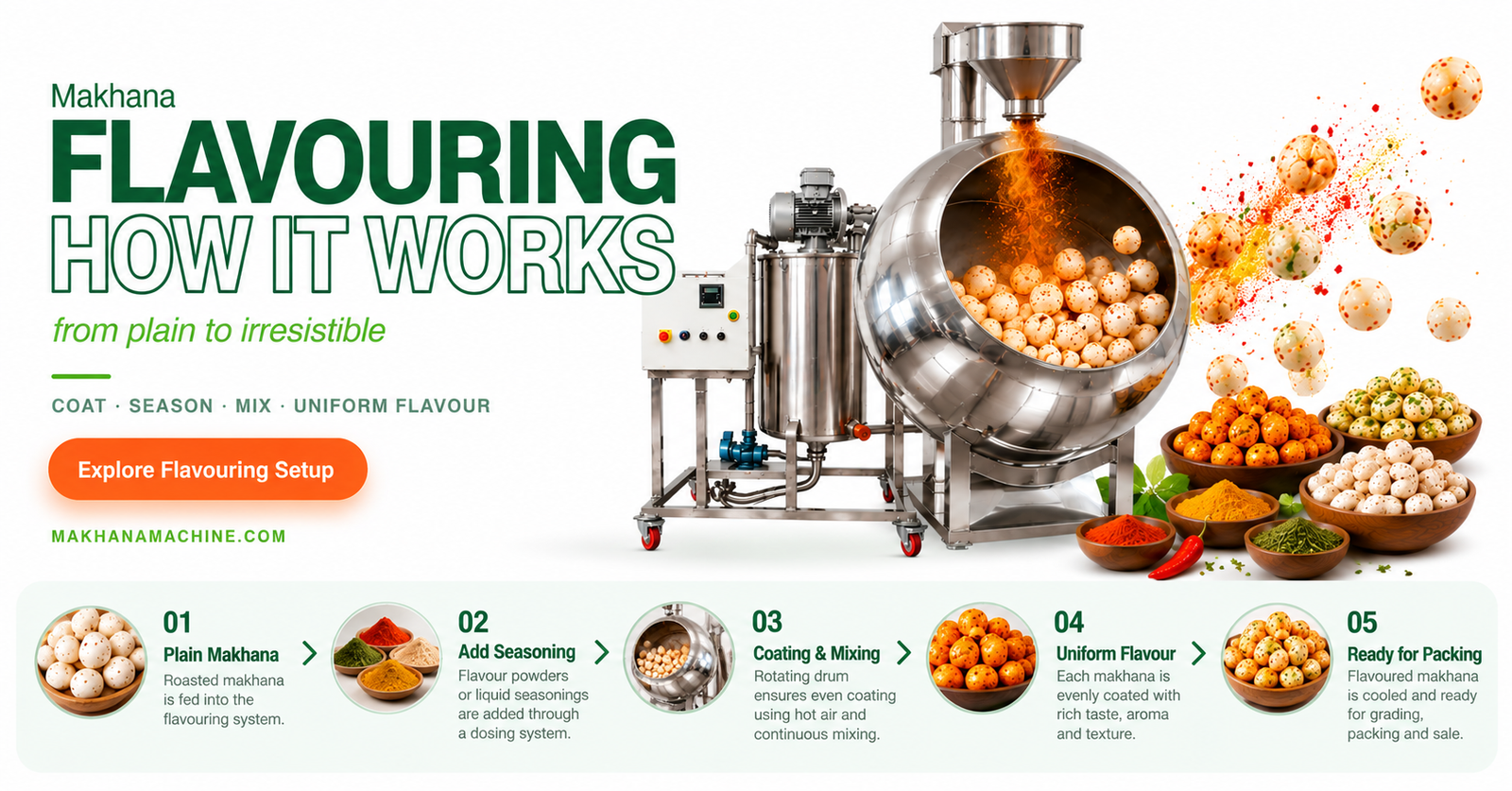
A makhana flavouring and seasoning machine coats roasted fox nuts with oil, salt, spices or other flavour blends. Its rotating drum gently tumbles the makhana while seasoning is added, helping create a more even coating and consistent product from batch to batch.
For snack makers, this equipment can be a standalone coating unit or part of a larger makhana processing line. This guide explains the working process, main parts, output considerations and how to assess a commercial makhana flavoring and seasoning machine in India.
What Is a Makhana Flavouring Machine?
Makhana flavouring machine it is a food-processing machine, which helps to add flavours to roasted makhana. It can consist of a rotating drum or coating pan, a dry powder feeding system, and a spray system for oil or liquid flavour. A roaster is not always used to roast makhana. Equipment for flavour coating is often a separate unit, with an oven with roaster capability included in the combined roaster/seasoning unit.
Be sure to read the equipment on the offer and the specifications; the supplier list companies use similar product names for different equipment. In a standard production line, the makhana is first roasted seasoned cooled if required and packed. Although the coating machine aids in streamlining the mixing phase, end results also vary based on the makhana quality, seasoning formula, amount of makhana loaded, running speed of drum and coating duration.
How the Process Works
The exact process varies by machine and product recipe. A common batch workflow looks like this:
1. Prepare the makhana
Use clean, roasted makhana that is suitable for the intended flavour. Remove visible foreign material and separate damaged or unsuitable pieces before loading. If the product is too cool or its surface is not receptive to the seasoning, the coating may not adhere as intended. Follow a consistent preparation method during trials.
2. Load the drum
The operator loads a measured quantity into the drum or coating pan. Avoid overfilling: makhana needs room to tumble. Too much product can restrict movement and cause uneven coating; too little may not produce efficient batches. Follow the manufacturer’s recommended batch size rather than estimating by drum volume alone.
3. Start gentle tumbling
Once the drum rotates, the makhana moves along its surface and falls back through the batch. This repeated movement exposes different sides of each piece to the seasoning. Internal fins or the drum’s shape may help lift and redistribute product, depending on the design.
The goal is controlled movementnot aggressive mixing. Makhana is a delicate snack, so operators should assess whether the machine handles the product gently and whether the operating speed can be adjusted for their specific product.
4. Apply oil or liquid coating
If the recipe uses oil or another liquid ingredient, it is usually applied in a measured way while the product tumbles. Some machines list a pump-based or gravity-fed oil spray arrangement; other configurations may use spray nozzles or a flavour applicator.
A fine, controlled application can help dry seasonings adhere. Excess liquid, however, may leave the snack greasy or affect its crispness. Confirm that the machine’s liquid-dosing arrangement is compatible with the viscosity and quantity required by your recipe.
5. Add the seasoning blend
Dry seasoning is added while the makhana continues to tumble. The motion distributes the powder across the batch. The operator may add the blend in one portion or gradually, depending on the formulation, batch size and machine design.
Seasoning recipes can include simple salt blends or more complex options such as masala, cheese, peri-peri or other profiles. The machine applies the blend; it does not automatically guarantee the right taste. Recipe development and controlled dosing are essential for repeatable flavour.
6. Check the coating and discharge
The operator observes for uniform seasoning distribution and integrity of the product. The batch is unloaded when the coating cycle ends. There are some machines equipped with tilting systems for easier unloading.
Once the makhana has been completed cooled, inspected, and packed, consider whether the product and pack-off plan should include some drying or cooling time, given the liquid ingredients present in the recipe. This depends on the formulation and process design. Not all flavouring machines necessarily contain this additional drying or cooling stage.
Main Parts and What They Do
Machine layouts differ, but a commercial unit may include these parts:
| Part |
Function |
|
Rotating drum or coating pan |
Holds and tumbles makhana during seasoning. |
|
Motor and drive |
Powers drum rotation. Gear-drive arrangements are listed for some models. |
| Internal fins or lifting elements |
Help redistribute product as the drum turns, depending on the design. |
|
Seasoning hopper or dosing arrangement |
Holds or feeds dry seasoning into the tumbling product. |
|
Oil tank and spray system |
Stores and applies oil or liquid coating where included. |
| Speed control or control panel |
Helps the operator manage machine operation; some listings specify variable-frequency control. |
| Frame and food-contact surfaces |
Support the machine and provide the surfaces that contact the product. |
| Discharge or tilting arrangement |
Helps empty the coated batch. |
These are common functional elements, not a guarantee that every machine includes them. Ask for a drawing or a written specification of the exact model, including which components are supplied and which are optional.
Batch and Continuous Models
A batch machine processes a set quantity at a time: load, tumble, season, discharge and repeat. This arrangement can suit small and medium production runs, frequent flavour changes or businesses still refining their recipes.
A continuous system is designed to receive and discharge product as it moves through the process. It can be more suitable for a linked production line, but it requires coordinated feeding, seasoning application and downstream handling. Supplier descriptions may call equipment “continuous” even when the product listing also mentions batch capacity, so verify how the model operates in practice.
The best choice depends on the actual production target, product range, labour availability and space. Do not select a machine based only on its automation label or advertised output.
Output: What to Check
Machine output is normally reported as either batch capacity or kg/hr. These are not interchangeable. Batch capacity is the amount a drum can carry during a single cycle while an hourly figure is based on a complete cycle of loading seasoning discharge, handling between batches and so on.
Different configurations are available on all the supplier listings. An example one listing describes a seasoning drum as having a 100 kg drum capacity and 200 kg/hour figure whereas another listing describes a makhana flavoring machine rated at 100kg/hour. These are supplier supplied specifications and do not imply the amount of output that your product will achieve.
When comparing output, ask:
- Is the stated capacity per batch or per hour?
- What product and process were used to determine the figure?
- Does the number include loading and discharge time?
- What batch size is recommended for delicate makhana?
- Is output affected by the selected flavour or coating method?
- Can you run a product trial before ordering?
A realistic production estimate should reflect your own recipe and operators. Request a demonstration or sample run with your makhana and seasoning wherever possible.
Semi-Automatic and Fully Automatic Models
Machines and processing lines are available in different automation levels. A semi-automatic setup may require manual loading, seasoning addition, transfer between stages or discharge. An automatic line can integrate more of the handling and control steps, depending on its configuration. Supplier listings include both semi-automatic flavouring equipment and automatic processing-line options.
“Automatic” can mean different things across manufacturers. It may refer to a specific machine function rather than the entire production process. Ask which tasks are automated and which still require an operator, including ingredient dosing, start-stop controls, transfer, discharge and cleaning.
For a new or smaller operation, a semi-automatic model may offer a simpler way to manage production and test several flavours. A higher level of automation may be worth evaluating when planned volume, repeatable recipes and staffing needs justify the additional investment.
Choosing a Machine in India
When searching for a makhana flavouring and seasoning machine in India, compare specifications and service support rather than relying on a product title or price alone. Machines are offered by suppliers in locations including Noida and Ahmedabad, and listings describe different capacities, materials and automation grades.
Consider these points before requesting a quotation:
- Product capacity: Match the recommended batch size and verified hourly throughput to your expected production.
- Product handling: Ask how the drum handles makhana and what steps help limit breakage.
- Seasoning method: Confirm whether the unit supports dry powders, oil spray or both.
- Food-contact materials: Check the grade and finish of all surfaces that contact the product. Some Indian listings specify SS304 for contact parts or construction, but verify this for the model being quoted.
- Controls: Ask whether speed adjustment, dosing controls and operating instructions are included.
- Cleaning access: Check how the drum, fins and seasoning-contact parts can be cleaned between batches and flavours.
- Utilities and space: Confirm power supply, phase, installed footprint and any other site requirements.
- Service and spares: Ask about installation, operator training, warranty terms and spare-part availability.
- Trial and documentation: Request a product trial and a written specification sheet before placing an order.
The machine should fit the wider process too. Consider how roasted makhana reaches the flavouring unit and how seasoned product moves to cooling, inspection and packing. A coating machine can perform well yet still become a bottleneck if the upstream or downstream equipment cannot keep pace.
Common Operating Problems
An excessively full drum, uneven powder dosing, poor liquid distribution or the wrong tumbling cycle can all produce a unevenly seasoned product. When testing, consider testing one variable at a time, as this will make it easier for the team to ascertain the root cause.
Fractured makhana could be due to rough handling, over loading, wrong speed or a prior incident damage. Check product before and after flavouring, save the setting for each flavour. The machine supplier can advise on the desired working range.
A greasy finish could point to too much oil or that the dry system and liquid aren’t working in tandem. A dusty surface may mean the powder isn’t sticking or the order of application needs to be changed. Take these as process development problems: run a series of tests with controls and compare sensory visual textural and packaging outcome.
Cleaning and Routine Care
After each production run and flavour change clean the machine as recommended in the manufacturer’s instructions and per your unit’s hygiene procedures. Clean off any remaining powder and oil from areas that contact the product, and ensure that seasoning has not built up on any seams, fins, or discharge points.
Before operation, examine the drum drive spray plant and controls. Operate to the manufacturers instructions for ensuring safety, selection of cleaning products and frequency of cleaning. Maintain a record of cleaning and maintenance as part of the production controls.
Conclusion
A makhana flavouring and seasoning machine uses controlled tumbling and seasoning application to coat roasted fox nuts. Its results depend on the machine design, product handling, coating method, recipe and operator settings not just the stated capacity. For a commercial purchase, verify batch size, real output, contact materials, automation scope, cleaning access and service support, then test the machine with your own product.
FAQs
What is a makhana flavouring and seasoning machine used for?
It coats the roasted makhana with oil salt spices or flavor combinations by gently tumbling in the roasting drum.
What are the major parts of a makhana flavouring and seasoning machine?
Common components are a rotating drum motor feeder for seasonings, oil spray system control frame and discharge device.
Is it available in semi-automatic and fully automatic models?
Yes. These can vary from semi-automatic machines to fully integrated automatic lines, given the production process and type of line being used.
How does a makhana seasoning machine coat each piece?
As the drum rotates makhanas roll around whilst the oil and seasoning are poured into the mix, giving an evenly seasoned batch.
Can one machine apply both oil and dry seasoning?
Some models have both through spray and powder-dosing configurations; specify, which system is supplied with the supplier.
What capacity should I choose for commercial production?
Select based on confirmed hourly output, batch size, operating cycle, products selected from trials and your production quantity.
What should I check before buying a machine in India?
Check contact material, output basis, scope of automation, cleaning access utilities service support and product trial.