
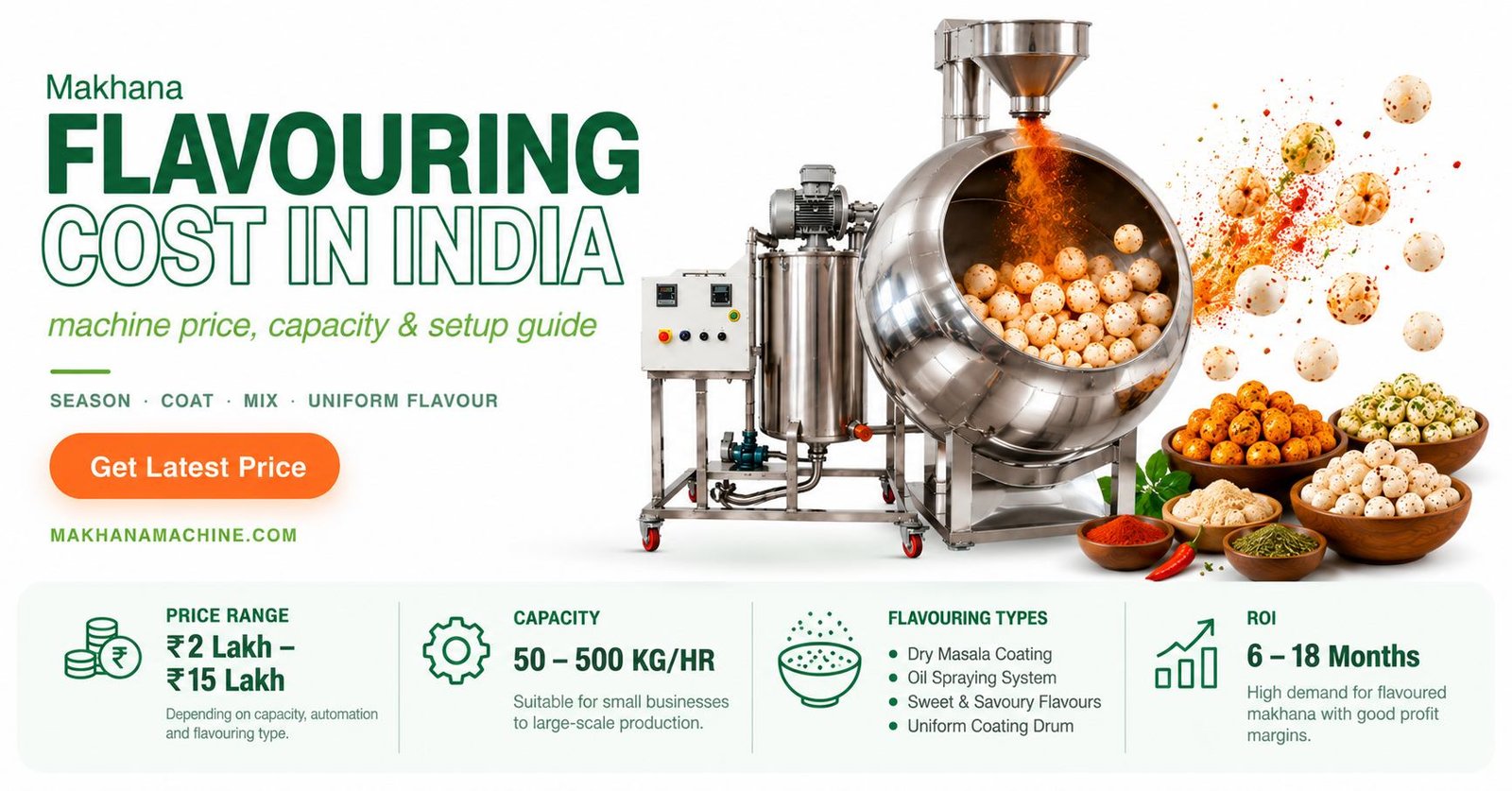
The makhana flavouring and seasoning machine price in India is not only based on the unit size: capacity, material used to build it, type of coating, amount of automation, and if it is a single unit or in a line processing chain all influence the quote. From direct supplier listings, you will see flavouring only units, but actual costing can vary based on setup and inclusions. Use online figures as a base only, then compare written proposals against this data.
What Does a Makhana Seasoning Machine Do?
A makhana flavoring and seasoning machine applies oil, liquid flavor, or dry seasoning powder to roasted fox nuts. Most machines feature a rotating drum or coating chamber that tumbles the product while seasoning is added by an operator or an integrated applicator. The objective is to achieve an even coating with minimal breakage, ensuring the snack maintains consistent taste and appearance across batches.
A flavouring machine may or may not be a roaster. Some vendors might quote flavouring as a separate process and not sell a combined unit or have a full-line of roasting, flavouring, and packaging. Clarify with each company exactly, which processes are performed by the machine before comparing prices.
Kalyan Machines has a semi-automatic flavouring machine priced at 1.75 lakh with a claimed capacity of 100 kg/hr, stainless-steel body and power of 415 V. The same supplier, lists, roasters, and complete processing line at different prices. These are prices listed by the vendor and not a market rate, contact the manufacturer for the same.
Indicative Price Range in India
Prices vary because “makhana seasoning machine” can refer to different equipment: a basic coating drum, a flavour applicator, a dedicated flavouring machine, or a more integrated processing unit. Listings also sometimes group flavouring with roasting, making like-for-like comparisons difficult.
Here are examples from supplier listings available online:
| Equipment listing | Published price | Listed details |
| Makhana flavouring machine | ₹1,75,000 | Semi-automatic; 100 kg/hour; stainless steel; 415 V |
| Seasoning machine | ₹25,000 | Electric; stainless-steel grade listed; capacity figures vary across the listing |
| Makhana processing machine | ₹3,00,000 | Roasting and grading; 100 kg/hour; SS 304; 3 hp |
| Automatic foxnut snacks processing plant | ₹13,50,000 | 100 kg/hour; automatic; commercial plant |
These listings have different types of equipment listed and should not be construed as price equivalents. The processing plant, for example, performs functions not available in the standalone seasoning drum. Marketplace listings often have dynamic capacity fields; ask for the latest model quotation and technical datasheet.
The simple trick is to compare apples with apples not apples with oranges. Simply ask whether the headline figure is for a seasoning unit only, or for a tank applicator control panel installation commissioning training transportation and taxes. This can Really alter your total investment.
What Drives the Machine Price?
1. Capacity and batch size
Capacity is one of the main price drivers. A small batch unit suitable for trials or limited production generally needs less material and a smaller motor than a machine designed for continuous commercial output. Larger drums, stronger drives and higher-throughput seasoning systems can add to the price.
Find out if the supplier is quoting capacity as kg/hr, kg/batch, or the drum load capacity alone. They are not the same. A machine sold as “100kg” may be a batch load figure not the hourly output, and a 100kg/hr figure may be dependent on flow of product and specific conditions. Have the supplier clarify the number and show that they can actually deliver with makhananot just another snack.
Standards published already have quite a spread. One sets a flavouring machine at 100kg/hr, one is 0-50kg/hr for the flavouring machine that range means it’s worth working out a specification to match your requirements and get that figure in writing.
2. Standalone machine versus integrated line
A standalone tumbler usually costs less than a system that combines multiple processing steps. An integrated setup may include a seasoning tank, oil tank, flavour applicator, conveyors, roaster, cooling equipment or packaging machinery. Each addition affects the capital cost, floor space, electrical load and installation requirements.
For a new business, buying an entire line may look convenient, but it can mean paying for equipment you do not yet need. If roasting is already handled elsewhere, a standalone flavouring machine may be the more appropriate purchase. Conversely, a growing manufacturer may benefit from equipment designed to connect with its upstream roasting and downstream packing operations.
Supplier pages illustrate this distinction: one lists a standalone makhana flavouring machine at around ₹1.75 lakh, but also lists automatic and semi-automatic processing plants priced much higher. The plant prices cannot be treated as the cost of the seasoning machine alone.
3. Construction material and food-contact parts
The material used for product-contact surfaces affects durability, hygiene, and price. Stainless steeloften specified as SS 304is commonly listed for food-processing equipment. The grade and extent of stainless-steel construction matter: a supplier may use stainless steel only for contact areas, or for most of the machine body and associated components.
Ask for a material-of-construction breakdown covering the drum, hopper, seasoning tank, spray parts and discharge area. If the quote simply says “stainless steel,” ask the supplier to clarify which grade is used and which parts are made from it. A precise specification helps avoid paying for a description that does not match your hygiene or cleaning requirements.
4. Seasoning and coating system
A more basic machine may simply require the operator to add powder or oil manually, whereas a more sophisticated model could have a dosing arrangement, a spray applicator, a seasoning tank, or variable controls to take the guess work out of some of the process. These all come at a cost.
The right machine will also vary according to what you are seasoning. A dry masala coating will have different process requirements to an oil-improved peri-peri marinade or a sugary glaze. Ensure you trial the machine with the specific seasoning you intend to use will it coat well without making the snack soggy.
5. Automation and controls
Manual, semi-automatic and automatic machines differ in how much of the process is controlled by the operator. Automation may include powered drum rotation, timed operation, adjustable speed or coordinated dosing. More automation can raise the initial price, but it may help when production volumes and repeatability requirements are higher.
Do not assume that the label “automatic” means the entire flavouring process is hands-free. Listings sometimes use automation terms inconsistently. Ask which tasks require an operator: loading, oil application, powder dosing, monitoring, unloading and cleaning. A clear process description is more informative than the automation grade alone.
6. Motor, power and electrical requirements
Motor power, voltage and phase affect both machine price and operating compatibility. For instance, one listed flavouring machine specifies 415 V and three-phase operation, while other snack machinery listings include different electrical configurations. Confirm that the supply available at your production site matches the machine, and ask for the installed load and running power consumption.
Do not compare motors by horsepower alone. Drum design, gear arrangement, loading conditions and running hours all influence performance. Ask for the recommended duty cycle and whether the machine is intended for intermittent or extended operation.
7. Drum design and gentle handling
Makhana is a delicate puffed snack. The drum’s diameter, slope, rotation speed and internal design influence how thoroughly it tumbles and how much breakage occurs. Larger or specially configured drums may increase the purchase price, but poor handling can also create losses through broken product and inconsistent seasoning.
Request a live trial or sample run with your own makhana. Check the percentage of broken pieces before and after processing, how evenly the seasoning is distributed, and whether product gets trapped in corners or around the outlet. A lower-cost machine is not necessarily the better value if it causes higher wastage.
8. Customisation and after-sales support
A bespoke drum size, a special arrangement of coating, a specific voltage configuration, or even compatibility with other plant. All can influence the quotation, as can the provision of installation commissioning operator training, warranty, or spare parts.
Request a written quotation showing item prices broken down by machine and optional items and services. Find out delivery date guarantee response time, service location and if all wear parts are held locally. This is important so you can take the total ownership costs (not just initial payment) into account.
Makhana Flavouring and Seasoning Machine Specifications to Compare
When you request a quotation, use a checklist so that suppliers quote against the same requirements. Commonly listed specifications include capacity, material, voltage, frequency, phase and automation grade. Some listings also state drum dimensions, power requirement, seasoning tank and applicator details.
| Specification | What to confirm |
| Capacity | kg/hour or kg/batch, with the measurement method stated |
| Product suitability | Tested on popped makhana of your intended size and condition |
| Drum | Dimensions, usable load, rotation speed and loading/unloading method |
| Material | Grade and location of all food-contact surfaces |
| Seasoning method | Dry powder, oil-assisted powder, liquid spray or other coating |
| Controls | Manual or powered operation; speed or time adjustment, if available |
| Power | Motor rating, voltage, phase, frequency and installed load |
| Cleaning | Access to product-contact areas and time needed for flavour changeover |
| Installation | Included or extra; site, electrical and space requirements |
| Commercial terms | Warranty, delivery, taxes, freight, commissioning and spares |
Use the table as a quotation checklist rather than a promise that every model includes each feature. Specifications vary by manufacturer and machine design.
How to Choose Capacity for Your Business
Calculate how much you actually want to use to season- don’t simply figure out how much makhana you think you’re going to sell! A good rule of thumb is your target amount to produce per day, divided by the number of hours that you have to produce it. Then add in cleaning, flavour changeovers, loading, and unloading, and quality checks.
Let’s say your operation needs to season 240 kg in a six-hour run. Simple average = 40 kg/hr. You might consider a machine that is rated above that figure to factor in burn-off time and recipe adjustments. Do not jump to a bigger machine without confirming it is capable of efficiently seasoning smaller batches; running under capacity can make trialing and small-batch production more difficult.
Request the supplier to explain their labelling of makhana flavouring and seasoning machinery capacity under similar circumstances. Different products, quantity of coating and method of operation can all impact capacity. Factory acceptance test on your own products and seasoning mixture can make this capacity claim more useful.
Applications and Products
A makhana flavouring machine is used to coat roasted fox nuts for retail packs, bulk supply or food-service use. With a suitable process and equipment configuration, the same kind of flavouring system may also handle other puffed or snack products. One supplier lists makhana, corn puff, rice puff, cheese balls, peanuts, Kurkure and potato chips among the applications for its flavouring machine. Confirm compatibility with the specific model before assuming it can process every product.
Common makhana applications include:
- Salted, masala and chilli-seasoned fox nuts.
- Peri-peri, cheese, pudina and other flavoured snack variants.
- Small-batch product development and flavour trials.
- Commercial production for packaged snack brands and food processors.
Seasoning equipment does not, by itself, guarantee a specific flavour profile or shelf life. Recipe design, ingredient quality, coating quantity, moisture control, packaging and storage all contribute to the final product.
Conclusion
Choosing a makhana flavouring and seasoning machine is about more than finding the lowest quoted price. Compare suppliers using the same production requirements, confirm the machine’s capacity and specifications, and account for installation, taxes, service and spare parts. A product trial and a detailed written quotation can help you verify that the equipment suits your makhana, seasoning process and production goals so you can make a confident investment based on value, not price alone.
FAQs
What is the makhana flavouring and seasoning machine price in India?
Pricing will depend on capacity, automation, and features, ask your supplier for an up to date quotation.
What is the usual capacity of a makhana seasoning machine?
Typical listed capacities are from 50 to 100 kg/hr.
What specifications should I check before buying?
Consider capacity materials motor voltage seasoning system, cleaning access, warranty.
Can the machine apply both oil and dry seasoning powder?
Some machines support both, but confirm compatibility with your specific coating process.
Can one machine flavour other snacks besides makhana?
Yes, there are machines available that flavour peanut, corn puff and chip.
Is a flavouring machine the same as a makhana roaster?
No, flavouring machines only are used for flavouring the product. Roasters only are used for Roasting the makhana.
What information should I give a supplier to get an accurate quote?
Supply capacity, type of product flavours coating method, power supply and equipment specifications.