
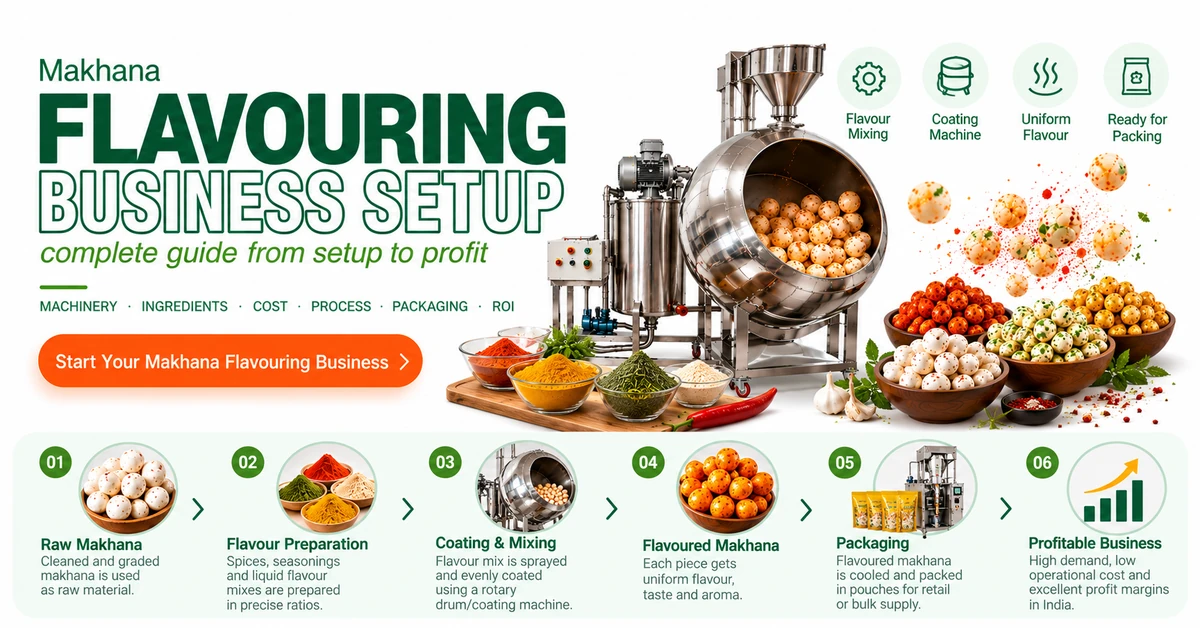
A lot goes into starting your flavoured makhana business than just purchasing a machine and selecting some masalas. You must identify what the business model is that you want to build, create a replicable product, identify the most appropriate makhana flavouring and seasoning machine, set up your work environment, plan your packaging and compliance, and find your customers before you increase production.
The industry is also broadening from basic plain snacks to packaged and flavoured ones. The Government of India says makhana marketing in India has been growing consistently these days. This growth has been driven by increased health consciousness, premiumisation, and branded products. But, while there is a good scope for value-added products, the same does not hold true for all brands. Product innovation, cost optimisation and ‘route to market’ still count.
Choose Your Business Model
First decide what role the machine will play in your business. The right setup depends on whether you are launching a consumer brand, seasoning makhana for other businesses, or processing a wider range of snacks.
Build your own brand
You buy plain or roasted makhana, season it, pack it under your brand and sell through retailers, online channels or direct sales. This gives you control over flavours, packaging and customer experience, but you also take responsibility for product development, food safety, inventory and marketing.
Provide contract seasoning
You process makhana for another brand or food business. This model can generate revenue from machine time and processing services, but it requires clear agreements on raw materials, recipes, quality standards, production quantities and responsibility for packaging and regulatory declarations.
Add seasoning to an existing food business
If you already make snacks, the machine can help add flavoured makhana to your product range. Before buying, check whether the model can handle your other products as well. Some suppliers list applications that include makhana, corn puffs, rice puffs, cheese balls, peanuts, Kurkure and potato chips, but suitability must be confirmed for the specific machine and product.
Your business model will influence your equipment, premises, packaging requirements and sales plan. A brand owner selling retail pouches, for example, needs to plan for filling, sealing, coding and distribution not only seasoning.
Validate the Product Idea
Before setting up production, identify who you want to sell to and what would make your product worth choosing. Decide whether you are targeting everyday snack buyers, premium grocery shoppers, office-goers, fitness-focused consumers, gift buyers or another audience. Avoid relying on broad claims such as “everyone likes healthy snacks.” A specific buyer profile helps guide the flavour, pack size, price and sales channel.
Start with a small range of flavours rather than many variations. You could test familiar choices such as salted, pudina or masala alongside a more distinctive option. The purpose of early trials is to learn which flavours customers like, what price they will accept, and whether the product remains crisp and appealing after packing.
Use basic customer research before committing to large production runs:
- Compare the products, flavours, pack sizes and prices sold by competing brands.
- Ask potential buyers to taste samples and share direct feedback.
- Test different seasoning levels and oil application rates.
- Record ingredient quantities and processing conditions for every sample.
- Estimate cost per pack before finalising the retail price.
Treat taste feedback as one part of validation. Also check seasoning coverage, broken pieces, aroma, crispness and how easily the product can be packed and transported. A recipe that tastes good immediately after coating may still need adjustment if the seasoning softens the snack or separates during handling.
Plan the Production Process
A makhana seasoning operation usually begins with suitable popped or roasted makhana and ends with a sealed, labelled pack. The process should be written down so operators can repeat it consistently.
A practical flow may look like this:
- Receive and inspect makhana and seasoning ingredients.
- Remove foreign matter and separate damaged or unsuitable pieces.
- Roast or condition the makhana if the recipe and process require it.
- Cool the product to the required processing condition.
- Weigh a batch and load it into the flavouring machine.
- Add oil, liquid flavour or dry seasoning using a controlled method.
- Tumble until the coating is reasonably uniform.
- Inspect the product for coating, breakage and taste.
- Dry or cool the product if the recipe requires it.
- Pack, seal, code and store finished goods.
The exact sequence depends on the recipe and equipment. A supplier may describe a flavouring machine as having a coating drum, seasoning applicator, oil tank or roasting-related features, but ask, which functions are included in the model you are buying. One supplier listing, for example, describes a semi-automatic machine with a flavour applicator, seasoning, and oil tanks, SS 304 food-contact material and a stated capacity of 100 kg per hour. Specifications and price should be confirmed with the supplier because listings can change and published details may not represent every configuration.
Create a simple batch record from the start. Note the weight of makhana, oil and seasoning; drum speed or operating time if adjustable; product temperature where relevant; and the quantity of acceptable finished product. This helps identify the source of variation when one batch tastes different or has more breakage than another.
Select the Right Machine
The makhana flavouring and seasoning machine should fit your production plan—not just your hoped-for future output. Ask suppliers to define the capacity in writing. It may refer to kilograms per hour, kilograms per batch or another measurement. These figures are not interchangeable, and actual output can depend on loading, coating time, cleaning and flavour changeovers.
Key specifications to compare
| Specification | What to clarify |
| Capacity | Is the stated figure kg/hour or kg/batch, and how was it measured? |
| Batch size | What is the minimum and maximum practical load? |
| Product contact material | Which parts are food-contact, and what material grade is used? |
| Drum design | What are the drum dimensions, operating speed and discharge method? |
| Seasoning system | Does it apply dry powder, oil, liquid flavour or a combination? |
| Automation | Which steps are automatic and which need operator involvement? |
| Electrical requirements | Confirm voltage, phase, frequency, motor rating and installed load. |
| Cleaning | How are contact surfaces accessed and cleaned between flavours? |
| Included equipment | Check for tanks, applicators, controls, trolley or other accessories. |
| Support | Confirm installation, training, warranty, spare parts and service availability. |
Do not select capacity by matching it only to your expected sales. Account for operating hours, changeovers, cleaning and the output of other equipment. If your roaster produces more product than the flavouring machine can handle, the seasoning stage may become a bottleneck. Likewise, a very high-capacity unit may be hard to use efficiently for small batches or product trials.
Ask for a demonstration using your own makhana and seasoning blend. Inspect how evenly the coating is distributed, how much product breaks, whether seasoning remains in the drum, and how much time the machine takes to clean. A supplier demonstration using a different snack or a different recipe may not predict results with your product.
Some equipment listings describe machines as suitable for several snacks. Treat those applications as possibilities to verify, not a guarantee. Differences in shape, density, fragility and coating method can affect performance.
Set Up the Workspace and Team
You do not need an elaborate factory for every business model, but you do need a clean, organised and suitable production space. Plan distinct areas for incoming raw materials, ingredient storage, processing, packing and finished goods. Keeping these activities organised helps reduce mix-ups and makes cleaning easier.
Before fitting the machine, check:
- The machine’s footprint, access for loading and unloading, and clearance for cleaning.
- The power supply and electrical installation recommended by the supplier.
- Ventilation, lighting, drainage and availability of potable water where needed.
- Dry, protected storage for makhana, seasoning ingredients and packaging.
- A separate place for cleaning tools and materials.
- Safe movement of staff and product through the work area.
Train operators to weigh ingredients accurately, follow the batch method, use the machine safely and clean it between production runs. Assign responsibility for receiving inspections, batch records, quality checks and finished-product release. FSSAI guidance for food manufacturing and processing refers to Good Manufacturing Practices and Good Hygiene Practices under Schedule for food businesses applying for licensing must also maintain a documented food safety management plan. Check the applicable requirements for your business type and licence category.
Develop Recipes and Control Quality
The recipe is not only a list of ingredients. It is a defined method that explains how much seasoning and oil to use, how to apply them, and what the finished product should look and taste like. Keep ingredient quantities in grams or percentages rather than relying on informal instructions such as “add a little more masala.”
Set quality checks that operators can follow for each batch. These may include:
- Appearance and seasoning coverage.
- Taste, aroma and salt level.
- Crispness and breakage.
- Batch weight before and after processing.
- Seal quality and pack appearance.
- Foreign-matter checks and product traceability.
Pay special attention to moisture and packaging. A crunchy product can lose texture if it absorbs moisture, while oil and seasoning can affect flavour stability during storage. Test the finished product in its intended packaging under realistic storage and transport conditions before printing a long shelf-life claim. A shelf-life decision should be based on suitable product and packaging evaluation, not on a guess or a competitor’s label.
Use ingredients and food additives that are permitted for the product category and intended use. Keep supplier specifications, purchase records and batch details for seasoning ingredients. If you make nutrition, health or other product claims, review the claim and supporting evidence before publishing it on the pack or in marketing material.
Complete Registration and Label Checks
Food businesses in India must obtain the FSSAI registration or licence applicable to their activity. FSSAI’s 2026 FAQs state that, for new applications from 1 April 2026, the revised turnover categories are registration up to ₹1.5 crore, State Licence above ₹1.5 crore and up to ₹50 crore, and Central Licence above ₹50 crore. The correct category can also depend on the kind of business and its production capacity, so check FoSCoS eligibility for your specific manufacturing or processing activity before applying.
For packaged products, prepare compliant label artwork before ordering packaging in bulk. FSSAI’s Labelling and Display Regulations cover declarations including the product name, ingredients, nutrition information, vegetarian or non-vegetarian symbol, allergen information, responsible business details, FSSAI logo and licence number, batch identification and date marking. Requirements can depend on product and packaging details, so review the current rules and have the final label checked before printing.
Retail packs must also be reviewed against applicable Legal Metrology requirements. These include declarations such as net quantity, MRP, manufacturer or packer details and consumer-care information. If you use plastic packaging, check whether the applicable Extended Producer Responsibility requirements apply to your role as a producer, importer or brand owner.
Udyam Registration is a separate MSME registration and does not replace food-business registration or licensing. The government portal describes Udyam Registration as an online, paperless process that is free of charge.
Plan Packaging, Pricing and Sales
A seasoning machine makes a flavoured snack; it doesn’t make the business profitable on its own. Calculate what your cost per pack will be before you select a selling price. Add makhana oil seasoning, packaging labour utilities wastage delivery, retailer, or platform margin, promotional, and advertising spend and see if there is enough contribution in the estimated selling price to absorb fixed costs. Select packaging that will safeguard the product and is appropriate for how your customers will purchase it. Smaller packs may be suitable for sample, impulse, or snacking in the office. Larger packs may be more suitable for consumption at home or for online sales. Check the pouch’s barrier, seal, and product protection. Ensure the label is readable.
Begin with your manageable channels. Local supermarkets, farm shops delicatessens cafes, corporate accounts, online platforms and direct marketing are options although there are costs and the ways of working are different. For instance, online selling, product photography, accurate listings, order filling and processing can be a lot more work, as will the repacking of returns and damaged packs. Wholesale to retail might need a distributor, trade margins and regular filling. Don’t just use early sales to maximize volume, learn. Measure what flavour is selling, what pack size is getting reorders, where they are coming across it and why they aren’t reordering. Use real feedback to change your product or sales method.
Make a Realistic Investment Plan
The machine is only one part of the project cost. Include roasting equipment if needed, weighing and packing equipment, electrical work, workspace preparation, packaging design, initial raw materials, testing, licences, transport and working capital. Costs depend on your location, production model and how much equipment you already have, so use supplier quotations and a written project plan rather than a generic online estimate.
Keep funds available for day-to-day operations. A business can have a suitable machine and still struggle if it cannot buy ingredients, pay for packaging or cover the time between making a product and receiving payment from customers.
You can also check current government or bank support schemes, but verify the application window and eligibility directly with the responsible department or lender. Scheme terms can change, and support should not be assumed in your base financial plan until it is confirmed.
Launch in Stages
A phased launch reduces the risk of investing in a capacity you cannot yet use.
Finalise the customer segment, business model and initial flavour range.
Obtain samples and compare makhana, seasonings and packaging options.
Trial the recipe on suitable equipment and record the process.
Confirm the machine’s specifications, capacity and utilities with a supplier.
Prepare the workspace and complete applicable registrations or licences.
Produce a small pilot batch and evaluate taste, quality and packaging.
Confirm label details, cost per pack and sales channel requirements.
Start limited sales, gather feedback and improve the process.
Increase production only when demand and unit economics support it.
For a new business, a small pilot run is especially useful. It can reveal problems with coating, breakage, pack size or sealing before you buy large quantities of ingredients and packaging. It also gives you samples to show potential retailers and customers.
Conclusion
The makhana business concept Start with the product and customer not just machine capacity a product trial will verify the flavours, compare the makhana flavouring and seasoning machine parameters, verify the genuine output and provide the evidence on the quality, demand, and timing for scale-up. It allows you to establish your business concept on hygiene packaging compliance, sales, and volume.
FAQs
What does a makhana flavouring and seasoning machine do?
It stirs the roasted makhana while adding oil, liquid seasoning or dry seasoning so it coats evenly.
What capacity should I choose for my makhana business?
Assess capacity on planned output, hours of operation, batch size, changeovers, and ‘demand’ imposed on the system.
Can one machine apply different makhana flavours?
Yes, but sanitize the equipment between recipes and proof each seasoning to ensure consistent batch results.
Can the machine process snacks besides makhana?
Other puffed snack products and nuts are included in some models; verify that they are safe with a product-specific trial.
Do I need FSSAI registration to sell flavoured makhana?
Yes. All food business activities require the appropriate registration or licence under the FSSAI Act.
What packaging works for flavoured makhana?
Use an appropriate, food-grade packaging that maintains crunch, limits exposure to moisture and ensures a tight seal.
Should I buy a machine before testing my recipe?
No. Develop and test the recipe first, then select the equipment based on the assured product and output requirements.