
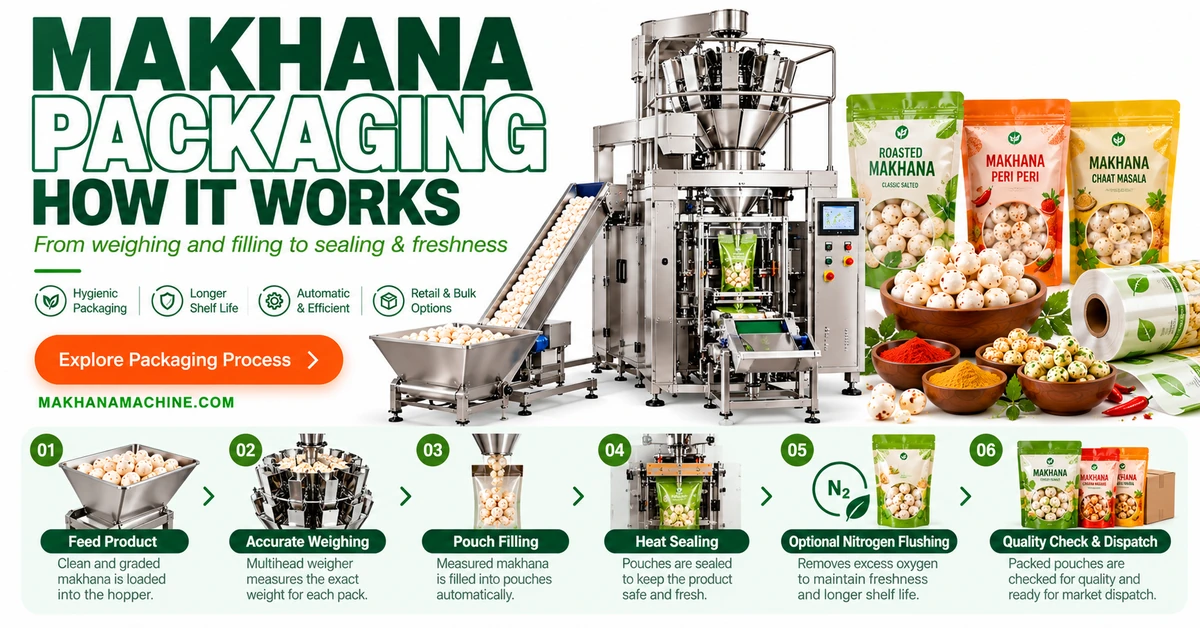
The packaging machine automatically weighs fills seals and (optionally) flushes makhana into retail-sized packs. The process automates what has been traditionally done by hand, reducing breakage, protecting the delicate makhana from moisture and loss of crispness.
Makhana packaging For makhana brands, packaging is just as much a part of the roasting or flavouring process. As makhana is fragile, brittle, and hygroscopic, any packaging system not correctly designed will cause varying pouch weights, broken kernels, weak seals and reduced shelf life. An ideal makhana packaging machine helps you increase shelf life, quality of appearance, output, and hygiene.
This guide explains how a makhana packaging machine works, its main parts, typical makhana packaging machine specifications, capacity ranges, applications, and the factors to check before buying one.
What is a makhana packaging machine?
A makhana packaging machine is a food-grade packaging system designed to pack popped, roasted, salted or flavoured makhana into pouches. Most commercial machines use a vertical form-fill-seal, or VFFS, principle: the machine forms a pouch from packaging film, fills it with a measured quantity of makhana, and seals it automatically.
The machine may be semi-automatic or fully automatic. A semi-automatic machine may require an operator to place pouches or initiate filling, while a fully automatic VFFS machine forms, fills, seals and discharges pouches continuously from a film roll.
Because makhana is a puffed snack, the machine must handle it gently. Manufacturers commonly use multihead weighers, servo-based filling and controlled product transfer to reduce breakage and improve filling accuracy.
Why makhana needs specialised packaging
Makhana is different from powders, grains and dense namkeen products. It has a large volume-to-weight ratio, fragile texture and high sensitivity to moisture. These characteristics make ordinary filling systems unsuitable unless they are configured for fragile snacks.
A good makhana packaging machine must do three things well: maintain accurate weight, prevent kernel breakage and create an airtight seal. Nitrogen flushing is often added because it replaces oxygen inside the pouch, helping retain freshness and extend shelf life.
Key packaging challenges
- Fragility: Rough transfer can break premium-sized makhana and reduce pack appeal.
- Low bulk density: Makhana occupies more space per gram than many snacks, requiring suitable pouch size and filling design.
- Moisture sensitivity: Poor seals allow humidity ingress, making makhana lose crispness.
- Weight variation: Manual filling often leads to underfilling or giveaway, both of which affect margins.
- Shelf-life needs: Roasted and flavoured makhana need protection from oxygen, moisture and light.
- Retail presentation: Transparent windows, zipper pouches and stand-up packs influence buyer perception.
How a makhana packaging machine works
A typical automatic makhana packaging machine follows a continuous sequence: film unwinding, pouch forming, product weighing, filling, gas flushing, sealing, coding and discharge. The exact sequence varies by machine type, but the core workflow remains similar.
Step 1: Product feeding
Roasted or flavoured makhana is loaded into an infeed hopper, bucket elevator or vibratory feeder. The feeding system transfers product upward to the weighing unit without dropping it from a height, which helps reduce breakage.
For flavoured makhana, the product should be cooled to room temperature before packing. Packing warm makhana can trap moisture inside the pouch and affect crispness during storage.
Step 2: Weighing
The weighing system measures the required quantity for each pouch. Small units may use a cup filler, while higher-speed commercial machines generally use a multihead weigher for better accuracy and lower product giveaway.
A multihead weigher distributes makhana across several weighing buckets and combines the optimal mix to reach the target weight. This is particularly useful for light, irregular products such as makhana, where individual kernel size and density vary.
Step 3: Film unwinding and pouch forming
Packaging film is drawn from a roll and guided through a forming collar. The film is shaped into a tube, and a horizontal seal creates the bottom of the pouch. This is the “form” stage of a form-fill-seal machine.
The film must be food-grade, heat-sealable and strong enough to hold the product. Common options include laminated films, metallised films and aluminium-foil-based structures, depending on shelf-life and branding requirements.
Step 4: Filling
Once the pouch is formed, the weighed makhana is released into it. The filling system must be calibrated to the pouch size and product density. For example, a machine designed for 10–50 g packs will need different settings from one packing 100–250 g retail pouches.
Gentle filling is essential. A machine built for puffed snacks uses controlled discharge and minimal free-fall distance to protect the makhana from impact damage.
Step 5: Nitrogen flushing
Many makhana packaging machines include a nitrogen-flushing system before final sealing. Nitrogen displaces oxygen inside the pouch, reducing oxidation and helping the product remain fresh for longer.
This step is especially valuable for roasted, flavoured and premium retail makhana. It also gives the pouch a slight cushion, which can reduce breakage during transport.
Step 6: Sealing and cutting
After filling and flushing, the machine applies a final horizontal seal and separates each pouch. The sealing temperature, pressure and dwell time must match the packaging film; otherwise, the seal may be weak, wrinkled or burnt.
Some machines also add notch cutting, tear lines, euro slots or zipper attachments, depending on the chosen pouch format.
Step 7: Batch coding and discharge
A batch coder prints manufacturing date, expiry date, batch number, MRPs or other statutory details on the pouch. The finished pouches then move to a discharge conveyor for quality checks, secondary packing and dispatch.
Main parts of a makhana packaging machine
Understanding the machine’s components helps buyers compare suppliers and identify the features that matter for their product.
| Machine part | Function |
| Infeed hopper | Holds roasted or flavoured makhana before weighing and filling. |
| Elevator or feeder | Transfers product gently from the hopper to the weighing system. |
| Multihead weigher or cup filler | Measures the target quantity for each pouch. |
| Film roll holder | Supports and feeds the packaging film roll. |
| Forming collar | Shapes flat film into a pouch tube. |
| Vertical sealer | Makes the lengthwise seal of the pouch. |
| Filling chute | Guides weighed makhana into the formed pouch with minimal drop. |
| Nitrogen-flushing unit | Replaces oxygen with nitrogen before final sealing. |
| Horizontal sealing jaws | Close the pouch after filling and cut individual packs. |
| Batch coder | Prints date, batch and mandatory product details. |
| Control panel | Allows operators to set weight, speed, sealing temperature and batch settings. |
| Discharge conveyor | Moves finished pouches toward inspection or secondary packing. |
Makhana packaging machine specifications
Makhana packaging machine specifications vary widely by automation level, pouch size, film type and production requirement. Buyers should compare machines using actual production needs rather than only headline speed.
Common specifications include filling range, packing speed, pouch type, sealing type, power requirement, film width and material of construction. Food-contact parts are commonly made from stainless steel, with SS 304 frequently used in snack packaging equipment.
Typical specification ranges
| Specification | Typical range or option |
| Filling range | 10–50 g for small packs; 100–250 g for larger retail packs. |
| Packing speed | Around 20–40 pouches per minute in semi-automatic models; up to 60–80 pouches per minute in high-speed automatic systems. |
| Capacity | Roughly 2,000–4,000 pouches per hour, depending on machine model and pack size. |
| Pouch formats | Pillow pouches, centre-seal pouches, gusseted pouches, zipper pouches and stand-up pouches. |
| Sealing type | Centre seal, back seal or other heat-seal formats, depending on machine design. |
| Film type | Heat-sealable laminates, metallised films and aluminium-foil laminates. |
| Nitrogen flushing | Optional or standard in many automatic machines; used for freshness and shelf life. |
| Material of construction | Stainless steel, commonly SS 304, for food-contact and machine-body areas. |
| Automation | Semi-automatic or fully automatic VFFS systems. |
These ranges are indicative. Always ask the supplier to test your actual makhana grade, pouch size and film structure before finalising the machine.
Makhana packaging machine capacity
Makhana packaging machine capacity is usually expressed in pouches per hour or pouches per minute. The right capacity depends on daily sales volume, pack size, labour availability and growth plans.
Semi-automatic machines may pack around 2,000 pouches per hour, while some models operate at 20–40 pouches per minute. Higher-speed automatic systems can reach up to 80 pouches per minute, and some industrial snack packaging machines are rated at 3,000–4,000 pouches per hour.
How to calculate required capacity
Use this simple calculation:
\text{Required pouches per hour} = \frac{\text{Daily pack requirement}}{\text{Operating hours}}
For example, if a brand needs 12,000 pouches per day and operates for 8 hours, it needs 1,500 pouches per hour. A machine rated at 2,000–2,500 pouches per hour may be suitable, provided changeovers, cleaning and minor stoppages are considered.
Do not select a machine based only on maximum speed. Real-world output is affected by film roll changes, product feeding delays, operator skill, maintenance and quality checks.
Makhana packaging machine applications
The applications of a makhana packaging machine extend beyond plain popped makhana. These machines are suitable for many light, brittle and puffed snack products, especially where accurate weight and protective sealing are important.
Common applications
- Plain popped makhana in 20 g, 50 g, 100 g and 250 g packs
- Roasted and salted makhana
- Peri-peri, cheese, tomato, chocolate or masala flavoured makhana
- Premium gift packs and resealable zipper pouches
- Makhana trail mixes with nuts, seeds or dried fruits
- Ready-to-eat makhana snacks for modern retail and e-commerce
- Export-oriented makhana packs requiring longer shelf life
- Other puffed snacks such as corn puffs, rice puffs, cheese balls and potato chips.
A machine designed for makhana can often handle similar fragile snacks, but product testing is still necessary. Kernel size, oil content, seasoning dust and bulk density can change filling behaviour and sealing performance.
Types of makhana packaging machines
Semi-automatic makhana packing machine
A semi-automatic machine is suitable for small and growing brands. It may use a cup filler or similar dosing system and typically handles filling ranges such as 10–50 g. One listed semi-automatic makhana packing machine offers a capacity of 2,000–2,500 pouches per hour with centre-seal packing.
This type of machine is easier to operate and usually requires lower investment. However, it may need more operator involvement and may not achieve the speed or weighing accuracy of a fully automatic line.
Automatic VFFS makhana packaging machine
An automatic vertical form-fill-seal machine is the preferred choice for organised retail, e-commerce and growing snack brands. It forms the pouch from film, fills it with weighed makhana, seals it and discharges the finished pack continuously.
Automatic machines often include multihead weighers, servo controls and nitrogen flushing. They are better suited to brands that require consistent pack weights, higher output and reduced manual handling.
Premade pouch packaging machine
A premade pouch machine fills and seals ready-made pouches rather than forming them from film. This format is useful for premium stand-up packs, zipper pouches and distinctive retail designs.
While it can improve shelf appeal, it usually has a higher packaging-material cost than roll-fed VFFS systems. It is best suited to premium makhana brands where presentation justifies the additional cost.
Packaging film and pouch selection
The machine is only one part of the packaging system. Film selection directly affects sealing quality, shelf life, print quality and transport durability.
For makhana, choose a film that provides a strong heat seal, moisture barrier and adequate puncture resistance. Laminated films and aluminium-foil structures are commonly used for snack packaging because they offer better protection than single-layer plastic films.
Film factors to check
- Seal integrity at the machine’s operating temperature
- Moisture and oxygen barrier properties
- Compatibility with nitrogen flushing
- Printability for branding and statutory information
- Puncture resistance for sharp or large makhana kernels
- Pouch size suitable for the product’s bulk density
- Food-grade certification and supplier traceability
A film that works well on one machine may not seal properly on another. Always conduct trial runs with the exact film, pouch size and makhana grade you intend to use commercially.
Output, accuracy and quality control
A makhana packing machine should be able to provide these three outcomes: precise weight, preserved product, and secure seals.
Weight precision is a safeguard against both a consumer and company. Under-filling poses a legal and image risk, but over-filling inflates the costs of raw materials. Commercial packers of makhana tend to use multihead weighers to improve weight accuracy and minimize product loss.
Seal quality is also crucial. A poor seal can let air and moisture enter the pouch, leading to loss of makhana crispness. Operators should routinely inspect seal appearance, test burst strength, and verify nitrogen-flush effectiveness.
Daily quality checks
- Verify target weight using a calibrated weighing scale.
- Check seal alignment, wrinkles and leakage.
- Inspect pouches for broken makhana or foreign material.
- Confirm batch coding clarity and correctness.
- Monitor nitrogen-flush consistency, if fitted.
- Record machine downtime, rejection rate and film wastage.
- Clean product-contact areas at defined intervals.
Factors to consider before buying
Choosing the right makhana packaging machine requires balancing speed, accuracy, gentleness, cost and future growth.
1. Pack size and pouch format
Decide whether you will pack 20 g trial packs, 50 g impulse packs, 100 g family packs or 250 g premium packs. A machine’s filling range must cover your current and planned pack sizes.
2. Required output
Calculate your daily pack requirement and choose a machine with realistic capacity, not just peak speed. A machine rated at 2,000–2,500 pouches per hour may suit many growing brands, while high-speed lines may be necessary for larger volumes.
3. Product delicacy
Ask the supplier to demonstrate minimal breakage with your makhana. A machine designed for puffed snacks should use gentle transfer, controlled filling and appropriate drop height.
4. Weighing accuracy
For retail packs, accurate weighing is non-negotiable. Multihead weighers are generally better than cup fillers for premium makhana because they reduce giveaway and improve consistency.
5. Nitrogen flushing
If you sell roasted or flavoured makhana, nitrogen flushing can help preserve freshness and extend shelf life. Confirm whether the machine offers consistent gas flushing and compatible film structures.
6. Hygiene and maintenance
Look for food-grade contact materials, easy-clean design, accessible parts and clear maintenance support. Stainless-steel construction is commonly used in snack packaging machinery.
7. After-sales support
A packaging machine is a long-term production asset. Check installation support, operator training, spare-part availability, response time and warranty terms before purchase.
Common mistakes to avoid
Many makhana brands lose money not because they buy the wrong machine category, but because they overlook operational details.
- Buying a machine without testing the actual makhana grade.
- Choosing speed without checking weighing accuracy.
- Using unsuitable film that does not seal properly.
- Packing makhana before it has cooled completely.
- Ignoring nitrogen-flush settings or seal integrity.
- Selecting a pouch size that does not match makhana’s bulk density.
- Underestimating space needed for hopper, conveyor and operator movement.
- Skipping operator training and preventive maintenance.
- Focusing only on machine price rather than cost per pouch and rejection rate.
Conclusion
A makhana packaging machine is a worthwhile investment if your brand needs regular pouch weights, improved cleanliness, quicker processing and extended shelf life. Manual packaging can suit small owners in home-based businesses, but for organised retail exports e-commerce and expanding snack brands, automated packaging is essential.
The benefit of return on investment are savings in labour, product giveaway, rejection of packs, better shelf appearance, reduced breakage. A nitrogen flushed machine is mostly suitable for premium roasted or flavoured makhana, where freshness impacts repeat purchases.
FAQs
What does a makhana packaging machine do?
It fills seals weighs, and in most cases nitrogen-flushes makhana into retail pouches.
What is the typical capacity of a makhana packaging machine?
If using semi-automatic machines then there will be a minimum of 2000 2500 pouches packed per hour. With the automatic machine, then there will be even more pouches packed per hour.
What pack sizes can a makhana packaging machine handle?
Normal machines make 1050 g small packs and 100250 g bigger retail packs.
Why is nitrogen flushing used for makhana packaging?
Nitrogen replaces oxygen to help makhana remain fresh and crispy for a longer period, increasing its shelf life.
Which pouch types are suitable for makhana?
Centre-seal gusseted zipper and stand-up pouches are the types of pillows most often used.
Can one machine pack flavoured makhana?
Yes if the machine is checked on your flavour coating, makhana size and pouch format.
What should I check before buying a makhana packaging machine?
Review the capacity, fill accuracy, control of breakages, use with certain films, nitrogen blanketing and post sale support.