
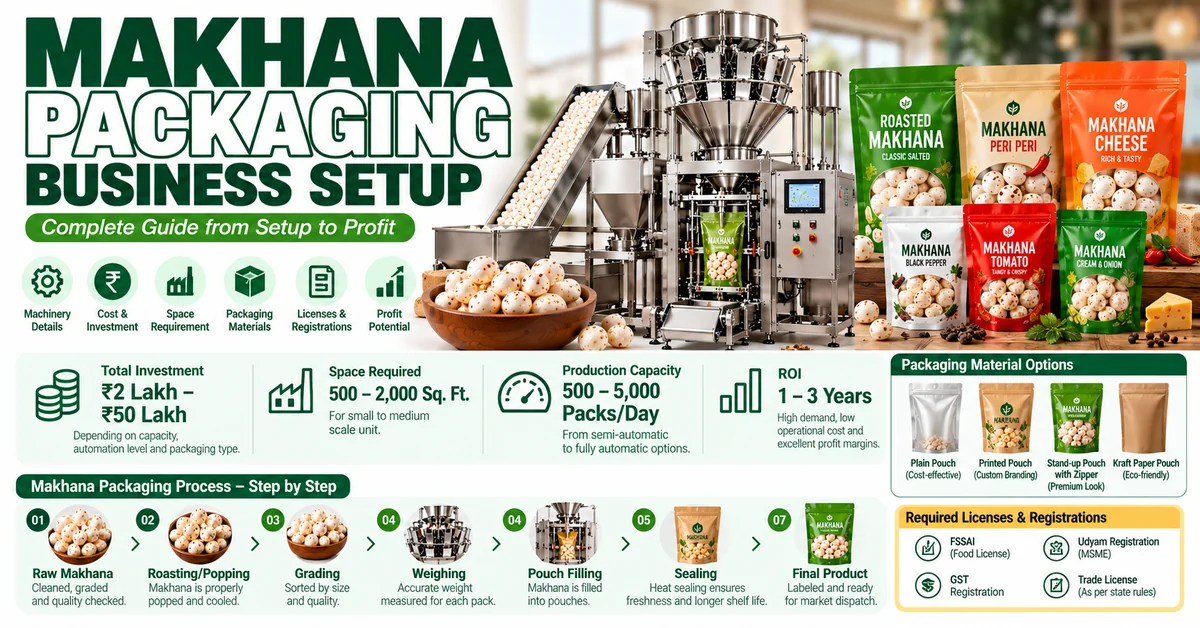
Makhana has moved beyond being a traditional snack category. With growing demand for makhana packaging machine price, the convenient, roasted, flavoured, and healthy snack options, entrepreneurs can build a scalable packaged-makhana business by combining reliable sourcing, strong branding, hygienic processing, and the right makhana packaging machine.
The product itself may be simple, but the packaging process has a major impact on shelf appeal, portion control, freshness, transport safety, and customer trust. Whether you plan to sell plain makhana, roasted makhana, flavoured fox nuts, premium gifting packs, or private-label snack products, a suitable packaging setup can help turn loose makhana into a retail-ready product.
This guide explains how to start a makhana packaging business, choose equipment, understand makhana packaging machine specifications, estimate makhana packaging machine capacity, and identify profitable makhana packaging machine applications.
Why Start a Makhana Packaging Business?
Makhana, also called fox nuts or lotus seeds, fits naturally into the better-for-you snacking market. It can be positioned as a light snack, a roasted savoury snack, an ingredient for fasting products, or a premium gifting product.
A packaging-focused business can operate in different ways:
- Buy raw or roasted makhana in bulk and pack it under your own brand.
- Source plain makhana and create flavoured variants.
- Offer contract packing for emerging snack brands.
- Supply packaged makhana to retailers, cafés, corporate gifting companies, and online marketplaces.
- Create specialised packs for fitness, fasting, kids, premium gifting, or travel snacking.
The opportunity is not only in selling makhana; it is in presenting it consistently. Loose product can lose its crunch when it is exposed to moisture, poor sealing, handling damage, or unsuitable storage. A well-selected makhana packaging machine supports better pack quality and creates a more professional product experience.
Before investing in machinery, define one important point: Are you building a small local brand, a regional distribution business, or a high-volume contract-packing unit? Your answer will determine the packaging format, automation level, floor space, staffing, and investment requirement.
Understand Your Product Before Choosing a Machine
Makhana is lightweight, irregularly shaped, and relatively fragile. Unlike powders or uniform granules, the product needs gentle handling during filling and packing. Excessive vibration, drop height, or compression can increase breakage and reduce the visual quality of the final pack.
Start by deciding which type of makhana you will pack:
- Plain raw makhana
- Roasted makhana
- Salted makhana
- Flavoured makhana
- Masala-coated makhana
- Chocolate-coated or sweet makhana
- Makhana trail mixes
- Makhana-based cereal or snack blends
Each format has different operational needs. For example, a plain makhana pack may require only weighing and sealing. A flavoured product may need roasting, seasoning, cooling, and quality checks before packaging. If your product contains oil-based seasoning, the packaging material and sealing quality become even more important.
The first operational goal should be to protect three product attributes:
- Crunch
- Appearance
- Flavour
A product may taste excellent at the factory, but poor packaging can make it stale, soft, crushed, or unattractive by the time it reaches the customer.
Select the Right Makhana Packaging Format
The pack format affects your machinery choice, packaging cost, brand positioning, and customer convenience. For a new business, pouches are often the most practical starting point because they are versatile, lightweight, and suitable for multiple pack sizes.
Common packaging formats include:
| Packaging format | Best suited for | Key advantage |
| Pillow pouch | Entry-level retail packs | Cost-effective and fast |
| Centre-seal pouch | Standard snack packs | Suitable for automated production |
| Stand-up zipper pouch | Premium and resealable packs | Strong shelf presence |
| Three-side seal pouch | Small samples and single servings | Compact and simple |
| Four-side seal pouch | Premium portions | Neat, structured appearance |
| Jar or container | Gifting and premium retail | Reusable and visually appealing |
| Bulk pouch | B2B and institutional supply | Efficient for larger quantities |
For a startup, popular retail weights may include 20 g, 30 g, 50 g, 70 g, 100 g, and 250 g. Sampling packs are useful for online orders, trial campaigns, and corporate gifting. Larger packs can target families, health-conscious buyers, and repeat customers.
Think about your sales channel before finalising the pack. A 20 g or 30 g pouch may work well for cafés and impulse purchases, while a 100 g zipper pouch may be more relevant for online marketplaces and modern retail.
Choose the Right Makhana Packaging Machine
A makhana packaging machine can range from a basic semi-automatic weighing and sealing unit to a fully automated vertical form-fill-seal system. The right option depends on your daily production target, number of SKUs, budget, and manpower availability.
Semi-Automatic Packaging Setup
A semi-automatic setup is suitable for small businesses, early-stage brands, and businesses testing multiple flavours or pack sizes.
This setup may include:
- Digital weighing scale
- Manual or semi-automatic filling arrangement
- Band sealing machine
- Nitrogen flushing attachment, if required
- Batch coding machine
- Label applicator or printed pouch system
The operator weighs the makhana, fills the pouch, removes excess air if needed, seals the pack, and applies coding details. This model offers flexibility, especially when producing smaller quantities across multiple variants.
However, it requires more labour and may result in variation if weighing and sealing are not properly standardised.
Automatic Packaging Setup
Automatic systems are more suitable when order volumes increase and consistent output becomes essential. A typical automatic makhana packaging line may use a multihead weigher or volumetric filling system connected to a vertical form-fill-seal machine.
The process usually includes:
- Product feeding into a hopper or conveyor.
- Gentle movement of makhana into the weighing system.
- Accurate portioning based on the set pack weight.
- Automatic pouch formation from film.
- Product filling into the pouch.
- Optional nitrogen flushing.
- Heat sealing and cutting.
- Date coding and final inspection.
Automatic packaging improves speed, consistency, and scalability. It also helps businesses manage large retailer orders, distributor requirements, and high-volume online sales.
Key Makhana Packaging Machine Specifications
When comparing suppliers, do not choose a machine only because it is inexpensive or promises high output. Review the complete makhana packaging machine specifications in relation to your actual product and packaging needs.
Important specifications to discuss with the manufacturer include:
1. Product Compatibility
The machine should be designed to handle fragile, irregular snack products. Ask whether the contact parts and feeding system are suitable for makhana without excessive crushing.
Key questions include:
- Does the machine have a gentle feeding mechanism?
- Is the hopper suitable for lightweight products?
- Can the vibration settings be adjusted?
- Is there a controlled drop height to reduce breakage?
- Can it handle roasted and flavoured makhana?
2. Packing Weight Range
Your machine should support your planned pack sizes. If you intend to sell 20 g, 50 g, and 100 g packs, ensure that the filling system can switch between these weights efficiently.
A flexible machine reduces the need to purchase separate units as your product range expands.
3. Accuracy of Weighing
Correct weight is essential for profitability and compliance. Overfilling increases product cost, while underfilling can lead to customer complaints and regulatory issues.
For snack products, a multihead weigher generally provides better accuracy and speed than manual filling. However, the final decision should depend on production scale and budget.
4. Machine Body and Contact Parts
Food-contact parts should be suitable for hygienic food packaging. Stainless steel construction is commonly preferred because it is durable, easier to clean, and appropriate for food-processing environments.
Ask the supplier about:
- Grade of stainless steel used
- Ease of cleaning
- Access to contact parts
- Hopper design
- Dust control features
- Food-grade material compliance
5. Sealing System
The seal is one of the most important parts of a makhana pouch. Weak seals may allow air or moisture inside, which can affect crispness and shelf stability.
Check whether the machine offers:
- Adjustable temperature control
- Consistent heat sealing
- Compatibility with your selected laminate
- Seal-width options
- Nitrogen flushing integration
- Leak-testing support
6. Pouch Dimensions
Confirm the minimum and maximum pouch width and length supported by the machine. This matters if you want both mini snack packs and family packs using the same equipment.
7. Electrical and Air Requirements
Machine specifications should clearly mention:
- Power consumption
- Voltage requirement
- Compressed air requirement
- Operating temperature range
- Footprint and machine dimensions
- Installation requirements
This helps you plan the production area, electrical load, and utility infrastructure before installation.
Understanding Makhana Packaging Machine Capacity
The right makhana packaging machine price capacity depends on your target output rather than the supplier’s highest claimed speed. A machine may technically pack a certain number of pouches per minute, but actual output can vary depending on pouch size, product shape, filling weight, film quality, operator efficiency, and changeover time.
For planning purposes, divide your production requirement into three categories:
| Business stage | Typical packaging need | Suitable setup |
| Startup | Small batches and multiple flavours | Semi-automatic sealing and weighing |
| Growing brand | Regular retailer and online orders | Semi-automatic or entry-level automatic system |
| Large-scale unit | High-volume distribution or contract packing | Fully automatic VFFS line with multihead weigher |
For example, a brand selling 100 g packs will need fewer pouches per day than a business selling 20 g single-serve packs for the same total product volume. Therefore, calculate capacity based on both kilograms per day and pouches per day.
Use this basic planning approach:
- Estimate projected monthly sales.
- Divide the quantity by working days.
- Calculate daily packed volume.
- Divide daily volume by pack size.
- Add allowance for rejections, machine downtime, and future demand.
If you expect to pack 200 kg per day in 50 g pouches, you need to produce approximately 4,000 pouches daily. This is a different requirement from packing 200 kg in 100 g pouches, where the output requirement becomes approximately 2,000 pouches per day.
Choose a machine that can comfortably meet your expected requirement without operating continuously at its maximum rated speed.
Set Up Your Makhana Packaging Unit
A small makhana packing unit does not always require a massive factory. However, the workspace should be clean, organised, and designed to prevent product contamination, mix-ups, and handling damage.
Divide the facility into practical zones:
- Raw material receiving area
- Raw makhana storage area
- Roasting and seasoning area, if applicable
- Cooling area
- Packaging material storage
- Packing area
- Finished-goods storage
- Quality-check area
- Dispatch section
Keep raw materials, flavoured products, packaging films, and finished goods properly separated. This improves hygiene and makes inventory management easier.
The packing room should be dry and protected from moisture. Makhana can lose its crisp texture when exposed to humidity, so storage conditions matter before and after packaging.
Good operating practices include:
- Use clean food-contact surfaces.
- Train staff on hygiene and handling.
- Keep packaging rolls protected from dust.
- Inspect pouches before use.
- Check seals regularly.
- Store finished pouches away from direct sunlight and moisture.
- Maintain batch-wise production records.
Build a Strong Packaging and Branding Strategy
Packaging is not only a protective layer; it is a sales tool. In a competitive snack category, your pouch must communicate value quickly.
Your pack design should make the product easy to understand. A customer should immediately know whether the product is plain, roasted, flavoured, spicy, low-oil, premium, or suitable for a particular occasion.
Include clear visual elements such as:
- Brand name
- Product name
- Flavour name
- Net quantity
- Ingredient highlights
- Serving suggestion
- Storage instructions
- Vegetarian symbol, where applicable
- Nutrition information
- Manufacturing and batch details
- Customer-care information
For Indian-packaged-food items, FSSAI regulations are applicable. As per Labelling and Display Regulations by FSSAI, on pre-packaged foods required information must be included on labels and label display should be seen clearly and legibly at a glance under normal buying and using conditions.
Its common on a compliant label to include product identification, net quantity, ingredient, and nutrition information (if relevant), date marking, lot, or batch number packer manufacturer and FSSAI licence information. The requirement may differ based on the product or sales format, so be sure of the latest rules before going to print packaging.
Don’t make unsubstantiated health claims (“cures diabetes, ” “guaranteed weight loss, ” “improves immunity, ” et al) unless you are prepared to defend the claim with the appropriate substantiation and regulatory clearance. Build your credibility with your audience through honesty about your ingredients, honest product descriptions, and simple nutrition information.
Explore Makhana Packaging Machine Applications
The makhana packaging machine applications go beyond plain retail pouches. A flexible setup can help you serve different customer segments and create multiple revenue streams.
Retail Snack Packs
This is the most common application. Packaged makhana can be sold through grocery stores, supermarkets, pharmacies, cafés, railway kiosks, offices, and online marketplaces.
Flavoured Makhana Products
Use your packaging line for peri-peri, cheese, pudina, salt-and-pepper, tomato, tangy masala, caramel, and other variants. Flavoured products can improve repeat purchases when the taste profile is consistent.
Private-Label Manufacturing
You can pack makhana for wellness brands, food startups, corporate gifting firms, or regional distributors. This reduces dependence on one brand and improves machine utilisation.
Institutional and Bulk Packs
Hotels, cafés, caterers, offices, and gifting companies may require larger packs. Bulk packing can also support distributors and repackers.
Combo and Gift Packs
Makhana can be combined with nuts, seeds, dried fruits, teas, or wellness products. Premium zipper pouches, jars, cartons, and gift boxes can help increase average order value.
Export-Oriented Packs
If you plan to serve overseas buyers, focus on food-safety documentation, market-specific labelling, durable packaging, moisture protection, and shipping-friendly carton packing.
Control Quality at Every Stage
A packaging machine cannot compensate for poor raw material or weak process control. Quality must be checked from sourcing to dispatch.
Create a basic quality checklist for every batch:
- Makhana size and grade
- Moisture condition
- Aroma and taste
- Foreign-material inspection
- Roasting consistency
- Seasoning uniformity
- Pack weight
- Seal strength
- Pouch appearance
- Batch coding accuracy
- Leakage and puffiness checks
Conduct periodic seal tests and shelf-life checks. Retain samples from each batch so you can investigate complaints if they arise.
It is also important to monitor breakage. If too many broken makhana pieces appear in packs, inspect the feeder, hopper, vibration settings, conveyor movement, filling height, and transport process.
Estimate Costs and Improve Profitability
Your total investment will depend on whether you start with manual packing, semi-automatic equipment, or a fully automatic line. Instead of focusing only on the machine purchase price, calculate the complete business cost.
Major cost heads include:
- Makhana procurement
- Roasting and seasoning equipment
- Makhana packaging machine
- Packaging film or pre-made pouches
- Nitrogen flushing system, if used
- Printing cylinders or pouch design costs
- Labour
- Electricity
- Rent and utilities
- Licences and registrations
- Quality testing
- Freight and logistics
- Marketing and marketplace commissions
Profitability improves when you control wastage, buy raw material strategically, use the right pack sizes, reduce overfilling, and create high-margin product variants.
A 20 g trial pack may create awareness, while a 100 g or 250 g pouch may improve revenue per transaction. A well-planned product portfolio can balance customer acquisition with better margins.
Conclusion
Starting a makhana packaging plant is not just about investing in a machine. It needs the correct product quality, pouch style, packaging method, capacity of the machine, food safety measures, and even a plan for where you’ll sell the product.
Set a reasonable production goal. Choose a makhana packaging machine that can delicately manage brittle items, is suitable for your typical pack sizes and can grow as your needs change. Make sure the equipment ensures accurate weighing, well-sealed packs, a hygienic design and effective service from your supplier.
With a well-organized setup you can produce shelf-ready, striking makhana products for neighbourhood convenience stores, online portals, distributors, and even private-label customers. The objective is straightforward: end users must receive a fresh safe attractive product they will repurchase.
FAQs
Which machine is best for packing makhana?
Our multihead weigher machines offer precise, softer, and fast makhana pouch filling.
Can makhana be packed in zipper pouches?
Yes zipper pouches improve reseal ability convenience shelf presence, and premium product positioning.
What capacity should a startup choose?
Select capacity for number of orders per day, pack size, increase in volumes, and hours of operation.
Does makhana packaging require nitrogen flushing?
Nitrogen flushing minimizes oxidation and assists with the crispness over shipment and stock.
Can one machine pack different makhana flavours?
Yes, one machine can have a couple of flavours if you do a thorough cleaning during changeover.
What pouch material is suitable for makhana?
Moisture resistant laminating pouches are designed to help provide a crunch, whilst also protecting quality.
Is FSSAI labelling necessary for packaged makhana?
Yes, Packaged Makhanas have to comply with the FSSAI labelling and food-safety requirements.