
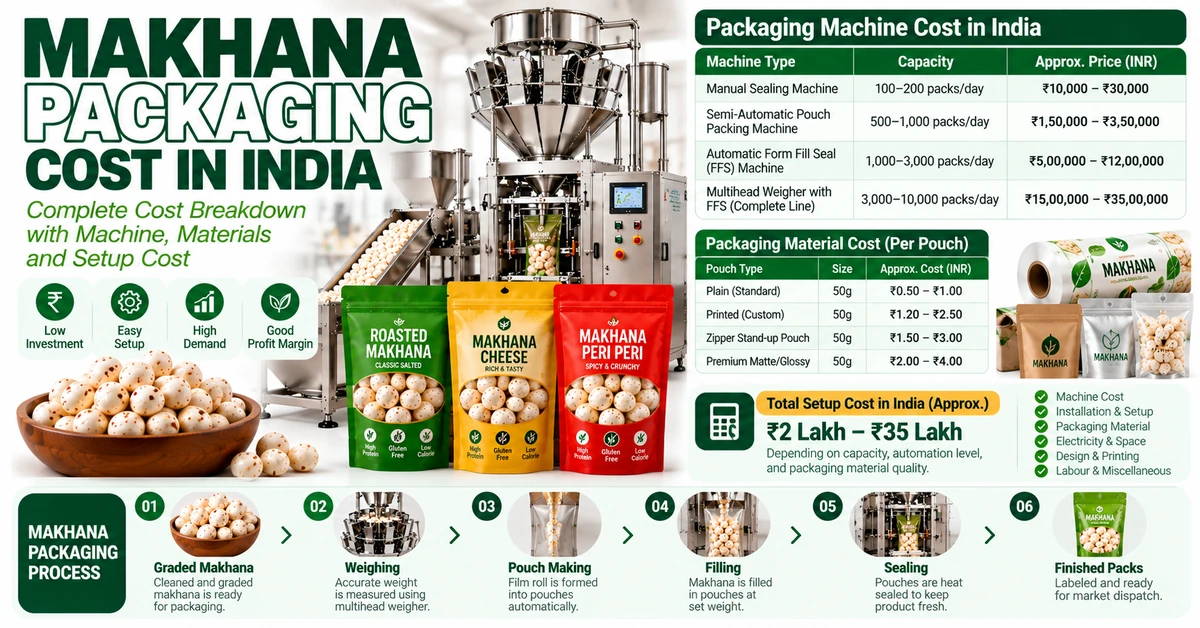
The packaged snack makhana segment is witnessing a consistent growth due to the increasing consumer preference for snacking that is light, easy to carry and more premium. Packaged variants like plain fox nuts roasted coated flavoured mixed with other snacks etc. are being offered in attractive packaging for consumer appeal and shelf visibility. Choosing the best packaging system is an important decision for entrepreneurs, snack makers, and private labels. The price of a makhana packing machine in India varies quite a bit by machine type, degree of automation speed weighing system, pouch style, construction quality, and additional features.
A basic pouch-sealing setup may be suitable for a new local brand, while a high-speed automatic line can support national distribution or contract manufacturing. The right choice is not always the lowest-priced machine. It is the machine that matches your product type, production target, packaging style, and future business plans. In this video, learn about the factors that affect the cost of a makhana packaging machine, the key specifications to look for, suitable capacity range, and the top uses of a makhana packaging machine for food manufacturers.
Why Makhana Needs Special Packaging Attention
Makhana is lightweight, irregular in shape, and fragile. During filling, sealing, transport, and storage, it can break easily if handled roughly. It can also lose crispness when exposed to humidity, poor-quality packaging material, or inadequate sealing.
Unlike powders, grains, or liquids, makhana requires a packaging system that balances speed with gentle product movement. Excessive vibration, a high product drop, poor hopper design, or incorrect sealing temperature can affect product quality.
A good makhana packaging setup should help businesses achieve the following:
- Accurate pack weights
- Reduced product breakage
- Strong and consistent pouch seals
- Better protection against moisture
- Attractive retail presentation
- Faster packing output
- Improved batch consistency
- Lower manual labour dependency
- Easier expansion into multiple pack sizes
The cost of the machine should therefore be evaluated against its ability to protect the product and reduce long-term production losses.
Makhana Packaging Machine Price in India: General Cost Range
The makhana packaging machine price depends on the level of automation and the production output you need. A small startup can begin with basic equipment, while larger snack brands may require a complete automated packaging line.
Indicative cost categories are listed below.
|
Machine category |
Typical business use | Indicative investment level |
|
Manual pouch sealing setup |
Home-scale or test-market production | Low |
|
Semi-automatic weighing and sealing machine |
Small brands and local distribution | Low to medium |
|
Entry-level automatic pouch packing machine |
Growing snack brands |
Medium |
| Automatic VFFS machine with weighing system | Regional and national distribution |
Medium to high |
| Multihead weigher with automatic packaging line | Large-scale brands and contract packers |
High |
| Customised integrated packaging line | High-volume industrial production |
Premium |
Actual prices vary based on the manufacturer, fabrication quality, automation technology, optional components, installation location, after-sales service, and customisation requirements. It is better to compare machine quotations feature by feature instead of comparing only the final purchase amount.
A machine that appears cheaper initially may have lower weighing accuracy, limited pouch-size flexibility, inadequate service support, or higher product breakage. Over time, these factors can raise your operating cost.
Factors That Affect Makhana Packaging Machine Price
Several technical and commercial factors influence the final price of a makhana packing system.
1. Level of Automation
Automation is one of the biggest cost drivers. A manual/semi-automatic system involves machines that need the operator to weigh, fill, and seal the pouches. Has a lower-cost machine, but greater reliance on labour and the consistency may be affected.
A machine capable of making pouches, taking the right amount of product, filling the pouch, flushing nitrogen if necessary sealing cutting and printing code details is another option. This ensures the process is uniform and rapid, but takes a more considerable initial investment.
Decide on automation based on your average daily order volume. If you’re a small brand, only making a few hundred pouches each day, your need for a fully automated line may not be pressing. But, if your business is selling to retailers, distributors, marketplaces, and private label clients, go for it.
2. Weighing System
The weighing mechanism has a significant effect on price and performance.
Common options include:
- Manual weighing
- Single-head weighing systems
- Linear weighers
- Multihead weighers
- Volumetric cup filling systems
For makhana, a multihead weigher is often preferred for businesses seeking higher speed and better weight accuracy. It can distribute product into multiple weighing heads and combine weights to meet the selected pack target.
However, makhana is fragile. The weigher must be configured to minimise product breakage. A machine with adjustable vibration, suitable hopper surfaces, controlled feeding, and gentle discharge can be more valuable than a faster machine designed for heavier products.
A basic volumetric filling system may be more affordable, but it may not provide the same level of weight consistency for irregularly shaped makhana.
3. Makhana Packaging Machine Capacity
The required makhana packaging machine capacity directly affects price. Higher output machines generally use more advanced controls, faster filling systems, better film-handling mechanisms, and stronger construction.
Capacity is usually measured in pouches per minute, pouches per hour, or kilograms per hour. However, output depends on several practical factors:
- Pack size
- Makhana size and grade
- Product density
- Type of flavour coating
- Pouch dimensions
- Film quality
- Filling system
- Operator skill
- Changeover frequency
- Machine settings
For example, packing 20 g snack packs may require a higher pouch count than packing 100 g family packs. The total kilograms packed may be similar, but machine speed requirements will differ.
Do not purchase a machine solely because it offers the highest pouch-per-minute claim. Instead, calculate your daily requirement, include room for growth, and select a machine that can handle routine demand without being continuously pushed to its maximum output.
4. Pouch Type and Packaging Style
Different pouch styles need different machine configurations. A simple pillow pouch usually requires a less complex machine than a premium zipper stand-up pouch.
Popular makhana pouch formats include:
- Pillow pouches
- Centre-seal pouches
- Three-side seal pouches
- Four-side seal pouches
- Stand-up pouches
- Zipper pouches
- Gusseted pouches
- Pre-made pouches
- Bulk packs
If your brand plans to use pre-made stand-up zipper pouches, you may need a pouch-filling and sealing machine rather than a standard form-fill-seal unit. If you want to make pouches directly from printed rollstock film, a vertical form-fill-seal machine may be more suitable.
Machines that support multiple pouch formats and sizes may cost more, but they can provide flexibility as your business grows.
5. Nitrogen Flushing System
Nitrogen flushing is an important optional feature for many snack products. It helps reduce oxygen inside the pouch and can support better protection of product texture and flavour during storage.
For makhana, nitrogen flushing can be useful when you are targeting longer distribution cycles, online sales, modern retail, exports, or premium positioning.
A machine with an integrated nitrogen flushing system may cost more than a basic packing unit. However, it can improve product presentation by creating a fuller pouch appearance and may help reduce the risk of product damage during transport.
Before selecting this feature, conduct product trials with your selected pouch material and storage conditions. Packaging performance depends on the combined effect of product quality, sealing, barrier film, storage temperature, and distribution handling.
6. Machine Material and Build Quality
Food packaging machinery should be durable, easy to clean, and suitable for regular operation. Stainless steel contact parts are generally preferred in food-processing environments because they support hygiene and easier cleaning.
The machine price may rise based on:
- Stainless steel grade
- Thickness of fabrication
- Quality of electrical panel components
- PLC and touchscreen controls
- Servo motors
- Pneumatic parts
- Sensors
- Bearings
- Imported components
- Safety guards
- Machine frame strength
A low-cost machine may use basic parts and offer limited durability. This may be acceptable for low-volume startup operations, but it can create maintenance challenges if your business depends on daily, high-volume packing.
Always ask what parts are included, where they are sourced, and how easily they can be replaced.
7. Controls, Sensors, and Automation Features
Modern packaging machines may include programmable controls and sensors that improve efficiency and reduce wastage.
Features that can influence the final machine cost include:
- PLC-based control systems
- Touchscreen HMI panels
- Servo-driven film pulling
- Automatic film tracking
- Photoelectric sensors
- Temperature controllers
- Error alerts
- No-film detection
- Automatic stop functions
- Batch coding integration
- Remote diagnostics
- Data logging
They may not be necessary features for a very small operation. But can boost operational control in larger plants where repeatability, speed, and traceability are critical.
For example, automatic film tracking keeps your printed packaging aligned correctly. This is mostly important when you are using branded rollstock, with logos, flavour names, nutrition panels and design elements aligned to fixed positions.
Important Makhana Packaging Machine Specifications
When evaluating suppliers, ask for a detailed specification sheet rather than relying on a verbal quote. The makhana packaging machine specifications should match your actual product, pouch, and output requirement.
Key specifications to review include:
Product Handling Design
Makhana is fragile, so the machine should have a product path designed for gentle movement. Check hopper angles, chute surfaces, vibration control, and discharge height.
Ask whether the supplier has previously tested the machine with makhana or similar fragile snack products.
Filling Range
The machine should support your planned pack sizes. For example, if you want 20 g, 40 g, 70 g, and 100 g packs, confirm whether the machine can be adjusted without major component replacement.
A broader filling range can help you introduce trial packs, standard retail pouches, family packs, and bulk packs with the same line.
Accuracy
Why do weight accuracy? Overfilling directly eats into your margins. Underfilling can harm relationships and cause compliance problems.
Inquire from the supplier how accurate it will be in actual makhana packing under factory conditions, not lab conditions. Inquire about whether accuracy is affected in plain, roasted, and flavoured varieties.
Speed
Machine speed should be measured realistically. Ask for expected output based on your pack weight and pouch dimensions.
For better decision-making, request a product trial using:
- Your makhana sample
- Your preferred pouch material
- Your target fill weight
- Your selected pouch dimensions
- Your expected flavour coating
This gives a more practical estimate of speed, breakage, seal quality, and weight variation.
Pouch Dimensions
Confirm the minimum and maximum pouch width and length that the machine can handle. This is mainly important if you want to use one machine for mini packs and large family packs.
Check also that your unit is compatible with printed rollstock, plain film, clear film, metallised laminate or other packaging structures that are suitable for your brand.
Sealing System
The sealing system should match your packaging material. Incorrect temperature or pressure can create weak seals, burnt film, wrinkles, or leaks.
Check the following:
- Horizontal seal quality
- Vertical seal quality
- Adjustable temperature settings
- Seal width
- Seal jaw construction
- Cooling system
- Compatibility with laminate thickness
- Leak prevention capability
Power and Utilities
Before finalising a machine, confirm electrical and utility requirements:
- Voltage requirement
- Phase requirement
- Power consumption
- Compressed air requirement
- Nitrogen supply requirement
- Space requirement
- Machine weight
- Installation conditions
This helps prevent unexpected expenses after delivery.
Makhana Packaging Machine Applications
The makhana packaging machine applications extend beyond basic retail packing. With the right machine configuration, businesses can pack several product categories and enter multiple sales channels.
Plain Makhana Packs
Plain makhana is suitable for customers who prefer unsalted, unflavoured, or traditional products. It can be packed in economical pouches for local stores or premium zipper pouches for modern retail.
Roasted and Flavoured Makhana
Roasted makhana is widely sold in flavours such as salt and pepper, peri-peri, cheese, pudina, cream and onion, tomato, tangy masala, and chilli lime.
Flavoured variants can improve repeat purchases, but product consistency is important. Seasoning should be evenly distributed, and the product should cool properly before packing to prevent moisture-related problems.
Makhana Trail Mixes
Makhana can be blended with nuts, seeds, dried fruits, millets, roasted chana, or other snack ingredients. This creates an opportunity for premium wellness mixes and on-the-go snack products.
For mixes, the weighing system should handle ingredients with different sizes and densities. A multihead weigher may offer better flexibility for such products.
Corporate Gifting Packs
Makhana can be packed in premium pouches, jars, boxes, or customised hampers for festive gifting, employee gifting, conferences, and wellness campaigns.
Businesses may use the same packaging line for inner pouches and then add cartons, sleeves, labels, or gift boxes manually.
Private-Label Packing
Private-label manufacturing allows you to pack makhana for other brands. This can improve machine utilisation and create recurring revenue.
To succeed in this segment, focus on consistent quality, flexible pack sizes, hygienic operations, reliable delivery, and clear batch documentation.
Institutional and Bulk Supply
Large-size pouches can be supplied to hotels, cafés, caterers, offices, distributors, and food-service businesses. Bulk packs may also be used by repackers and businesses preparing snack combinations.
Export-Oriented Packaging
Export packaging requires greater focus on barrier properties, carton strength, shipment handling, market-specific labels, and product shelf life. A machine with consistent sealing and nitrogen flushing capability can be useful for brands targeting longer distribution routes.
Manual, Semi-Automatic, or Automatic: Which Is Better?
There is no single best option for every makhana business. The ideal setup depends on current scale and future growth.
|
Setup type |
Best for | Main benefit | Main limitation |
|
Manual |
Product testing and very low-volume sales |
Lowest initial investment | High labour requirement |
| Semi-automatic |
Small and growing brands |
Flexibility across SKUs |
Slower than automated systems |
| Automatic | Regular medium-to-high-volume production | Better consistency and speed |
Higher initial investment |
| Fully automatic line | Large manufacturers and contract packers | High capacity and lower labour dependence | Requires trained operators and maintenance |
A startup should not overinvest in a high-capacity line if demand is uncertain. At the same time, a growing brand should not stay with manual packing for too long if inconsistent weights, slow dispatch, and labour dependency start affecting growth.
The best approach is to choose equipment that meets current demand and allows practical expansion.
Additional Costs Beyond the Machine Price
The machine itself is only one part of the investment. Businesses should budget for supporting equipment, utilities, packaging materials, and operational costs.
Common additional expenses include:
- Product feeding conveyor
- Roasting machine
- Seasoning drum
- Cooling conveyor
- Metal detector
- Checkweigher
- Nitrogen generator or gas cylinders
- Air compressor
- Batch coding machine
- Packaging film or pouches
- Printing plates or cylinders
- Electrical installation
- Factory flooring and hygiene setup
- Staff training
- Spare parts
- Annual maintenance
- Freight and installation charges
Ask suppliers for a complete commercial proposal that clearly separates the machine cost, optional accessories, taxes, freight, installation, commissioning, and training.
This prevents confusion when comparing quotations.
How to Compare Supplier Quotations
When comparing quotations, create a simple table with the same evaluation points for every supplier.
Review the following factors:
- Machine model and automation level
- Filling system type
- Makhana packaging machine capacity
- Pouch type compatibility
- Supported pack-weight range
- Nitrogen flushing availability
- Material of construction
- Electrical components used
- Warranty period
- Installation support
- Operator training
- Spare-parts availability
- Service response time
- Delivery timeline
- Total landed cost
Do not choose a machine only because it has the lowest price. A dependable supplier with proven experience, accessible service support, and clear machine documentation can reduce operational risk.
Ask for customer references where possible. If practical, visit an existing installation or request a live packing demonstration before placing the order.
Improve Return on Your Packaging Investment
A packaging machine becomes profitable when it helps reduce wastage, improves output, strengthens brand presentation, and supports sales growth.
To improve return on investment:
- Standardise pack sizes to reduce changeover time.
- Use accurate weighing to minimise overfilling.
- Select moisture-resistant packaging material.
- Reduce breakage through gentle machine settings.
- Maintain the machine regularly.
- Train operators on cleaning and setup.
- Monitor pouch leakage and seal strength.
- Build high-margin flavoured product variants.
- Offer both trial and family pack sizes.
- Use premium packaging for gift and online channels.
- Consider private-label production during unused capacity.
A strong packaging operation can help your business move from small local sales to organised retail, online marketplaces, distributors, and institutional customers.
Conclusion
Makhana packaging machine price in India the cost for making makhana packaging is not just the body of the packaging machinery. The price is determined by several factors including level of automation output weighing system, style of pouch, use of nitrogen flushing, quality of construction and service and support. For a semi-automatic system, this may be the ideal combination of flexibility versus investment for an SME. Automatic machine with weighing system for emerging brands, this can provide efficiencies in speed, consistency of product and cost. Multihead weigher with automatic pouch-packing line for larger businesses, this will provide the output and professional finish to the pack.
Check what your target pack size, daily volume type intended floor space, man power and future growth will be before committing. Then go for a machine that is going to be safe for your product, will give you a secure seal, reduce wastage and enable you to grow your brand.
FAQs
What is the makhana packaging machine price in India?
Prices depend on which automation capacity features, support from supplier, and customisation the customer needs.
Which packaging machine suits a makhana startup?
Semi-automatic weighing and sealing equipment is a good match for startups with relatively low production levels to begin with.
Does nitrogen flushing increase machine cost?
Yes, the bunded nitrogen flushing increases the cost of equipment but is better for protecting the product in the pack.
Can one machine pack multiple makhana pouch sizes?
Can the packaging machines accommodate various pack weights and pouch sizes? Yes.
What affects makhana packaging machine capacity?
Capacity is influenced by pack size, weighing system, product flow, pouch design and automation.
Is a multihead weigher suitable for makhana?
Yes, it offers truly accurate filling when set-up for gentle fragile-product handling.
What should buyers check before purchasing?
Check specs test warranty aftersales capacity, and total cost of ownership.