
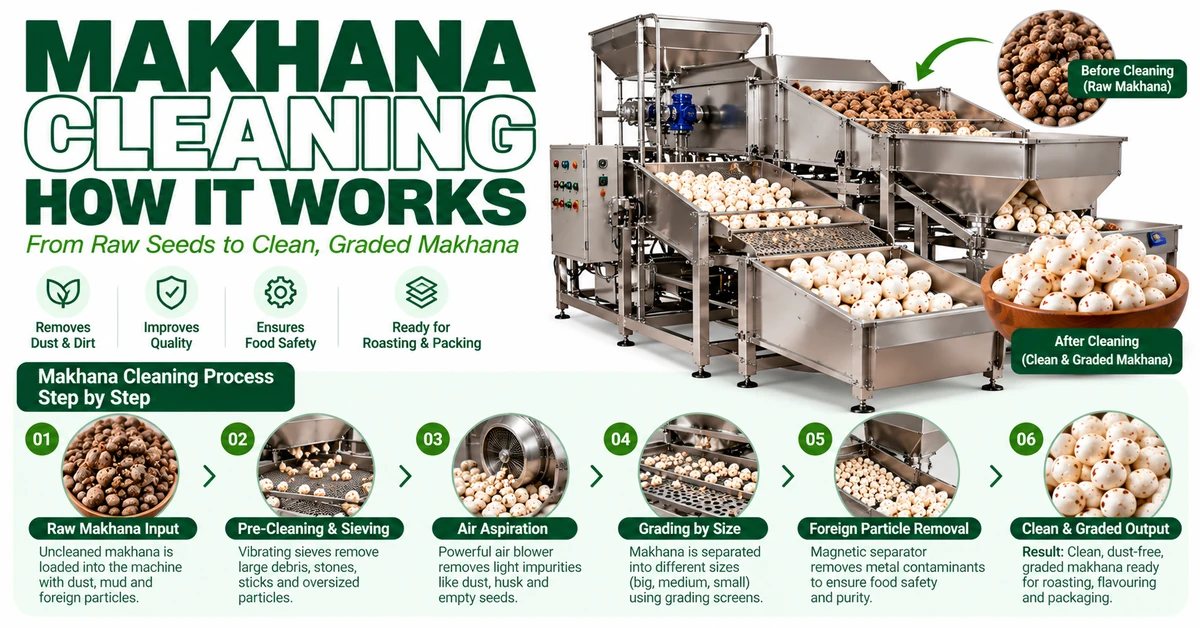
A makhana cleaning and washing machine is used to remove mud, pond debris stones seed coats, plant fragments, and damaged or floating impurities from raw makhana seeds before drying, grading, roasting, and popping. This is the first critical stage of commercial makhana processing because clean, uniformly washed seeds improve roasting consistency, popping quality, hygiene, and final product yield.
Brings Indian processors, cooperatives, FPOs, and packaged makhana brands the means to reduce reliance on manual washing and maintain more consistent input quality. Conventional processing includes cleaning and washing of raw makhana seeds to separate foreign matter and mud.
What Is a Makhana Cleaning and Washing Machine?
What is a makhana cleaning and washing machine? A makhana washing plant is a kind of food processing machinery that is used to wash the raw makhana, also known as foxnut or Euryale ferox, which is harvested from the pond. It works by water flow agitation brushing/rubbing, screens, and drainage to remove mud sand snails shells leaves, hollow seeds, rotten seeds, and other debris from the makhana.
Generally the machine is fitted at the start of a makhana processing line. On washing, the makhana are either surface-dried or sun-dried graded roasted conditioned popped and graded again as popped makhana or lawa.
What It Removes
A well-designed commercial makhana cleaning and washing machine can remove:
- Mud, silt, clay, and pond sediment
- Sand, grit, and small stones
- Snails, shells, dead plant matter, and other foreign objects
- Seed membrane or outer seed coat
- Floating impurities such as leaves and light debris
- Hollow, rotten, or poor-quality seeds, depending on the machine design
Cleaning and washing are recognised as primary processing steps for makhana, before high-temperature roasting.
Why Cleaning and Washing Matter
Raw makhana seeds arrive from ponds with a high amount of natural contamination. If mud, grit, or damaged seeds enter the roasting and popping stage, they can affect equipment performance, product appearance, food safety, and yield.
Proper washing helps processors achieve:
- Cleaner raw material before roasting
- Lower risk of stones or hard foreign particles damaging downstream equipment
- More uniform roasting because seed size and surface condition are more consistent
- Better popping performance and fewer unopened or poorly popped seeds
- Improved hygiene for packaged makhana products
- Reduced manual handling and more predictable batch output
For brands selling flavoured, roasted, or ready-to-eat makhana, the washing stage also supports a cleaner final product and more consistent batch-to-batch quality.
How a Makhana Cleaning and Washing Machine Works
The exact design varies by manufacturer and capacity, but most machines follow a similar sequence: feeding, pre-cleaning, washing, scrubbing, separation, rinsing, and discharge.
1. Raw Makhana Feeding
Raw makhana seeds are loaded into the feed hopper manually or through a conveyor. The hopper controls the flow of seeds into the washing chamber so the machine is not overloaded.
In smaller semi-automatic systems, operators may feed seeds in batches. In larger commercial systems, a bucket elevator, inclined conveyor, or continuous feeder can transfer seeds from collection bins into the washer.
2. Initial Water Rinse
Water is sprayed or circulated over the seeds as they enter the washing chamber. This first rinse loosens mud and washes away light dirt before the seeds reach the main cleaning zone.
Water flow is important because makhana seeds often carry sticky pond sediment. Adequate water volume helps prevent seeds from clumping and ensures that loose impurities are carried away rather than remaining on the seed surface.
3. Agitation and Scrubbing
The seeds are then agitated using one or more cleaning mechanisms. Depending on the machine, this may include:
- Rotating brushes or nylon brushes
- Paddle beaters
- Rotating drums
- Vibrating trays
- Water jets and circulating water
- Rubbing or tumbling action
This stage removes the outer seed coat, mud layers, and attached debris. Brush-based systems are commonly used to clean seed surfaces, while paddle or drum systems provide gentle tumbling that avoids excessive seed damage.
4. Separation of Heavy and Light Impurities
As the seeds move through the washer, impurities are separated by weight, size, and buoyancy.
- Heavy particles such as stones and sand settle at the bottom or are removed through a discharge outlet.
- Light materials such as leaves, membranes, and floating debris are carried away with water flow or removed through an overflow channel.
- Hollow or rotten seeds may float and can be separated where the machine includes a flotation or sorting arrangement.
This separation stage is one of the main reasons a dedicated washing machine performs better than simple manual washing.
5. Final Rinse
After scrubbing, the seeds receive a final clean-water rinse. This removes remaining loose particles, seed-coat fragments, and dirty water from the seed surface.
Some machines use fresh water for the final rinse while recirculating water for the initial washing stage. Water-recycling arrangements can help reduce overall water consumption, which is important for commercial processors operating at higher volumes.
6. Draining and Discharge
Clean seeds move toward the discharge end, where excess water is drained. Depending on the system, seeds may exit through:
- A perforated discharge chute
- A vibrating drainage tray
- A mesh conveyor
- An air-drying section
- Directly into collection crates or trolleys
Some advanced washing systems include an air-blast or high-speed fan section to surface-dry washed seeds before they move to sun drying, mechanical drying, or grading.
Main Parts of a Makhana Cleaning and Washing Machine
A typical commercial makhana cleaning and washing machine includes the following components:
|
Part |
Function |
|
Feed hopper |
Receives raw makhana seeds and controls entry into the machine |
|
Water inlet and spray system |
Supplies clean water for rinsing and washing |
|
Washing chamber |
Holds seeds while water, brushes, or paddles clean them |
| Brushes or paddle beaters |
Remove mud, seed coat, and attached impurities |
| Rotating drum or agitation system |
Tumbles seeds for uniform cleaning |
| Screen or perforated section |
Allows water and fine impurities to drain |
|
Sediment outlet |
Removes stones, sand, and heavy particles |
|
Overflow or floating-impurity outlet |
Removes leaves, membranes, and light waste |
|
Clean-water rinse section |
Provides final washing before discharge |
| Drainage system |
Removes wastewater and excess surface water |
| Discharge chute or conveyor |
Releases cleaned makhana for drying or grading |
|
Motor and drive system |
Powers brushes, drums, pumps, conveyors, or vibration systems |
|
Control panel |
Operates the motor, pump, water flow, and safety controls |
| Frame and body |
Supports the machine; food-contact areas should be easy to clean and corrosion-resistant |
Machine designs may use nylon brushes, paddle beaters, water pumps, and heavy-duty bodies depending on the intended capacity and level of automation.
Semi-Automatic and Fully Automatic Models
Makhana cleaning and washing machines are available in both semi-automatic and fully automatic configurations. The right choice depends on daily volume, labour availability, budget, water management, and whether the machine will be part of a complete processing line.
|
Feature |
Semi-Automatic Machine | Fully Automatic Machine |
|
Feeding |
Manual or assisted feeding |
Conveyor, elevator, or continuous feeding |
| Operation | Operator monitors batches |
Continuous or controlled automatic operation |
|
Labour requirement |
Moderate | Lower |
|
Suitable scale |
Small to medium processors | Medium to large commercial plants |
|
Water control |
Manual or semi-controlled |
Automated flow, recycling, and drainage options |
| Integration | Can work as a standalone unit |
Often integrated with dryer, grader, roaster, and packing line |
| Investment | Usually lower |
Usually higher |
| Best for | Startups, FPOs, local processors |
Branded processors and high-volume units |
Semi-automatic models are often suitable for processors who want to mechanise washing without immediately investing in a complete automated line. Fully automatic systems are better suited to commercial makhana plants that need continuous throughput and reduced manual handling.
Typical Capacity and Output
Capacity varies widely by machine size, seed condition, water flow, and degree of automation. Published makhana processing equipment references show capacities ranging from smaller pilot-scale systems to larger commercial washers.
For example, one makhana processing reference lists a seed washer capacity of around 400 kg per hour, while another commercial listing refers to cleaning machines with capacities around 300 kg per hour. Smaller project reports also describe lower-capacity systems for micro and small enterprises.
When comparing capacity, buyers should clarify whether the stated figure refers to:
- Raw makhana input per hour
- Cleaned makhana output per hour
- Continuous operation capacity
- Batch capacity
- Capacity under wet, muddy, or high-impurity raw material conditions
Actual output can be lower than rated capacity if the raw seeds contain excessive mud, stones, or plant waste.
Specifications to Check Before Buying
Before purchasing a makhana cleaning and washing machine, ask the manufacturer for a detailed specification sheet. Key points to verify include:
- Processing capacity: Kilograms per hour and expected output per shift.
- Raw material condition: Whether the machine handles highly muddy, wet, or mixed-quality seeds.
- Cleaning method: Brush type, paddle system, drum, vibration, or combined cleaning.
- Water requirement: Litres per hour or per kilogram of makhana processed.
- Water recycling: Whether wash water can be filtered and reused.
- Power load: Motor rating, pump rating, and total connected load.
- Material of construction: Food-contact surface material, corrosion resistance, and ease of cleaning.
- Impurity separation: How stones, floating waste, and damaged seeds are removed.
- Seed damage control: Brush speed, paddle design, and gentle handling features.
- Drainage and discharge: Whether the machine includes dewatering or air-drying support.
- Automation level: Manual, semi-automatic, or fully automatic.
- Footprint and installation: Required floor space, drainage arrangement, and water inlet connection.
- After-sales support: Spare parts, installation, operator training, and service availability.
A good supplier should be able to explain how the machine performs with the specific type of raw makhana used in your region, since seed size, mud content, and moisture can vary.
Where It Fits in a Makhana Processing Line
A cleaning and washing machine is normally the first mechanised step in the makhana value chain. A typical commercial flow is:
- Raw makhana seed collection
- Cleaning and washing
- Surface drying or mechanical drying
- Raw seed grading
- Primary roasting
- Conditioning
- Secondary roasting and popping
- Popped makhana grading
- Packaging
This sequence is consistent with makhana processing systems that include seed washing, drying, grading, roasting, conditioning, popping, and final grading.
The washing machine should therefore be selected not in isolation, but according to the capacity of the grader, roaster, popping machine, and packaging line that will follow it.
Applications in India
A makhana cleaning and washing machine is useful for:
- Makhana processors and popping units
- Farmer producer organisations and cooperatives
- Packaged makhana snack brands
- Food-processing entrepreneurs setting up makhana units
- Contract processors handling raw makhana from multiple farmers
- Export-oriented makhana suppliers requiring cleaner input material
- Integrated makhana processing plants with roasting, popping, flavouring, and packing lines
India’s makhana sector has been moving from traditional processing toward greater mechanisation, particularly in stages such as washing, grading, roasting, and drying.
Benefits for Commercial Processors
A commercial makhana cleaning and washing machine can deliver several practical advantages:
- Consistent cleaning: Mechanical washing provides more repeatable results than manual washing.
- Better hygiene: Removes mud, organic waste, and visible contaminants before further processing.
- Reduced labour dependence: Lowers the physical effort required for washing large volumes.
- Improved downstream efficiency: Cleaner seeds support smoother grading, roasting, and popping.
- Lower equipment risk: Removing stones and hard particles helps protect roasting and popping equipment.
- Better product presentation: Clean seeds and uniform input material support a higher-quality final product.
- Scalability: Allows processors to increase daily throughput without proportionally increasing manual washing labour.
These benefits are most visible when the machine is correctly matched to raw-material quality, water availability, and downstream processing capacity.
Limitations and Practical Considerations
A makhana cleaning and washing machine improves cleaning efficiency, but buyers should still plan for:
- Water availability: Washing requires a reliable water supply and proper drainage.
- Wastewater management: Mud and organic impurities create wastewater that must be drained responsibly.
- Pre-sorting needs: Very large stones, excessive plant waste, or heavily damaged batches may need manual pre-checking.
- Seed handling: Excessive brush speed or aggressive agitation can damage soft or immature seeds.
- Maintenance: Brushes, pumps, bearings, screens, and drainage channels need periodic cleaning and inspection.
- Space and utilities: The machine needs adequate floor space, power supply, water connection, and drainage slope.
Choosing a machine with accessible cleaning points and simple maintenance requirements can reduce downtime.
How to Choose the Right Machine
Use the following checklist before finalising a supplier:
- Define daily processing volume. Calculate expected raw makhana intake per shift, not only popped makhana output.
- Assess raw material quality. Share samples or photographs of muddy, wet, and mixed-grade seeds with the supplier.
- Confirm impurity-removal performance. Ask how stones, floating material, seed coats, and damaged seeds are separated.
- Check water consumption. Compare fresh-water use and whether recycling is available.
- Verify construction quality. Prioritise sturdy frames, reliable motors, replaceable brushes, and easy-to-clean contact surfaces.
- Match capacity with downstream machines. The washer should not become a bottleneck for the grader, roaster, or popping line.
- Request a demonstration. Ask for a live trial or demo video using raw makhana similar to your sourcing quality.
- Review installation needs. Confirm power load, water inlet, drainage, floor space, and operator requirements.
- Compare total cost of ownership. Consider spare parts, brushes, pumps, power, water, maintenance, and service support.
- Get a written specification sheet. Ensure capacity, power, dimensions, material, warranty, and delivery terms are documented.
FAQs
1. What is a makhana cleaning and washing machine used for?
It is used to clean raw makhana seeds by removing dust sand stones, pond waste, seed coat, plant debris, and other impurities before drying, grading, roasting, and popping.
2. What are the main parts of a makhana cleaning and washing machine?
Typical sections of the equipment are a feed hopper, a water spray system, a washing section, brushes, or paddle beaters, a screen or perforated drain section, a sediment outlet, a floating-impurity outlet, a discharge chute, a motor, a pump and control panel.
3. Is it available in semi-automatic and fully automatic models?
Yes. Semi-automatic machines need manual or assisted feeding with operator supervision. Fully automatic machines can provide continuous feeding, automatic washing and drainage, and can be linked to a large-line makhana processing line.
4. What capacity should I choose for a commercial makhana unit?
Select capacity as raw makhana handled (per hour / per shift). A number of commercial washers are on the market some equipment references listed are 300kg per hour and 400kg per hour, though the correct size for you will be determined by the amount of raw-material you handle and downstream machinery.
5. Does the machine remove stones and damaged seeds?
Some separators are designed to get rid of stones sand shells, leaves, and other plant materials, and floating trash. Others are able to sort or float hollow or rotten seeds for removal (check with the manufacturer).
6. How much water does a makhana washing machine require?
The amount of water varies with machine design and capacity, mud content in raw seed and whether water recycling is adopted. Certain commercial systems are geared for low water consumption and they have water recycling arrangements.
7. Can the washed makhana be roasted immediately?
Typically, the washed seeds need to be drained and surface-dried before grading and roasting. Most processes for making makhana involve washing, sun, or air drying, grading, roasting, conditioning, and popping.