
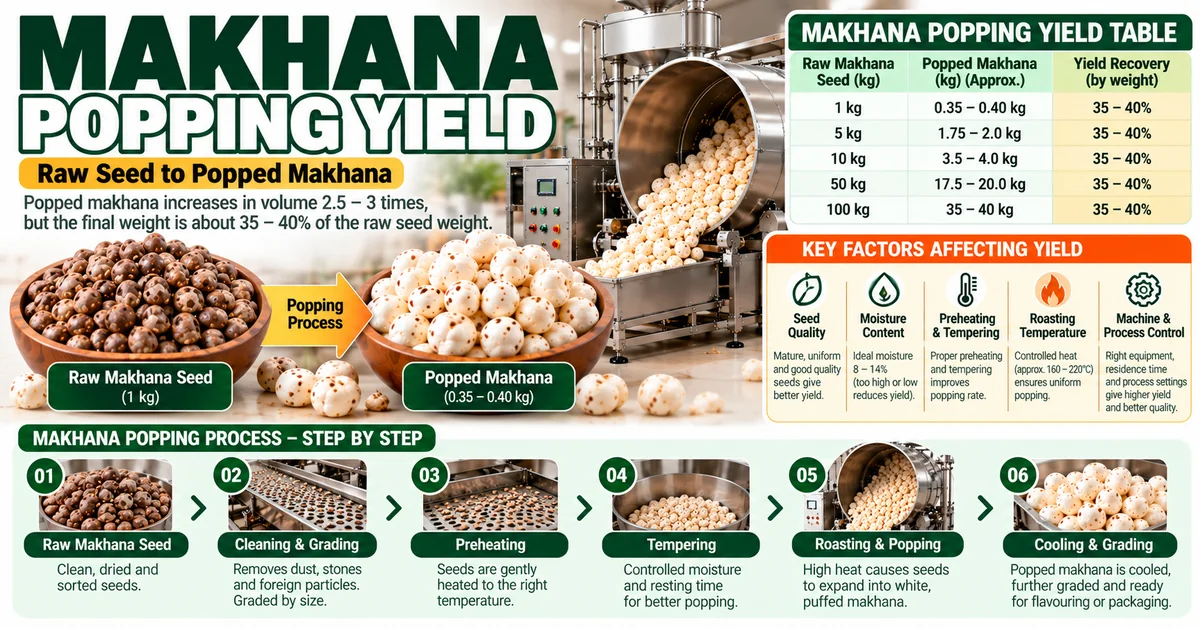
Makhana popping yield varies from batch to batch mainly because of differences in seed moisture, seed size, heat transfer, tempering time, and operator handling. Even when two batches look similar, small changes in drying, roasting temperature, or seed grading can produce noticeably different quantities of properly popped makhana.
For Indian makhana processors, understanding these variables is essential because popping yield directly affects raw-material cost, plant capacity, labour planning, and profitability. Published processing guidance indicates that around 100 kg of makhana seed can yield approximately 38–40 kg of popped makhana, with a recovery rate of about 40–42%, but actual results can move above or below this range depending on process control.
What Is Makhana Popping Yield?
Makhana popping yield is the amount of usable popped makhana, also called lava, obtained from a given quantity of raw makhana seeds after cleaning, drying, grading, roasting, tempering, and popping.
It is usually expressed as a percentage:
Popping Yield (%) = (Weight of Popped Makhana Obtained / Weight of Raw Makhana Seeds Used) × 100
For example, if 100 kg of raw seeds produces 40 kg of popped makhana, the popping yield is 40%.
Traditional processing references commonly report a recovery rate of 40–42%, or roughly 38–40 kg of popped makhana from 100 kg of seed. However, this is a practical benchmark, not a guaranteed result for every processor.
Why Yield Matters to a Makhana Business
Popping yield is one of the most important commercial metrics in a makhana processing plant because it determines how much saleable product you obtain from every kilogram of raw seed purchased.
A lower-than-expected yield can increase:
Raw-material cost per kilogram of popped makhana
Labour cost per finished kilogram
Fuel or electricity cost per batch
Wastage and rework
Packaging and dispatch delays
Pressure on working capital
A higher and more consistent yield improves cost control and helps a processor plan production more accurately. For a food-business founder, tracking yield batch by batch is also one of the easiest ways to identify problems in drying, grading, roasting, or popping.
The Main Reasons Popping Yield Differs
Popping yield is not controlled by one factor alone. It is the combined result of raw-material quality, moisture management, seed grading, heat control, and handling after roasting.
1. Moisture Content
Moisture is the most influential factor in makhana popping. Seeds need enough internal moisture to create steam pressure during roasting, but not so much moisture that they fail to pop properly or burst unevenly.
In conventional processing, fresh cleaned seeds are sun-dried for about 2–3 hours to reduce moisture to approximately 25%. The seeds are then pre-heated and tempered for 48–72 hours before final roasting and popping.
Research on roasted makhana seeds suggests that an optimum roasted-seed moisture range of approximately 15–15.53% on a dry basis supports maximum popping performance. Excess moisture above about 16% has been associated with bursting during popping of freshly roasted seeds.
How Moisture Affects Yield
|
Moisture Condition |
Likely Effect on Popping |
|
Too much moisture |
Uneven popping, bursting, sticking, poor expansion, higher breakage |
|
Too little moisture |
Hard seeds, incomplete popping, lower expansion, more unpopped seeds |
| Uneven moisture within a batch |
Mixed results are some seeds pop well, others remain hard or break |
| Well-controlled moisture |
Better expansion, more uniform popping, improved recovery |
Moisture variation often happens when seeds are dried in open sun without consistent turning, when weather changes between batches, or when seeds are stored without proper moisture equilibration.
2. Seed Size and Grading
Seed size affects how heat travels through each seed. Larger seeds generally need more time or heat to reach the right internal temperature, while smaller seeds heat faster and can burn or over-roast if processed with larger seeds. Uniform grading is therefore essential. Processing guidance specifically notes that dried seeds with optimum moisture are graded for uniform heating and popping.
If a batch contains mixed seed sizes, the processor faces a compromise:
Heat the batch long enough for large seeds, and smaller seeds may overheat.
Heat it briefly for smaller seeds, and larger seeds may remain under-popped.
Use higher heat to speed up large seeds, and smaller seeds may char or burst.
A makhana grader helps separate seeds into more uniform size categories before roasting. This improves heat distribution and reduces the number of unpopped, burnt, or broken seeds.
3. Heat Control During Roasting
Makhana popping depends on controlled, high-temperature roasting. Traditional processing uses very high temperatures, commonly reported in the range of 250°C to 320°C, followed by tempering and a second roasting stage before manual popping.
Other processing references describe final roasting around 300°C, while practical makhana-processing sources report roasting ranges of roughly 230–335°C for pre-heating and 290–340°C for the popping stage.
Insufficient heat can lead to improper popping and toughening, while excessive heat can burn the makhana. In both cases, usable yield falls.
Common Heat-Related Problems
Low flame or uneven heat: Seeds do not develop enough internal pressure to pop fully.
Excessive heat: Seeds char, discolour, or burst before proper expansion.
Uneven pan temperature: Some seeds receive more heat than others, creating mixed popping results.
Overloading the pan: Too many seeds reduce contact with the heating surface and cause uneven roasting.
Poor stirring: Seeds remain in contact with hot spots for too long.
Inconsistent batch size: Changing the quantity of seeds per batch changes heat exposure and roasting time.
Mechanical roasting systems can help standardise temperature, rotation, and batch time, but operators still need to adjust settings for seed size, moisture, and variety.
4. Tempering and Resting Time
Tempering is the resting period after pre-heating or first roasting. During this stage, moisture redistributes within the seed, making later popping more uniform.
Traditional and institutional processing guidance describes tempering for 48–72 hours after pre-heating. Research on roasted makhana seeds also refers to 48 hours of tempering before popping.
If tempering is too short, moisture may remain unevenly distributed. If seeds are stored for too long or in unsuitable conditions, they may absorb or lose moisture, again affecting popping behaviour.
5. Raw Seed Quality and Variety
Not all makhana seeds pop equally well. Seed maturity, harvest condition, physical damage, hollow seeds, rotten seeds, and varietal differences can all influence expansion and recovery.
A batch with more immature, hollow, damaged, or poorly developed seeds will usually produce more waste and fewer premium popped kernels. Cleaning and grading before processing help remove obvious poor-quality material, but they cannot fully compensate for weak raw seed quality.
6. Cleaning and Foreign Material
Mud, sand, stones, seed coats, and plant debris can interfere with heat transfer and create safety and equipment risks. Clean seeds also allow more accurate grading and more consistent roasting.
A cleaning and washing stage before drying helps remove mud and foreign matter, while grading helps create uniform batches for roasting. These upstream steps may not directly “pop” the seed, but they strongly influence popping consistency.
7. Operator Skill and Batch Discipline
In manual and semi-automatic operations, operator judgement has a major impact. Experienced operators recognise changes in sound, colour, aroma, seed movement, and crackling during roasting.
Common operator-related variations include:
Changing roasting time without recording it
Using different flame levels for similar batches
Loading different quantities of seed per batch
Popping seeds too early or too late
Applying uneven hammer pressure during manual popping
Mixing seed sizes in one roasting batch
Maintaining a simple batch record can quickly reveal why one shift performs better than another.
A Practical Makhana Popping Yield Checklist
Use this checklist for every major batch to identify the cause of yield variation.
Before Processing
Record raw seed source, variety if known, and purchase date.
Check for mud, stones, damaged seeds, hollow seeds, and foreign material.
Clean and wash seeds if required.
Dry seeds to the intended moisture level before pre-heating.
Grade seeds into uniform size categories.
Avoid mixing different grades in the same roasting batch.
During Pre-Heating and Tempering
Use a consistent pre-heating temperature and time.
Stir continuously to avoid local overheating.
Allow seeds to temper for the planned period, commonly 48–72 hours in traditional processing.
Store tempered seeds in a way that avoids moisture gain or loss.
Check seed condition before final roasting.
During Roasting and Popping
Use the same seed grade and batch weight where possible.
Maintain consistent temperature and avoid sudden flame changes.
Avoid overloading the roasting pan or machine.
Stir or rotate seeds uniformly.
Record roasting time, temperature, and operator observations.
Pop seeds at the correct stage rather than delaying the batch.
Use consistent hammer pressure or machine settings for popping.
After Popping
Separate unpopped seeds, broken makhana, burnt material, and premium popped makhana.
Weigh each category separately.
Calculate yield using the same weighing method every time.
Record yield percentage, grade-wise output, and reasons for rejection.
Compare results across seed source, moisture condition, grade, and operator.
Common Mistakes That Reduce Popping Yield
1. Skipping Seed Grading
Mixed seed sizes are one of the most common causes of inconsistent popping. Uniform grading allows seeds in a batch to heat at a similar rate.
2. Not Controlling Moisture
Drying seeds only by visual judgement can create batch-to-batch variation. Processors should use a defined drying routine and, where possible, moisture measurement to confirm seed condition before processing.
3. Ignoring Tempering
Roasting and popping immediately after pre-heating can produce uneven results because moisture has not had time to equilibrate. Traditional processing uses a tempering period of 48–72 hours.
4. Using Excessive Heat to Save Time
Higher heat may make seeds pop faster, but it can also cause burning, bursting, discolouration, and lower premium output. Heat should be controlled, not simply maximised.
5. Overloading the Roaster
A larger batch does not always mean higher productivity. Overloading reduces uniform heat exposure and often increases unpopped or poorly popped seeds.
6. Poor Record-Keeping
Without batch records, a processor cannot tell whether low yield came from seed quality, moisture, roasting temperature, operator handling, or equipment variation.
7. Mixing Good and Poor-Quality Seeds
Blending weak, hollow, or damaged seeds with good seeds reduces the overall yield of premium popped makhana. It is better to process poor-quality material separately or reject it before roasting.
How to Improve Popping Yield
Standardise the Process
Create a written standard operating procedure for cleaning, drying, grading, pre-heating, tempering, roasting, and popping. Include target moisture, seed grade, batch weight, temperature range, roasting time, and acceptance criteria.
Grade Before Roasting
Use a makhana grading machine to sort seeds by size before roasting. Uniform batches heat more evenly and are easier to roast consistently.
Control Moisture at Every Stage
Monitor moisture after drying, after pre-heating, and before final popping. Avoid relying only on appearance, especially when weather, seed source, or storage conditions change.
Use Consistent Batch Sizes
Fix the seed quantity per roasting batch. This makes temperature, time, and operator settings easier to replicate.
Train Operators
Train staff to recognise proper roasting indicators and to follow the same process for every batch. Encourage them to record deviations instead of adjusting silently.
Track Yield Daily
Maintain a daily yield register with columns for raw seed weight, popped makhana weight, unpopped seeds, broken makhana, burnt material, seed grade, moisture condition, roasting time, and operator name.
Invest in Mechanisation Where Needed
Cleaning, grading, roasting, and popping machines can reduce manual variation and improve repeatability. Mechanised primary roasting, in particular, is designed to address moisture control and heat consistency during roasting.
Typical Yield Expectations
Published machana processing guidelines cite a popping recovery of 40 to 42% for makhana, which is 38 to 40 kg of popped makhana per 100 kg of seed.
Further work with popping behaviour has demonstrated popped makhana recovery of greater than 47% under specific roasting, tempering, and storage conditions with moisture content. So yield may be increased through improved process control but is still highly dependent on seed quality and operating conditions.
Instead of aiming for one “magic number, ” perhaps processors need to create a baseline of what is reasonable for their seed source, equipment, and operation. They can then focus on reducing variation around that baseline.
How to Calculate and Use Yield Data
A simple daily record can make yield management practical.
|
Batch Detail |
Example Entry |
|
Date |
15 October |
|
Seed source |
Supplier A |
|
Seed grade |
Medium |
|
Raw seed weight |
100 kg |
|
Popped makhana weight |
41 kg |
| Unpopped seeds |
6 kg |
| Broken or burnt material |
3 kg |
| Popping yield |
41% |
| Main observation |
Slight moisture variation; roasting time extended by 30 seconds |
Over time, this data helps identify patterns. For example, if yield drops whenever a particular supplier’s seeds are used, the issue may be raw-material quality. If yield drops during humid weather, moisture control may be the issue. If one operator consistently achieves better results, their method can be documented and used for training.
Who Can Help First-Time Processors?
First-time makhana processors should seek practical guidance from:
Makhana machine manufacturers: For machine selection, capacity matching, installation, and operator training.
Makhana processing consultants: For plant layout, process flow, yield improvement, and quality-control systems.
Experienced local processors: For region-specific insight into seed quality, seasonal variation, and traditional handling practices.
Food-technology institutions and government schemes: For technical references, training, and processing guidance.
Equipment suppliers offering trials: For testing your actual seed samples before finalising machinery.
A good supplier or consultant should not only sell equipment but also help you match cleaning, drying, grading, roasting, popping, and packaging capacity. Makhana processing typically involves cleaning, grading, sun drying, pre-heating, roasting, popping, and polishing, so each stage should be planned as part of one integrated system.
FAQs
- Why does popping yield differ from batch to batch?
Results vary due to variations in seed moisture, seed size, quality of raw seed, toasting time, roasting temperature, batch size and operator handling. Even slight variations in heat or moisture can influence the popping rate.
- What is a good makhana popping yield?
The general recovery figure is 40 42 % or 38 40 kg. Of popped makhana /100kg. Of seed. But the actual amount you get will depend upon the quality of seed you have, control of moisture content, grading of seed and the method used to pop.
- Does seed size really affect popping yield?
Yes. Big seeds and small seeds heat and transfer heat differently. An even size of seeds can pop and heat more evenly.
- What moisture level is best for makhana popping?
Seeds that are freshly cleaned are generally sun-dried to moisture content of about 25% before further processing, and then conditioned and preheated. Other evidence points to that seed moisture levels of about 15-15.53% (dry basis) after roasting allows good popping.
- Why do some makhana seeds not pop?
Reasons why the seeds may not have popped? Seeds may have been too dry, too wet immature hollow broken poorly graded, not roasted enough, not handled long enough on the heat, etc. Poor tempering may also lead to uneven popping.
- What are the most common mistakes to avoid?
The commonest errors include ungraded seed, not using moisture control, failing to temper seed, heating seed excessively, overfilling the roaster, mixing seed grades and a lack of batch records.
- How can anyone assist me with this if I’m doing it for the first time?
Begin your search with a good makhana machine manufacturer or processing consultant. Seek a process-flow inspection, use of their machine capacity, operator training, and a trial on your raw makhana.