
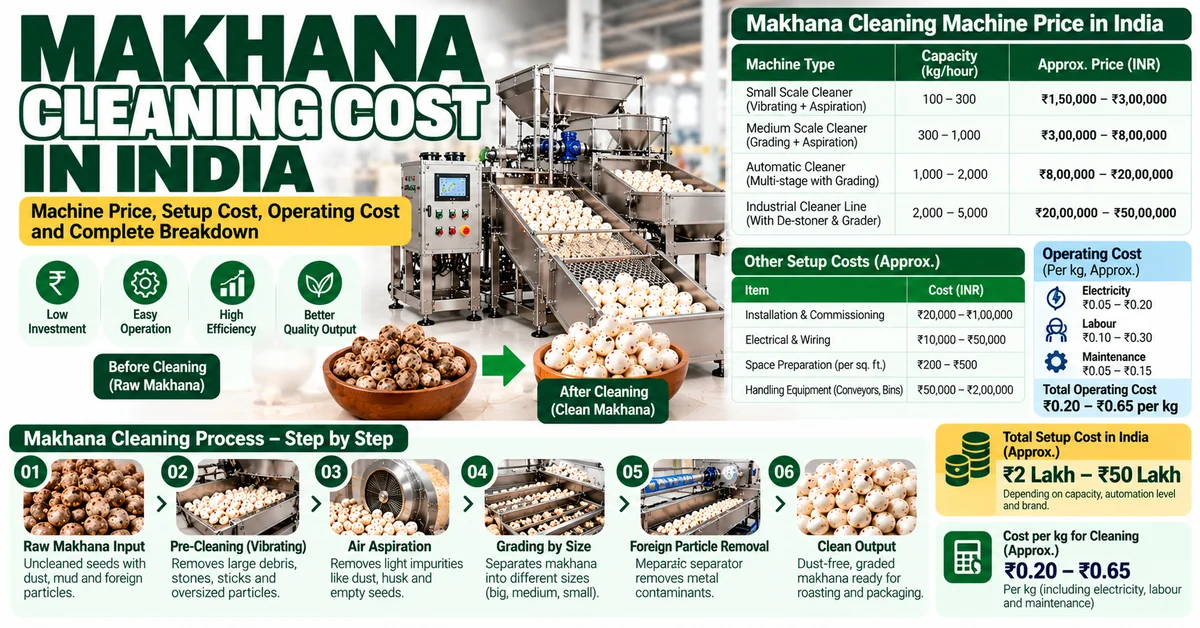
The cost of a makhana cleaning and washing machine generally depends on capacity, automation level, construction material, water-recycling features, and whether it is supplied as a standalone unit or as part of a complete makhana processing line. Entry-level seed washers can start around ₹1.9 lakh, while higher-capacity or customised machines may cost more.
This guide explains what a makhana cleaning and washing machine does, what you should check before buying, which specifications affect the final price, and how to choose the right machine for your production capacity.
What Is a Makhana Cleaning and Washing Machine?
A makhana cleaning and washing machine removes soil, dust, plant residue, hollow seeds, rotten seeds, shells, stones, and other unwanted material from raw makhana seeds before drying, grading, roasting, popping, or further processing.
In a modern makhana processing setup, this machine is usually placed at the beginning of the line. Clean raw material improves the efficiency of downstream machines, reduces contamination risk, and helps maintain more consistent product quality.
A typical cleaning and washing system may include:
- Feeding hopper or infeed conveyor
- Washing tank or washing chamber
- Agitation or scrubbing mechanism
- Water circulation and filtration arrangement
- Floating-material removal system
- Drainage and dewatering section
- Discharge conveyor or collection tray
- Control panel with motor starters and safety features
The exact configuration varies by manufacturer and production requirement. Some machines are designed only for washing, while others combine washing with preliminary cleaning, destoning, or dewatering.
Why Cleaning and Washing Matters
Raw makhana seeds often carry mud, silt, organic impurities, broken plant material, and other foreign particles. If these are not removed properly, they can affect roasting quality, popping consistency, grading accuracy, and the final appearance of the popped makhana.
Proper washing also helps processors reduce manual labour and improve hygiene. A well-designed washer can remove soil, the outer layer of the seed coat, unwanted plant parts, shells, debris, stones, dirt, and floating material.
For businesses supplying makhana to snack brands, export buyers, or organised retail, consistent cleaning is especially important. It supports better batch uniformity and reduces the risk of quality complaints.
Makhana Cleaning and Washing Machine Price in India
The price of a makhana cleaning and washing machine in India depends largely on capacity and machine configuration. As a practical planning range, processors should budget approximately:
|
Machine category |
Typical capacity | Approximate price range | Best suited for |
|
Basic washing unit |
100–200 kg/hr | ₹1.5–2.5 lakh | Small processors, startups |
|
Semi-automatic washer |
200–500 kg/hr | ₹2–4 lakh |
Growing makhana units |
| Washing machine with cleaning and dewatering | 300–800 kg/hr | ₹3–5 lakh+ |
Medium-scale processors |
| Customised washer for complete line | 500 kg/hr and above | ₹5 lakh+ |
Large plants, integrated lines |
These figures are indicative. Final pricing depends on stainless-steel grade, motor capacity, automation, water treatment, conveyor length, and installation requirements.
Market listings show that makhana cleaning machines can be available from around ₹1.25 lakh for a semi-automatic unit with approximately 300 kg/hr capacity, 1.5 kW power consumption, and a 300 kg machine weight. A makhana seed washer has also been listed at ₹1.9 lakh, with a starting capacity of 200 kg/hr and features such as removal of soil, hollow and rotten seeds, floating material, shells, debris, stones, and dirt.
For a complete makhana processing plant, the investment is naturally higher. Industry estimates place a small semi-automatic makhana processing unit with 100–200 kg/day capacity at ₹5–10 lakh, including grading, roasting, and basic packing machinery, while fully automated turnkey plants handling 1,500–2,500 kg/day can cost ₹25–35 lakh.
What Drives the Price?
1. Processing capacity
Capacity is the biggest price driver. A machine designed for 200 kg/hr will cost less than one engineered for 500 kg/hr or 1,000 kg/hr because it requires a larger washing chamber, stronger motors, heavier fabrication, and more robust water-handling systems.
Before choosing capacity, calculate your daily raw makhana intake, operating hours, and expected growth over the next two to three years. Buying a machine that is too small can create a bottleneck; buying one that is too large can increase capital cost and idle capacity.
2. Level of automation
Manual and semi-automatic machines are usually more affordable. They require operator involvement for feeding, monitoring water flow, removing heavy impurities, or discharging cleaned seeds.
Automatic machines cost more because they may include:
- Continuous feeding
- Automated water circulation
- Sensor-based controls
- Automatic discharge
- Higher-speed washing mechanisms
- Integration with conveyors, dryers, or graders
Semi-automatic machines are often a practical choice for small and medium processors because they balance cost, labour savings, and operational control.
3. Construction material
Food-contact surfaces should ideally use food-grade stainless steel, commonly SS 304. Stainless-steel construction improves corrosion resistance, hygiene, durability, and ease of cleaning.
Machines with mild-steel bodies may cost less initially, but they may require more careful maintenance, especially in a wet washing environment. For makhana processing, where water, mud, and organic impurities are involved, SS 304 contact parts are generally a better long-term investment.
4. Washing mechanism
The washing method affects both price and cleaning performance. Common options include:
- Tank washing: Lower cost, suitable for smaller batches.
- Agitator-based washing: Better scrubbing action for muddy seeds.
- Rotary or drum washing: Suitable for continuous processing.
- Multi-stage washing: Higher cost but better removal of fine dirt and floating impurities.
- Washing with dewatering: Reduces moisture before drying and may improve downstream efficiency.
A machine that removes floating material, stones, shells, and damaged seeds will usually be more expensive than a basic washer, but it can reduce manual sorting later.
5. Water consumption and recycling
Water-efficient machines may include recirculation tanks, filters, settling chambers, or separate drainage systems. These features increase the machine price but can lower operating costs in areas where water availability or wastewater disposal is a concern.
Some makhana seed washers are specifically designed for low water consumption and water recycling. For processors running multiple shifts, this can make a meaningful difference in monthly utility expenses.
6. Motor, power load, and electrical configuration
Power requirements vary by capacity and design. A smaller semi-automatic makhana cleaning machine may operate on a 1.5 kW load and 220 V single-phase supply. Larger machines may require three-phase power, heavier motors, and more advanced control panels.
Before ordering, confirm:
- Required load in kW or HP
- Single-phase or three-phase connection
- Voltage and frequency compatibility
- Starter type and emergency-stop arrangement
- Cable length and panel specifications
- Backup power requirements, if any
7. Accessories and add-ons
The base machine price may not include every accessory. Common add-ons that can increase the quotation include:
- Incline conveyor
- Feed hopper
- Dewatering vibrator
- Water pump
- Filtration unit
- Sediment tank
- Stainless-steel discharge chute
- Variable-frequency drive
- Extra control panel features
- Spares kit
- Installation and commissioning support
Ask the supplier for a clearly itemised quotation so you know exactly what is included.
8. Installation, training, and after-sales support
Some suppliers include installation, operator training, and commissioning in the quoted price. Others charge separately based on location, machine size, and site readiness.
For buyers outside major industrial hubs, travel, accommodation, and installation charges can affect the final project cost. It is also important to ask about spare-part availability, warranty terms, service response time, and remote technical support.
Key Specifications to Check Before Buying
When comparing quotations, do not judge machines by price alone. Compare the technical specifications side by side.
|
Specification |
What to check |
| Capacity |
Rated input capacity in kg/hr and actual output after washing |
|
Material of construction |
SS 304 for product-contact areas; MS frame may be acceptable if properly coated |
|
Power load |
kW or HP, phase, voltage, and starter type |
| Washing system |
Tank, agitator, drum, spray, or multi-stage washing |
| Impurity removal |
Soil, stones, shells, floating material, hollow/rotten seeds |
|
Water usage |
Litres per kg or per hour; recycling arrangement |
|
Dewatering |
Whether the machine reduces surface moisture before drying |
|
Dimensions |
Floor space, height, discharge height, and loading requirements |
|
Weight |
Important for transport, foundation, and installation |
| Controls |
Start-stop controls, emergency stop, overload protection |
| Warranty |
Motor warranty, machine warranty, and exclusions |
| After-sales service |
Spare availability, engineer support, response time |
A semi-automatic makhana cleaning machine listed in the market has a capacity of around 300 kg/hr, 1.5 kW power consumption, 220 V supply, 50 Hz frequency, and a machine weight of about 300 kg. These figures are useful benchmarks, but your ideal specification will depend on your raw-material condition and production scale.
Applications of a Makhana Cleaning and Washing Machine
A makhana cleaning and washing machine is used across several stages of makhana processing:
- Raw seed preparation: Removes mud, dust, stones, and plant residue before processing.
- Pre-drying preparation: Washed seeds can be drained or dewatered before drying.
- Quality improvement: Removes damaged, hollow, rotten, or floating seeds.
- Roasting and popping lines: Provides cleaner input material for consistent roasting and popping.
- Snack manufacturing: Supports hygienic processing for flavoured makhana, roasted makhana, and packaged snack products.
- Integrated processing plants: Works alongside dryers, graders, roasters, poppers, polishers, and packing machines.
The machine is particularly useful for processors handling raw makhana seeds directly from farms or collection centres, where soil and foreign matter levels can vary significantly.
How to Choose the Right Machine
Step 1: Define your daily throughput
Start with your target daily processing volume. For example, if you process 2 tonnes of raw makhana in an 8-hour shift, your average requirement is approximately 250 kg/hr. Add a safety margin for peak-season supply and future expansion.
Step 2: Assess raw material quality
If your raw makhana contains heavy mud, stones, or high levels of organic impurities, choose a machine with stronger cleaning action and better impurity-removal capability. If the material is relatively clean, a simpler washing unit may be sufficient.
Step 3: Decide between standalone and integrated equipment
A standalone washer is suitable if you already have other processing machines. An integrated washing, dewatering, and conveying system may be better if you are setting up a new line or want to reduce manual handling.
Step 4: Check utility readiness
Confirm water availability, drainage arrangement, electrical load, floor strength, and space for maintenance access. A machine that looks affordable on paper can become expensive if your site needs major electrical or civil work.
Step 5: Compare total cost of ownership
Look beyond the purchase price. Consider:
- Electricity consumption
- Water consumption
- Labour requirement
- Spare-part cost
- Maintenance frequency
- Downtime risk
- Cleaning time
- Expected machine life
- Warranty and service support
A slightly higher-priced machine with lower water use, better build quality, and reliable service can be more economical over time.
Does the Price Include Installation and Training?
Not always. Many suppliers quote the ex-works machine price, while installation, transportation, GST, and commissioning may be additional.
Before confirming an order, ask the supplier these questions:
- Does the quoted price include GST?
- Is transportation included, and up to which location?
- Is installation and commissioning included?
- How many days of operator training are provided?
- Are spare parts included in the first-year supply?
- What is the warranty period for the machine, motor, and electrical components?
- Is remote support available after installation?
- What is the estimated service response time?
A transparent supplier should provide a detailed commercial offer covering machine specifications, inclusions, exclusions, delivery terms, payment terms, warranty, and installation scope.
Common Buying Mistakes to Avoid
- Choosing capacity only by price: A low-cost machine may become a bottleneck during peak season.
- Ignoring water drainage: Poor drainage can slow operations and create hygiene issues.
- Overlooking material quality: Wet processing demands corrosion-resistant contact parts.
- Not confirming impurity-removal capability: Washing alone may not remove stones, shells, or floating waste effectively.
- Skipping a demo video or trial: Request a demonstration using material similar to your raw makhana.
- Ignoring after-sales support: Downtime during harvest or peak processing season can be costly.
- Not planning for expansion: Select a machine that can accommodate moderate capacity growth.
Indicative Budget Planning
For a small or medium makhana processor, a practical budget could look like this:
This budget covers the washing stage only. If you are planning a complete processing line, include dryers, graders, roasters, popping equipment, polishers, and packaging machinery in your project estimate. A complete small semi-automatic makhana unit may require ₹5–10 lakh, while larger automated plants can require substantially higher investment.
Frequently Asked Questions
How much does a makhana cleaning and washing machine cost in India?
Most standalone machines fall in the range of ₹1.5–5 lakh. Basic models can start around ₹1.25–1.9 lakh, while higher-capacity, stainless-steel, semi-automatic, or customised machines can cost more.
What capacity should I choose?
Choose capacity based on your hourly raw makhana intake, not just daily volume. For example, a 250 kg/hr machine is suitable for roughly 2 tonnes per 8-hour shift, assuming continuous operation.
Does the machine remove stones and damaged seeds?
Many makhana seed washers are designed to remove soil, hollow and rotten seeds, floating material, shells, debris, stones, and dirt. Confirm the exact impurity-removal capability in the machine specification.
Does the price include installation and training?
It depends on the supplier. Always request an itemised quotation that clearly states whether GST, transport, installation, commissioning, operator training, and spares are included.
Is stainless steel necessary?
For product-contact areas, SS 304 is strongly recommended because the machine operates in a wet and abrasive environment. It supports better hygiene, durability, and cleaning.
Can the machine reduce water consumption?
Yes. Some machines offer low water consumption and water-recycling arrangements, which can reduce operating costs over time.
Can it be connected to a full makhana processing line?
Yes. A cleaning and washing machine is commonly used at the start of a line, followed by drying, grading, roasting, popping, polishing, and packing equipment.