
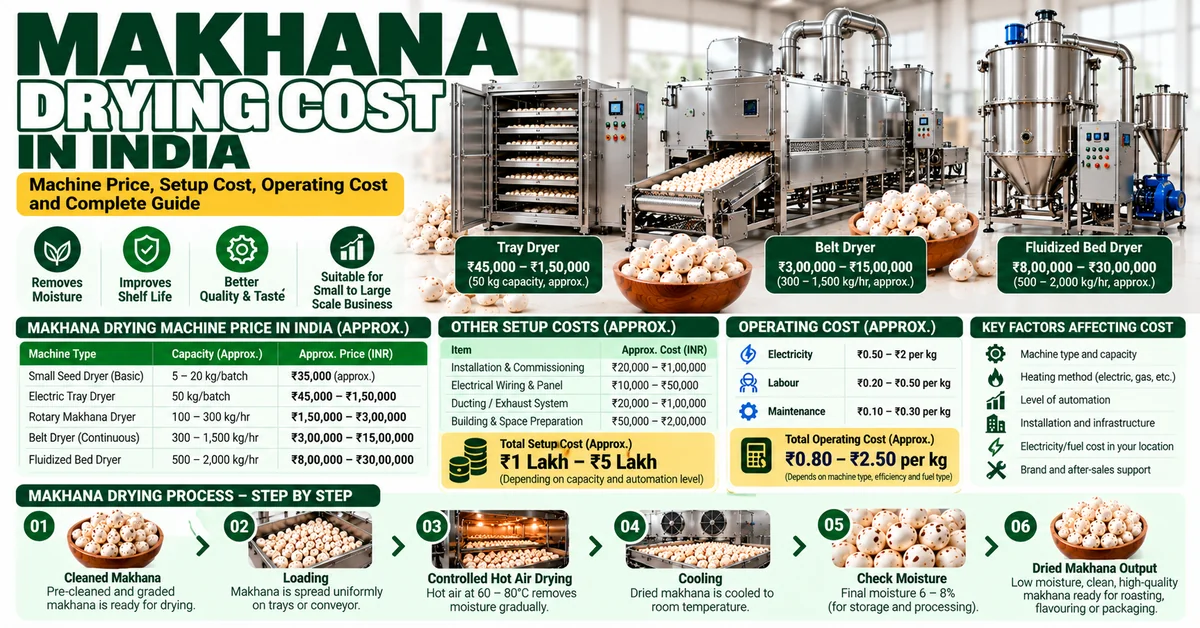
A makhana seed drying machine in India is mostly dependent on capacity, construction material, heating method, automation level, and whether it is a batch tray dryer or a continuous industrial system. For a complete makhana processing line, drying equipment is only one part of the total investment.
For makhana processors, the right dryer is not simply the lowest-priced machine. It must remove surface moisture consistently, protect seed quality, suit your daily throughput, and remain practical for your power supply, labour availability, and working space.
What Is a Makhana Seed Drying Machine?
A makhana seed drying machine removes moisture from washed or processed makhana seeds before grading, roasting, popping, or further processing. Controlled drying helps reduce spoilage risk, improve handling, and support more consistent downstream processing.
In practice, these machines may use:
- Tray dryers, where seeds are loaded in batches onto perforated trays.
- Continuous belt or conveyor dryers, where makhana moves through a heated chamber.
- Hot-air dryers, using electric, biomass, gas, or hybrid heating.
- Solar-assisted dryers, often with an electric backup for cloudy weather or higher volumes.
The best choice depends on whether you process a few hundred kilograms per day or run a commercial-scale makhana unit.
Makhana Seed Drying Machine Price in India
Prices vary widely because “makhana seed drying machine” can refer to anything from a compact tray dryer to a custom-built industrial drying system. The following ranges reflect commonly listed Indian market prices and should be treated as indicative, not fixed quotations.
|
Machine type |
Typical capacity / configuration | Indicative price range |
| Small makhana seed drier | Compact industrial unit |
₹35,000 per piece |
|
Tray dryer |
Around 50 kg batch capacity, 5 kW, SS304 | Around ₹1.25 lakh per piece |
|
Solar makhana dryer |
5–500 kg per batch, configurable | ₹1.37–1.44 lakh per piece |
| Makhana seed dryer | Project-listed unit |
₹3.5 lakh per unit |
| Rotary dryer | Around 200 kg/hr, electric heating |
Around ₹2.5 lakh per piece |
A practical budgeting approximately range is therefore:
- ₹35,000–₹75,000: Entry-level or small-capacity drying setups.
- ₹1 lakh–₹2.5 lakh: Mid-size tray, hot-air, solar-assisted, or rotary drying systems.
- ₹3 lakh and above: Larger, customised, higher-capacity, or fully integrated drying systems.
These figures usually exclude GST, freight, civil work, electrical upgrades, installation, and optional automation unless specifically included by the supplier.
What Drives the Price?
1. Drying capacity
Capacity is the biggest cost driver. A 50 kg batch tray dryer will cost far less than a 200 kg/hr rotary dryer or a continuous conveyor dryer designed for round-the-clock production.
Before comparing prices, define your requirement in kg per batch or kg per hour, not just “machine size.” Also check whether the stated capacity refers to wet input, dried output, or total daily processing volume.
2. Machine type
A basic tray dryer is generally the most affordable option. Continuous dryers cost more because they include conveyors, heating chambers, controls, and a more complex material-flow system.
| Machine type | Best suited for | Relative cost |
| Tray dryer | Small and medium batches | Lower |
| Hot-air batch dryer | Consistent daily processing | Moderate |
| Rotary dryer | Higher-volume continuous processing | Moderate to high |
| Continuous belt dryer | Large commercial plants | Higher |
| Solar-assisted dryer | Lower operating costs, suitable weather | Moderate, with backup options |
3. Material of construction
Food-contact surfaces should ideally use SS304 stainless steel, especially where washed makhana seeds are handled. Stainless-steel construction increases cost but improves hygiene, corrosion resistance, cleaning ease, and long-term durability.
Mild-steel machines may be cheaper initially, but they can require more careful maintenance in a wet or humid processing environment.
4. Heating source
The heating source affects both purchase price and running cost:
- Electric heating: Clean, easy to control, but can increase power costs.
- Biomass or wood-fired heating: Lower fuel cost in some regions, but needs fuel handling and emission management.
- Gas heating: Fast and controllable, subject to fuel availability.
- Solar with electric backup: Lower daytime energy cost, but initial system cost and backup configuration affect pricing.
Ask the supplier for an estimated cost per kg of moisture removed, not only the machine price.
5. Automation and controls
Manual loading and temperature monitoring cost less. Semi-automatic or fully automatic systems with digital temperature controllers, timers, airflow controls, sensors, and safety features cost more but reduce labour dependency and improve consistency.
For commercial operations, automation often pays back through better drying uniformity and reduced product rejection.
6. Build quality and customisation
Custom dimensions, higher insulation, food-grade contact parts, special trays, dust collection, exhaust systems, variable-speed fans, PLC controls, and integration with washing or roasting lines can all increase the price.
A standard catalogue model is usually cheaper than a machine engineered around your specific seed moisture level, batch size, and plant layout.
Specifications to Check Before Buying
Do not select a makhana seed dryer based only on price. Compare these specifications across suppliers:
- Drying capacity: kg per batch or kg per hour.
- Input and output moisture: For example, one listed rotary dryer works from around 16% input moisture to 5% output moisture.
- Heating source and connected load: Electric load, fuel type, phase, and power requirement.
- Tray area or belt width: Determines how evenly seeds are spread.
- Temperature range and control: Adjustable temperature is important for avoiding overheating.
- Airflow design: Uniform hot-air circulation supports more consistent drying.
- Material of construction: Prefer food-grade SS304 for product-contact areas.
- Footprint and height: Check whether it fits your shed, doorway, and ventilation arrangement.
- Cleaning access: Look for removable trays, accessible chambers, and hygienic surfaces.
- Power supply: Confirm single-phase or three-phase compatibility.
- Warranty and spares: Ask what is covered and how quickly spare parts are available.
Does the Price Include Installation and Training?
Sometimes, but not always. Many Indian machinery listings show a base machine price and provide installation, commissioning, training, and freight only on request.
Before confirming an order, ask the supplier to state clearly whether the quotation includes:
- GST and freight.
- Unloading and placement at site.
- Electrical wiring and commissioning.
- Trial run with your makhana seeds.
- Operator training.
- Warranty terms and response time.
- Spare parts, heaters, fans, trays, motors, and control components.
A slightly higher quotation that includes installation, operator training, and after-sales support can be more economical than a lower-priced machine with hidden site costs.
How to Choose the Right Machine
Use this simple selection process:
- Calculate daily throughput. Estimate wet makhana seed quantity processed per day.
- Decide batch versus continuous drying. Batch systems suit smaller or variable production; continuous systems suit steady commercial volumes.
- Check seed moisture and target dryness. Ask for a trial based on your actual raw material.
- Compare cost per kg dried. Include electricity or fuel, labour, maintenance, and depreciation.
- Inspect build quality. Check SS contact parts, insulation, fan quality, controls, and weld finish.
- Request a live demo or video. See loading, unloading, temperature control, and drying uniformity.
- Confirm after-sales support. Reliable service matters more than a small upfront saving.
Conclusion
Choosing a makhana seed drying machine in India requires balancing price with performance, hygiene, capacity, and long-term operating cost. A dryer that delivers uneven moisture removal, consumes excessive power, or lacks reliable after-sales support can increase production losses and maintenance expenses over time.
Before buying, processors should clearly define their daily throughput, preferred heating source, available power supply, floor space, and target moisture level. It is equally important to compare specifications such as drying capacity, construction material, temperature control, airflow design, and ease of cleaning. Food-grade SS304 contact parts, uniform hot-air circulation, and dependable controls are especially valuable for maintaining seed quality and consistent processing results.
FAQs
1. How much does a makhana seed drying machine cost in India?
A makhana seed drying machine generally costs between ₹35,000 and ₹3.5 lakh (approx) in India. Small industrial driers may start around ₹35,000, while larger or customised drying systems can cost approximately ₹2.5–3.5 lakh or more.
2. What is the price of a 50 kg makhana tray dryer?
A 50 kg batch-capacity SS304 tray dryer has been listed at around ₹1.25 lakh, with a 5 kW power rating. The final price can change with insulation, controls, brand, and delivery terms.
3. Is a solar makhana dryer cheaper than an electric dryer?
A solar dryer may have a lower operating cost because it uses sunlight as the primary energy source, but the upfront price depends on tray capacity, glazing, airflow system, and electric backup. Listed solar makhana dryers are around ₹1.37–1.44 lakh per piece.
4. What capacity should I choose for a small makhana processing unit?
For a small unit, start by calculating your daily wet seed volume. A 50 kg batch tray dryer may suit low-volume operations, while higher-volume processors may need a rotary dryer of around 200 kg/hr or a custom continuous system.
5. Does the machine price include GST, transport, and installation?
Not always. Many listed prices are base machine prices, so confirm whether GST, freight, unloading, installation, commissioning, and operator training are included before comparing quotations.
6. Which material is best for a makhana seed drying machine?
For hygienic food processing, SS304 stainless steel is preferred for product-contact areas. It is easier to clean, more corrosion-resistant, and better suited to wet makhana seed handling than ordinary mild steel.
7. Can one dryer handle both makhana seeds and popped makhana?
Some dryers can be used for compatible food products, but seed drying and popped makhana drying may require different temperature, airflow, and residence-time settings. Always ask the manufacturer to validate the machine for your exact product and moisture level.