
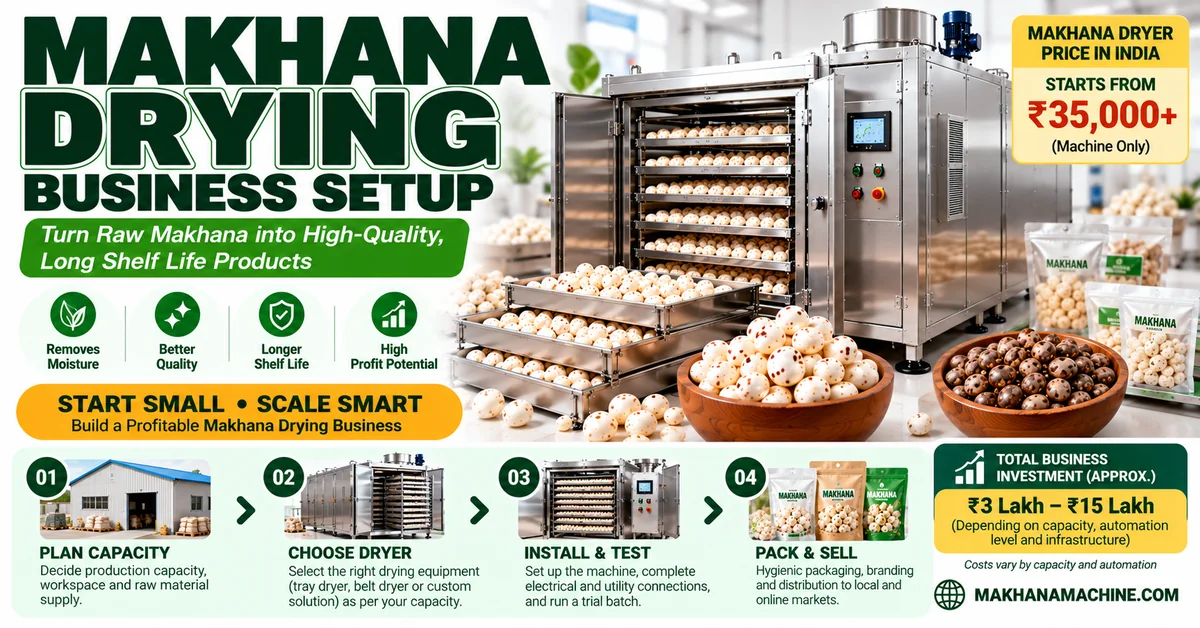
Starting a makhana seed drying business in India can be a strong opportunity for entrepreneurs located near makhana-growing regions, local mandis, or processing clusters. A drying machine helps reduce dependence on unpredictable weather, improves seed quality, and creates a steady service or supply business for farmers, traders, roasters, and makhana brands.
However, success does not depend only on buying a machine. You need a clear business model, reliable raw-material supply, adequate space and power, food-safety compliance, and a practical plan to find buyers. This guide explains how to set up a makhana seed drying unit step by step, from machine selection to licences, investment, operations, and payback planning.
Why Start a Makhana Seed Drying Business?
Makhana, also known as fox nut, is an important crop in parts of Bihar and eastern India. After harvesting, makhana seeds need cleaning, washing, and drying before they can move to grading, roasting, popping, or packing. Traditional sun-drying is common, but it depends heavily on sunlight, open space, labour, and weather conditions.
A makhana seed drying machine solves several practical problems:
- It reduces drying time and weather dependency.
- It supports more consistent moisture removal.
- It helps maintain better hygiene compared with open-air drying.
- It allows processing during monsoon, winter, and humid conditions.
- It creates an opportunity to offer paid drying services to nearby farmers and traders.
For a new entrepreneur, the business can begin with a single drying machine and expand gradually into grading, roasting, popping, packaging, and branded makhana sales.
Choose Your Business Model
Before purchasing equipment, decide how you will earn revenue. A makhana seed drying machine can support more than one business model.
Custom Drying Service
In this model, farmers, traders, and small processors bring washed makhana seeds to your unit. You charge on a per-kg or per-batch basis. This is often the easiest entry model because you do not need to purchase large quantities of raw material or hold high inventory.
Your income depends on:
- Drying charge per kg.
- Number of batches processed daily.
- Machine capacity and utilisation.
- Electricity, labour, and maintenance costs.
Dried Seed Supply Business
Here, you purchase wet or semi-processed makhana seeds, dry and grade them, and sell the finished dried seeds to roasters, popped-makhana manufacturers, wholesalers, or food brands. This model can generate better margins but requires working capital, quality control, and buyer development.
Integrated Makhana Processing
An integrated unit combines drying with cleaning, grading, roasting, popping, flavouring, and packaging. This model has the highest revenue potential, but it also needs higher investment, more skilled labour, stronger compliance, and a clear retail or distribution strategy.
For most first-time entrepreneurs, the best approach is to start with drying and grading, then expand once you understand local demand and margins.
Select the Right Makhana Seed Drying Machine
Machine selection is the most important technical decision in your setup. Do not choose a dryer only based on its price. The right machine should match your expected daily volume, available power supply, seed moisture level, and quality requirements.
Types of Drying Machines
| Machine type | Best suited for | Main advantage |
| Tray dryer | Small and medium batches | Lower investment and simple operation |
| Hot-air seed drier | Regular commercial drying | Controlled airflow and faster drying |
| Solar-assisted dryer | Areas with good sunlight | Lower operating cost with backup support |
| Continuous dryer | Large-scale processing | Higher throughput and consistent output |
Commercial makhana seed-drying systems are available in different capacities. Some semi-automatic makhana seed processing setups use high-speed fans and airflow to surface-dry washed seeds. Larger project specifications also refer to seed drying machines with capacities of up to 700 kg per batch.
Specifications to Compare
When requesting quotations, compare these specifications carefully:
- Drying capacity: Confirm whether capacity is stated in kg per batch or kg per hour.
- Moisture reduction: Ask for input and output moisture levels based on your actual seed quality.
- Heating source: Electric, biomass, gas, solar, or hybrid systems have different running costs.
- Power load: Check connected load, phase requirement, and estimated units consumed per day.
- Construction quality: Food-grade SS304 contact parts are preferable for hygiene and durability.
- Temperature control: Adjustable temperature and airflow help prevent over-drying or uneven drying.
- Machine footprint: Ensure the machine fits your shed, doorway, and workflow layout.
- After-sales support: Confirm warranty, spare parts, installation, and operator training.
A machine with proper airflow, uniform heat distribution, and reliable controls will usually deliver better long-term value than a cheaper unit with inconsistent drying performance.
Plan Your Workspace and Layout
A makhana drying unit does not need a large factory in the beginning, but it does need an organised layout. A small setup can often operate in 500–800 sq ft, while a more structured unit with separate storage, processing, drying, and packing areas may require around 1,000–1,500 sq ft.
Plan the workflow in one direction to avoid mixing raw and processed material:
- Raw seed receiving and storage.
- Washing and cleaning.
- Drying.
- Grading and inspection.
- Packing or dispatch.
Keep the drying area well ventilated, dry, and protected from dust, pests, and moisture. Leave enough space around the machine for tray loading, cleaning, maintenance, and safe staff movement.
If you plan to use biomass or fuel-based heating, check local ventilation, fire-safety, and pollution-control requirements. Electric or solar-assisted systems may be simpler to manage, but their operating cost and power availability should be assessed carefully.
Power Requirements
Power requirements vary widely based on machine capacity and heating method. A makhana processing project referenced by NIFTEM estimates a 14 kWh power connection, approximately 112 units of electricity consumption per day, and around 2,800 units per month.
Before applying for an electricity connection, ask your machine supplier for:
- Connected load in kW or HP.
- Single-phase or three-phase requirement.
- Estimated units consumed per batch.
- Peak load during startup.
- Recommended wiring, starter panel, and safety devices.
- Backup options in case of power interruption.
If you plan to run the unit for long hours, calculate electricity cost per kg of seed dried. This figure will help you set realistic drying charges and understand your break-even point.
Licences and Compliance
The licences you need depend on whether you only provide drying services or process and sell food products. If you sell processed or packed makhana, FSSAI compliance is mandatory.
| Requirement | When it applies |
| FSSAI Registration | Petty food manufacturers with production capacity up to 100 kg/day. |
| State FSSAI Licence | Typically for medium-scale food businesses, commonly linked to turnover between ₹12 lakh and ₹20 crore. |
| Central FSSAI Licence | Typically for larger operations or turnover above ₹20 crore. |
| GST Registration | Generally required when turnover exceeds ₹20 lakh; ₹10 lakh for special category states. |
| Udyam/MSME Registration | Useful for schemes, subsidies, and easier access to institutional credit. |
| Trade licence | May be required by the local municipal authority for operating from a premises. |
| IEC and APEDA registration | Required if you plan to export makhana or agricultural products. |
Even if you begin only as a drying-service provider, maintain basic hygiene, pest control, waste disposal, and record-keeping practices. These systems will make it easier to upgrade to FSSAI-licensed processing and packaged makhana sales later.
Estimate Your Investment
Your investment depends on whether you buy only a drying machine or set up a complete processing line. A basic makhana business setup can begin around ₹4–6 lakh, including a basic roasting machine, grading setup, sealing machine, and packaging unit. A drying-focused unit may require less capital if you already have access to a shed, power connection, and raw-material suppliers.
Your investment should include:
- Makhana seed drying machine.
- Washing, cleaning, and grading equipment.
- Weighing scale and moisture-testing arrangement.
- Electrical wiring, panels, and safety equipment.
- Trays, trolleys, racks, and material-handling tools.
- Shed rent, civil work, ventilation, and storage.
- Licences, insurance, and initial working capital.
Request at least three written quotations from suppliers. Compare the total landed cost—not just the advertised machine price—including GST, freight, unloading, installation, commissioning, training, warranty, and spare parts.
Calculate Payback Period
A realistic payback period depends on your business model, capacity utilisation, raw-material margin, labour cost, and local demand. A drying-service business generally recovers investment faster than a full processing-and-branding business because it needs less working capital and fewer downstream machines.
Use this formula:
{Payback period} ={Total initial investment} /{Average monthly net profit}
For example, if your total setup cost is ₹6 lakh and your average monthly net profit after power, labour, maintenance, and raw-material costs is ₹50,000, the payback period is:
{6,00,000}/{50,000} = 12 { months}
In real operations, the first few months may involve lower capacity utilisation, machine trials, customer acquisition, and seasonal variation in seed availability. Therefore, plan conservatively for a 12–24 month payback period, rather than assuming full capacity from day one.
Build a Reliable Raw-Material Supply Chain
A drying machine is only useful if you can source makhana seeds consistently. Identify local growers, traders, farmer producer organisations, cooperatives, or mandi suppliers who can provide washed seeds regularly.
Before finalising suppliers, check:
- Seed quality, size, and moisture content.
- Seasonal availability and price variation.
- Transport distance and loading arrangements.
- Payment terms and quality-rejection policy.
- Ability to supply during peak and lean seasons.
Maintain records for every lot, including supplier name, purchase weight, moisture level, drying date, output weight, and quality observations. Good record-keeping helps you maintain consistency and resolve quality disputes.
Find Buyers Before Installation
Do not wait until the machine is installed to search for customers. Start building demand during the setup phase.
Potential buyers include:
- Makhana roasting and popping units.
- Local traders and wholesalers.
- Food processors and snack manufacturers.
- Packaged-makhana brands requiring dried raw material.
- Retailers, distributors, and online makhana sellers.
If you plan to sell packed makhana, invest early in compliant packaging, clear labelling, and a simple brand identity. FSSAI-compliant packaging and branding help you access retail, online, and institutional markets.
Operating Tips for Better Returns
- Start with a machine capacity slightly above your confirmed demand, but avoid over-investing in unused capacity.
- Track electricity or fuel consumption for every batch.
- Standardise seed layer thickness, drying temperature, and drying time.
- Use a moisture meter rather than relying only on visual inspection.
- Train operators on loading patterns, temperature control, cleaning, and safety.
- Schedule preventive maintenance for fans, heaters, motors, trays, and control panels.
- Maintain separate records for drying-service income, raw-material purchases, and finished-product sales.
Conclusion
A makhana seed drying machine business can be a practical and scalable venture for Indian entrepreneurs, especially those with access to makhana-growing regions, local traders, and processing clusters. The business can begin as a simple custom-drying service and gradually expand into dried-seed supply, grading, roasting, popping, packaging, and branded makhana sales. However, profitability depends on more than machine ownership. You must plan for consistent raw-material supply, adequate power, proper workspace, food-safety compliance, and dependable buyers.
Choose a drying machine based on capacity, construction quality, heating source, moisture-reduction performance, and after-sales support—not price alone. Food-grade SS304 contact parts, controlled airflow, reliable temperature settings, and easy maintenance can make a major difference in daily operations. Before ordering, obtain multiple quotations and confirm the total landed cost, including GST, freight, installation, training, warranty, and spare parts.
For most new units, a conservative payback period of 12–24 months is a sensible planning assumption. Start with a capacity that matches confirmed demand, maintain batch records, track energy consumption, and focus on quality consistency. With disciplined operations and a clear market strategy, a makhana seed drying unit can become the foundation for a profitable food-processing business.
FAQs
1. Is a makhana seed drying machine business profitable in India?
Yes, it can be profitable if you have steady raw-material supply, regular buyers, and good machine utilisation. Profitability improves when you offer drying plus grading or supply dried seeds instead of relying only on drying charges.
2. How much space is required for a makhana drying unit?
A small unit can often operate in 500–800 sq ft, while a structured setup with storage, drying, grading, and packing zones may need 1,000–1,500 sq ft.
3. What licences are needed to start this business?
FSSAI registration or licence is essential if you process or sell food products. You may also need GST registration, Udyam/MSME registration, and a local trade licence depending on turnover and business structure.
4. How much power does a makhana seed drying machine need?
Power requirement depends on machine capacity and heating method. One makhana processing project estimates a 14 kWh connection and around 112 units of daily electricity consumption.
5. What machine capacity should a beginner choose?
Choose capacity based on confirmed demand rather than maximum machine size. Commercial systems range from smaller batch dryers to units with capacities up to 700 kg per batch.
6. What is a realistic payback period for this business?
A realistic planning range is 12–24 months for a well-managed small unit. The actual payback depends on investment, capacity utilisation, drying charges, energy costs, labour, and raw-material margins.
7. Can I start with only a makhana seed drying machine?
Yes, you can start by offering custom drying services to farmers, traders, and processors. Adding grading, weighing, moisture testing, and basic quality checks can help you charge better rates and build repeat business.