
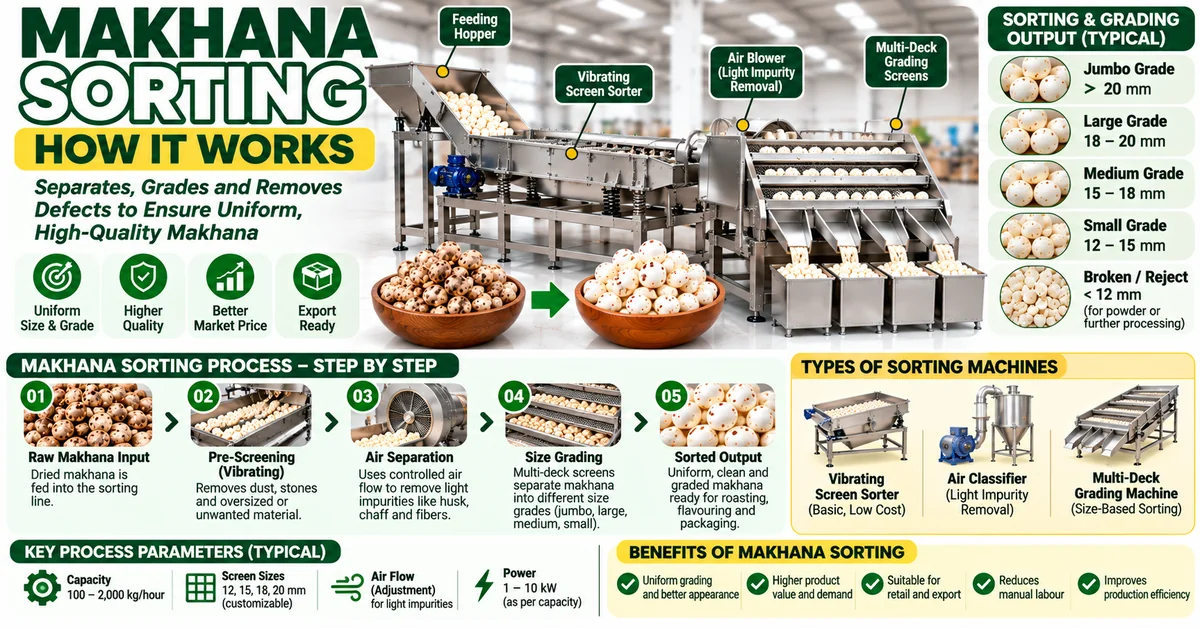
A makhana seed sorting machine separates raw fox nut seeds into uniform size grades before roasting, popping, packaging, or further processing. It replaces slow manual grading with a controlled, continuous system that improves batch consistency, reduces breakage, and helps processors command better prices for premium grades.
For Indian makhana processors, the machine is especially useful because raw makhana seeds vary widely in diameter, moisture, shape, and density. A well-selected sorting machine can produce three to five clean grades, remove undersized or damaged material, and feed only the required seed size into the next stage of production.
What Is a Makhana Seed Sorting Machine?
A makhana seed sorting machine also called a makhana grader, fox nut grading machine, or makhana seed classifier is equipment designed to classify makhana seeds primarily by size. Depending on the model, it may also remove dust, husk, flat seeds, broken pieces, and other light impurities.
The machine is typically placed early in a raw makhana processing line. After cleaning, seeds pass through vibrating screens, rotating perforated drums, or a combination of both. Each screen or drum section has a specific hole size, allowing smaller seeds to fall through while larger seeds continue forward.
Main purpose
The core purpose is not merely to make makhana look uniform. Consistent seed size affects:
- Popping performance and expansion
- Roasting uniformity
- Final kernel size after popping
- Packaging presentation
- Pricing and buyer acceptance
- Downstream machine efficiency
For example, larger seeds may be directed toward premium popped makhana production, while smaller seeds can be used for value-added products, lower-grade packs, or other processing applications.
Why Size Sorting Matters in Makhana Processing
Raw makhana is a natural agricultural product, so no two batches are exactly alike. Seeds may range from smaller grades to larger premium sizes, and uneven feeding into roasting or popping equipment can create inconsistent results.
A sorting machine helps processors create defined commercial grades. Indian systems commonly sort makhana into grades such as 6 suta and above, 5–6 suta, 4–5 suta, and below 4 suta, though exact grade names and cut-off sizes vary by buyer, region, and product requirement.
Business benefits
|
Benefit |
How the machine helps |
|
Better product value |
Uniform premium grades look cleaner and command higher market acceptance. |
|
Lower manual labour |
Mechanical grading reduces dependence on repetitive hand sorting. |
| Improved consistency |
Defined screen sizes create repeatable batches. |
| Reduced breakage |
Gentle vibration and polished contact surfaces help protect delicate seeds. |
|
Better downstream control |
Similar-sized seeds roast, pop, or process more uniformly. |
| Cleaner output |
Pre-cleaning or air separation can remove dust, husk, and light impurities. |
How a Makhana Seed Sorting Machine Works
Most commercial makhana seed sorting machines follow a simple principle feed, separate by size, discharge into grade-specific outlets, and collect the sorted material. The exact mechanism may be vibratory, rotary drum, or hybrid, but the workflow remains broadly similar.
Step 1: Loading raw makhana seeds
Raw makhana seeds are loaded into an inlet hopper. The hopper holds a working batch and feeds material steadily into the sorting chamber.
A controlled feed is important. If too many seeds enter at once, they may pile up on the screen, reduce separation accuracy, or increase the chance of breakage. Many machines use a vibrating feeder or adjustable gate to regulate the flow.
Step 2: Pre-cleaning and impurity removal
In many setups, the first stage removes loose dust, husk, small foreign particles, and occasionally flat or damaged seeds. This may be done using:
- A vibratory pre-cleaner
- Air aspiration or blower system
- Scalping screen
- Dedicated flat-seed removal system
Cleaning before grading protects the main sorting screens and improves the appearance of the final output. Some advanced fox nut systems combine cleaning, grading, and flat removal in one line.
Step 3: Size-based separation
This is the heart of the machine.
In a vibratory grader, seeds travel across inclined mesh screens. The vibration moves seeds forward while allowing them to settle and pass through openings matched to their diameter. Multiple decks may be used, with the coarsest screen at the top and finer screens below.
In a rotary drum grader, seeds enter a rotating cylinder with perforations of increasing size along its length. Small seeds fall through the first section, medium seeds through the next, and larger seeds exit at the end. This method is commonly used for gentle, continuous size classification.
Step 4: Multi-grade discharge
As seeds pass through different screen sections, they are separated into distinct grades. A standard commercial machine may produce:
- Jumbo or premium grade
- Large grade
- Medium grade
- Small grade
- Oversize, undersize, or reject fraction
Many machines are configured for three to five grades, and screen sizes can often be changed according to the processor’s requirement.
Step 5: Collection and bagging
Each grade exits through a separate chute or outlet. From there, seeds can be collected in trays, bins, bags, or conveyed to the next processing stage.
A good machine should allow easy bagging without spillage. Some models include collection drawers, discharge chutes, or direct bagging attachments to reduce handling time.
Main Parts of a Makhana Seed Sorting Machine
Understanding the main components helps buyers compare machines, request the right specifications, and plan maintenance.
1. Feed hopper
The feed hopper receives raw makhana and supplies it to the sorting section. Its capacity should match the machine’s throughput and the operator’s batch size. Hopper capacities vary widely; some raw makhana grading systems use hoppers from around 50 kg to 300 kg or more.
2. Vibratory feeder or feed regulator
This component controls how quickly seeds enter the sorting area. A steady feed improves grading accuracy and prevents overloading.
3. Sorting screen or rotating drum
This is the main grading element.
- Vibratory screens: Use layered mesh decks and controlled vibration.
- Rotary perforated drums: Use rotating cylinders with graded hole sizes.
- Hybrid systems: May combine screening, air separation, and flat-seed removal.
The screen configuration determines how many grades the machine can produce and the size range it can handle.
4. Vibratory motor or drive system
The motor creates the vibration or rotation required to move seeds across the sorting surface. Some Indian makhana grading machines use a vibratory motor of around 1 HP, three-phase power, depending on capacity and design.
5. Discharge chutes
Separate chutes direct each grade into its own collection point. Clear grade separation at the outlet is essential for efficient packing and batch control.
6. Frame and body
Food-contact areas are commonly made from stainless steel, especially SS 304, for hygiene, corrosion resistance, and easier cleaning. The supporting frame may be mild steel or stainless steel depending on the model and budget.
7. Control panel
A control panel may include switches for the vibrator, feeder, blower, and emergency stop. Semi-automatic machines may have basic controls, while fully automatic lines may include sensors, variable-speed controls, and integration with conveyors or packaging equipment.
8. Wheels or leveling mounts
Portable models may include castor wheels for movement within the plant. Fixed commercial installations may use leveling mounts to keep the machine stable during operation.
Types of Makhana Seed Sorting Machines
Makhana sorting machines are available in different configurations. The right choice depends on daily volume, labour availability, seed condition, required grades, and budget.
Manual or semi-automatic sorting machine
A semi-automatic machine usually requires an operator to load seeds and monitor discharge. The machine performs the mechanical separation, but feeding, bagging, or screen changes may be manual.
This type suits:
- Small and medium makhana processors
- Units handling mixed or variable raw material
- Businesses upgrading from manual grading
- Processors needing flexible grade changes
Fully automatic sorting machine
A fully automatic system can include automatic feeding, continuous grading, discharge conveyors, and sometimes integration with cleaning or packaging equipment. It reduces operator intervention and is better suited to higher-volume processing.
This type suits:
- Large makhana processing units
- Export-oriented suppliers
- Brands requiring consistent commercial grades
- Plants planning a complete raw makhana processing line
Vibratory screen grader
A vibratory grader uses multiple mesh decks to classify seeds by size. It is compact, relatively easy to operate, and suitable for processors who need frequent grade adjustments.
Rotary drum grader
A rotary drum grader uses perforated cylinders to separate seeds as they travel through the drum. It is often preferred for continuous operation and gentle handling of larger volumes.
Cleaning-cum-grading system
Some machines combine cleaning, size grading, and flat-seed removal. These are useful where raw makhana contains dust, husk, broken material, or a high proportion of flat seeds.
Typical Makhana Seed Sorting Machine Specifications
Specifications differ by manufacturer and configuration, but the following ranges are common in the Indian market.
|
Specification |
Typical range |
|
Capacity |
Around 100–500 kg per hour, depending on model and seed condition. |
|
Grades |
Commonly 3–5 grades. |
| Sorting method |
Vibratory screen, rotary drum, or hybrid system. |
|
Contact material |
Food-grade stainless steel, often SS 304. |
|
Seed size range |
Often around 7–14 mm, depending on the design. |
|
Operation |
Continuous or batch-type. |
| Power |
Varies by motor size; some systems use around 1 HP vibratory motors. |
| Automation |
Semi-automatic or fully automatic. |
These figures are indicative. Always confirm the actual capacity, screen sizes, power load, floor area, and grade configuration with the manufacturer before purchase.
Output Quality: What to Expect
A properly set makhana seed sorting machine should deliver:
- Clearly separated size grades
- Minimal seed breakage
- Reduced dust and loose impurities
- Consistent batch quality
- Easy collection of each grade
- Better control over premium and economy grades
Machines designed for makhana often emphasize low breakage, smooth operation, and high grading accuracy. Some suppliers claim grading accuracy within 1%, though real-world performance depends on feed rate, seed moisture, screen condition, and maintenance.
What affects output quality?
- Feed rate: Overfeeding reduces separation accuracy.
- Seed moisture: Wet or sticky seeds may cling together and affect flow.
- Screen selection: Wrong mesh size creates mixed grades.
- Vibration settings: Excessive vibration can damage delicate seeds.
- Machine cleanliness: Dust buildup affects movement and hygiene.
- Raw material quality: Heavily mixed or damaged seeds may need pre-cleaning.
Semi-Automatic vs Fully Automatic Models
|
Factor |
Semi-automatic model | Fully automatic model |
| Labour requirement | Higher; operator loads and monitors material |
Lower; feeding and discharge can be automated |
| Suitable scale |
Small to medium units |
Medium to large processing plants |
|
Initial investment |
Generally lower | Generally higher |
|
Throughput |
Moderate |
Higher and more consistent |
| Flexibility | Easier for frequent grade changes |
Better for standardized continuous production |
| Best use case | Startup or growing processor |
Commercial processor or integrated line |
Both options can produce good results. The decision should be based on your daily processing volume, available labour, desired grade consistency, and future expansion plans.
Where It Fits in a Makhana Processing Line
A makhana seed sorting machine is usually installed after initial cleaning and before roasting, popping, or packaging.
A typical raw makhana flow may look like this:
- Raw makhana reception
- Cleaning and impurity removal
- Seed sorting or grading
- Roasting or popping
- Popped makhana grading
- Flavouring or coating, if applicable
- Packaging
Sorting raw seeds before processing helps ensure that similar-sized seeds move through the next stage together. This supports more uniform roasting or popping and reduces variation in the final product.
Applications in India
Makhana seed sorting machines are used by:
- Makhana processing units in Bihar and other makhana-producing regions
- Fox nut traders and bulk suppliers
- Popped makhana snack manufacturers
- Exporters requiring uniform grades
- Food brands producing flavoured or packaged makhana
- Contract processors handling multiple buyer specifications
The machine is useful for both raw seed grading and, in some cases, popped makhana grading. However, raw seed sorting and popped kernel sorting may require different screen sizes, airflow settings, and handling designs.
How to Choose the Right Machine
Before buying a makhana seed sorting machine, assess your current and expected production volume not just today’s requirement.
Check capacity
Choose a machine with enough capacity for peak-season volumes. A 100 kg/hr machine may suit a smaller unit, while larger processors may need 250–500 kg/hr or more.
Confirm grade requirement
Decide how many commercial grades you need. If your buyers require premium, regular, and small grades, a three-grade machine may be sufficient. If you supply multiple market segments, a four- or five-grade model may be better.
Review seed condition
If your raw makhana contains dust, husk, flat seeds, or broken pieces, consider a cleaning-cum-grading system rather than a basic grader.
Inspect build quality
Ask about food-contact material, screen quality, weld finish, vibration settings, motor rating, and ease of cleaning. SS 304 contact parts are commonly preferred for hygienic food processing.
Ask about changeover
If you process different seed sizes or serve buyers with different grade specifications, confirm how quickly screens can be changed and cleaned. Interchangeable mesh screens can reduce downtime between batches.
Request a demo
A demo using your own raw makhana is the best way to check real grading accuracy, breakage level, discharge clarity, and ease of operation.
Maintenance and Operating Tips
Regular maintenance keeps grading accuracy high and extends machine life.
- Clean screens and chutes after each shift.
- Check for seed buildup around mesh openings.
- Inspect vibration mounts, belts, and fasteners periodically.
- Avoid overloading the hopper.
- Use the recommended screen size for each grade.
- Keep the machine dry and protected from moisture.
- Train operators on safe startup and shutdown procedures.
- Maintain a record of screen changes and grade settings.
A simple daily cleaning routine can prevent contamination, improve output consistency, and reduce unplanned downtime.
Common Buying Mistakes to Avoid
- Buying only on price without checking grading accuracy
- Choosing a capacity lower than peak-season requirement
- Ignoring seed moisture and raw-material variation
- Selecting too few grades for future market needs
- Not confirming screen-change convenience
- Overlooking after-sales support and spare-part availability
- Assuming one machine can handle both raw seeds and popped makhana without configuration changes
Is a Makhana Seed Sorting Machine Worth It?
For a processor handling regular volumes, yes especially if manual grading is slowing production or creating inconsistent batches. The machine reduces labour dependency, improves grade uniformity, and helps create market-ready product categories.
For very small units with limited capital, a semi-automatic grader may be the practical first step. For growing brands and commercial processors, a fully automatic cleaning-cum-grading system can support higher throughput and more consistent quality.
FAQs
1. What is a makhana seed sorting machine used for?
It sorts raw makhana seeds into uniform size grades for processing and packaging.
2. What are the main parts of a makhana seed sorting machine?
Main parts include hopper, feeder, screens or drum, motor, chutes, frame, and control panel.
3. Is it available in semi-automatic and fully automatic models?
Yes, both semi-automatic and fully automatic models are available for different production scales.
4. How many grades can a makhana sorting machine produce?
Most commercial machines produce three to five separate makhana grades.
5. What capacity should I choose for my unit?
Choose capacity based on peak daily volume, usually 100–500 kg per hour.
6. Does the machine break makhana seeds?
A well-designed machine uses gentle vibration and smooth surfaces to minimize breakage.
7. Can it remove dust and flat seeds?
Yes, some models include cleaning, aspiration, and flat-seed removal systems.