
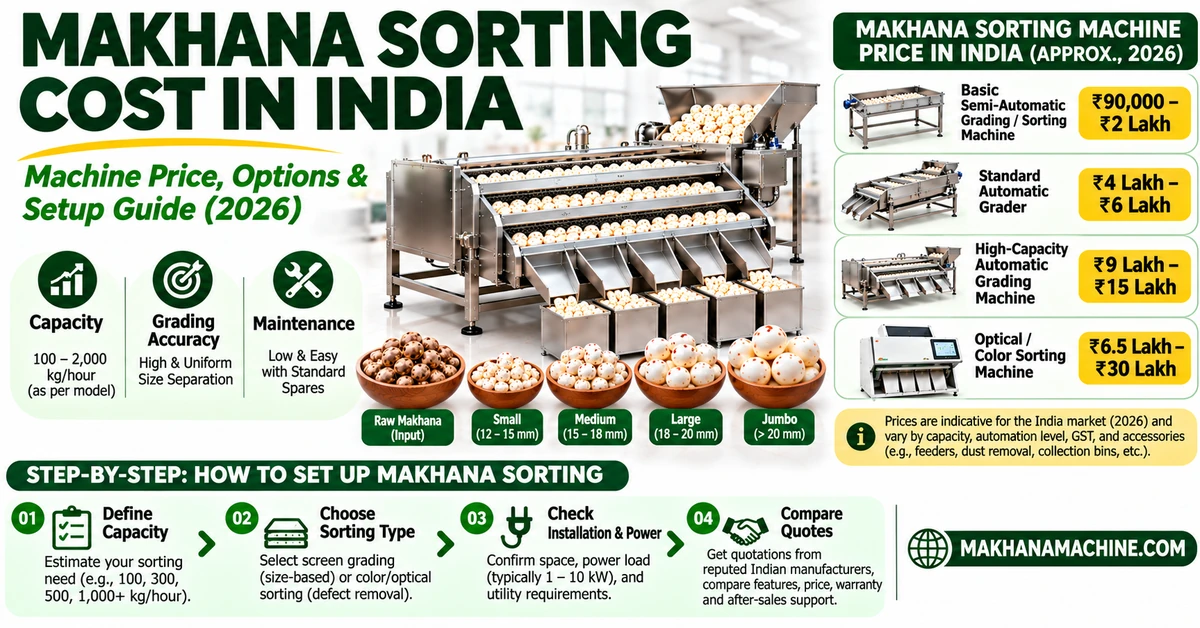
A makhana seed sorting machine price in India generally costs more for standard-size grading units, while advanced optical or high-capacity sorting systems. The final price depends mainly on capacity, number of grades, automation level, construction material, and after-sales support.
For a makhana processor, the machine is not just an equipment purchase it directly affects seed uniformity, popping consistency, yield, labour cost, and the price you can command for graded lots. This guide explains realistic price ranges, hidden costs, specifications to check, and how to choose the right machine for your processing scale.
What Is a Makhana Seed Sorting Machine?
A makhana seed sorting machine separates raw makhana seeds into uniform size categories before cleaning, drying, popping, roasting, or packaging. It typically uses vibrating screens, rotary sieves, or multi-deck graders to separate seeds by diameter, weight, or size class.
Seed sorting is different from popped makhana grading. Raw seed sorting prepares uniform input for popping, whereas popped makhana grading separates finished fox nuts into commercial grades such as jumbo, regular, and small kernels.
A good seed sorting machine should:
- Handle wet or semi-dry makhana seeds without clogging.
- Separate seeds into 3–4 or more consistent grades.
- Minimise seed breakage and wastage.
- Allow quick sieve or mesh changes.
- Operate with low power and limited manual handling.
- Use food-contact-safe materials such as SS 304 where required.
Makhana Seed Sorting Machine Price in India
The Indian market includes basic mechanical graders, semi-automatic vibratory machines, and fully automated optical sorters. Prices vary widely because “sorting machine” can mean anything from a simple sieve-based grader to a camera-based colour and defect sorter.
|
Machine type |
Typical capacity | Indicative price range | Best suited for |
|
Basic makhana seed grader |
100–300 kg/hr | ₹1.25 lakh–₹3.25 lakh |
Small processors, startups, pilot units |
| Vibratory seed grading machine | 300–500 kg/hr | ₹3.25 lakh–₹4.5 lakh |
Growing processing units needing consistent grades |
| Multi-deck makhana grader |
500–1,000 kg/hr |
₹4.25 lakh–₹5.5 lakh | Commercial processors and aggregators |
|
High-capacity sorting/grading system |
600 kg/hr and above | ₹12.5 lakh–₹26 lakh | Large plants, exporters, integrated facilities |
| Makhana colour/optical sorter |
Application-specific |
₹6.5 lakh–₹16 lakh+ |
Premium sorting, defect removal, export-focused units |
These are indicative market prices, not fixed MRP. Machinery sellers often quote “price on request” because the final configuration, sieve count, motor rating, body material, and delivery location change the cost.
Price by Processing Scale
Small-scale makhana unit
A small processor handling roughly 100–300 kg/hr can usually begin with a compact seed grader. Listings for automatic makhana grading machines start around ₹1.25 lakh, while 300 kg/hr grading machines are commonly quoted around ₹3.25 lakh.
At this scale, prioritise:
- Simple operation and easy sieve replacement.
- Low power consumption.
- Gentle handling to avoid seed damage.
- Availability of local service support.
- Clear output chutes for manual bagging.
Medium-scale commercial processor
A processor handling 300–500 kg/hr should consider a vibratory or multi-deck grader. Machines in this category are commonly listed between ₹4.25 lakh and ₹4.5 lakh, with capacities around 300–500 kg/hr.
For this scale, look for:
- At least 3–4 output grades.
- Adjustable screen mesh.
- SS 304 contact parts.
- Stable vibration and uniform feeding.
- Easy cleaning between batches.
- A written warranty and operator training.
Large makhana processing plant
Large processors, exporters, and integrated makhana plants may need higher-throughput systems or optical sorting. Market listings show makhana sorting machines around ₹12.5 lakh to ₹26 lakh, depending on capacity and technology.
At this level, the machine should be evaluated as part of a complete line: cleaning, washing, grading, drying, popping, polishing, and packaging. A seed sorter that performs well alone may create bottlenecks if its capacity does not match upstream and downstream equipment.
What Drives the Price?
1. Capacity
Capacity is the biggest price driver. A 300 kg/hr grader costs far less than a 600 kg/hr or 1,000 kg/hr system because it needs a larger frame, stronger vibratory mechanism, more powerful motors, bigger screens, and heavier-duty construction.
Do not buy only for today’s volume. If you expect volume to double within 12–18 months, a slightly higher-capacity machine may be more economical than replacing an undersized unit later.
2. Number of grades
More output grades usually mean more decks, chutes, screens, and separation points. Standard makhana graders often produce 3–4 grades, while some systems can be configured for more.
For example, a processor may want:
- Large premium seed grade.
- Medium uniform seed grade.
- Small seed grade.
- Reject, broken, or oversized material.
Each additional grade improves product control but increases machine complexity and cost.
3. Automation level
Manual and semi-automatic machines are cheaper but need more operator attention. Automatic machines cost more upfront but reduce labour dependency and improve consistency.
A fully automatic system may include:
- Continuous feeding.
- Automatic screen cleaning.
- Motorised discharge.
- Sensors or controls.
- Integration with conveyors or downstream machinery.
For a new unit, semi-automatic equipment is often the practical starting point. For an established brand scaling production, automation can reduce cost per kg over time.
4. Construction material
Food-grade stainless steel, especially SS 304, costs more than mild steel but is easier to clean and better suited to hygienic food processing. Many makhana machines use SS 304 for contact parts and powder-coated mild steel for the main frame.
Check exactly which parts are stainless steel. A seller may advertise “SS machine” when only selected contact components are SS 304.
5. Sorting technology
Mechanical size grading is more affordable than optical sorting. A vibratory grader separates seeds using screens and vibration, while an optical sorter uses cameras, air jets, and software to identify colour, defects, or foreign material.
Optical sorting is useful when you need to remove discoloured seeds, shells, debris, or defective material at premium quality standards. However, it requires higher investment, trained operation, and more technical maintenance.
6. Customisation
Custom sieve sizes, additional decks, special discharge arrangements, wet-seed handling, dust extraction, and integration with existing lines can increase the quote. Makhana seed sizes commonly range from around 7 mm to 14 mm, so sieve configuration must match your raw-material profile.
Ask the manufacturer to confirm:
- Seed size range handled.
- Moisture level acceptable.
- Number of grades.
- Screen mesh options.
- Changeover time.
- Expected breakage percentage.
7. Brand, warranty, and service
Established manufacturers may charge more, but they often provide better engineering support, spare-part availability, installation guidance, and operator training. Some suppliers offer a 12-month warranty on manufacturing defects, though electrical components such as motors may be excluded.
A lower price is not a saving if the machine stops frequently and spare parts take weeks to arrive.
Specifications to Check Before Buying
Before comparing quotations, prepare a specification sheet. This helps you compare machines on performance rather than only on price.
|
Specification |
What to confirm |
|
Capacity |
Rated kg/hr for raw makhana seed, not just popped makhana |
|
Grades |
Number of output grades and whether they are adjustable |
| Seed size range |
Minimum and maximum seed diameter handled |
| Moisture tolerance |
Whether the machine can handle wet or semi-dry seed |
|
Screen type |
Vibratory, rotary, multi-deck, or optical |
|
Contact material |
SS 304 or food-grade contact surfaces |
| Motor power |
HP or kW, phase, and voltage requirement |
|
Breakage rate |
Expected seed damage or breakage percentage |
| Cleaning system |
Manual, brush-based, or automatic screen cleaning |
|
Power consumption |
Units consumed per hour at rated load |
| Footprint |
Machine dimensions and required installation space |
|
Output arrangement |
Number and position of discharge chutes |
| Warranty |
Coverage period and excluded components |
|
Installation |
Whether commissioning and training are included |
Makhana graders commonly use multi-layer vibrating screens, adjustable mesh, and capacities around 300–500 kg/hr, though configurations can range from 50 kg/hr to 1,000 kg/hr.
Hidden Costs Beyond the Machine Price
The quoted machine price is rarely the complete project cost. Before finalising your budget, include the following:
- GST & freight: State if the price does not include GST and freight.
- Installation: Some suppliers have included commissioning; others have it as a separate charge for on-site installation.
- Electrical: You may require wiring stabilisers starters, panels, or three phase arrangements.
- Support or platform: According to the size of the vibratory machine, a level platform or other support may be needed.
- Extra sieves: Save other mesh screens for various seed sizes and future product types.
- Training: The manufacturer may provide training at their site instead of at your plant.
- Spare parts and consumables: belts bearings vibratory elements, screens, and motors may require replacement over time.
- Downtime buffer: Allow a contingency for delayed delivery, test runs and initial calibration.
Ask for a landed project cost, not just the ex-works machine price.
Does the Price Include Installation and Training?
Sometimes, but not always. Some manufacturers provide training at their facility before dispatch, while on-site installation, commissioning, and operator training may be chargeable depending on the supplier and location.
Before paying an advance, get written confirmation on:
- Whether installation is included.
- Whether training is on-site or at the factory.
- Travel, accommodation, and labour charges for engineers.
- Warranty start date: dispatch date, delivery date, or commissioning date.
- Response time for service complaints.
- Spare-part availability and pricing.
- Whether remote video support is available.
A clear installation and training clause protects you from unexpected post-purchase expenses.
How to Calculate the Right Capacity
Do not choose capacity based only on peak daily production. Calculate it from your actual processing hours and desired growth margin.
Use this simple formula:
Required capacity = Effective working hours / Daily seed volume
Then add a buffer of 20–30% for feed variation, cleaning stops, sieve changes, and future expansion.
For example, if you process 2,000 kg of raw makhana seed in 8 effective hours:
2,000 / 8 = 250 kg/hr
With a 25% buffer, your target capacity becomes approximately 312 kg/hr. In that case, a 300–500 kg/hr grader is a more practical choice than a 250 kg/hr machine operating at full load.
Mechanical Grader vs Optical Sorter
|
Factor |
Mechanical seed grader | Optical colour sorter |
|
Main function |
Size grading | Colour, defect, and foreign-material sorting |
| Typical cost | Lower to mid-range |
Higher |
| Capacity flexibility |
Good for standard seed grading |
Best for premium quality control |
|
Labour requirement |
Moderate | Lower after setup |
|
Maintenance |
Simpler |
More technical |
| Best use |
Pre-popping seed grading |
Premium sorting and defect removal |
|
Suitability |
Most Indian processors |
Exporters and premium brands |
For most Indian makhana processors, a mechanical vibratory grader is the first investment. An optical sorter becomes valuable when quality rejection, foreign material, or premium grading has a direct impact on sales price.
Common Buying Mistakes
Avoid these mistakes when comparing makhana seed sorting machine prices:
- Comparing machines with different capacities without normalising cost per kg/hr.
- Buying a popped makhana grader when you actually need a raw seed sorter.
- Ignoring wet-seed handling capability.
- Choosing the lowest quote without checking SS 304 coverage.
- Not confirming the number of grades and sieve sizes.
- Overlooking installation, freight, GST, and commissioning costs.
- Buying capacity far above current requirements without a clear expansion plan.
- Not checking spare-part availability in your region.
- Accepting verbal promises about training and warranty.
- Failing to request a live trial or demo video with your seed sample.
A machine that grades dry seed efficiently may perform poorly with wet makhana seed. Since some seed grading systems are specifically designed to grade wet seed, share your actual process conditions with the manufacturer before ordering.
How to Choose the Right Manufacturer
Choose a supplier based on engineering clarity, not just the lowest quotation. A reliable makhana seed sorting machine manufacturer should provide:
- A detailed technical specification sheet.
- Capacity confirmation for raw makhana seed.
- Sieve and grade configuration.
- Material construction details.
- Motor and power requirements.
- Breakage and accuracy expectations.
- Warranty terms in writing.
- Installation and training scope.
- Spare-part list and pricing.
- Demo video or trial run option.
Some suppliers offer training before delivery and a 12-month warranty on manufacturing defects, which can be useful indicators of after-sales commitment. Before ordering, request a spec sheet and quotation with the same parameters from at least three suppliers. This makes price comparison transparent and helps you identify missing costs.
Is a Makhana Seed Sorting Machine Worth the Investment?
For a serious makhana processor, yes provided the machine matches your seed quality, volume, and product plan. Uniform seed grading supports consistent popping, reduces manual sorting, improves batch control, and helps create cleaner commercial grades.
The return on investment improves when the machine:
- Reduces manual sorting labour.
- Improves popping uniformity.
- Reduces breakage and rejection.
- Enables better grade-wise pricing.
- Supports higher throughput.
- Improves packaging consistency.
- Helps meet buyer or export quality requirements.
If you are processing small batches occasionally, a basic grader may be enough. If you are building a commercial makhana brand or planning exports, invest in a properly sized, hygienic, and serviceable grading system.
Conclusion
The right seed selection machine for you is the one that: fits your seed condition, the grades you need, with the power you have, fits your ground space and your growth plan not just the cheapest listing. For many Indian commercial seed operations it is an attainable practical starting range and for larger/optical systems get your project-specific quotation. Ask for a detailed specification sheet, a video/demo, and a complete landed-cost quote including freight, GST, installation, training, and spares.
FAQs
What is the cost of a sorting machine for makhana seed?
Typical equipment approximately ranges from Rs. 15 lakh and its high-capacity or optical systems, more than Rs. 6.5 lakh.
Does the price include installation and training?
Not necessarily, check installation, commissioning, travel, and training charges in the written quotation.
What capacity should a small makhana processor choose?
For small processors, a machine with a capacity of 100-300 kg/hr is more appropriate, based on the number of working hours per day and the total volume.
How many grades can the machine separate?
Standard separating machines usually divide 34 grades, yet additional outputs are designed to be achieved as required.
Can it sort wet makhana seeds?
You can find wet seed graders as well. But, you’ll need to verify with the manufacturer if they tolerate wet seed.
Which material is best for a makhana sorting machine?
SS 304 is the best choice for contact parts because it is hygienic, easy to clean, and resistant to food processing conditions.
Is an optical makhana sorter worth the higher cost?
It is suitable when colour and impurities need to be controlled for purposes like export, high value addition or quality.