
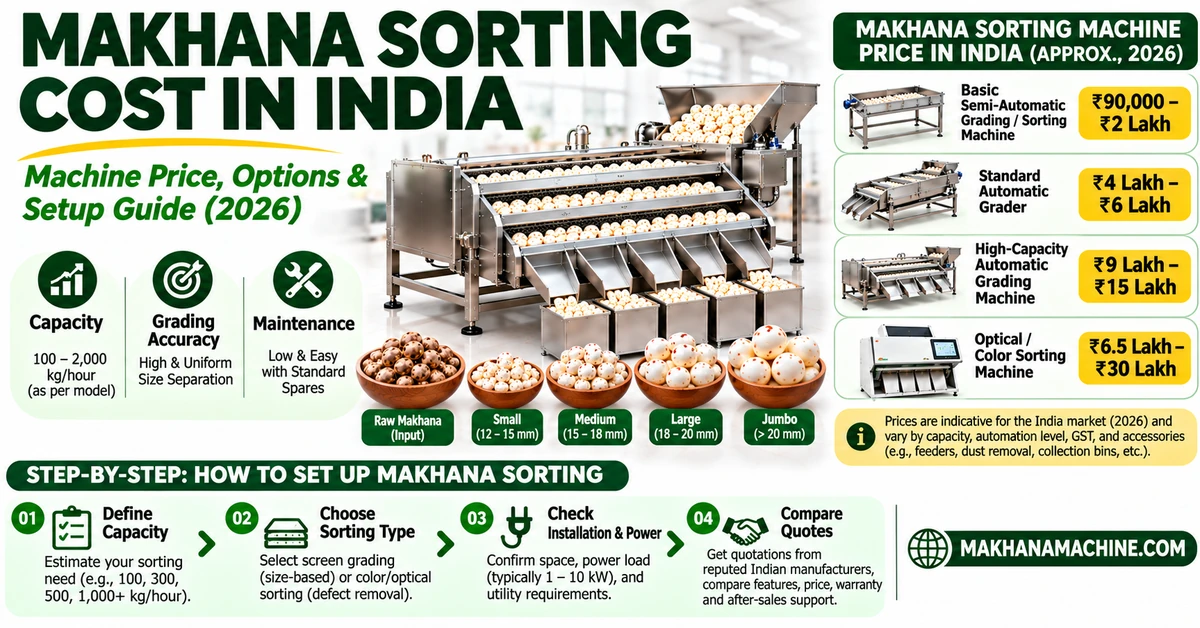
A makhana seed sorting machine can become the backbone of a profitable makhana processing business in India. It helps you remove impurities, separate seeds by size or colour, improve batch consistency, and supply cleaner raw material for roasting, popping, grading, packaging, and branded sale.
This guide explains how to plan, set up, and run a commercial makhana seed sorting business from machine selection and installation to licensing, staffing, pricing, and payback.
What Is a Makhana Seed Sorting Machine?
A makhana seed sorting machine separates raw makhana seeds based on physical characteristics such as size, weight, colour, shape, density, or surface defects. Depending on the technology, it may use vibrating screens, air separation, gravity separation, or camera-based optical sorting.
The machine is typically used before roasting, popping, or packaging. Clean, uniformly sorted makhana improves processing efficiency and reduces rejection at later stages.
What It Removes or Separates
A good sorting setup can handle:
- Undersized or oversized makhana seeds
- Broken, immature, or shrivelled seeds
- Dust, husk, sand, and other foreign matter
- Discoloured or damaged seeds
- Mixed grades that otherwise reduce product value
- Material unsuitable for premium popping or packaging
Sorting does not replace roasting, popping, or grading after processing. Instead, it prepares raw makhana for a more controlled and profitable production line.
Why Sorting Matters in the Makhana Business
Raw makhana is rarely uniform. Seeds differ in moisture, size, density, and maturity. If these variations enter the roasting or popping stage together, the output becomes inconsistent: some seeds may pop well, while others remain unpopped, burn, or break.
A commercial makhana seed sorting machine reduces this variation before processing begins.
Business Benefits
- Better product uniformity: Consistent input leads to more consistent popped makhana.
- Lower wastage: Damaged or unsuitable seeds can be separated early instead of contaminating a full batch.
- Higher premium-grade recovery: Uniform seeds are easier to grade and sell at better prices.
- Improved buyer confidence: Traders, processors, and packaged-food brands prefer clean, sorted material.
- Better machine performance downstream: Roasters, poppers, and packaging lines run more smoothly with uniform feed.
- Stronger brand positioning: Sorted makhana supports premium, export-oriented, and retail-ready product claims.
For a business selling loose makhana, sorted raw material itself can command a better price. For a value-added brand, sorting is even more important because it protects quality from the first stage.
Types of Makhana Seed Sorting Machines
Before buying, understand that “sorting machine” can mean different technologies. The right choice depends on your raw material quality, target output, budget, and whether you need colour sorting, size grading, or both.
|
Machine type |
Main function | Best suited for | Typical indication |
|
Vibratory grader |
Separates makhana by size using screens | Basic grading and batch preparation |
Often available in capacities around 300–2,000 kg/hr depending on design |
| Destoner / cleaner | Removes stones, dust, and heavy impurities | Farms, mandis, and initial cleaning |
Useful as a pre-cleaning stage |
|
Air separator |
Removes light impurities using airflow | Cleaning before grading or colour sorting | Often combined with grading systems |
|
Gravity separator |
Separates by density and maturity | Separating immature or lightweight seeds |
Useful where raw material quality varies |
| Colour sorter | Uses cameras and air jets to remove discoloured or defective seeds | Premium sorting and export-oriented units |
Commercial models are commonly listed around 200–1,000 kg/hr capacity |
| Combined cleaning-sorting line | Cleaning, grading, and sorting in one flow | Medium and large processing plants |
Higher investment but better automation |
A small unit may begin with a vibratory grader or basic sorting machine. A commercial processor supplying branded or export-quality makhana should consider optical colour sorting along with size grading.
Key Specifications to Check Before Buying
Do not choose a makhana seed sorting machine only by price. Compare the machine against your actual raw material, production target, and quality requirements.
1. Capacity
Capacity is usually expressed in kilograms per hour. However, confirm whether the stated capacity refers to raw makhana, cleaned makhana, or throughput under ideal conditions.
Market listings for makhana sorting machines commonly show capacities from around 200 kg/hr to 600 kg/hr, while graders may be rated higher depending on the model.
For planning:
- Small unit: 100–300 kg/hr
- Medium commercial unit: 300–600 kg/hr
- Large processor: 600 kg/hr and above, often with multiple machines or a complete line
Choose capacity based on daily processing volume, not just peak demand. If you process 2 tonnes per day in an 8-hour shift, you need an average of 250 kg/hr plus buffer time for feeding, cleaning, and changeovers.
2. Sorting Accuracy
Ask the manufacturer what “accuracy” means for their machine. A high accuracy claim is useful only if it is tested on your makhana variety, moisture level, and impurity profile.
Optical sorting machines are often advertised with accuracy levels around 99%, but real performance depends on feed consistency, lighting, calibration, and seed condition.
3. Power Consumption
Check connected load, running load, and whether the machine runs on single-phase or three-phase power. Some makhana sorting machines are listed with 1 kW to 2 kW consumption, while larger optical systems may require more power.
For a small rural unit, single-phase compatibility can be a major advantage. For a larger plant, confirm voltage stability, starter type, and backup-power requirements.
4. Construction Material
Food-contact areas should preferably use stainless steel or food-grade material. The frame may be mild steel with powder coating, but chutes, hoppers, screens, and product-contact surfaces should be easy to clean and corrosion-resistant.
5. Ease of Cleaning
Makhana dust and broken particles can accumulate in screens, air channels, and collection trays. Look for:
- Removable trays and screens
- Accessible inspection points
- Minimal dead zones
- Easy filter or dust-bag cleaning
- Clear maintenance instructions
6. Automation Level
Manual feeding reduces machine cost but increases labour dependency. Automatic feeding improves consistency but needs a more stable power supply and better operator training.
For a new business, a semi-automatic machine is often a practical starting point. It balances investment, labour, and control.
7. After-Sales Support
Ask about:
- Installation and commissioning
- Operator training
- Spare-part availability
- Warranty terms
- Response time for breakdowns
- Remote support or video assistance
- Availability of local service engineers
A slightly costlier machine with dependable service is usually better than a cheaper machine that stops production frequently.
Space, Power, and Infrastructure Requirements
The exact requirement depends on machine capacity and whether you install a standalone sorter or a complete line. As a practical planning range, reserve enough space for the machine, feeding area, collection bins, operator movement, maintenance access, and packed-material storage.
Recommended Setup Area
| Business scale | Approximate machine area | Practical working area |
| Small sorting unit | 100–200 sq. ft. | 300–500 sq. ft. |
| Medium commercial unit | 200–400 sq. ft. | 600–1,000 sq. ft. |
| Large sorting line | 400+ sq. ft. | 1,200+ sq. ft. |
These are planning estimates, not fixed standards. Optical sorters can be relatively compact but need clear space around them for feeding, rejection collection, maintenance, and airflow. Some industrial colour-sorting machines are listed with dimensions around 1.5–2.2 metres in length and 1–1.6 metres in height.
Power Planning
Before installation, confirm:
- Single-phase or three-phase supply
- Connected load in kW or HP
- Voltage fluctuation range in your location
- Earthing and electrical safety arrangements
- Need for a stabiliser or generator
- Separate power line for the machine
A small makhana sorting machine may operate on a 1 kW load, while larger models may need around 2 kW or more. Always ask the supplier for the full electrical load sheet, including motors, blowers, compressors, lights, and control panels.
Other Infrastructure
Plan for:
- A dry, covered shed with good ventilation
- Concrete or level flooring
- Raw makhana storage away from moisture
- Dust-control arrangements
- Fire extinguishers and basic safety signage
- Weighing scale
- Tarpaulins, crates, or food-grade bins
- Cleaning water supply and drainage, if needed
- Office or record-keeping space
Avoid storing raw makhana directly on the floor. Moisture absorption can affect sorting accuracy and later popping performance.
Licenses and Registrations Needed in India
The licenses required depend on whether you only sort and trade raw makhana or also process, pack, and sell it as food.
Essential Registrations
- Udyam Registration: Useful for MSME benefits, subsidies, and government scheme eligibility.
- GST Registration: Generally required when turnover crosses the applicable threshold; common guidance places the threshold at ₹40 lakh for goods, with ₹20 lakh for special-category states.
- FSSAI Registration or License: Required if you handle food for sale. A basic registration may apply to smaller businesses, while a State or Central license may be required based on turnover, capacity, and activity.
- Shop and Establishment Registration: Required in many states if you employ workers or operate a commercial establishment.
- Factory Licence / Labour Registrations: May apply if you employ a specified number of workers or operate a factory under state rules.
- Pollution / Local Body NOC: Check with your local municipal authority or industrial area authority, especially for a processing shed.
If you are only sorting raw makhana for sale to processors, your compliance burden may be lower than a full packaged-makhana brand. But once you clean, grade, pack, label, or sell food commercially, FSSAI compliance becomes central.
Documents Usually Needed
Keep these ready:
- Aadhaar and PAN of proprietor or partners
- Business address proof or rent agreement
- Electricity bill
- Passport-size photographs
- Bank account details
- GST certificate, if applicable
- Layout plan of the unit
- Machinery list and invoices
- Water test report, if required for food processing
- FSSAI application documents
Consult a local CA or FSSAI consultant before finalising your license category, because state-level implementation and turnover thresholds can affect the requirement.
Business Models You Can Choose
A makhana seed sorting machine supports several business models. Choose one before buying machinery, because it affects machine capacity, packaging, licences, and marketing.
1. Raw Makhana Sorting and Trading
You buy unsorted makhana from farmers, traders, or collection centres, sort it, and sell clean graded lots to processors, wholesalers, or exporters.
Best for: Entrepreneurs close to makhana-growing clusters, especially in Bihar and nearby regions.
Revenue source: Margin between unsorted procurement cost and sorted-material sale price.
2. Sorting Plus Roasting or Popping
You sort raw makhana and then roast or pop it for wholesale supply.
Best for: Units that want higher value addition than raw trading.
Revenue source: Sale of roasted or popped makhana in bulk.
3. Branded Packaged Makhana
You sort, process, flavour, pack, and sell makhana under your own brand.
Best for: Entrepreneurs targeting retail, e-commerce, modern trade, or export buyers.
Revenue source: Higher margin on branded, packaged products.
4. Custom Sorting Service
You offer sorting as a service to farmers, FPOs, traders, and small processors who do not want to invest in a machine.
Best for: Areas with high makhana availability but limited processing infrastructure.
Revenue source: Per-kg sorting or grading charges.
Investment Estimate
Investment varies widely with automation, capacity, brand, and whether you add roasting, popping, or packaging equipment.
A basic makhana sorting machine may start around ₹1 lakh, while advanced optical sorting machines can cost several lakh rupees. Industry listings show makhana sorting machines in a broad range from about ₹1 lakh to ₹5 lakh, with higher-speed or optical systems priced higher. Some commercial colour-sorting models are listed around ₹6.5 lakh to ₹12.5 lakh, depending on capacity and features.
Indicative Setup Budget
| Item | Small unit | Medium commercial unit |
| Makhana seed sorting machine | ₹1–3 lakh | ₹4–10 lakh |
| Pre-cleaning / destoning equipment | ₹0.5–1.5 lakh | ₹1.5–3 lakh |
| Weighing scale, bins, tarpaulins | ₹0.3–0.8 lakh | ₹0.8–2 lakh |
| Shed renovation / electrical work | ₹0.5–2 lakh | ₹2–5 lakh |
| Licensing, consultancy, and misc. | ₹0.3–1 lakh | ₹1–2 lakh |
| Working capital for raw material | ₹2–5 lakh | ₹5–15 lakh |
| Approximate total | ₹4.5–13 lakh | ₹14–37 lakh |
These figures are indicative. Your actual cost will depend on machine configuration, location, building condition, labour model, and procurement volume.
Operating Cost Considerations
Your monthly cost will include more than electricity.
Main Operating Costs
- Raw makhana procurement
- Labour for feeding, collection, packing, and cleaning
- Electricity
- Machine maintenance and spare parts
- Transport and logistics
- Packaging material, if applicable
- Rent, if the premises are leased
- Marketing and sales expenses
- Loan EMI, if financed
Electricity is usually a smaller cost compared with raw material and labour. The bigger financial risk is poor procurement: buying wet, mixed, or poor-quality makhana at the wrong price can reduce sorting recovery and profit.
How to Calculate Profitability and Payback
A realistic payback period depends on sorting margin, capacity utilisation, raw-material cost, and selling price. Avoid relying only on machine capacity; calculate profit per kilogram after all costs.
Simple Payback Formula
\text{Payback Period} = \frac{\text{Total Machine and Setup Investment}}{\text{Average Monthly Net Profit}}
Example Calculation
Suppose you install a medium-capacity sorting setup for ₹8 lakh.
- Sorting capacity used: 300 kg/hr
- Effective working hours: 6 hours/day
- Daily sorted volume: 1,800 kg
- Working days: 25 per month
- Monthly sorted volume: 45,000 kg
- Net margin after procurement, labour, power, and overheads: ₹2 per kg
- Monthly net profit: ₹90,000
\text{Payback Period} = \frac{₹8,00,000}{₹90,000} \approx 9 \text{ months}
In this example, the payback period is around 9 months. However, if capacity utilisation is only 40%, the same setup may take closer to 20–24 months to recover its investment.
What Improves Payback
- Buying raw makhana directly from farmer groups or FPOs
- Maintaining consistent machine uptime
- Reducing manual handling losses
- Selling sorted material in bulk to repeat buyers
- Adding value through roasting, popping, or packaging
- Securing contracts with processors or retailers
- Using the machine for multiple products or seasons, if technically suitable
Step-by-Step Setup Plan
Step 1: Study Your Local Market
Identify where raw makhana is available, who buys sorted material, and what quality grades command better prices. Speak with farmers, traders, FPOs, makhana processors, and packaged-food brands.
Step 2: Decide Your Business Model
Choose whether you will trade sorted raw makhana, offer sorting services, process makhana, or build a retail brand. Your model determines machine type and investment.
Step 3: Finalise Capacity
Calculate your expected daily volume. Add 20–30% buffer for growth, downtime, and variable raw-material quality.
Step 4: Shortlist Machines
Request quotations from at least three manufacturers or suppliers. Compare capacity, power, accuracy, material of construction, warranty, installation support, and spare-part availability.
Step 5: Ask for a Live Trial
Do not buy based only on a brochure. Ask for a demo using your own raw makhana sample. Check recovery percentage, rejection quality, breakdown rate, dust generation, and ease of operation.
Step 6: Confirm Installation Requirements
Get a written specification covering floor load, space, power connection, compressed-air requirement if applicable, operator requirement, and maintenance schedule.
Step 7: Complete Licences
Apply for Udyam, GST if applicable, FSSAI registration or licence, and local business registrations before commercial sales begin.
Step 8: Train Operators
Train staff on safe operation, feeding rate, machine cleaning, fault identification, and record-keeping. Good operation directly affects sorting accuracy and machine life.
Step 9: Start With Trial Batches
Run small commercial batches first. Track input weight, sorted output, rejected material, power use, labour hours, and buyer feedback.
Step 10: Scale Gradually
Once sorting quality, procurement, and sales are stable, add roasting, popping, packaging, or a second sorting line.
Common Mistakes to Avoid
- Buying a machine without testing it on your local makhana
- Choosing capacity without checking real daily volume
- Ignoring moisture variation in raw material
- Underestimating working-capital needs
- Not planning for dust, cleaning, and maintenance
- Starting sales before completing FSSAI and tax registrations
- Depending on a single buyer
- Comparing machines only on price
- Not recording recovery percentage and rejection rate
- Assuming high advertised accuracy equals real-world performance
How to Choose the Right Manufacturer
Look for a supplier that understands makhana as a food material, not just as a generic seed. The best manufacturer will ask about your raw material source, moisture level, impurity profile, target grade, and downstream processing.
Before finalising, ask:
- Can you provide a demo with my makhana sample?
- What is the guaranteed capacity at my feed condition?
- What is the expected sorting recovery?
- What impurities can the machine remove?
- What is the power consumption per hour?
- What spare parts are required monthly or annually?
- What is the warranty coverage?
- Do you provide installation and operator training?
- Can you share references from similar makhana units?
- What is the delivery and commissioning timeline?
A reliable makhana seed sorting machine manufacturer should provide transparent specifications, installation support, and long-term service not only a low initial quotation.
Marketing Your Sorted Makhana Business
Even a good machine needs a clear market strategy.
Target Buyers
- Makhana processors and roasting units
- Wholesalers and commodity traders
- Packaged-food brands
- Exporters
- Retail stores and supermarkets
- HoReCa buyers, such as hotels and cafés
- FPOs and farmer producer companies
- E-commerce sellers
Positioning Ideas
- “Uniformly sorted raw makhana for consistent popping”
- “Clean, graded makhana with reduced foreign matter”
- “Premium-grade makhana for roasting and packaging”
- “Bulk sorting and grading services for makhana processors”
- “Consistent supply for makhana brands and exporters”
Use WhatsApp Business, IndiaMART, trade directories, local trader networks, and direct visits to processing clusters. For B2B sales, a simple catalogue with machine photos, sorting grades, capacity, and sample reports can build trust quickly.
Frequently Asked Questions
1. What does a makhana seed sorting machine do?
It removes impurities and separates makhana seeds by size, colour, density, or quality before processing or sale.
2. What capacity should a new business choose?
Start with 200–300 kg/hr if you are testing the market; choose higher capacity only after confirming regular raw-material supply.
3. How much space does a sorting unit need?
A small unit usually needs 300–500 sq. ft., including machine space, storage, operator movement, and material handling.
4. Does the machine need three-phase power?
Not always; many smaller machines run on single phase, while larger optical sorters may need three-phase power.
5. Is FSSAI registration mandatory?
Yes, if you handle, process, pack, or sell makhana commercially; the applicable registration or licence depends on scale and activity.
6. What is a realistic payback period?
With steady procurement, good capacity utilisation, and a healthy per-kg margin, many small units target 12–24 months.
7. Can one machine handle both cleaning and grading?
Some combined systems can, but many businesses use separate cleaning, grading, and colour-sorting stages for better quality control.