
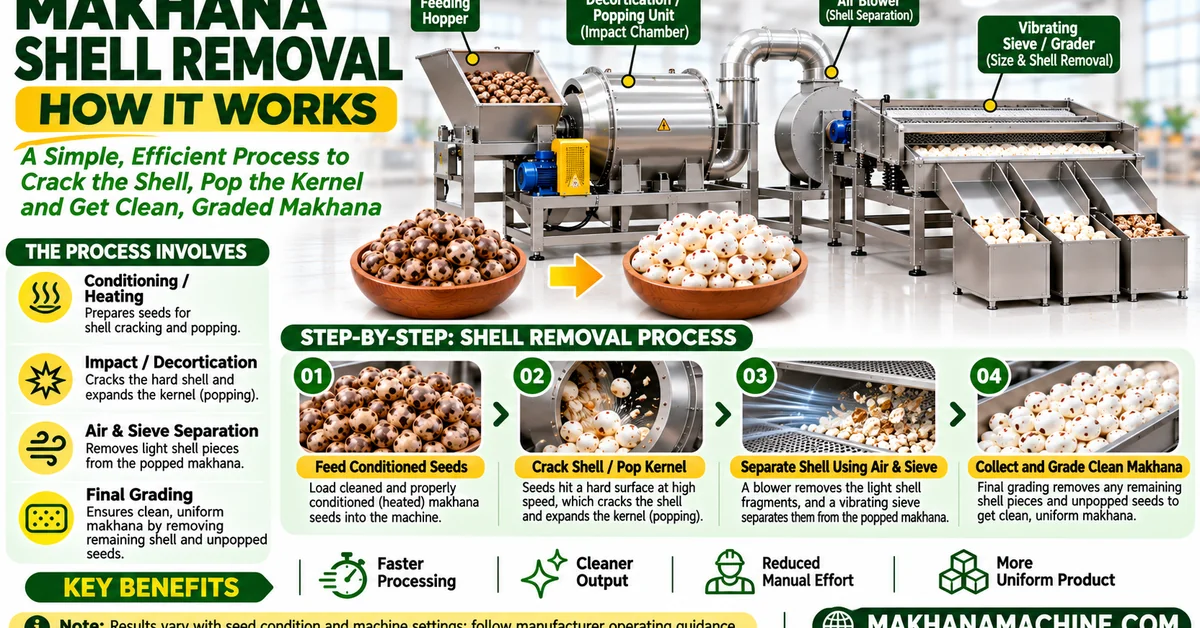
A makhana shell removal and polishing machine is used to separate the hard outer shell and loose husk from popped makhana, then improve the kernel’s whiteness, smoothness and shine. For commercial processors in India, it replaces labour-intensive manual cleaning and bamboo-basket polishing with a more consistent, scalable process.
This guide explains how the machine works, its main components, the difference between shell removal and polishing, output quality, capacity considerations, and what buyers should check before purchasing a commercial makhana shell removal and polishing machine in India.
What Is a Makhana Shell Removal and Polishing Machine?
Makhana, also called fox nut or lawa after popping, is obtained from the kernel of Euryale ferox seeds. After roasting and popping, the expanded white kernel must be separated from broken shell, husk, dust, unpopped material and defective seeds. Traditional processing uses manual impact and rubbing; mechanised systems use controlled impact, aspiration, screening and abrasive or friction-based polishing.
A makhana shell removal and polishing machine generally performs two related functions:
- Shell removal: Removes the black outer shell fragments, husk and loose impurities from popped makhana.
- Polishing: Rubs the popped kernels gently against each other or against a controlled polishing surface to remove residual bran-like particles and improve whiteness and lustre.
In many Indian processing lines, this machine works alongside a raw-seed washer, roaster, popping or decortication unit, grader and packaging machine.
Why Shell Removal and Polishing Matter
The commercial value of makhana depends heavily on appearance, cleanliness, uniformity and freedom from hard shell particles. Consumers and institutional buyers expect white, round, crisp makhana with minimal broken kernels and no visible black shell.
Polishing is particularly important because traditional polishing is done by rubbing makhana pops together in bamboo baskets or jute bags. This friction improves whiteness and shine. A machine performs the same principle in a controlled, repeatable way.
A well-designed shell removal and polishing system helps processors:
- Reduce manual labour and handling time
- Improve the visual quality of popped makhana
- Remove dust, husk and loose shell fragments
- Minimise kernel breakage through controlled impact and speed
- Achieve more uniform batch quality
- Support hygienic, higher-volume production
- Prepare makhana for grading and retail packaging
Where the Machine Fits in Makhana Processing
A makhana shell removal and polishing machine is not usually the first machine in the line. It is positioned after popping, when the kernel has expanded and the hard shell has cracked.
A typical commercial makhana processing flow is:
- Raw seed cleaning and washing: Removes mud, stones, snails, membrane and other foreign material from freshly harvested seeds.
- Size grading: Sorts raw seeds by size so roasting and popping are more uniform.
- Drying and pre-heating: Conditions the seeds before final roasting.
- Tempering: Pre-heated seeds are stored for about 48–72 hours, which helps loosen the kernel inside the hard seed coat.
- Roasting and popping: Heat causes the shell to crack and the kernel to expand into popped makhana or lawa.
- Shell removal: The machine separates shell, husk and impurities from the popped kernel.
- Polishing: The kernels are gently rubbed to improve whiteness, smoothness and shine.
- Final grading: Separates popped makhana by size and removes flat, broken or defective material.
- Packaging: The polished and graded makhana is packed for retail, bulk supply or export.
How a Makhana Shell Removal Machine Works
The shell-removal stage relies on a combination of mechanical separation, airflow and screening. The exact design varies by manufacturer, but most systems use one or more of the following principles.
1. Controlled Feeding
Popped makhana is fed into the machine through a hopper, vibratory feeder or conveyor. A controlled feed rate is important because overloading can reduce separation efficiency and increase kernel breakage.
In semi-automatic systems, an operator loads the hopper manually. In fully automatic lines, an elevator or conveyor transfers material from the popping or roasting section directly into the shell-removal unit.
2. Impact or Abrasive Action
For makhana that still has attached shell or tightly held husk, the machine may use a controlled impact or abrasive action. In mechanised decortication and popping systems, hot roasted nuts strike a hard impact surface; the shell breaks and the sudden pressure drop helps the kernel pop out.
For already popped makhana, the action must be much gentler. The objective is not to re-crack the kernel, but to loosen residual shell and husk without damaging the expanded white makhana.
3. Air Separation
A blower or aspiration system removes lighter particles such as dust, thin husk and shell fragments. Heavier sound kernels continue through the machine, while lighter waste material is drawn away into a collection chamber or dust outlet.
This stage is important for producing clean makhana with fewer visible black specks and less foreign matter.
4. Screening and Grading Support
Screens, sieves or vibratory trays can separate material by size and density. A popped makhana grader is commonly used to separate husk, unpopped whole seeds, unpopped decorticated kernels, partially popped makhana and properly popped makhana.
Some shell-removal machines include basic screening. Others are designed to work as part of a complete line, with a separate popped makhana grader after polishing.
How the Polishing Section Works
Polishing improves the appearance and market value of makhana. It is based on gentle friction: the kernels rub against each other and, in some designs, against a soft or food-compatible polishing surface.
Friction-Based Polishing
In a polishing drum, chamber or rotating unit, makhana is tumbled gently. As the kernels move, their surfaces rub together. This removes fine dust, loose husk and surface impurities, giving the makhana a whiter and glossier appearance.
This mechanised version follows the same principle as traditional polishing in bamboo baskets, where rubbing makhana pops together creates whiteness and lustre.
Adjustable Polishing Time
Polishing time must be controlled carefully. Too little polishing may leave the makhana dull or dusty. Too much polishing can create heat, abrasion, breakage or loss of natural shape.
Commercial machines may allow operators to adjust:
- Drum or chamber speed
- Feed rate
- Polishing duration
- Airflow
- Discharge rate
- Brush or abrasive contact, where applicable
Gentle Discharge
After polishing, makhana is discharged through an outlet into a collection tray, bin, conveyor or grading machine. A good machine should discharge the kernels gently to avoid unnecessary breakage.
Main Parts of a Makhana Shell Removal and Polishing Machine
While configurations differ, a commercial machine commonly includes the following components.
| Machine Part | Function |
| Feed hopper | Holds popped makhana and feeds it into the processing chamber at a controlled rate |
| Vibratory feeder or conveyor | Moves material smoothly into the shell-removal and polishing zones |
| Shell-removal chamber | Loosens or separates attached shell and husk using controlled impact, friction or abrasion |
| Blower or aspiration system | Removes light dust, husk and shell particles through airflow |
| Dust collection outlet | Collects removed dust and light impurities for easy disposal |
| Polishing drum or chamber | Gently tumbles makhana so kernels rub against each other and gain shine |
| Sieve or screen section | Separates undersize material, broken pieces and unwanted particles, depending on the model |
| Discharge outlet | Releases cleaned and polished makhana for grading or packing |
| Electric motor and drive system | Powers the rotating, vibrating or polishing mechanism |
| Control panel | Operates the machine and may control speed, airflow, timers and safety functions |
| Frame and body | Supports the machine; food-contact areas are often made from stainless steel, while structural parts may use powder-coated mild steel |
Machine specifications in the Indian market vary widely. Some listed makhana processing machines use stainless steel 304 contact parts, while others use powder-coated mild-steel bodies with stainless-steel contact components.
Semi-Automatic vs Fully Automatic Models
Buyers in India can generally choose between semi-automatic and fully automatic configurations. The right choice depends on daily volume, labour availability, budget and the level of integration required.
| Feature | Semi-Automatic Machine | Fully Automatic Machine |
| Material feeding | Manual loading into hopper is common | Conveyor, elevator or automated feeding system |
| Operator involvement | Higher; operator monitors feed and discharge | Lower; line can run with limited supervision |
| Best suited for | Small and medium processors, startups, batch production | Medium and large processors, continuous production |
| Labour requirement | Moderate | Lower |
| Initial investment | Usually lower | Usually higher |
| Floor space | Often more compact | May require more space and supporting equipment |
| Output consistency | Good when operated correctly | Higher consistency with proper calibration |
| Integration | Can work as a standalone unit | Often integrated with roasting, popping, grading and packing lines |
A semi-automatic machine is often suitable for processors who want to mechanise shell removal and polishing without investing in a complete automated line. Fully automatic systems are better for businesses handling larger volumes and seeking lower dependence on manual handling.
Indian supplier listings show makhana processing equipment in a range of automation levels and capacities, including semi-automatic and automatic models.
Typical Capacity and Output
Capacity depends on the machine design, makhana quality, moisture level, degree of popping and whether the unit is standalone or part of a complete processing line.
Commercial makhana equipment available in India is listed across a broad capacity range. Examples include popped makhana grading machines around 250–300 kg per hour, processing machines around 300–350 kg per hour, and larger grading systems designed for 500–1,000 kg per hour.
For a shell removal and polishing machine, the practical output should be evaluated in terms of:
- Input capacity: Kilograms of popped makhana fed per hour
- Clean output capacity: Kilograms of polished, shell-free makhana discharged per hour
- Rejection percentage: Shell, dust, broken kernels and defective material removed
- Breakage percentage: Percentage of kernels damaged during processing
- Polishing quality: Whiteness, shine and surface cleanliness
- Continuous operation capability: Whether the machine is designed for batch or continuous production
A machine with a high rated capacity may not deliver the best commercial result if it causes excessive breakage or leaves shell particles in the final output. For premium makhana, gentle handling is often more valuable than maximum speed.
Machine Specifications to Check Before Buying
Before requesting a makhana shell removal and polishing machine specification sheet and quote, buyers should compare the following details.
Construction and Food Safety
Ask which parts come into direct contact with makhana. Stainless steel 304 is commonly preferred for food-contact components because it is durable and easier to clean. Some machines use powder-coated mild steel for the body and stainless steel for contact parts.
Check whether the polishing chamber, screens, brushes and discharge channels can be opened or cleaned easily.
Motor Power and Electrical Load
Confirm the motor rating, power consumption, voltage and phase requirement. Indian equipment listings include single-phase and three-phase options, with motor ratings commonly ranging from below 1 HP to several HP depending on capacity.
Ensure the facility has the correct electrical connection, starter, wiring and safety protection before installation.
Capacity Matching
Match machine capacity to the upstream roasting and popping capacity. If the shell removal and polishing machine is slower than the popping line, it becomes a bottleneck. If it is much larger than required, it may increase capital cost and floor-space requirements unnecessarily.
Kernel Breakage Control
Ask the manufacturer how the machine prevents kernel damage. Important questions include:
- Is the impact adjustable?
- Can polishing speed be reduced for delicate makhana?
- Does the machine use gentle tumbling rather than aggressive abrasion?
- What breakage percentage is expected with good-quality popped makhana?
- Can the machine handle different makhana sizes?
Dust and Shell Separation Efficiency
Request a demonstration or sample trial using your own makhana. Evaluate whether the machine removes shell, husk and dust effectively without blowing away good kernels.
Maintenance Requirements
Check the frequency of cleaning, brush replacement, belt tensioning, bearing lubrication and screen replacement. A machine that is easy to maintain will deliver more reliable long-term performance.
Spare Parts and Service Support
For buyers in India, after-sales support is critical. Confirm availability of spare parts, service engineers, installation support, operator training and warranty terms.
Applications of a Makhana Shell Removal and Polishing Machine
This machine is useful across several segments of the makhana value chain.
- Makhana processing units: For cleaning, polishing and preparing popped makhana before grading and packing.
- Makhana brands: For producing clean, visually appealing retail-ready makhana.
- Bulk suppliers and traders: For improving the presentation of makhana supplied to distributors, retailers and food manufacturers.
- Snack manufacturers: For preparing a clean base material before roasting, seasoning or flavour coating.
- Export-oriented processors: For meeting higher visual and cleanliness expectations in premium markets.
- Farmer producer organisations and cooperatives: For adding value to locally processed makhana and reducing dependence on manual polishing.
Benefits for Indian Makhana Processors
India is a major makhana-producing market, and mechanisation is increasingly important as demand grows for packaged, clean and premium-quality makhana. A shell removal and polishing machine supports this shift by improving consistency and reducing manual handling.
Key benefits include:
- Better product appearance and whiteness
- Lower manual labour requirement
- More hygienic processing
- Reduced dust and shell contamination
- Improved batch-to-batch consistency
- Higher throughput compared with manual polishing
- Better preparation for grading and packaging
- Improved suitability for branded and export-oriented supply
Traditional polishing already uses friction to improve whiteness and lustre; mechanisation makes this process faster, more uniform and easier to scale.
Limitations and Practical Considerations
A shell removal and polishing machine improves efficiency, but it cannot correct poor upstream processing. The quality of raw seeds, roasting, popping and moisture control directly affects final output.
Buyers should keep the following points in mind:
- Over-popped or under-popped makhana affects performance: Uneven popping can increase rejection and breakage.
- Excess moisture can reduce polishing quality: Damp makhana may not polish evenly and can affect shelf life.
- Excessive machine speed can damage kernels: Gentle settings are essential for premium whole makhana.
- Screen selection matters: Wrong screen size can remove good kernels or allow unwanted material to pass through.
- Machine capacity should match the full line: A single high-capacity machine cannot solve bottlenecks elsewhere in the process.
- Operator training is necessary: Feed rate, airflow and polishing time must be set correctly for each batch.
How to Choose the Right Machine
Use this checklist before finalising a supplier or model.
- Define your daily processing volume. Calculate expected input in kilograms per hour and per shift.
- Decide between standalone and line integration. Determine whether the machine will work independently or connect to roasting, popping, grading and packing equipment.
- Check material quality. Confirm the material used for food-contact parts and the body construction.
- Ask for a trial with your makhana. Test shell removal, polishing finish, breakage and dust separation.
- Review power and installation needs. Confirm phase, load, floor space and operator requirements.
- Compare output quality, not only price. Whiteness, whole-kernel recovery and low breakage matter more than the lowest quoted price.
- Confirm service support. Ask about installation, training, warranty, spare parts and response time.
- Request a detailed quotation. The quotation should list model number, capacity, power, dimensions, material of construction, inclusions, exclusions, freight and installation charges.
Frequently Asked Questions
What is a makhana shell removal and polishing machine used for?
It is used to remove shell fragments, husk, dust and loose impurities from popped makhana, then polish the kernels to improve whiteness, smoothness and shine.
What are the main parts of a makhana shell removal and polishing machine?
Common parts include a feed hopper, shell-removal chamber, blower or aspiration system, dust outlet, polishing drum or chamber, screen or sieve section, discharge outlet, motor, control panel and machine frame.
Is it available in semi-automatic and fully automatic models?
Yes. Semi-automatic models usually require manual feeding and operator monitoring, while fully automatic models can be integrated with conveyors, elevators and other makhana processing equipment.
Does polishing damage makhana?
It should not, if the machine uses controlled speed, gentle friction and correct polishing time. Excessive speed or abrasive action can increase breakage and reduce whole-kernel recovery.
What capacity should a small makhana processor choose?
A small processor should choose capacity based on popped makhana output per hour, not just machine rating. A semi-automatic machine may be suitable for lower volumes, while larger processors may need higher-capacity equipment or a complete processing line. Indian listings show makhana processing machines in capacities from around 200–300 kg per hour to higher-capacity systems.
Can one machine do both shell removal and polishing?
Some machines are designed as combined shell-removal and polishing units, while others are separate machines installed in sequence. The best configuration depends on the raw material, desired finish and production volume.
Is stainless steel necessary?
Stainless steel is preferred for food-contact parts because it is durable and easier to clean. Many Indian machines use stainless steel 304 for contact parts and powder-coated mild steel for the main body.