
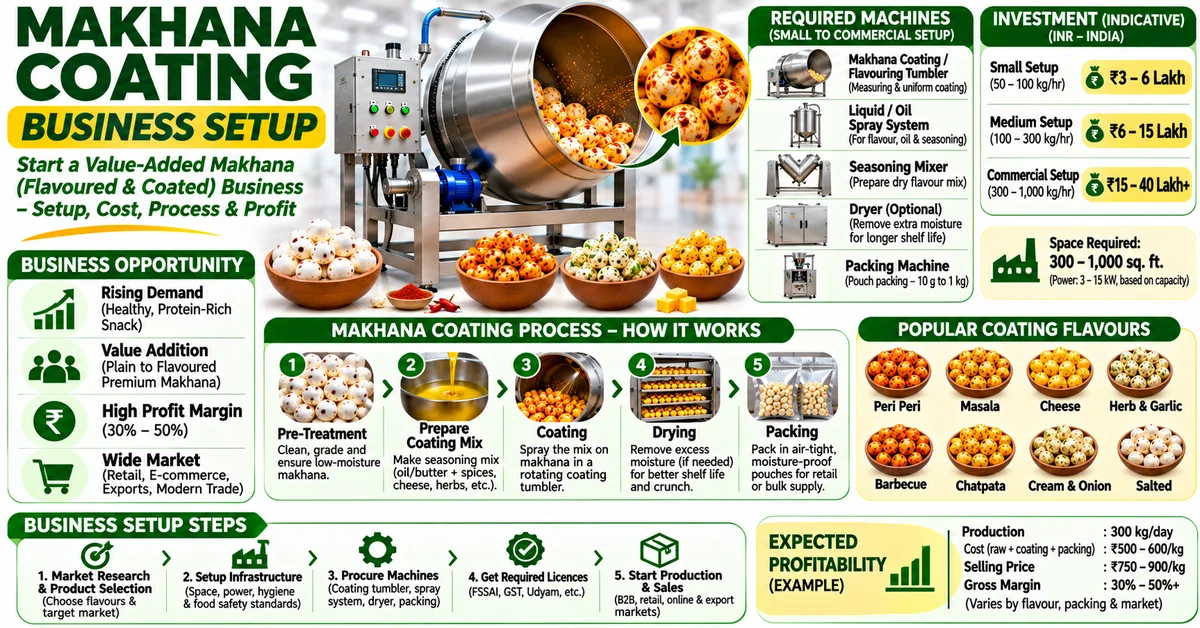
A makhana coating and caramelising machine can help snack brands turn plain fox nuts into premium, flavoured products such as caramel makhana, jaggery-coated makhana, chocolate-coated makhana, cheese makhana, masala makhana, and other value-added snack variants. Instead of relying on manual mixing, the machine helps create a more controlled process for heating, coating, mixing, and finishing batches.
Before publishing this page, confirm that the makhana coating and caramelizing machine is currently available or formally planned in the product catalogue. The exact machine configuration, batch capacity, heating method, control panel, food-contact material, and automation level should always be verified with the manufacturer before a buyer makes an investment decision.
Why Start a Coated Makhana Business?
Makhana is already familiar to Indian consumers as a light snack, but the category has expanded beyond plain roasted fox nuts. Brands are increasingly positioning coated makhana as an affordable premium snack for gifting, office snacking, travel packs, children’s snacking, and health-conscious consumers.
The business opportunity is not simply to sell makhana. It is to create a differentiated finished product through:
- Better flavour combinations
- Attractive coating and gloss
- Consistent taste across batches
- Branded retail packaging
- Product variants for different price points
- Better margins than unflavoured bulk makhana
A commercial makhana coating and caramelising machine supports this value-addition stage. It can help operators coat roasted makhana with caramel syrup, jaggery blends, seasoning systems, chocolate-style compounds, or other recipe-specific coating media.
The core business model is straightforward:
- Source good-quality raw or roasted makhana.
- Roast or prepare it to the required moisture and crispness.
- Prepare the coating syrup, seasoning, or flavour blend.
- Process the makhana in the coating and caramelising machine.
- Cool the product properly.
- Pack it in moisture-resistant retail packs.
- Sell through distributors, online marketplaces, modern retail, cafés, gifting channels, or direct-to-consumer platforms.
The commercial success, however, depends on recipe consistency, process control, packaging quality, and distribution not only on buying a machine.
What Does a Makhana Coating and Caramelising Machine Do?
A makhana coating and caramelising machine is generally designed to tumble or rotate makhana while controlled heat and mixing help spread the coating uniformly over the product. Depending on the process and machine configuration, it may be used for caramelisation, syrup coating, seasoning application, or flavour blending.
The basic goal is simple each makhana piece should receive a relatively even layer of coating without excessive breakage, burning, sticking, or clumping.
A typical process may involve:
- Loading roasted makhana into the machine
- Heating the product or pan as required
- Adding syrup, caramel base, jaggery mixture, oil, seasoning, or flavouring
- Rotating or tumbling the batch for even application
- Continuing heating for controlled caramelisation or drying
- Discharging the coated product for cooling and packing
For caramel makhana, the coating stage is especially important. Too little heat can leave the coating sticky or uneven. Too much heat can darken the sugar, create bitter notes, or cause excessive product breakage. That is why temperature control, rotation speed, batch loading, and recipe timing should be standardized during product trials.
Products You Can Make
A makhana coating and caramelising machine can support multiple snack concepts, depending on the recipe, ingredients, and associated processing equipment.
Possible applications include:
- Caramel-coated makhana
- Jaggery-coated makhana
- Chocolate-flavoured makhana
- Honey-style coated makhana
- Coconut-coated makhana
- Sesame-jaggery makhana
- Cheese-flavoured makhana
- Peri peri makhana
- Pudina makhana
- Tangy tomato makhana
- Cream and onion makhana
- Sweet-and-spicy makhana
- Festival and gifting snack mixes
Some products require a syrup-based coating process, while dry seasoning products may require oil or another binding medium before powder seasoning is applied. Do not assume one formulation will work for every flavour. A caramel coating recipe, for example, behaves very differently from a dry masala seasoning system.
Before commercial production, run trials for each variant and document:
- Ingredient ratios
- Batch size
- Heating temperature
- Mixing time
- Coating addition point
- Cooling time
- Finished-product moisture
- Taste and crunch after storage
This process record becomes the foundation for repeatable production.
Choosing the Right Machine
A buyer should not select a commercial makhana coating and caramelising machine only by price. The machine must match the intended product range, batch size, factory space, labour availability, and expansion plans.
Ask the manufacturer or supplier for a detailed specification sheet covering the following points.
Batch Capacity
Capacity is often mentioned in kilograms per batch or kilograms per hour. Confirm whether the stated output refers to raw input, finished output, or theoretical output under ideal conditions.
For example, a batch capacity may depend on:
- Makhana size and density
- Type of coating
- Coating percentage
- Heating time
- Cooling time
- Operator skill
- Product discharge and cleaning time
A heavily caramelised product may need longer processing than a dry-seasoned product. Therefore, hourly output should be calculated from actual trial conditions rather than from a headline capacity claim.
Heating Method
Ask whether the machine uses electric heating, LPG, steam, thermal oil, induction, or another heating arrangement. The best choice depends on local utility availability, operating cost, process requirements, and safety practices.
Electric heating may be easier to control in some small and medium units, while gas-based systems may suit facilities with reliable LPG infrastructure. The supplier should clearly state the heat source, power consumption or fuel requirement, temperature range, and safety provisions.
Food-Contact Material
For food processing, all food-contact surfaces should be suitable for food use and easy to clean. Stainless steel is commonly preferred for food-contact parts because it supports cleaning and hygiene. Ask specifically about:
- Material grade of the pan or drum
- Material grade of mixing paddles
- Food-contact weld finishing
- Surface smoothness
- Cleaning accessibility
- Whether any coated or painted surface touches the food
A cleanable design reduces the risk of flavour carryover, burnt residue, microbial contamination, and allergen cross-contact between batches.
Control System
A practical commercial machine should offer controls that make the process repeatable. Depending on the model, useful features may include:
- Temperature display and control
- Variable-speed rotation
- Timer controls
- Forward and reverse rotation
- Emergency stop
- Overload protection
- Batch discharge arrangement
- Insulated heating zone
- Operator safety guards
For a new business, simple and reliable controls are often more useful than unnecessary automation. Choose an interface your production team can operate confidently after training.
Cleaning and Maintenance
Caramel and jaggery coatings can stick strongly to hot surfaces. Ask how the machine is cleaned after a batch and whether parts are easily accessible.
A machine that is difficult to clean can create production delays and food-safety concerns. Evaluate:
- Time required between different flavours
- Access to the coating pan or drum
- Ability to remove sticky residue
- Drainage or discharge design
- Availability of spare parts
- Local service support
- Recommended preventive maintenance schedule
Space and Utility Requirements
The exact space and power requirement of a makhana coating and caramelising machine depends on its size, heating source, and supporting equipment. Buyers should obtain a final layout drawing and utility sheet from the supplier before renting or constructing a facility.
A small commercial unit typically needs more than just machine floor space. Plan for raw material handling, roasting or pre-processing, ingredient storage, coating, cooling, packing, finished-goods storage, washing, and staff movement.
A practical small-unit layout may include these zones:
- Raw makhana receiving and storage
- Roasting or pre-heating area
- Coating and caramelising area
- Cooling and inspection table
- Seasoning or final blending zone
- Packaging area
- Finished-product storage
- Cleaning and utensil-wash area
- Staff hygiene area
- Office and dispatch space
Keep the coating area separate from raw material storage wherever possible. A clear product flowfrom incoming material to finished packs helps reduce mix-ups and improves hygiene control.
For utilities, confirm:
- Electrical load in kilowatts
- Voltage and phase requirement
- Fuel requirement, if applicable
- Compressed-air requirement, if any
- Exhaust or ventilation need
- Cooling arrangement
- Water requirement for cleaning
- Drainage requirement
- Fire-safety provisions
Do not finalise your power connection based only on the main machine’s load. Include roasters, sealing machines, compressors, lights, air conditioning, exhaust systems, and future equipment additions.
Licences Needed in India
A makhana coating and caramelising business is a food-processing activity, so compliance planning should begin before commercial production. Every food business operator in India needs the applicable FSSAI registration or licence, and applications are handled through the FoSCoS platform.
The exact registrations and approvals depend on your entity type, location, scale, turnover, product category, local authority rules, and environmental classification. Seek professional legal and compliance advice for your specific unit.
Common requirements may include:
- FSSAI registration or food licence
- Business entity registration
- GST registration, where applicable
- Udyam registration for MSME recognition
- Shop and establishment registration, where applicable
- Local trade licence, where applicable
- Factory licence, if applicable to your unit and workforce
- Fire-safety approval or no-objection certificate, where applicable
- Consent to Establish and Consent to Operate from the relevant State Pollution Control Board, where applicable
- Trademark registration for the brand name
- Legal Metrology compliance for packaged commodities
- Packaging-label compliance
Food manufacturers must follow applicable hygiene and sanitary requirements. FSSAI training materials point to Schedule 4 hygiene requirements, while Food Safety Supervisors are expected to support compliance and train food handlers periodically.
For packaged makhana, your label should be checked for mandatory declarations such as product name, ingredient list, allergen information where relevant, nutrition information, net quantity, batch or lot details, date marking, FSSAI licence number, storage guidance, and manufacturer or marketer details.
Do not make health or nutrition claims such as “weight-loss snack,” “diabetic-friendly,” “immunity booster,” or “high protein” unless the formulation, claim wording, and labelling are compliant with applicable regulations.
Raw Materials and Recipe Planning
Your machine can only deliver good results when the raw materials and formulation are controlled.
For caramelised makhana, key inputs may include:
- Graded roasted makhana
- Sugar, jaggery, or another sweetening system
- Butter, edible fat, or oil, if used in the recipe
- Salt
- Flavours
- Natural colours, where permitted and appropriate
- Nuts, seeds, or inclusions
- Anti-caking or processing aids, where suitable and compliant
Raw makhana quality affects final appearance and yield. Buy from dependable suppliers and define standards for size, colour, puffing quality, broken percentage, foreign matter, moisture, and sensory quality.
A good starting strategy is to launch a limited range of three to five products instead of creating too many variants immediately. For example:
- Classic caramel makhana
- Jaggery sesame makhana
- Cheese makhana
- Peri peri makhana
- Himalayan salt makhana
This gives enough variety for market testing without making inventory and production management unnecessarily complicated.
Packaging Matters as Much as Processing
Makhana can lose crispness when exposed to moisture. Caramel-coated products can also become sticky if the coating absorbs moisture during storage. This makes packaging a major part of product quality.
Use a suitable moisture-barrier packaging structure and validate it through shelf-life testing. Depending on your product and channel, packaging options may include pouches, zipper pouches, jars, tins, pillow packs, or gift boxes with internal barrier packs.
Consider:
- Moisture barrier
- Oxygen barrier, where required
- Seal integrity
- Pack size
- Shelf visibility
- Shipping durability
- Cost per pack
- Compatibility with nitrogen flushing, if used
- Consumer convenience
A premium product with poor packaging will generate complaints even if the coating process is excellent.
Estimating Investment and Payback
A realistic payback period cannot be calculated from machine cost alone. It depends on your total project investment and actual sales performance.
Your investment may include:
- Makhana coating and caramelising machine
- Roasting machine or pre-processing equipment
- Cooling trays, trolleys, and tables
- Weighing scales
- Packaging machine
- Nitrogen flushing system, if required
- Date coder and labelling equipment
- Electrical installation
- Exhaust and ventilation
- Interior work and food-grade flooring
- Raw material inventory
- Packaging inventory
- Product trials
- Labour cost
- Brand design and marketing
- Distributor margins
- Working capital
A simple way to estimate payback is:
{Payback Period} = {Total Project Investment}\ {Average Monthly Net Cash Contribution}
For example, do not treat total sales as profit. First subtract raw materials, packaging, production labour, rent, utilities, logistics, commissions, returns, marketing, maintenance, and taxes as relevant. The remaining contribution available to recover your initial investment is what matters.
A cautious entrepreneur should prepare three projections:
- Conservative case: lower sales and higher costs
- Expected case: realistic production and sales assumptions
- Growth case: stronger distribution and repeat purchases
The business becomes more stable when repeat ordersnot one-time trial salesdrive production.
Common Mistakes to Avoid
New entrants often focus heavily on buying machinery but underinvest in product development and market validation. Avoid these common mistakes:
- Buying a machine without testing the intended recipe
- Assuming theoretical capacity equals daily saleable output
- Ignoring cooling and packaging requirements
- Launching too many flavours at once
- Using inconsistent raw makhana grades
- Underestimating packaging cost
- Failing to document recipes and batch parameters
- Making unverified health claims
- Neglecting cleaning and hygiene systems
- Choosing a supplier without service support
- Selling without a clear channel strategy
A better approach is to run product trials, calculate per-pack economics, test packaging, sell in a limited market, collect feedback, and then scale.
Questions to Ask Before Buying
Before you buy a makhana coating and caramelising machine in India, ask the supplier:
- What is the usable batch capacity for caramel makhana?
- What is the expected cycle time per batch?
- Which heating method does the machine use?
- What is the connected electrical load or fuel consumption?
- What material is used for food-contact parts?
- Can the machine handle jaggery, sugar syrup, and dry seasoning applications?
- How is the temperature controlled?
- What cleaning process is recommended?
- Does the supplier provide installation and operator training?
- Is a recipe trial possible using your makhana and ingredients?
- What are the dimensions and recommended floor space?
- Which spare parts are supplied?
- What after-sales service is available in your region?
- Can the supplier share a demo video and technical specification sheet?
- What warranty applies to the machine and electrical components?
The strongest purchase decision comes after a live trial with your own raw material and target recipe.
FAQs
- What is a makhana coating and caramelising machine used for?
A makhana coating and caramelising machine is used to apply sweet or savoury coatings evenly on roasted makhana. It can support products such as caramel makhana, jaggery makhana, cheese makhana, peri peri makhana, and other flavoured fox nut snacks.
- What capacity should I choose for a commercial makhana coating and caramelising machine?
The right capacity depends on your expected daily production, product range, batch cycle time, and future expansion plans. Ask the manufacturer for the usable batch capacity for your specific recipe, especially if you plan to make sticky caramel or jaggery-coated makhana.
- Can the machine be used for both sweet and savoury makhana flavours?
Yes, a suitable commercial machine can generally be used for sweet coatings such as caramel and jaggery as well as savoury seasoning applications. Proper cleaning between batches is essential to prevent flavour carryover and allergen cross-contact.
- How much space is needed for a makhana coating and caramelising machine?
The required space depends on the machine dimensions and supporting equipment, including roasting, cooling, packaging, raw-material storage, and finished-goods storage. Request a layout drawing from the supplier before finalising your production area.
- What power requirement does a makhana coating and caramelising machine have?
Power requirements vary by machine capacity, heating method, motor size, and automation level. Confirm the connected electrical load, voltage, phase requirement, and any LPG or other fuel requirement directly with the machine manufacturer before installation.
- What licences are required to start a makhana coating business in India?
Food businesses generally need the applicable FSSAI registration or licence. Depending on the business scale and location, you may also need GST registration, Udyam registration, local trade permissions, fire-safety approvals, pollution-control permissions, and packaged-food labelling compliance. Always verify requirements with a qualified compliance professional for your specific facility.
- What factors affect the payback period for a makhana coating and caramelising machine?
Payback depends on total project cost, machine capacity, raw-material prices, packaging cost, labour, utility expenses, sales volume, distributor margins, and repeat demand. Calculate payback using actual expected net contribution rather than only projected sales revenue.