
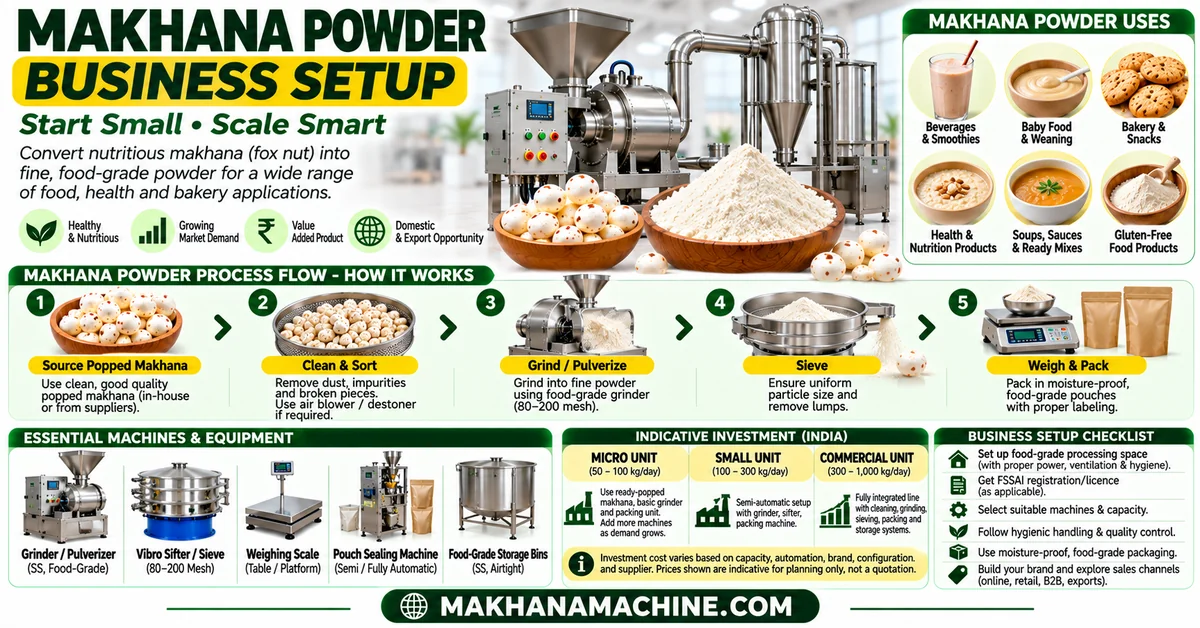
Makhana powder also called fox nut flour or lotus seed powder is becoming a strong value-added product for health-food brands, bakeries, baby-food formulators, ayurvedic product makers, and packaged-food companies. A dedicated makhana powder grinding machine lets you convert cleaned makhana into a fine, uniform powder that can be sold directly or used in laddus, cookies, porridge mixes, protein blends, and ready-to-cook products.
India is the world’s largest makhana producer, accounting for roughly 80% of global production, and the domestic makhana market has grown at about 17–18% annually between 2021–22 and 2024–25. That makes powder grinding a sensible entry point for entrepreneurs who want to move beyond selling raw or roasted makhana and capture more value per kilogram.
This guide explains how to select the right machine, plan your unit, meet compliance requirements, estimate costs and payback, and build a profitable makhana powder business in India.
What Is a Makhana Powder Grinding Machine?
A makhana powder grinding machine is a food-grade pulverizer or grinding system designed to convert dried or lightly roasted makhana kernels into fine flour. Unlike a general grain mill, it should handle makhana’s light, brittle texture without excessive heating, oil separation, or inconsistent particle size.
Commercial machines commonly use an impact pulverizer, hammer mill, or pin mill configuration. A suitable machine can typically produce powder in the 60–100 mesh range, depending on the sieve and application.
A practical production flow is:
- Cleaning and grading – Remove dust, stones, broken kernels, and foreign material.
- Drying or light roasting – Reduce surface moisture and improve grindability.
- Cooling – Allow makhana to cool for around 20 minutes before grinding, as recommended in makhana processing guidance.
- Grinding – Feed makhana into the pulverizer to obtain fine powder.
- Sieving – Ensure uniform particle size and remove coarse particles.
- Packing – Fill food-grade, moisture-proof pouches or bulk bags.
Why Makhana Powder Is a Good Business
Makhana powder is more versatile than whole makhana and can serve multiple customer segments:
- Health-food brands: Protein mixes, millet blends, energy laddus, and gluten-free baking mixes.
- HoReCa buyers: Hotels, cafés, bakeries, and cloud kitchens using it in desserts and batters.
- Ayurvedic and nutrition brands: Health drinks, porridge mixes, and functional food formulations.
- Retail consumers: Ready-to-use flour for homemade laddus, halwa, pancakes, and baby-food preparations.
- Industrial buyers: Food manufacturers needing a consistent ingredient for cookies, snacks, and bakery products.
The opportunity is supported by rising demand for makhana-based products. India produces more than 0.6 lakh metric tonnes of makhana annually, and about 40% is exported, while the rest is consumed domestically. Makhana powder also has a separate export classification, with HS code 2008-1922 used for makhana flour/powder.
Choosing the Right Grinding Machine
Before buying, do not choose only on price. The right makhana powder grinding machine should match your target output, powder fineness, power availability, hygiene standards, and expansion plans.
Key specifications to check
| Specification | What to look for |
| Capacity | Choose based on kg/hour input or output; small units may start around 10–30 kg/hour, while commercial systems can handle 50–100+ kg/hour. |
| Material of construction | Food-grade stainless steel, preferably SS304, for all product-contact parts. |
| Grinding mechanism | Impact pulverizer, hammer mill, or pin mill; select based on required fineness and heat generation. |
| Powder fineness | Confirm mesh size, commonly 60–100 mesh for fine makhana powder. |
| Motor power | Match to your available single-phase or three-phase supply; larger commercial systems often require 415 V, three-phase power. |
| Dust control | Look for enclosed feeding, dust collection, and easy cleaning. |
| Sieving system | A built-in or separate vibro sifter helps maintain consistent powder quality. |
| Safety features | Emergency stop, guards, overload protection, and stable mounting. |
| After-sales support | Ask about installation, operator training, spare parts, warranty, and service response time. |
Capacity planning
Your machine capacity should be based on realistic working hours, not maximum nameplate capacity.
For example:
- A 10–30 kg/hour machine may suit a small home-based or pilot unit.
- A 50 kg/hour machine can support a growing local brand.
- A 100 kg/hour or higher system is more appropriate for bulk supply, private labeling, or industrial ingredient sales.
Makhana processing equipment is available in a broad range, from small 10–20 kg/hour units to automated lines above 200 kg/hour. For powder grinding specifically, capacity depends heavily on the desired fineness: finer powder generally means slower throughput and more sieving.[
Space, Power, and Utilities
A makhana powder unit does not need a large factory at the beginning, but it does need a clean, dry, ventilated workspace with proper material flow.
Space requirement
For a small commercial setup, plan for:
- Grinding machine area
- Raw makhana storage
- Cleaning and roasting area, if roasting in-house
- Sieving and packing area
- Finished-goods storage
- Office or records area
- Washroom and handwashing area
A compact 300–600 sq. ft. space may be enough for a small grinding-and-packing operation, while a full processing line with roasting, grading, grinding, sieving, and automated packing may need 800–3,500 sq. ft. or more. Larger makhana plants are commonly planned around 800 sq. ft. for 50 kg/hour capacity and 3,500 sq. ft. for 100 kg/hour capacity.
Power requirement
Power needs vary by machine size and whether roasting is included. A standalone grinder may require less power than a complete processing line. Commercial food-processing machinery often uses a 415 V, three-phase, 50 Hz connection, so confirm your electricity sanction before ordering.
Before installation, ask the supplier for:
- Connected load in kW or HP
- Recommended phase and voltage
- Starting current and whether a starter or VFD is needed
- Earthing and safety requirements
- Expected power consumption per kg of powder
Other utilities
You will also need:
- Clean water for cleaning and staff hygiene
- Proper drainage
- Ventilation to control dust and heat
- Fire extinguishers
- Pest-proof doors, windows, and storage
- Weighing scale
- Moisture meter, preferably
- Sealing or pouch-packing machine
Licenses and Compliance in India
Food businesses in India must obtain the applicable FSSAI registration or license before manufacturing, processing, repacking, or selling food. Operating without the required FSSAI authorization violates the Food Safety and Standards Act, 2006.
FSSAI registration or license
The correct category depends mainly on turnover and production capacity.
|
Business scale |
Typical requirement |
| Turnover up to ₹12 lakh per year and production capacity up to 100 kg/day |
Basic FSSAI Registration; fee is ₹100 per year. |
|
Larger food businesses, generally above 100 kg/day up to 2 MT/day |
State FSSAI License; fees commonly range from ₹2,000 to ₹5,000 per year depending on category. |
| Above 2 MT/day or qualifying larger operations |
Central FSSAI License; fee is ₹7,500 per year. |
Apply through FoSCoS, the official FSSAI online licensing and registration system.
Other registrations
Depending on your structure and scale, you may also need:
- GST registration, generally once turnover crosses the applicable threshold.
- Udyam/MSME registration, which is free and can help with government schemes and financing.
- Trade license, if required by your local municipal body.
- Factory license or labour registrations, depending on employee count and state rules.
- Pollution/NOC requirements, if applicable to your premises and machinery.
- Fire safety compliance, especially for a commercial unit.
- IEC and APEDA registration, if you plan to export makhana powder.
Do not treat compliance as paperwork only. A clean facility, traceable raw-material records, pest control, staff hygiene, and proper labeling will directly affect buyer trust and repeat orders.
Machinery and Setup Investment
Your investment will depend on whether you buy only a grinder or set up a complete powder-production line.
Basic setup
A basic makhana powder unit may include:
- Cleaning sieve or cleaning machine
- Roaster or roasting pan, optional
- Makhana powder grinding machine
- Vibro sifter or sieve
- Weighing scale
- Pouch sealing machine
- Storage racks and food-grade containers
This is suitable for a small entrepreneur supplying local retailers, nutrition stores, bakeries, or direct-to-consumer customers.
Commercial setup
A commercial setup may add:
- Automatic cleaning and grading system
- Continuous roaster
- Cooling conveyor
- Pulverizer with dust collection
- Vibro sifter
- Automatic pouch packing machine
- Metal detector or checkweigher
- Batch-coding and labeling system
Makhana machinery capacities commonly range from around 30 kg/hour for small units to 200 kg/hour or more for industrial lines. Complete plant requirements also rise with capacity one industry guide estimates approximately 12 kW and 800 sq. ft. for 50 kg/hour, 26–27 kW and 3,500 sq. ft. for 100 kg/hour, and 60 kW and 5,500 sq. ft. for 200 kg/hour.
How Much Can You Earn?
A realistic business model should be based on your selling price, raw-material cost, yield, labour, packaging, power, and distribution costs.
Makhana powder/flour is often estimated to sell in the ₹800–₹1,200 per kg range in value-added markets, with raw material costs around ₹300–₹500 per kg and estimated margins of 40–60%. Actual margins vary widely by brand, packaging, channel, and quality.
Sample monthly model
Assume a small commercial unit grinding 20 kg per hour for 6 productive hours per day, 25 days per month:
- Monthly output: 20 × 6 × 25 = 3,000 kg
- Average selling price: ₹900 per kg
- Monthly revenue: ₹27 lakh
This is a gross-sales illustration, not profit. From this revenue, deduct:
- Raw makhana cost
- Labour
- Electricity
- Packaging
- Freight
- Rent
- Marketing
- Machine EMI or depreciation
- Compliance and testing costs
A more conservative early-stage target may be 500–1,500 kg per month while you build distributor, retail, and institutional demand.
What Is a Realistic Payback Period?
Payback period depends on machine cost, utilization, selling price, and working-capital needs. For a small grinding setup, many entrepreneurs should plan for 12–24 months, while a larger automated line may take longer if sales volumes are not secured early.
A simple calculation is:
{Payback period} = {Total initial investment}}\{Average monthly net cash profit}
For example, if your total setup cost is ₹8 lakh and your average monthly net profit after all operating expenses is ₹50,000, the payback period is:
{8,00,000}\{50,000} = 16 { months}
Avoid calculating payback using only gross margin. Include marketing costs, payment cycles, damaged stock, machine maintenance, and the working capital locked in raw material and finished inventory.
Business Models to Consider
1. Sell branded makhana powder
Create your own retail brand in 200 g, 500 g, and 1 kg packs. This offers better margins but requires packaging design, digital marketing, and distribution.
2. Supply to nutrition and bakery brands
Sell in 5 kg, 10 kg, or 25 kg bags to bakeries, health-food brands, and food manufacturers. This gives steadier volumes but usually requires consistent quality and documentation.
3. Private labeling
Produce powder under another brand’s label. This reduces marketing work but demands strict quality consistency and reliable supply.
4. Local retail and institutional sales
Sell through grocery stores, ayurvedic shops, gyms, diet clinics, bakeries, and local wholesalers. This is often the fastest way to test demand.
5. Export-oriented supply
Once your process, documentation, and quality systems are stable, explore export buyers. Export businesses require an FSSAI Central License, and makhana flour/powder has a distinct HS code.
Quality Control Checklist
Quality is the biggest differentiator in makhana powder. Buyers will judge your product on colour, aroma, fineness, moisture, cleanliness, and consistency.
Follow these practices:
- Buy cleaned, graded makhana from reliable suppliers.
- Test moisture before grinding; excess moisture causes poor grinding and shorter shelf life.
- Cool makhana before grinding to avoid heat-related quality issues.
- Use food-grade SS304 contact parts.
- Sieve every batch to maintain uniform mesh size.
- Keep batch records for raw material, production date, operator, and packing date.
- Store powder in airtight, moisture-proof packaging.
- Conduct periodic microbiological and moisture testing as required by your buyers or FSSAI category.
- Use clear labels with ingredients, net weight, batch number, manufacturing date, best-before date, storage instructions, and FSSAI license number.
Common Mistakes to Avoid
- Buying a machine before confirming buyers. Secure at least a few pilot customers or distribution commitments.
- Choosing capacity based on peak demand. Plan for average monthly demand and realistic working hours.
- Ignoring powder fineness. A laddu maker, bakery, and nutrition brand may need different mesh sizes.
- Underestimating packaging. Makhana powder is sensitive to moisture; poor packaging can ruin shelf life.
- Skipping operator training. Proper feeding rate, sieve selection, and cleaning routines affect output quality.
- Not checking service support. Downtime can be more expensive than a slightly higher machine price.
- Starting with too much inventory. Build sales gradually and keep working capital available.
Conclusion
A simple makkah powder grinding machine can get you into the quickly expanding Indian value added makhan market. It’s not always the biggest machine with the largest capacity that wins simply ensure your capacity, mesh size, local electricity supply, hygiene standards, and after sales service are tailored to actual customer demand. Begin with a small SS304 grinding and packing unit; find some pilot end users, get the right FSSAI registration, and stay on top of quality control through cleaning drying sieving, moisture testing, and moisture proof packing; and sell through local traders bakeries nutrition brands or private label brands until you can move into branded retail or export. With disciplined costing, dependable supply and consistency of finished powder, a small unit can achieve regular sales and a 12-24 month payback.
FAQS
- What is the actual output in kg/hour at my required mesh size?
Produced quantity is 50100 kg/hour, based on the required mesh size and feed moisture.
- Is the machine suitable for popped makhana, unpopped kernels, or both?
Though it is suitable for popped makhana, unpopped ones must be pre-roasted or cracked.
- Which parts are SS304 and, which are not?
The contact parts hopper grinding chamber, and sieve are made of SS304, mild steel is used for the main frame.
- What is the connected load and recommended power supply?
Connected load is approximately 7.5 kW; the proposed supply is 415 V, three phase, 50 Hz.
- What floor area and ceiling height does the machine require?
It takes about 10 ft 8 ft floor space and 910 ft high ceiling.
- Does it include dust collection, sieving, and what fineness/rejection rate?
Yes, it has cyclone dust collection as well as a sieve. Fineness is 60-100 mesh with little rejected.
- What warranty, spare parts, delivery, installation, training, and service support are included?
One-year warranty, essential spares, 3–4 week delivery, installation, operator training, and service support included.