
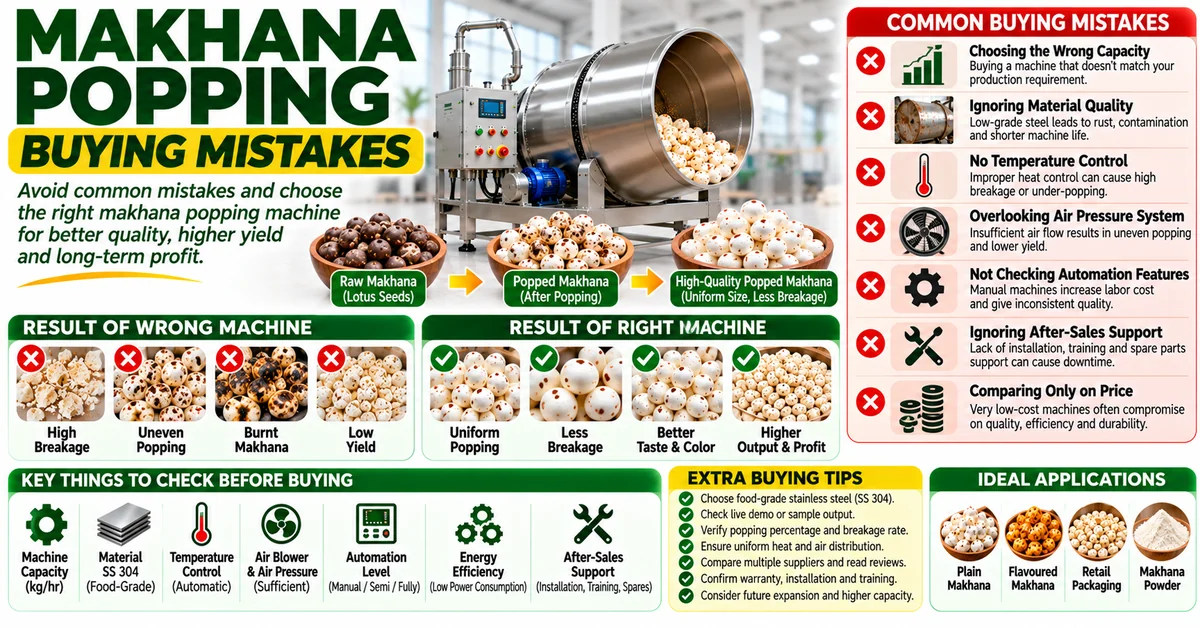
A makhana popping machine converts cleaned and roasted makhana seeds into the light, expanded fox nuts sold as phool makhana. Buying the right machine can reduce labour, improve popping consistency, and make your unit saferbut buying the wrong capacity, heating system, or supplier can lock your capital into equipment that does not match your market.
The most common first-time mistake is buying a machine based only on its advertised kg/hour capacity. In real makhana processing, output depends on seed grade, moisture, roasting quality, operator skill, and the popping efficiency of the machinenot just the nameplate figure. A properly developed makhana popping system has been reported to achieve around 80–85% popping efficiency at roughly 10 kg/hour feed rate.
This guide explains what a makhana popping machine does, which mistakes to avoid, how to choose between semi-automatic and fully automatic systems, and what to verify before paying an advance.
What Does a Makhana Popping Machine Do?
Makhana popping is not simply “roasting.” It is a controlled process in which moisture inside the conditioned makhana seed turns into superheated steam; when pressure is suddenly released, the kernel expands and the hard outer shell breaks. The expanded kernel is what consumers know as makhana or fox nut.
Traditional processing involves roasting seeds at very high temperaturesoften 250–320°Cfollowed by manual striking with a mallet. This method is labour-intensive and exposes workers to intense heat and burns.
A mechanized popping machine typically combines:
- Preheating or roasting: Conditions the seed for popping.
- Impact or popping chamber: Breaks the heated seed and releases the expanded kernel.
- Discharge and separation: Collects popped makhana and shell fragments.
- Cooling and grading: Prepares the output for cleaning, sorting, and packing.
ICAR-CIPHET has developed and commercialized a mechanized system covering threshing, cleaning, grading, drying, roasting, and popping. Its insulated barrel design reduces worker exposure to heat and eliminates manual malleting by allowing hot roasted seeds to strike a closed casing automatically.
Why the Right Machine Matters
A good makhana popping machine should deliver four things:
- Consistent popping percentage: Fewer unpopped or half-popped seeds.
- Lower breakage: More whole, saleable makhana.
- Safe operation: Reduced direct contact with hot seeds and high-temperature surfaces.
- Predictable capacity: Output that supports your daily sales and labour plan.
Mechanization can also shorten the process dramatically. ICAR reports that its mechanized system reduces processing time from 2–3 days to about 20 hours. For a growing processor, that difference can determine whether you can fulfil bulk orders on time.
Mistake 1: Buying Capacity Without Checking Real Output
Many buyers see “50 kg/hour” or “100 kg/hour” and assume that is the quantity of finished popped makhana they will receive every hour. That is rarely true.
Capacity can refer to:
- Raw seed input rate
- Roasting capacity
- Popping-chamber throughput
- Finished popped makhana output
- Maximum laboratory or ideal-condition capacity
Before ordering, ask the supplier to specify input kg/hour, popped output kg/hour, and expected popping efficiency under your seed conditions.
For example, one reported makhana popping machine operated satisfactorily at a 10 kg/hour feed rate with 80–85% popping efficiency. If your raw material has higher moisture, uneven grading, or poor pre-roasting, actual performance may be lower.
What to ask the supplier
- Is the quoted capacity based on raw seed or popped output?
- What popping percentage is guaranteed, and under what seed grade?
- What moisture level is ideal before popping?
- What seed size range does the machine handle best?
- How many operators are required per shift?
- What is the realistic output after eight hours of continuous running?
Mistake 2: Ignoring Seed Grading and Pre-Processing
A popping machine cannot fix poor raw material. Makhana seeds must be cleaned, washed, dried to the right moisture level, and graded before roasting and popping. Uneven seed sizes pop unevenly because smaller and larger seeds need different heat exposure.
Before buying the popping machine, plan for:
- Cleaning: Remove dust, mud, stones, and foreign matter.
- Washing and drying: Bring seeds to suitable moisture for roasting.
- Grading: Separate seeds by size so heat penetration is uniform.
- Roasting: Use a compatible roaster or preheater.
- Cooling/conditioning: Allow seeds to stabilize before final popping.
A complete mechanized line includes threshing, cleaning, grading, drying, roasting, and poppingnot popping alone. If your budget is limited, buy a popping machine that matches your existing roasting and grading setup rather than buying an oversized popper that will remain underutilized.
Mistake 3: Choosing the Wrong Heating System
Heating affects fuel cost, temperature control, popping quality, and operating safety. Traditional makhana processing uses very high temperatures, while mechanized systems may use electrically heated thermic oil in a closed barrel; ICAR notes that other heating sources can also be used depending on availability.
Common options include:
| Heating option | Advantages | Points to check |
| Electric heating | Clean, easy to control, suitable where power supply is stable | Connected load, phase, backup power, electricity cost |
| LPG/gas heating | Fast heating and potentially lower fuel cost in some locations | Gas safety, regulator quality, ventilation, approvals |
| Diesel/thermic oil | Useful where electricity is unreliable | Fuel storage, emissions, maintenance, temperature control |
| Hybrid heating | Flexibility during power or fuel shortages | Complexity, switch-over system, service support |
Do not choose heating based on the lowest machine price alone. Calculate the cost per kg of popped makhana over a month, including electricity or fuel, labour, maintenance, and wastage.
Mistake 4: Buying Fully Automatic Too Early
A fully automatic makhana popping machine can improve consistency and reduce labour, but it usually costs more, needs better utilities, and requires trained operators. For a first-time processor, a semi-automatic machine is often easier to operate, maintain, and scale gradually.
Semi-automatic vs fully automatic
| Factor | Semi-automatic | Fully automatic |
| Initial investment | Lower | Higher |
| Labour requirement | Moderate | Lower |
| Operator skill needed | Basic to moderate | Higher |
| Output consistency | Good with trained staff | Usually more consistent |
| Maintenance complexity | Simpler | More complex |
| Best for | Startups and small processors | Established units with steady orders |
| Expansion | Easier to upgrade in stages | Better for high-volume production |
Market listings show a wide range of makhana popping machines: mini semi-automatic models around 8–10 kg/hour, standard models around 20–25 kg/hour, and larger plants capable of 40–80 kg/hour or more. Other commercial listings include 25 kg/hour, 50 kg/hour, and higher-capacity systems.
Practical advice: Start semi-automatic if you are still testing buyers, seed suppliers, and product quality. Move to fully automatic only when you have stable demand, trained staff, and reliable utilities.
Mistake 5: Overlooking Material Quality and Safety
Makhana comes into direct contact with hot surfaces, so machine construction and safety design matter.
Check:
- Food-contact material: Prefer SS304 stainless steel for product-contact areas where possible.
- Insulation: Proper insulation protects operators and reduces heat loss.
- Emergency stop: Must be accessible from the operator’s position.
- Guards: Rotating parts, belts, and hot zones should be protected.
- Temperature control: Digital controls and reliable sensors help prevent burning or under-popping.
- Dust and fume management: Roasting generates heat, smoke, and fine particles.
- Stable base: The machine should not vibrate excessively during operation.
- Fire safety: Keep extinguishers and clear exits around the machine.
The ICAR-developed system specifically uses a thermally insulated barrel to protect workers from intense heat and avoid manual malleting. That is the kind of operator-safety feature worth prioritizing.
Mistake 6: Not Calculating Total Cost of Ownership
The purchase price is only one part of the investment. A machine that looks affordable may become expensive if it consumes too much power, needs frequent repairs, or produces high wastage.
Include these costs in your project plan:
- Machine price and taxes
- Transportation and installation
- Electrical wiring, starters, and earthing
- Roaster, grader, cleaner, and sieve, if not included
- Packing machine and weighing scale
- Labour and training
- Electricity, gas, diesel, or other fuel
- Spare parts and annual maintenance
- Working capital for raw makhana and packaging
- FSSAI, GST, and other compliance costs
Makhana machinery prices vary widely by capacity and automation. Industry price guides place basic roasting machines from about ₹50,000–₹1.5 lakh, semi-automatic systems from ₹1.5–₹5 lakh, and fully automatic roasting and flavouring systems from ₹8–₹18 lakh. Popping-specific models also range from mini startup units to larger plants costing several lakhs.
ICAR has estimated that a mechanized makhana popping system may require about ₹15 lakh in fixed cost and ₹5 lakh monthly working capital, with a reported breakeven period of around six months under its project assumptions. Treat that as a reference point, not a guarantee; your actual payback depends on sales price, seed cost, yield, and capacity utilization.
Mistake 7: Skipping a Live Trial or Demo Video
Photographs and brochures cannot show popping quality. Before paying an advance, insist on a demonstration using makhana similar to the grade you will process.
Ask for:
- A live trial at your site or the supplier’s facility
- A video showing feeding, roasting, popping, discharge, and cleaning
- Sample output after continuous running
- Data on unpopped seeds, broken kernels, and shell separation
- Power consumption during the trial
- Details of the operator training included
If a supplier cannot provide a demo or clear performance data, treat that as a warning sign.
Mistake 8: Not Checking After-Sales Support
A makhana popping machine is a production asset. If it stops during peak season, every idle day affects revenue.
Before purchase, confirm:
- Warranty period and what it covers
- Response time for service calls
- Availability of heaters, motors, belts, bearings, and control parts
- Whether installation and commissioning are included
- Whether operator training is provided
- Whether the supplier can support your city or district
- Whether spare parts are standardized or proprietary
Ask for the service contact person’s name and response commitment in writing. A slightly costlier machine from a responsive manufacturer is often safer than a cheaper machine with weak support.
What to Check Before Paying an Advance
Use this checklist before transferring money:
- Written quotation: Machine model, capacity, dimensions, weight, material, power load, and included accessories.
- Performance commitment: Popping efficiency, output rate, and acceptable breakage percentage.
- Heating details: Fuel type, connected load, temperature range, and safety controls.
- Material specification: SS304 or other food-contact material clearly mentioned.
- Delivery timeline: Manufacturing, dispatch, installation, and commissioning dates.
- Payment terms: Advance, balance, and milestone-linked payments.
- Warranty terms: Duration, exclusions, and spare-part policy.
- Installation and training: Confirm whether they are free, chargeable, or included in freight.
- Trial condition: Ask for a demo before final payment or include acceptance criteria in the purchase order.
- GST invoice and company details: Verify the manufacturer’s legal name, GSTIN, and bank account.
Never rely on a WhatsApp message alone for technical commitments. Put capacity, material, warranty, delivery, and installation terms in the purchase order or proforma invoice.
How to Plan Your First Makhana Popping Unit
A practical starting layout should follow the material flow:
Raw makhana storage → cleaning → washing/drying → grading → roasting → popping → cooling → de-shelling/separation → grading → packing
For a new entrepreneur, avoid buying every machine at once. A sensible sequence is:
- Start with a semi-automatic popping machine matched to your roasting capacity.
- Add or upgrade grading and cleaning equipment as volumes grow.
- Standardize seed moisture and roasting practice.
- Build a small base of retailers, wholesalers, or brand buyers.
- Add automation, packing, flavouring, or higher-capacity equipment once demand is proven.
This approach protects working capital and helps you learn the variables that affect popping quality before committing to a large automated line.
Conclusion
A makhana popping machine can transform a small makhana business into a consistent, scalable processing unitbut only if you buy it for the right reasons. Avoid choosing a machine based only on price or advertised capacity. Instead, verify actual popping output, seed-grading requirements, heating system, power load, construction quality, safety features, and after-sales support. For most first-time buyers, a semi-automatic machine is the practical starting point, while fully automatic systems suit established processors with steady demand. Always request a live demo or trial video, get all technical commitments in writing, and calculate the total cost of ownership before paying an advance. With the right machine, reliable raw material, and a clear sales plan, a makhana popping unit can deliver strong long-term returns.
FAQs
1. What is the most common mistake first-time buyers make?
The most common mistake is buying based only on advertised capacity. Buyers often do not ask whether the quoted kg/hour refers to raw seed input or finished popped output, nor do they check popping efficiency, seed grade, moisture requirements, and actual running output. A reported makhana popping machine achieved 80–85% popping efficiency at about 10 kg/hour feed rate, showing that real performance must be evaluated beyond the capacity label.
2. What capacity should a beginner buy?
For most first-time entrepreneurs, an 8–25 kg/hour semi-automatic machine is a practical starting range. Mini models around 8–10 kg/hour are often marketed for startups, while standard models around 20–25 kg/hour suit small commercial units. Choose capacity based on your confirmed monthly sales, not on the largest machine you can finance.
3. Semi-automatic or fully automatic: which should I start with?
Start with semi-automatic if you are new to makhana processing, have limited working capital, or are still developing buyers. It is easier to operate and maintain. Choose fully automatic when you have steady orders, trained staff, reliable power or fuel supply, and enough volume to justify the higher investment.
4. What should I check before paying an advance?
Check the written quotation, machine specifications, capacity definition, material of construction, heating system, warranty, delivery date, installation terms, operator training, and spare-parts availability. Also request a live demo or detailed trial video before final payment.
5. Does the machine include roasting?
Not always. Some suppliers sell a standalone popping machine, while others offer a roaster-cum-popper or a complete processing line. A complete mechanized system may include cleaning, grading, drying, roasting, and popping operations. Confirm exactly which operations are included before comparing prices.
6. What power supply does a makhana popping machine need?
It depends on capacity and heating type. Smaller semi-automatic machines may run on single-phase power, while larger commercial systems commonly require three-phase supply. Some commercial models list single-phase operation for mini units and three-phase for larger plants. Ask for the connected load in kW or HP and confirm your electricity sanction before ordering.
7. How long does it take to recover the investment?
Payback depends on machine cost, capacity utilization, seed cost, popping yield, selling price, and working capital. ICAR has reported a breakeven period of around six months for its mechanized popping system under specific project assumptions, with approximately ₹15 lakh fixed cost and ₹5 lakh monthly working capital. For a smaller semi-automatic setup, a more conservative planning range is often 12–24 months.