
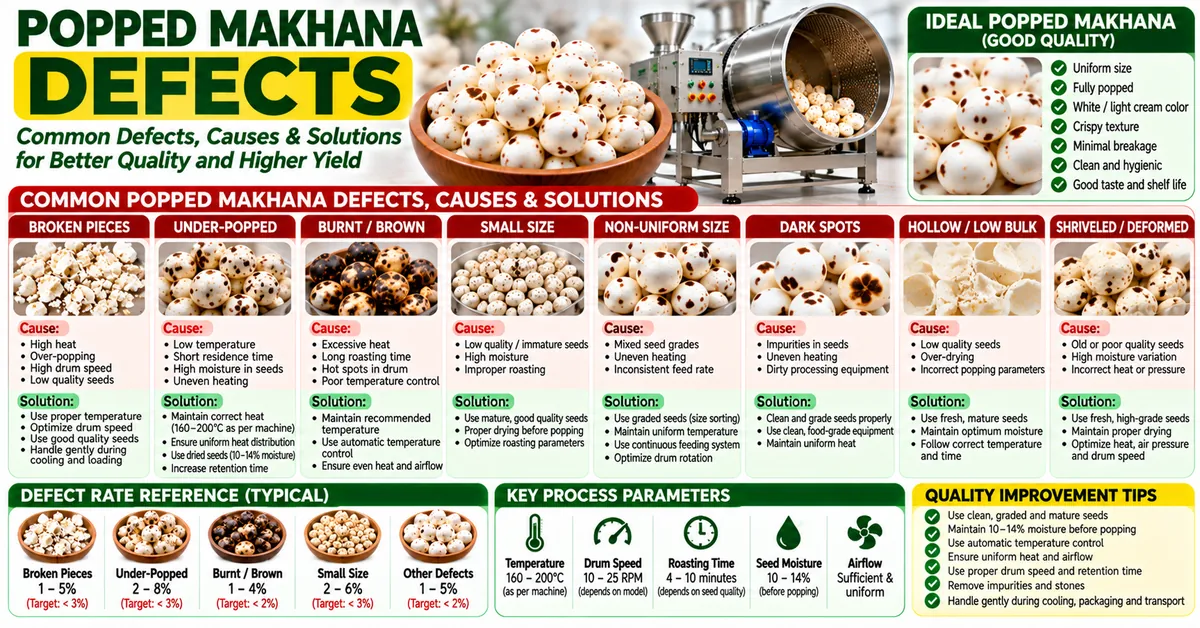
Popped makhana quality is decided long before the seed reaches the popping stage. Poor drying, uneven grading, incorrect roasting, inadequate tempering, delayed popping, and poor storage can all cause defects such as unpopped seeds, hard kernels, broken makhana, dull colour, burnt lots, or low yield.
This guide explains the most common popped makhana defects, their likely causes, and practical corrective actions for Indian makhana processors, machine operators, and food-business founders.
Why Defects Occur in Makhana Popping
Makhana popping is a controlled transformation. The seed must retain enough internal moisture to generate steam pressure, while its shell must become brittle enough to break cleanly during roasting and impact.
If the seed is too wet, too dry, unevenly heated, or popped at the wrong stage, the kernel may not expand properly. Research on roasted makhana seeds indicates that an optimum roasted-seed moisture range of approximately 15–15.53% on a dry basis supports good popping performance, while excess moisture above about 16% has been associated with bursting during popping of freshly roasted seeds.
Even small variations in seed moisture, seed size, roasting temperature, batch size, and operator handling can change the popping rate and final quality.
Defect 1: Unpopped or Hard Makhana Seeds
What it looks like: Seeds remain hard, dense, or fail to expand into light white popped makhana.
Likely causes:
- Seed moisture is too low or too high
- Pre-roasting temperature or time is incorrect
- Tempering time is too short
- Final roasting is insufficient
- Seed is popped after cooling
- Seed size is not uniform
- Poor-quality, hollow, or damaged seeds are mixed into the batch
How to fix it:
Maintain a written process for drying, pre-heating, tempering, final roasting, and popping. Traditional processing commonly involves roasting, tempering for 48–72 hours, and a second roasting stage before popping. A study also describes initial roasting at 270–280°C, tempering for 48 hours, and final roasting at 260–270°C before machine popping.
Also avoid mixing large and small seeds. Larger seeds need more heat time, while smaller seeds heat faster and can over-roast if processed together.
Defect 2: Low Popping Yield
What it looks like: The batch produces fewer usable popped makhana than expected.
Likely causes:
- Poor raw-seed quality
- Incorrect moisture level
- Uneven seed grading
- Inconsistent roasting temperature
- Overloading the roaster or pan
- Delay between final roasting and popping
- Excessive breakage or burnt material
- No standard operating procedure
How to fix it:
Track yield batch-wise. Processing guidance suggests that around 100 kg of makhana seed can yield approximately 38–40 kg of popped makhana, or about 40–42% recovery, though actual results vary with process control.
Record the seed source, grade, batch weight, moisture condition, roasting time, temperature, unpopped seeds, broken makhana, and rejected material. Comparing these records across batches helps identify whether the issue is raw material, moisture, heat, or operator handling.
Defect 3: Broken Makhana and Excessive Fragments
What it looks like: Popped makhana breaks into small pieces, reducing premium-grade output.
Likely causes:
- Seed is over-roasted
- Seed is too dry
- Impact pressure or machine setting is too high
- Seed is popped too late
- Kernel expansion is uneven
- Seed shell is damaged before popping
- Handling after popping is rough
How to fix it:
Control final roasting carefully and avoid overheating. Excessive heat can damage seeds during roasting. Use consistent impact settings or hammer pressure, and pop seeds while they are still hot rather than allowing them to cool. Traditional guidance notes that even a short delay in hitting hot roasted seeds can prevent proper popping.
Separate premium popped makhana from broken pieces and unpopped seeds rather than mixing all output together. This makes grading, pricing, and quality control easier.
Defect 4: Brown, Yellow, or Dull Popped Makhana
What it looks like: Kernels are not white or creamy; they appear brown, yellow, grey, or dull.
Likely causes:
- Over-roasting
- Local overheating due to poor stirring
- Excessively high final roasting temperature
- Prolonged heating
- Poor seed quality
- Maillard reaction and caramelisation during high-temperature processing
- Storage-related colour changes
How to fix it:
Maintain uniform heat and avoid sudden flame changes. Stir or rotate seeds consistently to prevent local overheating. Research notes that colour changes during roasting are associated with degradation, oxidation, Maillard reaction, and caramelisation of sugars.
Also control storage. A study found significant colour changes in popped makhana after 135 days of storage, with increased redness and decreased lightness and yellowness. Use airtight packaging and avoid storing roasted seeds for unnecessarily long periods.
Defect 5: Burnt Kernels or Burnt Smell
What it looks like: Dark brown or black makhana, smoky smell, bitter taste, or excessive charred material.
Likely causes:
- Final roasting temperature is too high
- Roasting time is too long
- Pan or roaster is overloaded
- Seeds are not stirred uniformly
- Small seeds are processed with large seeds
- Machine heater or flame is uneven
- Operator ignores colour change during roasting
How to fix it:
Use consistent batch weights and avoid overloading the roasting pan or machine. Maintain a stable temperature and avoid sudden flame changes. Traditional processing uses very high temperatures, commonly reported between 250°C and 320°C, so close supervision is essential.
Grade seeds before roasting. Smaller seeds heat faster and can burn or over-roast if processed with larger seeds.
Defect 6: Bursting or Uneven Expansion
What it looks like: Seeds burst irregularly, split badly, or expand unevenly instead of forming uniform puffed kernels.
Likely causes:
- Freshly roasted seed moisture is too high
- Drying or pre-heating is inconsistent
- Tempering is inadequate
- Seed shell condition varies
- Final roasting is uneven
- Machine impact is applied incorrectly
How to fix it:
Manage moisture throughout the process. Fresh cleaned seeds are commonly sun-dried for about 2–3 hours to reduce moisture to around 25%, then pre-heated and tempered for 48–72 hours before final roasting and popping.
Tempering allows moisture to redistribute inside the seed, making later popping more uniform. Avoid popping seeds immediately after pre-roasting without the planned conditioning period.
Defect 7: Soft or Non-Crispy Popped Makhana
What it looks like: Popped makhana loses crunch after packing or becomes soft during storage.
Likely causes:
- Popped makhana is packed while hot
- Finished product moisture is too high
- Packaging is not moisture-resistant
- Storage area is humid
- Popped makhana is exposed to air after opening
- Delay between popping and packing
How to fix it:
Cool popped makhana before packing. A seed that is packed hot can go soft due to moisture migration. Use moisture-barrier packaging and store finished makhana in a dry area.
Industrial processing guidance for export-grade lots targets final moisture content of 7% or below for crispness and shelf life. Verify the appropriate finished-product moisture specification for your market, product type, and packaging format before publishing regulatory or export claims.
Defect 8: Foreign Material and Poor Cleanliness
What it looks like: Mud, husk dust, stones, damaged seeds, or other foreign matter remains in the final lot.
Likely causes:
- Inadequate washing or cleaning
- Poor grading
- No magnetic trap or inspection system
- Damaged or hollow seeds are not removed
- Poor hygiene in drying, roasting, or packing areas
How to fix it:
Clean and inspect raw seeds before processing. Check for mud, stones, damaged seeds, hollow seeds, and foreign material. Use grading and sorting equipment to remove unsuitable seeds before roasting.
After popping, use polishing, sieving, and sorting to remove residual brown husk dust and separate kernels by size.
Defect 9: Inconsistent Quality Between Batches
What it looks like: One batch pops well, while the next has poor colour, low yield, or excessive breakage.
Likely causes:
- Different seed sources or varieties
- Changing moisture levels
- No fixed batch weight
- Inconsistent roasting time and temperature
- Operator-dependent popping
- No batch records
- No acceptance criteria
How to fix it:
Create a standard operating procedure covering cleaning, drying, grading, pre-heating, tempering, roasting, and popping. Include target moisture, seed grade, batch weight, temperature range, roasting time, and acceptance criteria.
Use the same seed grade and batch weight where possible. Maintain consistent roasting conditions and record operator observations for every batch.
Defect 10: Poor Storage Performance of Roasted Seeds
What it looks like: Roasted seeds that initially pop well begin giving poor recovery, colour, or expansion after storage.
Likely causes:
- Roasted seeds are stored too long
- Packaging does not block moisture or air
- Storage moisture is not controlled
- Seed is exposed to heat or humidity
- Popping is delayed beyond the recommended period
How to fix it:
Research indicates that popping of roasted makhana seeds should generally be performed within 10 days of primary roasting. Another study found that 80 μm LDPE, BOPP, PP, and silver-laminate packets helped maintain popping efficiency, recovery, and expansion for longer storage periods than thinner 15 μm LDPE packaging.
Use airtight, moisture-resistant packaging and maintain a controlled storage environment. Avoid treating roasted-seed storage as an open-ended waiting period.
Practical Quality Checklist for Processors
Use this checklist before and during every popping batch:
- Check raw seed quality, cleanliness, and foreign material
- Remove damaged, hollow, and undersized seeds
- Dry seeds to the planned moisture level
- Grade seeds into uniform size categories
- Avoid mixing grades in the same roasting batch
- Maintain consistent pre-heating temperature and time
- Stir continuously to avoid local overheating
- Temper seeds for the planned period
- Protect tempered seeds from moisture gain or loss
- Confirm seed condition before final roasting
- Avoid overloading the roaster or pan
- Maintain stable heat and avoid sudden flame changes
- Pop seeds at the correct hot stage
- Use consistent machine settings or impact pressure
- Separate unpopped seeds, broken makhana, burnt material, and premium output
- Weigh each category and calculate yield consistently
- Record batch data and rejection reasons
- Cool popped makhana before packing
- Use moisture-barrier packaging
- Store finished makhana in a dry environment
Common Mistakes to Avoid
Many popped makhana defects come from avoidable process-control mistakes:
- Mixing seed sizes in one batch
- Guessing moisture instead of checking seed condition
- Roasting at unstable temperatures
- Overloading the roaster
- Skipping or shortening tempering
- Delaying popping after final roasting
- Packing makhana while hot
- Using poor-quality packaging
- Failing to record batch results
- Relying only on operator experience instead of written procedures
When to Use Machines for Better Control
Machines can improve consistency when they provide controlled roasting, uniform heat transfer, repeatable impact, and reliable grading. Mechanised systems for cleaning, grading, drying, roasting, and popping have been developed to improve efficiency and working conditions.[makhana]
However, a machine does not eliminate defects by itself. It works best when paired with good raw material, correct moisture management, proper grading, trained operators, and batch-wise quality records.
Who Should Help You Reduce Defects?
A makhana processing consultant, machine supplier, or plant-setup partner can help with:
- Seed grading and moisture-control workflow
- Roasting and tempering parameters
- Machine selection and commissioning
- Operator training
- Standard operating procedures
- Yield tracking and rejection analysis
- Packaging and storage recommendations
For a new unit, start with small controlled batches, record every result, and refine the process before scaling production.
Conclusion
Most popped makhana defects are not random. They are usually caused by moisture imbalance, uneven grading, poor heat control, inadequate tempering, delayed popping, rough handling, or weak storage practices.
A processor who controls seed quality, moisture, grading, roasting, tempering, popping timing, and packaging can significantly improve white colour, expansion, crispness, yield, and batch consistency.
FAQs
Why do some makhana seeds not pop?
Seeds may not pop due to incorrect moisture, poor grading, insufficient roasting, short tempering, or popping after the seed has cooled.
Why is my popped makhana brown instead of white?
Brown colour is commonly caused by over-roasting, local overheating, prolonged heating, or Maillard and caramelisation reactions during high-temperature processing.
Does seed size affect popping quality?
Yes. Larger and smaller seeds transfer heat differently, so uniform grading is essential for even roasting and popping.
Why does popped makhana become soft after packing?
It may be packed while hot, contain excess moisture, or be stored in non-moisture-resistant packaging.
What is a good popping yield?
Around 100 kg of seed may yield approximately 38–40 kg of popped makhana, or 40–42% recovery, but actual yield varies with process control.
How long can roasted makhana seeds be stored before popping?
Research suggests roasted seeds should generally be popped within 10 days of primary roasting.
What is the first step to reduce defects?
Create a written standard operating procedure for cleaning, drying, grading, pre-heating, tempering, roasting, and popping, including target moisture, batch weight, temperature, and acceptance criteria.