
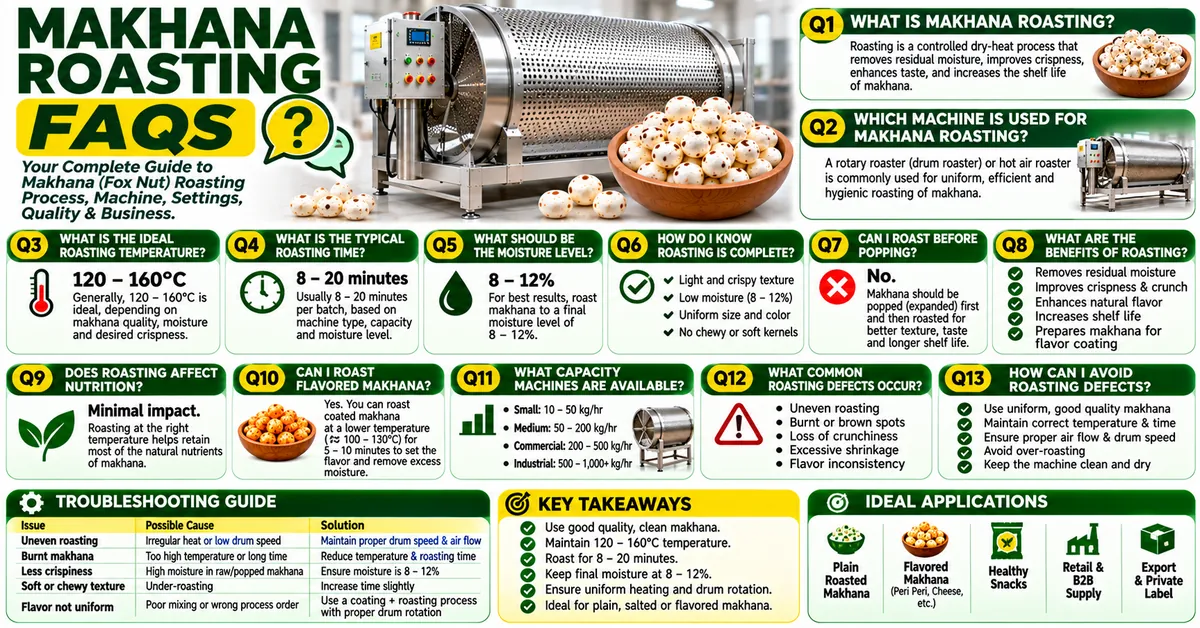
A makhana roasting machine helps Indian food businesses convert raw fox nuts into evenly roasted, market-ready makhana with better consistency, hygiene, and throughput than traditional manual roasting. Before buying one, the most important decisions are capacity, heating source, food-contact material, automation level, power supply, installation support, and after-sales service.
This guide answers the questions Indian makhana processors, snack brands, SHGs, and entrepreneurs most commonly ask before purchasing a commercial makhana roasting machine.
What is a makhana roasting machine?
A makhana roasting machine is food-processing equipment designed to heat and roast makhana, also called fox nuts or lotus seeds, uniformly. Depending on the model, it may use a rotating drum, hot-air system, pan roaster, or continuous roasting line to reduce manual handling and deliver consistent colour, crunch, and flavour.
Traditional makhana roasting is labour-intensive and typically handles small batches at a time. Mechanised systems can process substantially larger batches for example, one ICAR-CIPHET primary roasting machine is designed to roast about 10 kg of makhana seeds per batch and 80–100 kg of raw seed per hour.
Who should buy a makhana roasting machine?
A makhana roasting machine is suitable for:
- Home-based or micro food businesses producing small quantities of roasted makhana.
- Local makhana processors upgrading from manual roasting.
- Snack brands producing flavoured, roasted, or packaged makhana.
- Cooperatives, FPOs, SHGs, and rural processing units.
- Medium and large factories running continuous makhana processing lines.
The right machine depends less on the “biggest” model and more on your daily sales volume, available space, electricity or gas connection, labour availability, and packaging plans.
What capacity should a small makhana roasting machine business start with?
For most new or small businesses, a machine in the 15–50 kg per hour range is a practical starting point. It provides enough output for local retail, online sales, and early B2B orders without requiring a very large investment or industrial-scale infrastructure.
A simple planning approach is:
|
Business stage |
Typical daily target | Suitable machine type |
| Home or micro unit | 20–50 kg/day |
Basic manual or semi-automatic roaster |
|
Small-scale unit |
50–150 kg/day | Mid-range semi-automatic machine |
|
Growing brand |
150–400 kg/day |
Fully automatic roasting system |
| Large processor | 400 kg/day and above |
High-capacity continuous line |
Do not buy capacity only for peak demand. Calculate your realistic average daily requirement, then add a modest buffer for growth. A 50 kg/hour machine may be excessive if your current sales are only 30–40 kg per day, while a 10–15 kg/hour unit may quickly become a bottleneck if you receive regular retail or export enquiries.
What are the main types of makhana roasting machines?
Manual or basic roaster
These are lower-cost machines suitable for very small operations. They usually require more operator attention and are best for testing recipes, local sales, or initial market validation. Basic manual machines are commonly available for up to around 15 kg per hour.
Semi-automatic roaster
A semi-automatic makhana roasting machine automates key functions such as rotation, heating, temperature control, or discharge, while an operator manages feeding, monitoring, and collection. This is often the best balance of affordability, control, and output for small and medium businesses.
Fully automatic roaster
Fully automatic machines are designed for higher throughput and lower dependence on manual labour. They may include automated feeding, temperature control, drum rotation, discharge, and sometimes integration with flavouring, cooling, grading, or packaging equipment.
Continuous roasting line
Continuous systems are appropriate for established brands and industrial processors that need steady production across long shifts. These lines are usually part of a broader setup including cleaning, grading, roasting, flavouring, cooling, and packaging.
What capacity options are available in India?
Indian suppliers offer a wide capacity range. Common commercial options include approximately 20–25 kg/hour, 50–60 kg/hour, 100–120 kg/hour, and 200 kg/hour, though exact output varies by raw-material grade, moisture, batch size, and roasting profile.
Other supplier listings show machines from roughly 20 kg/hour to 200 kg/hour, with electric or gas heating and semi-automatic or automatic operation. Larger makhana processing setups can be designed for 80–500 kg/hour or more, particularly when roasting is integrated with grading, polishing, and packaging.
What specifications should you check before buying?
Ask the supplier for a written specification sheet covering at least the following:
- Production capacity: Kilograms per hour under real operating conditions, not only ideal laboratory conditions.
- Batch size: Important for batch roasters; it affects labour planning and changeover time.
- Heating source: Electric, LPG, PNG, diesel, or other fuel options.
- Temperature range: Many roasters offer digital temperature control, with some models covering roughly 50–290°C.
- Material of construction: Food-contact parts should preferably be SS 304 stainless steel.
- Power load: Check kW requirement, voltage, and whether single-phase or three-phase power is needed.
- Drum or pan design: Rotation speed, drum diameter, insulation, and ease of cleaning.
- Controls: Digital display, PID controller, safety cut-offs, emergency stop, and adjustable airflow.
- Footprint: Machine dimensions, installation area, ventilation, and operator movement space.
- Warranty and spares: What is covered, for how long, and how quickly spare parts can be supplied.
Food-grade SS 304 is widely used for food-contact surfaces in commercial roasting equipment, and suppliers commonly specify it for hygienic operation and durability.
Electric, LPG, or PNG: which heating source is better?
There is no single best fuel; the right choice depends on your site and cost structure.
|
Heating source |
Best suited for | Key considerations |
|
Electric |
Small units, urban locations, businesses needing clean operation | Easy control and cleaner working area, but higher electricity load may be required. |
| LPG |
Small and medium units without PNG access |
Portable and widely available, but fuel handling, cylinder storage, and safety procedures matter. |
| PNG | Units with a reliable piped-gas connection |
Convenient continuous fuel supply where infrastructure is available. |
| Diesel or wood-fired |
Select rural or cost-sensitive installations |
Fuel cost may be lower in some locations, but emissions, handling, and consistency need careful review. |
Before finalising, compare not only the machine price but also the cost per kilogram roasted, local fuel availability, safety requirements, and expected production volume.
How much space and power does a makhana roasting machine need?
Space and power requirements vary significantly by capacity. As an indicative example, supplier data for makhana processing equipment suggests approximately 2,000 sq ft for a 30 kg/hour setup, 5,000 sq ft for 50 kg/hour, and around 10,000 sq ft for a 100 kg/hour plant, depending on the complete line configuration.
Power requirements also rise with capacity. Some roasting machines are listed in the 6–25 kW range, while larger automatic systems may require substantially more power. Always confirm:
- Connected load in kW.
- Single-phase or three-phase requirement.
- Voltage and frequency.
- Whether a stabiliser, panel, wiring upgrade, or generator backup is needed.
- Ventilation and heat-discharge arrangements.
A machine that looks affordable can become expensive if your premises need an electrical upgrade, gas pipeline, exhaust system, or additional floor space.
What does a makhana roasting machine cost in India?
Prices vary widely by automation, capacity, material, heating system, controls, and brand support. Market estimates place basic manual machines at roughly ₹50,000–₹1.5 lakh, semi-automatic machines at ₹1.5–₹5 lakh, and fully automatic roasting-and-flavouring systems at ₹8–₹18 lakh. High-capacity continuous lines can exceed ₹18–25 lakh.
These figures are indicative, not fixed quotations. The final price can change based on SS 304 construction, PLC/HMI controls, custom drum design, gas train, feeding systems, installation, freight, GST, and after-sales commitments.
Can the machine be customised for a specific product?
Yes. Many manufacturers can customise a makhana roasting machine for product characteristics and production goals. Customisation may include drum type, rotation speed, heating source, temperature range, feeding system, discharge arrangement, insulation, controls, and compatibility with other makhana processing equipment.
For example, some machines offer customisable hexagonal or circular drums, adjustable airflow, and rotation speeds typically in the 10–28 RPM range depending on product density. If you plan to roast makhana along with peanuts, seeds, spices, or other dry snacks, ask whether the machine can handle multiple products without cross-contamination or lengthy cleaning downtime.
What after-sales support is typically included?
After-sales support can differ substantially between suppliers, so it should be confirmed in writing before purchase. Typical support may include:
- Installation and commissioning.
- Operator training.
- Operating and maintenance manual.
- Warranty on manufacturing defects.
- Spare-parts availability.
- Remote or on-site service support.
- Annual maintenance contracts.
- Technical assistance for recipe trials and process optimisation.
Some suppliers include installation and operator training in the machine price, while others charge separately. Before ordering, ask specifically: “What is included in the quoted price, what is chargeable later, and what is the response time for a breakdown?”
What maintenance does a makhana roasting machine require?
Routine maintenance keeps roasting uniform, reduces downtime, and extends machine life. A practical schedule includes:
- Daily: Clean product-contact surfaces, remove residual makhana dust, inspect heating elements or burners, and check controls.
- Weekly: Inspect belts, bearings, motors, fasteners, gas connections, and safety devices.
- Monthly: Check temperature accuracy, drum alignment, airflow, wiring condition, and lubrication points as recommended by the manufacturer.
- Quarterly or as advised: Replace worn parts, service motors or burners, and review safety cut-offs.
Avoid water entering electrical panels or heating components. Follow the manufacturer’s cleaning procedure, particularly if the machine is also used for flavoured or oil-coated products.
How do you get uniform roasting and consistent quality?
Uniform roasting depends on more than the machine. Focus on these variables:
- Raw makhana quality: Consistent grade, size, and moisture content produce more predictable results.
- Pre-cleaning and grading: Remove dust, broken seeds, and undersized material before roasting.
- Correct batch loading: Overloading reduces heat circulation and causes uneven colour.
- Temperature control: Use the supplier-recommended temperature range and avoid frequent manual adjustments.
- Roasting time: Record time, temperature, batch weight, and final colour for each product variant.
- Cooling: Allow roasted makhana to cool before flavouring or packaging to protect crispness and shelf life.
- Packaging: Use moisture-resistant packaging to preserve crunch.
A machine with adjustable temperature, airflow, and drum speed gives you more control over these variables.
Can one machine handle flavoured makhana?
A roasting machine can prepare the base roasted makhana, but flavouring usually requires a separate or integrated coating, seasoning, or mixing system. For flavoured products such as peri-peri, cheese, tomato, salted, or chocolate-coated makhana, discuss whether you need:
- A seasoning drum or coating pan.
- Oil spraying or dry-flavour application.
- Cooling conveyor.
- Dust extraction.
- Grading and packaging integration.
Some suppliers offer combined roasting and flavouring systems, particularly for fully automatic commercial lines. If flavouring is central to your business, ask for a trial with your actual recipe and flavour ingredients.
Is a makhana roasting machine suitable for other products?
Many commercial roasters are multipurpose and can process items such as peanuts, cashews, almonds, seeds, spices, chana, grains, and other dry snacks.
However, “suitable” does not always mean “ideal.” Different products have different density, moisture, oil content, and roasting times. If you plan to process multiple products, ask the manufacturer for:
- Recommended temperature and time for each product.
- Cleaning procedure between products.
- Whether flavour transfer is a concern.
- Expected capacity for each product, since capacity may differ from makhana capacity.
What safety features should a commercial machine have?
Safety is especially important for machines using high temperatures, electricity, or gas. Look for:
- Emergency stop button.
- Temperature cut-off or overheat protection.
- Proper insulation on hot surfaces.
- Guarding around moving parts.
- Stable base and anti-vibration mounting.
- Clear gas-leak detection and shutdown procedure for LPG/PNG models.
- Earthing and protected electrical wiring.
- Operator training for startup, shutdown, cleaning, and emergency handling.
Digital controllers and safety cut-offs are common features in modern roasting equipment. Never allow untrained staff to operate gas-fired equipment, and ensure your facility follows local fire-safety and food-safety requirements.
Does the machine help with FSSAI compliance?
A roasting machine alone does not make a business FSSAI-compliant, but hygienic equipment supports good manufacturing practices. Food-contact surfaces should be smooth, cleanable, non-toxic, and appropriate for food use; SS 304 is commonly specified for this purpose.
For compliance, also plan for:
- FSSAI registration or licence as applicable to your business.
- Clean water, pest control, and staff hygiene practices.
- Proper raw-material storage.
- Batch records and traceability.
- Labelling requirements for packaged makhana.
- Regular equipment cleaning and maintenance records.
Confirm the exact licensing category and documentation requirements with FSSAI or a qualified food-safety consultant for your state and business scale.
Are government subsidies available?
Depending on eligibility, project profile, location, and current scheme guidelines, food-processing machinery may qualify for support under schemes such as PMFME. One industry source notes that PMFME can offer up to a 35% credit-linked subsidy on eligible food-processing machinery, subject to scheme conditions and a maximum subsidy limit per unit.
Do not treat subsidy availability as guaranteed. Verify the current guidelines, eligible machinery list, documentation, bank-linkage requirements, and application process before basing your purchase decision on subsidy support.
What questions should you ask a makhana roasting machine manufacturer?
Before paying an advance, ask for answers in writing:
- What is the actual output in kg/hour for makhana of my grade and moisture level?
- Is the quoted capacity based on raw makhana or finished roasted makhana?
- What material is used for all food-contact parts?
- What heating source, power load, voltage, and phase does the machine require?
- What is the total price including GST, freight, installation, commissioning, and training?
- What is the warranty period, and which parts are excluded?
- How quickly are spare parts available in my region?
- Can I see a live demonstration or customer reference unit?
- Can the machine be customised for my desired batch size, flavouring, or future expansion?
- What maintenance schedule, consumables, and operator skills are required?
- What safety features are included?
- Do you provide a layout drawing, utility requirement sheet, and process-flow recommendation?
These questions help you compare suppliers on total cost of ownership rather than the lowest headline price.
Common buying mistakes to avoid
- Buying too much capacity: It increases power bills, space needs, and upfront investment before sales justify it.
- Buying too little capacity: It creates bottlenecks when orders grow.
- Ignoring power supply: A three-phase requirement can delay installation if your site is not prepared.
- Choosing only on price: Poor insulation, weak controls, or unavailable spares can cost more later.
- Not confirming food-contact material: Ask specifically for SS 304 or an equivalent food-grade specification.
- Skipping a trial: Request a demo with your own makhana grade where possible.
- Overlooking service support: A distant supplier with slow spare-part supply can halt production.
- Not planning downstream steps: Roasting is only one stage; grading, flavouring, cooling, and packaging also affect output.
How do you choose the right supplier?
Choose a supplier that can demonstrate relevant experience with makhana or similar snack roasting equipment. Review machine construction, control quality, service network, spare-parts policy, customer references, and willingness to provide a demonstration.
A good supplier should provide:
- A detailed technical quotation.
- A machine layout and utility requirement sheet.
- Clear warranty terms.
- Installation and training details.
- Spare-parts price list.
- Support for installation, trials, and troubleshooting.
- Transparent delivery timelines.
For buyers in India, it is also useful to ask whether the manufacturer can support pan-India delivery, installation, and service. Some makhana machine suppliers advertise pan-India shipping and dedicated makhana processing equipment.
Conclusion
A makhana roasting machine is a practical investment for Indian businesses that want consistent roasting, improved hygiene, reduced manual labour, and scalable production. The right choice depends on your current and target output, available power or gas connection, floor space, product range, and budget. For new businesses, a 15–50 kg/hour semi-automatic machine is often a balanced starting point, while established brands may need fully automatic or continuous systems.
Before buying, compare capacity, food-grade construction, temperature control, safety features, installation needs, warranty, spare-part availability, and after-sales support not just the initial price. Request a detailed specification sheet, ask for a demonstration, and confirm customisation options for your makhana grade and flavouring plans. With the right machine and supplier, you can build a reliable, quality-focused makhana processing business.
FAQs
What is the best capacity for a new makhana business?
For a new business, 15–50 kg per hour is usually a sensible starting range. It supports early commercial sales while keeping investment, power demand, and space requirements manageable.
How much does a commercial makhana roasting machine cost?
Indicative Indian market pricing ranges from about ₹50,000–₹1.5 lakh for basic manual machines to ₹1.5–₹5 lakh for semi-automatic models and ₹8–₹18 lakh for fully automatic roasting-and-flavouring systems. High-capacity continuous lines can cost ₹18–25 lakh or more.
Is SS 304 necessary for a makhana roasting machine?
SS 304 is strongly preferred for food-contact parts because it is durable, hygienic, and widely used in food-processing equipment. Confirm the exact material specification for every surface that touches makhana.
Can a makhana roasting machine run on single-phase power?
Some smaller machines may be available for single-phase supply, but many commercial and automatic models require three-phase power. Check the machine’s voltage, phase, and connected load before ordering.
What is the difference between batch and continuous roasting?
A batch roaster processes a fixed quantity at a time, making it suitable for smaller or flexible production. A continuous roaster feeds material steadily through the system and is better for larger, consistent production volumes.
How long does a makhana roasting machine last?
Lifespan depends on build quality, operating hours, maintenance, and operating conditions. A well-maintained SS 304 machine with quality motors, controls, and readily available spares can serve a commercial unit for many years. Follow the manufacturer’s maintenance schedule and keep spare parts available.
What after-sales support should I expect?
At minimum, expect clear warranty terms, installation guidance, operator training, access to spare parts, and responsive technical support. Confirm whether installation and training are included or billed separately.