
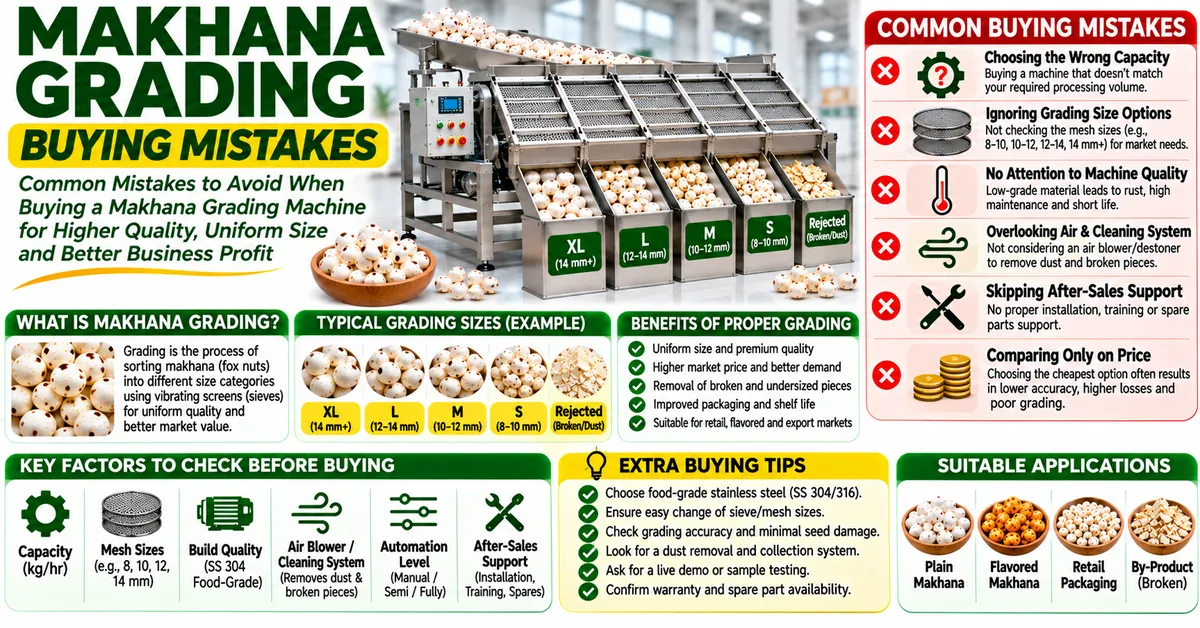
A makhana grading machine separates popped makhana into uniform size grades, removes unwanted material, and helps processors command better prices. Before buying one, the biggest risk is choosing a machine based only on price or headline capacity instead of matching its grading accuracy, food-contact construction, power setup, and after-sales support to your actual production needs.
This guide is written for Indian makhana processors, startups, traders, and existing units planning to upgrade from manual grading. It covers the mistakes that most often lead to poor output quality, unexpected costs, and difficult operations.
What a makhana grading machine does
After makhana is roasted and popped, the output is not uniform. It contains different sizes of popped makhana, flattened pieces, un-popped material, and dust or other impurities. A grading machine uses screens, vibration, and controlled material flow to separate popped makhana into size-based grades while removing unsuitable material.
In commercial terms, this matters because buyers and brands pay differently for grades. Uniform sizing improves packing presentation, supports consistent pricing, reduces manual sorting labour, and makes it easier to supply retail packs, bulk buyers, or exporters. Machines may produce three, four, five, six, or more grades depending on the screen configuration and customer requirement.
A typical machine includes:
- A feed hopper for controlled input
- Vibratory or rotary grading screens
- Multiple discharge outlets for each grade
- A motor and drive system
- A frame, guards, and control panel
- Optional dust aspiration, feeding elevator, and collection bins
Mistake 1: Buying capacity without checking real throughput
Many first-time buyers see “300 kg/hr” or “500 kg/hr” and assume that is the output they will get every hour. In practice, actual throughput depends on the moisture and size distribution of the makhana, feed rate, number of grades required, screen condition, operator skill, and whether the machine is being fed continuously.
For example, one commercial grader is listed at 300 kg/hr with a 2 hp motor and six output grades, while another automatic vibratory grader is rated at 300–500 kg/hr with three grading decks. These figures can be valid, but they are not interchangeable. A machine designed to make six clean grades may deliver less usable output per hour than a simpler machine making three grades.
Ask the supplier these questions:
- Is the stated capacity based on raw makhana or popped makhana?
- Is it continuous input capacity or peak/batch capacity?
- What grading accuracy is achievable at that capacity?
- How many grades can the machine produce at the same time?
- What happens to capacity when screens are adjusted for finer separation?
- What feed arrangement is required to achieve the quoted output?
A useful rule is to size the machine for your peak-season requirement, not your average daily requirement. If you plan to process 1,000 kg per day over an 8-hour shift, a 150 kg/hr machine may look sufficient on paper, but it leaves little room for feeding delays, cleaning, screen changes, breakdowns, or higher-season volumes. ICAR-CIPHET’s popped makhana grader, for instance, is rated at 150 kg/hr and requires two unskilled workers.
Mistake 2: Ignoring whether you are grading raw or popped makhana
“Makhana grading machine” can refer to equipment for raw seeds, popped makhana, or both. This is one of the most expensive misunderstandings in the buying process.
Popped makhana is light, fragile, and irregular in shape. It needs gentle handling and screens suited to popped product. Raw makhana seeds are denser and may require a different screen arrangement, feed system, and separation logic. Some listings explicitly state whether the machine is intended for raw makhana or roasted/popped makhana.
Before requesting a quote, confirm:
- Whether the machine is designed for popped makhana, raw makhana, or both
- Whether it removes un-popped makhana and flattened pieces
- Whether it can handle your target size range
- Whether the screens are customisable for local grade definitions
ICAR-CIPHET describes a popped makhana grader that separates un-popped material, grades popped makhana into three sizes, and removes flattened makhana functions that are especially valuable for commercial processing. If your supplier cannot clearly explain how their machine handles un-popped and broken material, treat that as a warning sign.
Mistake 3: Choosing automation level for the wrong reason
First-time buyers often ask, “Should I buy semi-automatic or fully automatic?” The right answer depends less on automation itself and more on labour availability, volume, budget, and product consistency.
|
Factor |
Semi-automatic grader | Fully automatic grader |
|
Best suited for |
Small and medium units, startups, batch processing | Higher-volume continuous processing |
| Labour need | Usually lower than manual grading but operator attention is needed |
Lower operator intervention, but skilled supervision may still be needed |
| Initial cost | Generally lower |
Generally higher |
|
Flexibility |
Often easier to adjust for different grades and batches | Better for standardised, repeatable production |
| Maintenance |
Usually simpler |
May include more electrical and mechanical components |
| Main risk | Labour dependency and inconsistent feed |
Paying for automation you do not fully utilise |
Many Indian machines in this category are semi-automatic, including models rated around 150 kg/hr and 300 kg/hr. Automatic machines are available too, often with hopper feeding, vibratory decks, multiple discharge points, and safety features such as emergency stop and overload protection.
For a new processor, a robust semi-automatic machine is often the safer starting point. It lets you learn your raw-material behaviour, grade requirements, and market demand before committing to a larger automated line. If you already have steady orders, reliable power, trained staff, and a clear requirement for continuous output, a fully automatic system can make more sense.
Mistake 4: Overlooking food-contact material and hygiene
Makhana is a food product. Any surface that touches it should be easy to clean, non-contaminating, and durable. Stainless steel, particularly SS 304, is commonly specified for makhana-contact surfaces because it supports hygiene and product quality.
Do not assume that “stainless steel machine” means all product-contact parts are SS 304. Some machines use a powder-coated mild-steel body with SS 304 only on contact parts, while others use galvanised iron or mild steel in non-contact areas. That can be acceptable if clearly specified, but you should know exactly what you are buying.
Check the following before ordering:
- Material of all makhana-contact surfaces
- Screen material and mesh quality
- Whether corners, joints, and collection trays are easy to clean
- Whether screens can be removed without special tools
- Whether the design prevents product accumulation
- Whether the machine is suitable for wet cleaning or dry cleaning only
- Availability of replacement screens and brushes
A low-cost machine that is difficult to clean can create hygiene problems, increase downtime, and shorten screen life. Ask for a material certificate or written specification for contact parts.
Mistake 5: Not matching grades to your market
A machine that produces four grades may be perfect for one processor and inadequate for another. Grade requirements vary by buyer, region, brand, and end use.
Common commercial size classifications include small, medium, large, extra-large, and jumbo categories. One industry reference lists grades from roughly 5–8 mm up to above 14 mm, while ICAR-CIPHET’s popped makhana grader works with 12–15 mm, 15–18 mm, and above 18 mm sizes. Other suppliers configure machines for 4 suta, 5 suta, 6 suta, and 6+ suta categories.
Before buying, collect samples of the grades your customers actually want. Then ask the manufacturer to demonstrate separation using your material not merely a standard demo sample.
Important questions include:
- How many grades do I need today?
- Will I need additional grades in the next two years?
- Do my buyers require size consistency, weight consistency, or both?
- Do I need to remove dust, broken pieces, flattened makhana, and un-popped material?
- Can screens be changed or customised later?
- What is the cost and lead time for replacement screens?
A machine with expandable or replaceable screens gives you more flexibility as your customer mix changes. Some manufacturers offer configurations with three plus one, four plus one, or more grades, and optional dust aspiration or feeding elevators.
Mistake 6: Underestimating power, space, and installation needs
A grading machine may look compact in a catalogue but require more space once you add infeed, discharge bins, operator access, maintenance clearance, and material movement. One automatic vibratory grader is listed with dimensions of approximately 3.48 m x 1.83 m x 1.65 m and a weight of about 1,000 kg.
Before finalising the order, prepare a simple layout covering:
- Machine footprint
- Space for feeding and collection containers
- Operator standing space
- Screen-removal and cleaning access
- Electrical panel location
- Safe movement of trolleys or bins
- Future expansion space
Also confirm the electrical requirement. Machines may be available in single-phase or three-phase versions, and power ratings vary widely from around 0.5 hp in smaller models to 2 hp, 3 hp, or more in higher-capacity units. If your facility has only single-phase power, confirm in writing that the proposed model will run reliably on your supply.
Ask the supplier to provide:
- Rated power consumption
- Recommended starter or control-panel specification
- Voltage and phase requirement
- Machine weight and floor-loading requirement
- Installation requirements
- Recommended operator count
- Expected noise level and vibration control needs
Mistake 7: Focusing on machine price instead of total cost
The quoted machine price is only one part of the investment. A lower-priced machine can become expensive if it needs frequent screen replacement, consumes more power, produces more breakage, or lacks local service support.
Indian market listings show a wide price range. Smaller semi-automatic machines have been listed around ₹1.25–2.8 lakh, while higher-capacity automatic graders can be listed around ₹4–6.5 lakh. Broader industry estimates place basic makhana grading machines from roughly ₹1.5 lakh to ₹6–8 lakh depending on capacity, automation, and grading accuracy.
When comparing quotations, build a total cost sheet:
|
Cost head |
What to confirm |
|
Machine price |
Ex-works, delivered, or installed price |
|
GST and freight |
Whether included in the quotation |
| Installation |
Engineer visit, labour, travel, and accommodation |
| Commissioning |
Trial run with your makhana sample |
|
Electrical work |
Wiring, starter, panel, earthing |
| Accessories |
Elevator, dust aspirator, extra screens, bins |
|
Spares |
Screen sets, belts, bearings, brushes |
| Warranty |
Coverage, exclusions, and response time |
| Training |
Operator training and operating manual |
|
After-sales support |
Local engineer, remote support, spare availability |
A slightly higher-priced machine from a manufacturer with strong service support can be more economical over three years than a cheaper machine with poor spare availability.
Mistake 8: Not taking a live trial with your own makhana
Catalogue videos and standard demonstrations can hide important issues. Makhana varies by region, season, popping quality, moisture, and size distribution. The only reliable test is a trial using a representative sample from your own processing line.
Before paying an advance, request a live demonstration or trial video using your sample. Observe:
- How cleanly each grade is separated
- Whether un-popped and flattened makhana are removed
- Amount of breakage during handling
- Dust generation
- Ease of feeding
- Screen choking or clogging
- Actual output over a sustained period
- Ease of changing grades
- Noise, vibration, and stability
- Cleanliness after the run
Ask for the trial to run long enough to reveal practical problems not just for a few minutes. A good supplier should be willing to share a demo video, arrange a factory visit, or provide a trial report with input weight, output grade weights, and rejection percentage.
Mistake 9: Ignoring screen quality and grading accuracy
Screens are the heart of a grading machine. Poorly made screens can tear, warp, clog, or allow mixed sizes into the same grade. Auto sieve cleaning can help maintain performance, and some manufacturers specifically highlight this feature.
Check:
- Screen material and thickness
- Mesh size options
- Screen tensioning method
- Whether screens are replaceable
- Availability of spare screen sets
- Whether the design includes screen-cleaning brushes or automatic cleaning
- How easily screens can be inspected and changed
Also ask how the supplier defines “grading accuracy.” A vague answer such as “very accurate” is not enough. Request a measurable trial result, such as the percentage of correctly graded output and the percentage of mixed material in each grade.
Mistake 10: Neglecting safety and operator training
Makhana grading machines use motors, moving screens, and vibration. Safety features should not be optional. Look for guarded moving parts, emergency stop arrangements, overload protection, stable mounting, and clear operating instructions. Some automatic graders list emergency stop and overload protection as standard safety features.
Train at least two operators, even if the machine is simple. Training should cover:
- Safe startup and shutdown
- Correct feed rate
- Screen cleaning and replacement
- Identifying abnormal vibration or noise
- Basic troubleshooting
- Daily cleaning routine
- What to do during a power interruption
- When to call service support
A written operating manual, wiring diagram, maintenance schedule, and spare-parts list should be part of the delivery. If a supplier cannot provide these documents, it is a sign to proceed carefully.
Mistake 11: Buying without checking after-sales support
The machine may work well on day one, but your long-term experience depends on service. Before ordering, verify whether the manufacturer or supplier can support your location in India.
Ask for:
- Names and locations of nearby installations
- Contact details of existing customers, if permitted
- Typical response time for service calls
- Availability of spare screens and mechanical parts
- Whether remote video support is available
- Warranty terms in writing
- Cost of annual maintenance, if applicable
- Lead time for replacement parts
A supplier who cannot show relevant installations or explain a service process may leave you stranded during peak season. This is particularly important for processors in makhana-producing belts, where seasonal volume and delivery commitments leave little room for downtime.
Mistake 12: Not planning the machine as part of a full line
A grading machine rarely works in isolation. It should fit smoothly with popping, roasting, cooling, polishing, packing, and material handling. If the grader receives makhana too quickly, grades may mix. If it receives material unevenly, capacity drops. If discharge bins are too small, operators must stop frequently.
Plan the flow:
- Popping or roasting
- Cooling, if required
- Feeding to grader
- Grading and separation
- Collection by grade
- Inspection or final cleaning
- Packing
Optional additions such as a Z-type feeding elevator, feed-control panel, and dust aspiration system can improve consistency and cleanliness, but they also add cost and space requirements. Decide which accessories are essential now and which can be added later.
Semi-automatic or fully automatic: which should you start with?
For most first-time buyers, a semi-automatic makhana grading machine is the practical starting choice. It usually costs less, is simpler to operate, and gives you time to understand your raw material and market grades. Many available Indian models are semi-automatic and fall in the 100–300 kg/hr range.
Choose fully automatic when:
- You process large and consistent volumes
- You have reliable power and trained staff
- You need continuous feeding and reduced labour dependence
- Your buyers require highly repeatable grades
- You plan to integrate the grader into a larger processing line
Choose semi-automatic when:
- You are starting or expanding gradually
- Your makhana quality varies by batch
- You need flexibility in grade configuration
- Your budget is limited
- You want lower initial risk
The best machine is not necessarily the most automated one. It is the one that produces your required grades consistently at a cost your business can sustain.
What should you check before paying an advance?
Do not pay an advance based only on a WhatsApp quotation or a product photograph. Before committing, obtain a written technical specification and commercial terms.
Your pre-advance checklist should include:
- Machine type: raw makhana, popped makhana, or both
- Rated capacity and whether it is based on your material
- Number of grades and screen sizes
- Material of construction for contact and non-contact parts
- Motor power, voltage, phase, and power consumption
- Machine dimensions, weight, and installation space
- Included accessories and optional extras
- Trial or demo arrangement
- Delivery period and dispatch terms
- Installation and commissioning charges
- Warranty coverage and exclusions
- Spare-parts price list
- Operator training and manuals
- Payment schedule linked to clear milestones
- GST invoice and formal purchase order
Pay only after these points are clear. If possible, link a portion of the payment to successful commissioning or a trial using your own makhana sample.
How to choose the right supplier
A good makhana grading machine supplier should behave like a processing partner, not merely a seller. Look for a manufacturer who asks about your raw material, target grades, daily volume, power supply, labour availability, and future expansion plans.
A strong supplier should provide:
- A detailed specification sheet
- A live demo or sample-based trial
- Clear material and screen specifications
- References or installation details
- Transparent pricing for machine, freight, installation, and spares
- Written warranty and service terms
- Training and operating documentation
- A realistic delivery schedule
Avoid suppliers who promise unrealistic capacity, refuse a trial, cannot explain screen configurations, or pressure you to pay the full amount quickly.
Frequently asked questions
1. What is the most common mistake first-time buyers make?
The most common mistake is buying on quoted capacity or lowest price without testing the machine on their own makhana. Capacity figures can differ significantly depending on whether the rating refers to raw or popped makhana, the number of grades, feed consistency, and grading accuracy.
Always ask for a trial with your own sample and compare actual output, grade purity, breakage, and labour requirement not just the brochure number.
2. What capacity makhana grading machine should I buy?
Choose capacity based on peak-season processing needs, not average daily volume. For example, if you need to process 800–1,000 kg per day in an 8-hour shift, a 150 kg/hr machine may be tight once you account for cleaning, feeding delays, and maintenance. ICAR-CIPHET lists a 150 kg/hr popped makhana grader as suitable for lower labour and energy requirements.
As a planning range, smaller units often consider machines around 100–150 kg/hr, while commercial units commonly look at 250–500 kg/hr or higher.
3. Semi-automatic or fully automatic: which should I start with?
Start with semi-automatic if you are new to mechanised grading, have variable raw material, or want a lower initial investment. Semi-automatic machines are widely used in India and are available in capacities such as 150 kg/hr and 300 kg/hr.
Choose fully automatic only when you have stable volumes, reliable power, trained staff, and a clear need for continuous operation. Automatic vibratory graders may include features such as hopper feeding, multiple decks, multiple discharge points, emergency stop, and overload protection.
4. Can one machine grade both raw and popped makhana?
Some machines are marketed for both, but you should not assume it. Raw makhana and popped makhana behave differently because of differences in density, fragility, shape, and size distribution. Supplier listings often specify whether a model is intended for raw makhana or roasted/popped makhana.
Ask the manufacturer to confirm the exact application and demonstrate separation for the material you will actually process.
5. How many grades should a makhana grading machine have?
It depends on your buyers and product strategy. Many commercial machines offer three to six grades, while some configurations can provide four, five, or more grades.
Before selecting the number of grades, collect requirements from your main customers. Buying extra grades you do not need increases cost and complexity, while too few grades can limit your ability to serve premium buyers.
6. What should I check before paying an advance?
Get a written specification covering capacity, number of grades, screen sizes, contact-part material, motor power, voltage, dimensions, accessories, warranty, installation, spares, and delivery terms. Also arrange a trial using your own makhana sample.
Avoid paying the full amount upfront. A milestone-based payment schedule advance, dispatch, installation, and final payment after commissioning gives you better protection.
7. How much does a makhana grading machine cost in India?
Prices vary widely by capacity, automation, construction, and number of grades. Public listings show smaller semi-automatic machines around ₹1.25–2.8 lakh, while higher-capacity automatic machines may be listed around ₹4–6.5 lakh. Industry estimates commonly place grading machines between roughly ₹1.5 lakh and ₹6–8 lakh. Treat these as indicative figures only. Final pricing should include freight, GST, installation, commissioning, accessories, and spare screens.