
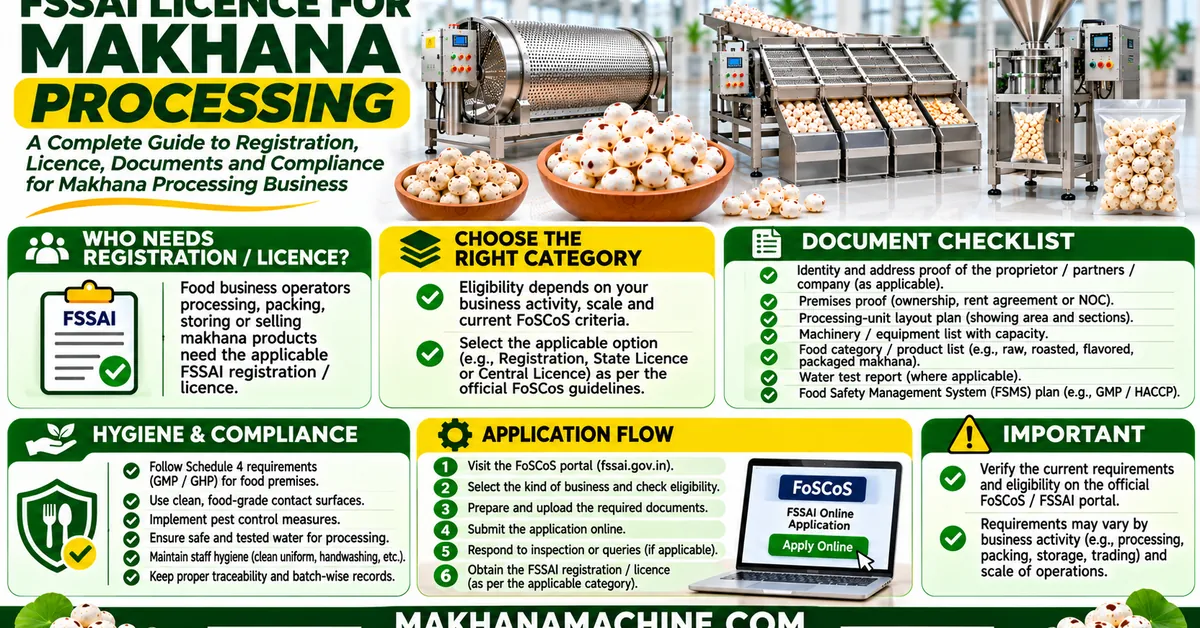
Makhana is one of India’s fastest developing healthy snack foods categories providing great potential to the processors, packers, retailer, and online sellers. If you are looking to start or expand a business in makhana then make sure to be aware of the Food-Safety compliance needed for a food business.
If you are making or selling makhana at a commercial level in India, you will need to get an FSSAI registration or FSSAI licence. As per FSSAI, all food business operators are to be registered or licensed under the Food Safety and Standards Act, 2006. This will be determined by your annual turnover, a day-to-day manufacturing capability, the kind of premises, and the KoB of the official FoSCoS portal.
Why makhana processors need FSSAI compliance
Makhana is a food product. Once your business converts raw makhana into roasted, popped, flavoured, graded, or packed makhana for sale, you become a Food Business Operator (FBO). FSSAI guidance for makhana states that every manufacturer, processor, repackaging unit, relabelling unit, and related food business operator must obtain FSSAI registration or a licence.
FSSAI compliance helps you:
- Sell legally through retailers, distributors, online marketplaces, and institutional buyers
- Build buyer confidence with a valid FSSAI number
- Maintain hygiene and food-safety standards at your unit
- Prepare for inspections and future expansion
- Print compliant labels on packaged makhana
- Avoid disruptions caused by incomplete or incorrect licensing
A small home-based packing operation, a village-level popping unit, and a branded flavoured-makhana factory may all need FSSAI compliance. However, they may not need the same licence category.
FSSAI registration vs licence
FSSAI compliance is commonly divided into three levels: Basic Registration, State Licence, and Central Licence. For makhana processing, the NIFTEM/PMFME guidance gives the following indicative structure: Basic Registration for turnover up to ₹12 lakh and production capacity up to 100 kg/day; State Licence for capacity above 100 kg/day up to 2 MT/day and turnover up to ₹20–30 crore; and Central Licence for production above 2 MT/day or higher-scale operations.
|
FSSAI category |
Typical applicability | Indicative annual fee |
|
Basic Registration |
Small/petty food businesses; turnover up to ₹12 lakh and capacity up to 100 kg/day, subject to activity-specific rules | ₹100 |
| State Licence | Medium-scale makhana processing, repacking, or manufacturing units; commonly above 100 kg/day up to 2 MT/day |
₹2,000–₹5,000 |
| Central Licence | Larger units, production above 2 MT/day, import/export activity, or other specified conditions |
₹7,500 |
Do not select a category based only on turnover. Your activity matters. For example, roasting or flavouring makhana is generally manufacturing, while filling retail packs from bulk makhana may be repacking. Selling already packed makhana is generally retail or wholesale.
Which FSSAI category suits your makhana unit?
Small home-based or startup unit
If you are starting with limited volumes, Basic Registration may apply if your turnover and production capacity fall within the applicable limits. You will still need to maintain hygiene, use safe packaging, and follow food-safety practices.
Village-level popping, roasting, or grading unit
If you process makhana beyond small-scale limits, you may need a State Licence. This commonly applies to units that roast, pop, grade, polish, flavour, or pack makhana for commercial sale.
Branded flavoured-makhana manufacturer
A branded unit producing flavoured or packaged makhana will usually need a State Licence, and a Central Licence if it crosses the higher capacity or turnover thresholds or meets other Central Licence conditions.
Exporter or importer
If you import or export makhana, additional requirements may apply, including an Import Export Code (IEC). FSSAI’s FoSCoS portal lists importer and merchant-exporter among the eligible Kinds of Business.
Documents required for a makhana processing unit
The documents you need depend on whether you apply for Basic Registration, a State Licence, or a Central Licence. For manufacturing and processing units, FoSCoS requires more detailed documentation than for simple retail activity.
Basic documents
Keep the following ready:
- Recent passport-size photograph of the applicant or authorised signatory
- Government photo ID, such as Aadhaar, PAN, voter ID, driving licence, or passport
- Business name and complete address
- Proof of possession of premises, such as rent agreement, sale deed, or utility bill
- PAN and GST details, where applicable
- Business constitution documents, such as proprietorship declaration, partnership deed, or company incorporation documents
- Details of the food activity and products you plan to handle
- Authority letter for the person filing or managing the application, where applicable
Additional documents for processing units
If your unit roasts, pops, flavours, grades, or repacks makhana, prepare:
- Layout plan of the premises with dimensions in metres or square metres
- Operation-wise area allocation for raw material, processing, packing, and finished-goods storage
- List of machinery and equipment with quantity, installed capacity, and horsepower
- Water-analysis report, chemical and bacteriological, if water is used in processing
- Food Safety Management System plan or certificate, where applicable
- List of food categories or products to be manufactured
- Authority letter naming the responsible person and alternate responsible person
- Recall plan, where applicable
- Supporting proof of annual turnover
FSSAI specifically requires manufacturing and processing applicants to provide a layout plan, machinery list, water potability report, food-category list, and authority letter.
How to apply for FSSAI registration or licence
Applications for new licences, renewals, and modifications are made through FoSCoS, FSSAI’s official Food Safety Compliance System. FSSAI directs food businesses to use FoSCoS for licensing and registration, and payments should be made only through the official portal.
Step-by-step application process
- Define your activity. Decide whether you are manufacturing, repacking, storing, trading, transporting, exporting, or doing multiple activities.
- Identify the correct premises. Use the actual processing address, not only an office or residential address.
- Calculate turnover and capacity. Prepare realistic annual turnover and daily production-capacity figures.
- Choose the right Kind of Business. Select the activity that matches what you actually do at the premises.
- Prepare the layout plan. Show receiving, storage, processing, packing, finished-goods storage, washing, and dispatch areas where relevant.
- Prepare the machinery list. Include popping, roasting, grading, flavouring, packing, sealing, weighing, and other equipment with capacity and horsepower.
- Arrange water testing. Obtain a chemical and bacteriological water-analysis report if water is used in the process.
- Prepare food-safety records. Create cleaning schedules, pest-control records, personnel-hygiene rules, and waste-management procedures.
- Apply on FoSCoS. Complete Form A or Form B as applicable, upload documents, pay the fee, and submit the application.
- Respond to queries promptly. Keep scanned copies ready and respond quickly if the authority asks for clarification or schedules an inspection.
Premises and hygiene requirements
An FSSAI certificate alone does not make a makhana unit compliant. The premises must support safe food handling and hygienic processing. Makhana processing guidance highlights the importance of hygienic premises, safe food-contact equipment, contamination control, and proper packaging and labelling.
Your makhana unit should have:
- Clean, durable walls, floors, and ceilings
- Adequate lighting and ventilation
- Potable water for cleaning and any food-contact use
- Protected storage for raw makhana and finished packs
- Separate areas for raw material, processing, packing, and finished goods where feasible
- Covered waste bins and a regular waste-disposal system
- Pest-control measures and records
- Handwashing facilities and clean uniforms or aprons
- Cleaning schedules for machines, trays, tables, and packing areas
- Trained staff following personal-hygiene practices
A practical production flow also reduces contamination risk:
Raw makhana receipt → cleaning/storage → roasting/popping → cooling → grading → flavouring, if applicable → packing → finished-goods storage → dispatch
Machinery and layout documentation
Your machinery list should match your actual production process. For a typical makhana processing unit, include:
- Cleaning or destoning equipment, if used
- Roasting or popping machine
- Grading machine
- Polishing or coating equipment, if applicable
- Flavouring mixer or coating drum, if producing flavoured makhana
- Weighing scale
- Packing or sealing machine
- Storage racks, bins, and containers
- Water filtration or treatment system, if used
FSSAI requires the machinery list to include the number of machines, installed capacity, and horsepower for manufacturing and processing units. Keep purchase invoices, photographs, and technical specifications available in case the authority requests supporting evidence.
Labelling requirements for packaged makhana
If you sell makhana under your own brand, your packaging must be accurate and compliant with applicable FSSAI labelling requirements. Avoid unverified claims such as “cures,” “treats,” or “guarantees weight loss.”
A makhana pack should generally display:
- Product name, such as “Roasted Makhana” or “Peri Peri Makhana”
- Ingredient list in descending order by weight
- Net quantity
- Manufacturer, packer, and marketer details
- FSSAI logo and licence or registration number
- Batch or lot number
- Manufacturing date
- Best-before or use-by date
- Storage instructions
- Nutritional information, where required
- Allergen declaration, where applicable
Your FSSAI number is a 14-digit number printed on food packages, and it identifies the licensed food business.
Common FSSAI mistakes to avoid
1. Choosing the wrong Kind of Business
Do not select “retailer” if you are actually roasting, flavouring, or repacking makhana. Your FoSCoS application must reflect the real activity performed at the premises.
2. Using the wrong premises address
The licence is linked to the premises where food activity occurs. Do not apply using an office address if processing happens at a different location.
3. Understating production capacity
Some applicants state lower capacity to remain in a lower licence category. This can create problems during inspection, expansion, marketplace onboarding, or future modification. Always declare realistic capacity.
4. Submitting an incomplete machinery list
“Makhana machines” is not sufficient. Provide machine names, quantities, installed capacity, and horsepower.
5. Ignoring the water test
If water is used in processing, cleaning, or as an ingredient, a potability report may be required. FoSCoS specifically calls for chemical and bacteriological water analysis from a recognised or public health laboratory.
6. Submitting a poor layout plan
A missing, unclear, or non-dimensioned layout can delay approval. Prepare a simple plan showing processing areas, storage, packing, dispatch, and hygiene facilities.
7. Treating FSSAI as a one-time task
After approval, maintain hygiene records, renew on time, update modifications when your business changes, and follow food-safety practices consistently.
8. Making unsupported health claims
Do not make medical or exaggerated health claims on packaging, advertisements, or social media unless they are accurate, substantiated, and compliant with FSSAI requirements.
9. Not planning for growth
If you plan to add flavoured makhana, retail packaging, e-commerce sales, or higher capacity, plan the upgrade early. Changes in products, premises, capacity, or business structure may require modification or a different licence category.
10. Relying completely on an agent
Consultants can help with paperwork, but the applicant is responsible for the accuracy of the application. Review every detail before submission, especially premises address, Kind of Business, product categories, capacity, and machinery list.
Who can help first-time applicants?
If this is your first food-business licence, start with the official FoSCoS portal. It provides application routes, eligible Kinds of Business, document requirements, and fee information.
You can also seek help from:
- An FSSAI-compliance consultant or food-safety consultant
- A chartered accountant, for turnover and business-structure documents
- Your State food safety department or local food safety officer
- A food-testing laboratory, for water analysis or product testing
- Your makhana machinery supplier, for machine specifications, layout inputs, and capacity details
A machinery supplier can help you prepare technical documents, but the final licence category and regulatory classification should always be verified with FSSAI or a qualified compliance professional.
FSSAI checklist for makhana processors
Use this checklist before applying:
- Confirm activity: manufacturing, repacking, storage, trading, or export
- Confirm actual processing premises and obtain address/possession proof
- Calculate expected annual turnover
- Calculate daily production capacity
- Determine Basic Registration, State Licence, or Central Licence eligibility
- Prepare applicant photograph and government photo ID
- Prepare PAN, GST, and business-constitution documents, if applicable
- Prepare a dimensioned layout plan
- Prepare a detailed machinery and equipment list
- Add machine capacity and horsepower details
- Arrange water chemical and bacteriological analysis, if applicable
- Prepare FSMS or food-safety documentation
- Nominate a responsible person and prepare authority letter
- Prepare recall plan, where applicable
- Prepare product and food-category details
- Check packaging and labelling compliance
- Apply through FoSCoS and retain the application reference number
- Track queries, inspection requests, and approval status
- Plan renewal and future modification requirements
FAQs
- Do I need an FSSAI licence to process and sell makhana?
Yes. If you commercially process, pack, store, distribute, or sell makhana, FSSAI registration or licensing is required. Makhana-specific guidance states that manufacturers, processors, repackaging units, relabelling units, and related food business operators must obtain FSSAI registration or a licence.
- Which FSSAI licence do I need for a small makhana unit?
A very small unit may qualify for Basic Registration if it meets the applicable turnover and production-capacity conditions. A common reference threshold is turnover up to ₹12 lakh and production capacity up to 100 kg/day, but the exact category depends on your Kind of Business and current FoSCoS rules.
- When does a makhana unit need a Central FSSAI licence?
A Central Licence is commonly required for larger-scale operations, such as production above 2 MT/day, higher turnover thresholds, import/export activity, or other specified conditions. Exporters may also need an IEC and additional trade-related documentation.
- What documents are required for a makhana processing unit?
For a manufacturing or processing unit, commonly required documents include Form B, layout plan, machinery list with capacity and horsepower, water-analysis report, identity and address proof, premises proof, food-category details, authority letter, and turnover proof.
- How much does an FSSAI licence cost for makhana processing?
Indicative annual fees are ₹100 for Basic Registration, ₹2,000–₹5,000 for a State Licence, and ₹7,500 for a Central Licence. Confirm the live fee in FoSCoS before payment because fees and activity-specific classifications can change.
- Can I start a makhana business from home?
You may be able to start from home if the premises meet food-safety and hygiene requirements and the activity fits the applicable FSSAI category. However, home-based does not mean exempt: if you are selling food commercially, you still need FSSAI registration or a licence.
- How long does FSSAI approval take?
Timelines depend on application completeness, licence category, State-level processing, and inspection requirements. FSSAI-related guidance indicates that a licence may be granted or rejected within 60 days of receiving a completed application, or within 30 days of inspection, depending on the applicable process. Incomplete documents, incorrect kind of Business, unclear layout plans, and delayed responses to queries are the most common reasons for delay.