
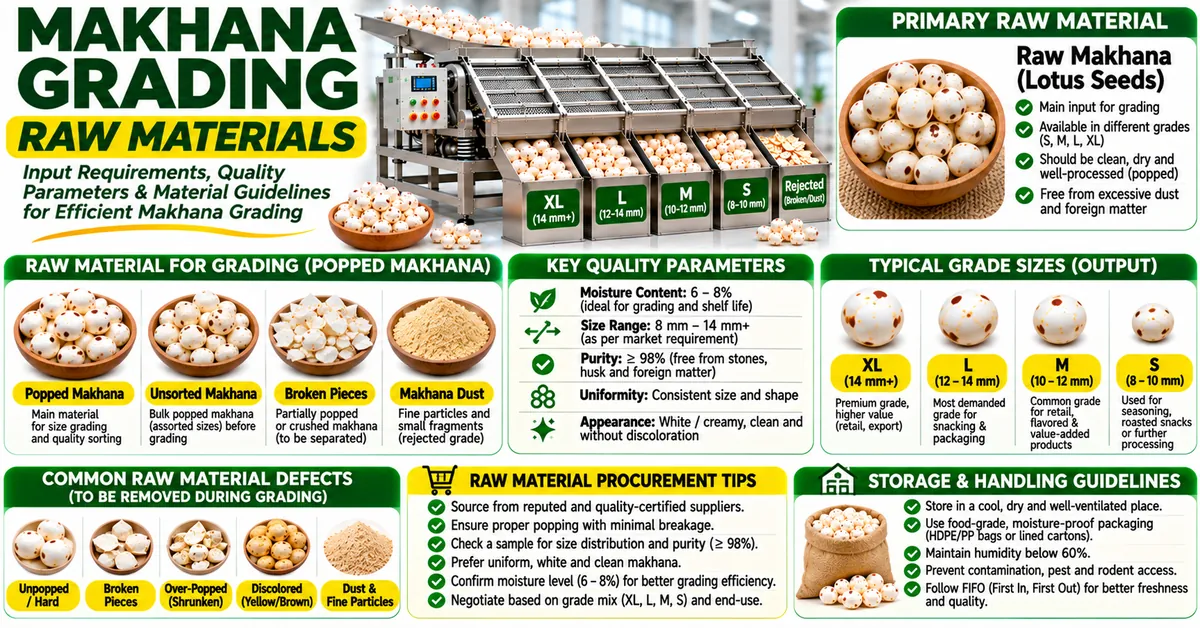
A makhana grading machine needs more than electricity and floor space to run efficiently. Its most important inputs are properly popped, cooled, and reasonably dry makhana lots, along with clear grading specifications, suitable screens, trained operators, and a planned collection system for each output grade.
This guide explains exactly what an Indian makhana processor needs before operating a commercial makhana grading machine—especially if the goal is consistent grades, low breakage, and saleable packed lots.
What a makhana grading machine actually does
A makhana grading machine separates popped makhana into size-based categories. It does not pop raw makhana, roast it, flavour it, or package it. Its role is to take a mixed lot of popped fox nuts and divide it into grades such as small, medium, large, premium, broken, and undersized material.
Most commercial machines use vibrating sieve decks or rotary perforated screens. Makhana is fed from a hopper onto the grading surface; vibration or rotation moves the product across screens of different aperture sizes. Smaller makhana falls through earlier, while larger makhana travels further before leaving through separate outlets.
The value of this process is commercial as much as technical. Uniform grades look better in retail packs, meet buyer specifications more reliably, and allow processors to price premium sizes separately from smaller or broken makhana.
The primary raw material: popped makhana lots
The main raw material for a makhana grading machine is popped makhana, also called popped fox nut or phool makhana. This is the material that has already been popped from raw makhana seeds and is ready for size classification.
A grading machine should receive popped makhana that is:
- Cool enough for safe handling
- Free-flowing and not clumped
- Reasonably dry
- Free from excessive un-popped seeds
- Free from large foreign material
- Not overloaded with broken pieces
- Supplied at a steady, controlled feed rate
Popped makhana is fragile compared with raw seed. If it is fed too quickly, dropped from a height, or subjected to excessive vibration, breakage can increase. This is why the machine design, feed rate, screen condition, and operator practice all affect final output quality.
Ideal condition of popped makhana
Before grading, popped makhana should be allowed to cool after popping or roasting. Hot makhana can be more delicate and may also create handling discomfort for operators. Once cooled, it should be free-flowing and evenly distributed.
Avoid feeding makhana that is:
- Still hot from the roaster
- Damp or unevenly dried
- Sticking together in clusters
- Mixed with stones, husk, or other foreign matter
- Heavily broken before grading
- Stored in a way that has absorbed moisture
If makhana is moist, it may cling to screens, reduce separation efficiency, and increase cleaning frequency. If it is too brittle, grading vibration may create additional breakage. The ideal input is a cooled, dry, free-flowing popped lot.
Raw makhana seeds: when they are also relevant
Although a popped makhana grader primarily handles popped product, some processors also need to grade raw makhana seeds before popping. Raw seeds are harder and less fragile than popped makhana, but they require different screen sizes and handling settings.
Raw makhana seed graders may be designed to separate three or four seed sizes across a range such as 7–14 mm. This pre-grading can improve popping consistency because similar-sized seeds tend to respond more uniformly to heat.
If your business handles both raw and popped makhana, do not assume one screen set will suit both. Ask the manufacturer whether the machine supports:
- Interchangeable screens
- Separate raw-seed and popped-makhana configurations
- Adjustable vibration intensity
- Different feed rates
- Separate validation trials for each material
A machine designed for popped makhana may not be ideal for raw seed grading without modification, and vice versa.
Grading specifications: the second essential input
The second major requirement is a clear grading specification. Without it, even a high-quality machine cannot produce the grades your buyers expect.
A grading specification defines:
- The number of grades required
- The size range for each grade
- The target percentage of each grade
- Whether broken makhana should be separated
- Whether dust or fines must be removed
- Whether premium and regular grades must be kept separate
- The acceptable tolerance for mixed material
For example, a processor may require four outputs:
- Premium large makhana
- Medium makhana
- Small makhana
- Broken or undersized makhana
Another processor may require only three grades, while a packing unit supplying organised retail may need tighter tolerances and more consistent separation. Commercial machines commonly offer three or four discharge outlets, which makes them suitable for these applications.
Traditional suta-based grading
In the Indian makhana trade, grading is often described using suta, a traditional size-based classification. Suppliers may configure machines for categories such as 5 suta and above, 5 suta and below, 6 suta and above, 5–6 suta, 4–5 suta, and below 4 suta.
If your buyers use suta terminology, share the exact definitions with the machine supplier. Different regions and buyers may use the same term differently, so screen selection should be based on physical samples and measured size ranges—not only grade names.
Screens and sieves: the heart of grading accuracy
Screens are not accessories; they are a core raw material requirement for accurate grading. The correct screen aperture determines which makhana passes through and which remains on the deck.
When selecting screens, consider:
- Screen material, preferably stainless steel for food contact
- Aperture size for each grade
- Screen strength and durability
- Ease of removal and replacement
- Compatibility with your makhana size distribution
- Availability of spare screens
- Screen-cleaning method
Vibratory graders commonly use multiple sieve decks, and some machines include automatic screen-cleaning arrangements to reduce clogging. Keep spare screens for each grade you regularly produce, especially during peak season or when buyer specifications change.
Supporting materials and utilities
A makhana grading machine does not operate in isolation. To run it efficiently, a processor needs several supporting inputs and utilities.
Electricity
Most makhana graders are electrically driven. Smaller machines may be available in single-phase configurations, while larger commercial units often require three-phase power.
Before installation, confirm:
- Available voltage
- Single-phase or three-phase supply
- Motor load in HP or kW
- Starter and control-panel requirement
- Earthing and electrical safety arrangement
- Backup power needs, if production is continuous
Floor space
You need space not only for the machine but also for:
- Input makhana bags
- Operator movement
- Screen removal and cleaning
- Grade-wise collection bags or bins
- Finished lot staging
- Maintenance access
A compact 100–200 kg/hr machine may fit in a modest processing room, but cramped layouts slow down feeding, collection, and cleaning.
Collection containers
Each grade needs a separate collection arrangement. Depending on your scale, this may include:
- Food-grade bags
- Plastic crates
- Stainless-steel trays
- Trolleys
- Bulk bins
- Direct connection to a packing line
Label each container clearly to prevent grade mixing. Even a small mixing error can downgrade a premium lot.
Cleaning materials
Keep food-safe cleaning tools available:
- Soft brushes
- Dry cloths
- Vacuum cleaner or air-blowing arrangement, where appropriate
- Screen-cleaning tools
- Dust collection bags
- Spare screens
Avoid spraying water directly onto motors, control panels, bearings, or electrical components.
Operators and training
A grading machine is simple to operate, but operator discipline strongly affects output. An untrained operator may overfeed the hopper, ignore screen clogging, mix grades, or fail to notice abnormal vibration.
Operators should be trained to:
- Feed makhana at the recommended rate
- Start and stop the machine safely
- Check screen condition
- Identify clogging or uneven flow
- Separate grades correctly
- Record output quantities
- Report unusual noise or vibration
- Clean the machine after each shift
- Follow safety procedures
A good supplier should provide installation guidance, operating instructions, and basic operator training. Many Indian suppliers also offer a one-year warranty, though exact terms vary by manufacturer and model.
Where can these raw materials be sourced in India?
Makhana is produced mainly in the eastern Indian belt, particularly Bihar, where the Mithila region is closely associated with makhana cultivation and processing. Processors, traders, and packing units may source raw or popped makhana through local farmer networks, mandis, aggregators, cooperatives, and established makhana traders.
For a grading-machine operator, sourcing depends on the stage of material required:
- Raw makhana seeds: Usually sourced from makhana-growing clusters, local traders, farmer groups, or aggregators.
- Popped makhana: Sourced from your own popping or roasting line, or purchased from a processor or trader.
- Spare screens: Sourced directly from the machine manufacturer or an approved spare-parts supplier.
- Collection bags and bins: Sourced from local packaging or industrial-supply vendors.
- Electrical components: Sourced through the machine supplier or a qualified local electrician.
The most important sourcing rule is traceability. Maintain records of supplier name, lot number, purchase date, moisture condition, and grade mix. This helps you identify whether quality issues come from incoming material, popping, storage, or the grading process.
If you buy popped makhana from outside suppliers, ask for a sample before placing a bulk order. Feed that sample through your grader to check flow, breakage, screen compatibility, and grade recovery.
How does raw material quality affect output?
Raw material quality has a direct impact on grading efficiency, recovery, breakage, and final pack quality.
Moisture content
Excess moisture can make makhana sticky or heavy. It may cling to screens, reduce free flow, and increase cleaning downtime. Very dry makhana may become brittle and prone to breakage.
Size distribution
If the incoming lot has a wide size range, the machine will separate it more effectively but it may also produce more grades than expected. If the lot is already fairly uniform, fewer screens or a simpler configuration may be sufficient.
Breakage level before grading
Makhana that is already broken before grading cannot be restored by the machine. High incoming breakage reduces the share of premium whole makhana and increases the volume of low-value material.
Foreign matter
Stones, husk, dust, metal fragments, and other contaminants can damage screens, reduce hygiene, and create safety risks. Pre-cleaning is advisable if the incoming lot is dusty or mixed with foreign material.
Popping consistency
Uneven popping creates uneven density and fragility. This can affect how makhana moves across screens and may increase the proportion of broken or undersized material.
A good grading machine improves separation, but it cannot compensate fully for poor incoming quality. The best results come from controlled popping, proper cooling, careful handling, and consistent grading specifications.
What storage conditions do the raw materials need?
Storage affects both raw makhana seeds and popped makhana. Poor storage can lead to moisture absorption, pest risk, contamination, and quality loss.
Raw makhana seed storage
Raw makhana seeds should be stored in a clean, dry, ventilated area, protected from moisture, pests, and direct contact with the floor. Use pallets, racks, or raised platforms where possible.
Key storage practices:
- Keep bags sealed or covered
- Maintain ventilation
- Avoid damp walls and floors
- Use first-in, first-out stock rotation
- Inspect regularly for insects or mould
- Keep the area away from chemicals and strong odours
Popped makhana storage
Popped makhana is more sensitive because it is ready for grading, packing, or flavouring. Store it in clean, dry containers or lined bags, away from humidity and contamination.
Recommended practices:
- Cool makhana fully before bagging
- Use food-grade storage bags or bins
- Keep bags closed when not in use
- Avoid storing directly on the floor
- Protect from dust, insects, and moisture
- Use older stock first
- Do not store near cleaning chemicals or strong-smelling materials
If popped makhana is stored for long periods, check it before grading. Clumping, dampness, or off-odour are warning signs that the lot may not grade cleanly or may affect final pack quality.
Machine capacity and feed preparation
The capacity of a makhana grading machine must match the material available from the popping or roasting line. Indian market machines commonly range from around 100 kg/hr to 300 kg/hr, while larger industrial graders may be specified at 300–500 kg/hr.
A practical approach is to match grading capacity to actual popped-makhana output:
|
Current popped makhana output |
Suitable grading capacity |
|
Up to 100 kg/hr |
100–150 kg/hr |
|
100–200 kg/hr |
150–250 kg/hr |
| 200–300 kg/hr |
250–300 kg/hr |
| Above 300 kg/hr |
Custom or industrial configuration |
Do not rely only on the nameplate capacity. Ask whether the stated capacity refers to popped makhana, the number of grades being produced, and the feed rate required to achieve it. A machine may have a high rated capacity but deliver lower effective output if the feed is uneven or the screens clog frequently.
Safety and hygiene requirements
Because makhana is a food product, hygiene and safety should be part of daily operation.
Follow these practices:
- Keep the machine and surrounding area clean.
- Use food-grade contact surfaces wherever possible.
- Prevent oil, grease, or chemical contact with makhana.
- Keep electrical panels dry and covered.
- Train operators on emergency-stop use.
- Do not open guards or screens while the machine is running.
- Disconnect power before screen replacement or deep cleaning.
- Keep loose clothing, jewellery, and hair away from moving parts.
- Use dust extraction or ventilation where dust accumulation is high.
Some commercial machines offer optional dust aspiration systems, which can help remove fine dust and improve workplace cleanliness.
Quality control checks during grading
To maintain consistent output, check the machine and material at defined intervals.
Before starting
- Confirm the correct screens are installed.
- Check that collection bags or bins are labelled.
- Inspect the hopper and discharge outlets.
- Ensure the machine is clean and dry.
- Confirm power supply and emergency stop function.
During operation
- Maintain steady feeding.
- Watch for screen clogging.
- Check grade separation at each outlet.
- Monitor breakage levels.
- Listen for abnormal vibration.
- Record input and grade-wise output quantities.
After production
- Clean screens, hopper, and discharge chutes.
- Remove trapped makhana and dust.
- Inspect screens for wear or damage.
- Store spare screens properly.
- Record any maintenance issue.
Regular checks help maintain grading accuracy and reduce unexpected downtime.
Common problems and practical solutions
|
Problem |
Likely cause | Practical solution |
|
Screens clog frequently |
Moist makhana, dust, or incorrect screen size |
Dry and cool material; clean screens; review aperture |
| Excessive breakage | Overfeeding, high vibration, brittle makhana |
Reduce feed rate; adjust vibration; improve popping control |
|
Mixed grades |
Damaged screens, wrong aperture, poor collection discipline | Replace screens; verify size specification; label containers |
|
Low output |
Uneven feeding, small hopper, manual-feed bottleneck |
Use controlled feeding; consider elevator or larger hopper |
| Dust in work area | No aspiration, dusty incoming lot |
Add dust extraction; pre-clean material; improve ventilation |
| Uneven separation | Incorrect screen angle, worn screens, uneven feed |
Check machine levelling; replace screens; regulate feed |
Frequently Asked Questions
- What raw material does a makhana grading machine require?
A makhana grading machine primarily requires popped and cooled makhana lots. The material should be dry, free-flowing, free from large foreign matter, and fed at a controlled rate. Some processors also grade raw makhana seeds before popping, but this requires different screens and machine settings.
- Can I grade raw makhana seeds and popped makhana in the same machine?
Sometimes, but not automatically. Raw makhana seeds and popped makhana differ in size, density, and fragility. Raw seed graders may separate sizes in the 7–14 mm range, while popped makhana graders focus on commercial popped-grade separation with low breakage. Ask the manufacturer whether interchangeable screens or separate configurations are available.
- How many grades can a makhana grading machine produce?
Most commercial machines produce three or four grades, depending on the number of sieve decks and discharge outlets. Some configurations provide separate outlets for premium, medium, small, and broken or undersized makhana.
- What moisture level is suitable before grading?
There is no single universal percentage because it depends on the makhana variety, popping process, and buyer requirement. As a practical rule, makhana should be fully cooled, dry to touch, free-flowing, and free from clumping before grading. If material sticks to screens or forms clusters, it is usually too moist or has absorbed humidity during storage.
- What capacity should a small makhana business start with?
A small or growing processor can usually begin with a 100–200 kg/hr grading machine. This capacity suits regular daily production without requiring the investment and space of a large industrial line. Machines in the Indian market commonly range from 100 kg/hr to 300 kg/hr, with larger industrial options also available.
- What after-sales support should I expect?
Look for installation guidance, operator training, an operating manual, spare-screen availability, remote or on-site service, and a written warranty. Many suppliers offer a one-year warranty, but coverage, response time, travel charges, and spare-part availability differ, so request these details in writing.
- How can I reduce breakage during makhana grading?
Use a machine designed for popped makhana, avoid overfeeding, ensure makhana is properly cooled and dried, use smooth food-grade contact surfaces, and maintain correct vibration settings. A sample trial with your own makhana is the best way to check breakage and grade recovery before purchase.