
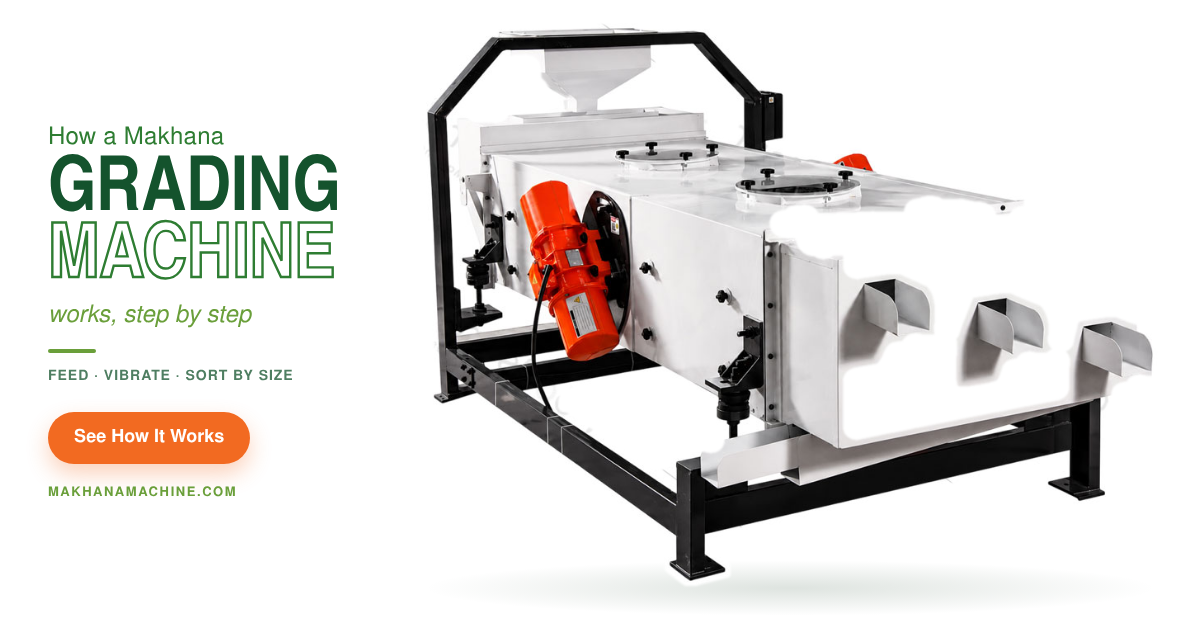
Makhana grading machine is a food processing and packaging equipment used in the processing of fox nuts or makhana to segregate them into various sizes of grades. The machine eliminates broken flat small, damaged, or un-popped pieces, enabling processors to pack exact quantities, assess price accurately and fulfill client orders.
In commercial makhana processing, grading is more than just a cosmetic step. Uniform sizing helps improve roasting and popping efficiency, reduces manual sorting, protects valuable kernels from damage, and directly affects the market value of the final product. Whether the machine is used for raw makhana seeds before roasting or for popped makhana before packaging, its main purpose remains the same: to provide accurate, gentle, and consistent size separation.
Why Makhana Grading Matters
Makhana is a high-value crop, but the value drops a lot when the size, shape, cleanliness, and uniformity of the product is affected. Small broken flat, or un-popped material is sold separately or used for lower-value applications.
The grading process is labour intensive and inconsistent. Workers sort the makhana visually, which may result in mixed batches and has a slow throughput with increased handling losses. A grading machine is designed to produce a more consistent product using an adjustable set of screens, vibrators, and multiple discharge outlets.
Grading is important because it helps processors:
- Achieve consistent pack appearance and kernel size.
- Reduce manual labour and human error.
- Separate defective material before packaging.
- Improve pricing by matching output to market grades.
- Support export, retail, and bulk-supply requirements.
- Maintain hygiene through controlled, food-contact equipment design.
For a processor supplying flavoured makhana, premium retail packs, or export consignments, grading is often the difference between a mixed, inconsistent product and a saleable, brand-ready batch.
Where Grading Fits in Makhana Processing
Makhana grading can occur at two key stages: before popping, when raw seeds are sorted, and after popping, when the final edible makhana is classified.
Raw Makhana Seed Grading
Raw makhana seeds are graded after harvesting, washing, and drying. At this stage, the machine separates seeds by diameter so that similar-sized seeds can be roasted and popped together.
This matters because seed size affects heat absorption and popping behaviour. When seeds are graded into 5–7 size categories using suitable sieves, processors can heat each batch more uniformly and improve processing efficiency.
Raw seed grading also removes or separates unwanted material such as dust, husk, broken seeds, and defective kernels. This ensures that only suitable seeds move forward to roasting and popping.
Popped Makhana Grading
After roasting and popping, makhana is graded again before polishing and packing. Here, the machine separates:
- Premium large pops.
- Medium-size pops.
- Small pops.
- Broken or chipped material.
- Flat or partially popped makhana.
- Un-popped hard seeds.
The ICAR-CIPHET popped makhana grading machine, for example, grades popped makhana into three sizes above 18 mm, 15 mm, and 13–15 mm while also separating flattened and un-popped material.
This second grading stage is especially important for branded snack manufacturers because retail buyers expect uniform appearance across every pouch or jar.
How a Makhana Grading Machine Works
Most commercial makhana grading machines use a mechanical sieving principle. Makhana is fed onto inclined, vibrating, or rotating screens with holes of different diameters. As the product moves across the screens, smaller particles fall through first, while larger kernels travel further before being discharged separately.
The exact mechanism varies by machine design, but the working sequence is broadly similar.
Step 1: Feeding
Makhana is loaded into an inlet hopper, either manually or through an elevator or conveyor. The hopper controls the flow of material onto the grading surface.
A controlled feed rate is essential. If too much makhana enters at once, the screens can overload, causing poor separation, kernel overlap, and higher breakage. A steady feed allows each kernel to contact the screen properly.
Step 2: Pre-Cleaning or De-Dusting
Some grading lines include a cleaning section before grading. This removes dust, seed portions, husk, foreign matter, and loose debris. In a full makhana processing setup, cleaning and grading are often arranged as connected stages.
Pre-cleaning protects the screens from blockage and reduces contamination in the final graded output.
Step 3: Size Separation
The makhana then passes over multi-deck vibrating screens or rotating perforated drums. Each screen has a specific hole size.
In a typical multi-stage system:
- The first screen separates the largest kernels.
- Intermediate screens divide medium sizes.
- Finer screens collect small kernels.
- The final discharge removes broken, flat, or unpopped material.
Rotary drum graders use perforated cylinders with different hole diameters, while vibrating graders use layered screens. Both systems classify makhana by physical size, but vibration-based machines are especially common for popped makhana because they offer gentle handling and quick screen changes.
Step 4: Removal of Defective Material
A good makhana grading machine does more than divide kernels by size. It also helps separate defective material.
For popped makhana, this includes unpopped hard seeds and flattened pieces, often called chapta. Removing these before packaging improves the eating experience and prevents quality complaints.
For raw seeds, the machine can separate undersized seeds, damaged kernels, and foreign particles. This improves the quality of material entering roasting and popping.
Step 5: Discharge and Collection
Each grade exits through a separate outlet. Operators collect the output in bags, bins, trolleys, or packaging-line hoppers.
A well-designed machine provides clearly separated discharge points so grades do not mix. This is particularly important when producing premium, regular, and economy packs from the same batch.
Main Parts of a Makhana Grading Machine
Although designs differ, most commercial makhana grading machines include the following components.
| Machine Part | Function |
| Inlet hopper | Holds and regulates the flow of raw or popped makhana into the machine. |
| Vibratory feeder | Distributes makhana evenly across the grading screen to prevent overload. |
| Grading screens or sieves | Separate kernels according to diameter using calibrated perforations. |
| Vibratory motor or rotary drive | Creates the movement needed to move makhana across the screens or drum. |
| Screen deck frame | Holds the sieves at the correct angle and supports smooth material flow. |
| Brush or auto-cleaning system | Prevents screen blockage and maintains grading accuracy during operation. |
| Separate discharge outlets | Collect each size grade without mixing. |
| Collection trays or bags | Receive graded makhana for weighing, packing, or further processing. |
| Motor and transmission system | Powers vibration, rotation, or drum movement. |
| Stainless-steel contact parts | Maintain hygiene and reduce contamination risk in food processing. |
| Control panel | Operates the motor, vibration intensity, and sometimes feed rate. |
| Frame and body | Provides structural stability and supports continuous commercial operation. |
Food-grade stainless steel, especially SS 304, is commonly used for product-contact parts because it is durable, hygienic, and easier to clean.
Types of Makhana Grading Machines
Makhana graders are available in different configurations depending on production scale, product type, and required number of grades.
Vibrating Screen Grader
A vibrating screen grader uses layered sieves that shake at controlled frequency and amplitude. Makhana moves across the screen surface, and kernels fall through holes based on size.
This type is widely used for popped makhana because it offers:
- Gentle product handling.
- Fast grading.
- Easy screen replacement.
- Effective separation of flat and unpopped material.
- Suitable output for retail and bulk packaging.
Rotary Drum Grader
A rotary drum grader uses rotating perforated cylinders. As the drum rotates, makhana tumbles gently and passes through holes of increasing or decreasing diameter.
This design is useful for continuous processing and can handle larger volumes. It is often preferred for raw makhana seed grading, where multiple size categories are needed before roasting.
Multi-Deck Grading Machine
A multi-deck machine has several screens arranged one above another. Each deck performs a different separation task, allowing the machine to produce three, four, five, or more grades in one pass.
Commercial machines commonly produce 3–5 grades, though some raw-seed graders can be configured for up to seven grades.
Cleaning-Cum-Grading Machine
Some machines combine dust removal, foreign-matter separation, and size grading. These are useful for small and medium processors that want to reduce the number of individual machines in their line.
Output Grades and Product Categories
The number of output grades depends on the machine configuration, screen selection, and market requirement. Indian processors commonly grade makhana into four broad categories: Grade A, Grade B, Chipta, and Thorri or wastage.
For popped makhana, grading may be based on diameter. One reference system grades popped makhana into sizes above 18 mm, 15 mm, and 13–15 mm, while separating flattened and un-popped material.
Typical commercial output categories include:
- Jumbo or premium makhana.
- Regular or medium-size makhana.
- Small makhana.
- Broken kernels.
- Flat or chapta makhana.
- Un-popped seeds.
- Dust and foreign matter.
The exact grade names vary by region and buyer. Some suppliers use terms such as 5-suta, 4-suta, jumbo, regular, and small, while others use Grade A, Grade B, chipta, and thorri.
Capacity, Power and Construction
Commercial makhana grading machines in India are available in a wide capacity range. Smaller popped-makhana graders may start around 100 kg per hour, while larger industrial systems can handle 250–1,000 kg per hour depending on model and configuration.
Typical specifications include:
| Specification | Common Commercial Range |
| Capacity | 100–1,000 kg per hour, depending on model and material. |
| Number of grades | 3–5 grades is common; some raw-seed graders support up to 7. |
| Power requirement | Often around 0.5–4 HP, depending on capacity and design. |
| Contact material | Food-grade stainless steel, commonly SS 304. |
| Operation | Manual, semi-automatic, or automatic, depending on the line. |
| Application | Raw makhana seed grading or popped makhana grading. |
Capacity should never be selected only from the brochure figure. Actual output depends on moisture level, kernel size distribution, percentage of broken material, screen configuration, feed consistency, and operator handling.
Benefits for Commercial Makhana Processors
A grading machine delivers value across quality, cost, and sales.
Better Product Uniformity
Uniform kernel size creates a professional retail appearance. This is especially important for flavoured makhana, premium gift packs, and export-oriented products.
Higher Realization
When premium kernels are separated cleanly, they can be sold at a higher price. Smaller and broken material can be channelled into appropriate lower-value packs instead of reducing the quality of the main batch.
Lower Labour Dependence
Manual sorting requires skilled workers and is difficult to scale. Mechanized grading reduces dependence on manual inspection and improves processing speed.
Reduced Breakage
A properly designed grader uses gentle vibration, smooth contact surfaces, and controlled feed to minimize kernel damage. This is essential for popped makhana, where breakage reduces premium-pack yield.
Improved Roasting and Popping
For raw makhana, size grading allows similar seeds to be roasted together. This supports more uniform heating and better popping consistency.
Hygienic Processing
Stainless-steel contact parts, enclosed discharge points, and easy-to-clean screens support better food-safety practices.
How to Choose the Right Makhana Grading Machine
Before purchasing, processors should assess their product type, volume, grade requirement, and future expansion plans.
Check Whether You Need Raw or Popped Grading
Raw makhana seed graders and popped makhana graders are not always interchangeable. Raw seed grading focuses on seed diameter before roasting, while popped grading must handle fragile, lightweight kernels and separate flat or unpopped pieces.
Match Capacity to Production Volume
Choose a machine with some buffer above your current daily requirement. For example, if your present requirement is 200 kg per hour, a 250–300 kg per hour machine may provide better operational flexibility.
Confirm the Number of Grades
Ask the manufacturer how many grades the machine can produce and whether screens can be changed. A standard machine may produce four grades, but your market may require five or more.
Inspect Screen Quality
Screens determine grading accuracy. Check the perforation sizes, screen material, ease of replacement, and availability of spare sieves.
Prioritize Gentle Handling
For popped makhana, excessive vibration or rough transfer points can cause breakage. Look for polished contact surfaces, controlled vibration, and smooth discharge chutes.
Verify Hygienic Construction
For food processing, SS 304 contact parts are preferable. Also check whether the machine allows easy cleaning between batches.
Ask About After-Sales Support
Spare screens, motors, brushes, and technical support are essential for continuous production. A lower-priced machine can become expensive if spare parts are difficult to source.
Operating Best Practices
To get accurate grading and long machine life, operators should follow a disciplined process.
- Clean the machine before and after each production shift.
- Inspect screens for damage, blockage, or worn perforations.
- Feed makhana at a steady rate rather than dumping large quantities.
- Avoid overloading the hopper or screen decks.
- Check discharge outlets to ensure grades are not mixing.
- Remove accumulated dust and broken material regularly.
- Replace damaged screens promptly.
- Record batch details, grade output, and rejection percentage.
- Train operators on startup, shutdown, and emergency-stop procedures.
These practices improve grading accuracy and reduce downtime, especially in continuous commercial operations.
Common Problems and Troubleshooting
Mixed Grades
Mixed output usually occurs due to overloaded screens, damaged sieves, incorrect screen selection, or excessive feed rate. Reduce the feed, inspect the screens, and confirm that each discharge chute is correctly positioned.
High Breakage
Breakage may result from excessive vibration, sharp edges, rough transfer points, or overly dry brittle makhana. Use gentle vibration settings and ensure all product-contact surfaces are smooth.
Screen Blockage
Dust, husk, and small particles can block perforations. Pre-cleaning, brush systems, and periodic screen cleaning help maintain consistent flow.
Poor Separation of Flat Makhana
Flat or chapta makhana can be difficult to separate using size alone. A machine designed specifically for popped makhana grading should include provisions to separate flattened and un-popped material.
Reduced Capacity
Lower-than-expected output may be due to high moisture, excess broken material, wrong screen configuration, or worn drive components. Review incoming material quality and machine settings before assuming the machine is undersized.
Makhana Grading Machine in India
India is the leading country in production and processing of makhana and Bihar accounts for prominent share of production and processing plant. Commercial makhana processors have started grading with machineries to fulfill retail and bulk demand and exports.
The Indian machinery suppliers provide equipments for raw makhana seed grading as well as popped makhana grading machinery. The equipments are available in small, 100 kg per hour to large 500 kg per hour machines.
When comparing suppliers, buyers should request:
- A detailed technical specification sheet.
- Number of grades and screen-size options.
- Capacity at their expected material condition.
- Power consumption and electrical requirements.
- Material of construction for all product-contact areas.
- Breakage guarantee or expected breakage level.
- Spare-part availability and service support.
- Installation, training, and warranty terms.
Is a Makhana Grading Machine Worth the Investment?
The grading machine is generally a good investment for commercial packaging units, brands of flavoured makhana, bulk traders, and exporters to keep up with quality and standards of makhana. Still, for a small home-scale processor with less volume, manual grading should suffice.
It improves uniformity and minimises labour requirement. It gives protection to the premium yield and allows the fetching of higher price for higher and finer grades. The machine for popped makhana can also segregate the unpopped and flattened ones.
The return on investment depends on the number of packets produced, labour cost, product positioning, and the price difference between premium and lower grades. In most growing makhana brands, the ability to consistently deliver uniform packs justifies the use of mechanized grading.
Conclusion
A makhana grading machine converts mixed makhana into clean, uniform, market-ready grades. It works by feeding product through calibrated vibrating screens or rotating perforated drums, separating kernels by size and discharging each grade separately. For Indian makhana processors, the right machine should match the product stage raw seed or popped makhana along with required capacity, number of grades, hygiene standards, and gentle-handling needs. When selected and operated correctly, it improves product consistency, reduces manual sorting, minimizes breakage, and helps brands capture better value from every batch.
Frequently Asked Questions
What is a makhana grading machine?
This is a machine to sort makhana into uniform sizes and to remove broken, flat, or un-popped makhana.
Can one machine grade both raw and popped makhana?
Not all machines are meant for both, but the graders for raw-seed and the ones for popped-makhana are commonly different.
How many grades can a makhana grading machine produce?
Many commercial machines generate 3 5 grades, though some raw-seed graders can be set up to seven.
What capacity should a small makhana processing unit choose?
A small single unit may begin on 100 250kg/hr based on packaging and production needs per day.
Does grading improve makhana quality?
Yes. Pack uniformity is obtained, reject material eliminated, what comes next upgrading is achieved and processors will make accurate pricing of each grade.
Which material is best for a makhana grading machine?
For all parts that contact makhana, the material used should be food grade stainless steel, like SS 304.
Does a grading machine break makhana?
A properly designed machine gives a smooth low vibration, lower impact, smooth surface, and low elevated material flow; so avoiding breakage.