
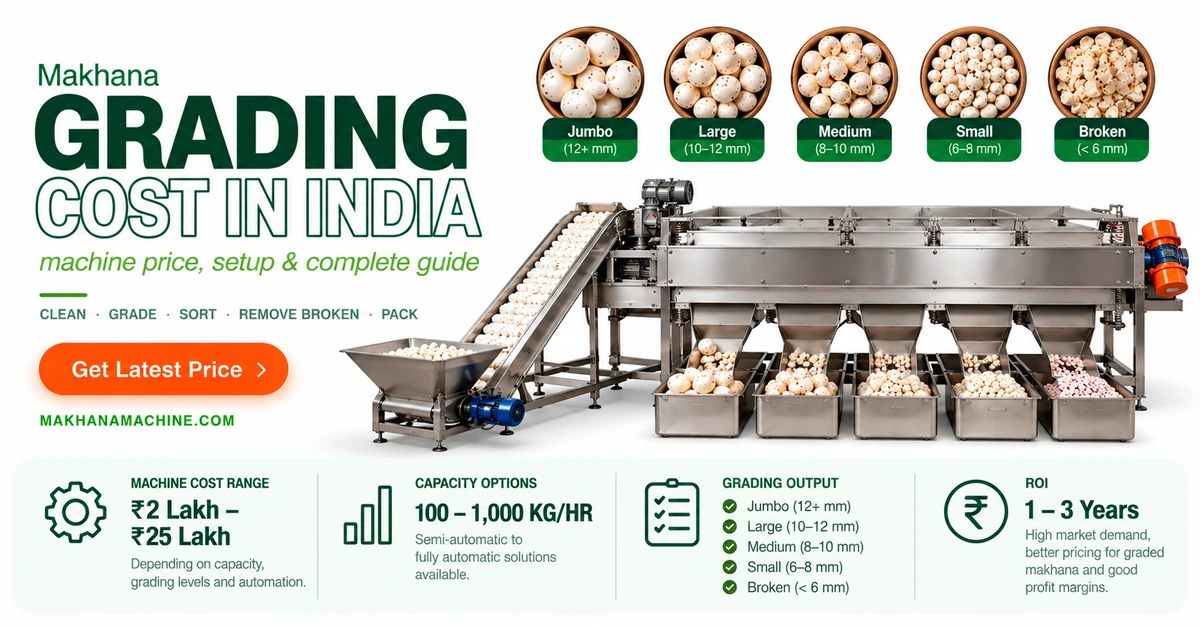
For processing companies looking to return makhana in a clean uniform marketable, ready-to-eat form, a makhana grading machine is essential. This machine sorts the makhana by size and eliminates bad or broken makhana, resulting in a consistent product.
Costing of a makhana grading machine is connected to the sensory appeal, consumer confidence and the branding for small-sized packaging units, commercial makhana brands, bulk buyers and export units. The combination of the machine should be found appropriate for improving the separating accuracy, reducing the labour, minimize the breakage and be easy for the makhana processors to grade the first grade, usual grade, second grade makhanas. This article discusses on the major costing factors of a makhana grading machine, which are helpful to the buyers to choose right combination for their production plan.
Typical Makhana Grading Machine Price in India
Prices vary significantly across suppliers, machine configurations, and production capacities. The figures below are indicative market prices and should be treated as planning estimates rather than fixed quotations.
| Machine Type | Typical Capacity | Indicative Price Range | Best Suited For |
|---|---|---|---|
| Basic popped makhana grader | 50–100 kg/hr | ₹49,500–₹1.5 lakh | Small units, startups, manual packaging. |
| Semi-automatic popped makhana grader | 50–300 kg/hr | ₹1.5–₹2.75 lakh | Small and medium commercial processors. |
| Multi-grade makhana grader | 200–500 kg/hr | ₹2.75–₹4.6 lakh | Commercial grading, retail packing, bulk supply. |
| High-capacity or advanced sorting machine | 500–600 kg/hr | ₹4.25–₹12.5 lakh | Large processors, exporters, industrial units. |
| Makhana grading plant | Up to 50 kg/hr; 50–200 kg/hr; 200+ kg/hr | ₹3–₹14 lakh | Dedicated grading operations and larger processing plants. |
| Full makhana processing line with grading | Varies | ₹3–₹30 lakh+ | Integrated cleaning, roasting, grading, and packing. |
A basic popped makhana grading machine from Jas Enterprise is listed at ₹49,500, while another popped makhana grader with 300 kg/hr capacity is listed around ₹1.95 lakh. At the higher end, a 500 kg/hr makhana grader is listed at approximately ₹4.5 lakh, while advanced makhana sorting machines can reach ₹12.5 lakh per unit.
Price by Machine Capacity
Capacity is one of the strongest price drivers. A machine designed for 50 kg per hour costs far less than a 500 kg per hour system because it requires a larger frame, more powerful motors, bigger screens, stronger structure, and often additional discharge outlets.
| Capacity Segment | Approximate Price Level | What You Can Expect |
| 50–100 kg/hr | ₹50,000–₹1.5 lakh | Basic grading, fewer features, suitable for small-scale use. |
| 150–300 kg/hr | ₹1.5–₹3 lakh | Better throughput, multiple grades, semi-automatic operation. |
| 300–500 kg/hr | ₹2.75–₹4.6 lakh | Commercial-grade construction, higher output, multi-grade separation. |
| 500 kg/hr and above | ₹4.25 lakh–₹12.5 lakh+ | Industrial-grade systems, advanced controls, higher automation. |
For example, a 500 kg/hr makhana grader is listed at ₹4.5 lakh, while a 500 kg/hr makhana grading and sorting machine is listed at ₹4.25 lakh. A 600 kg/hr makhana sorting machine is listed much higher, at ₹12.5 lakh, showing how features such as sorting technology, accuracy claims, and industrial construction can increase the price.
Price by Automation Level
Automation has a direct impact on both purchase price and operating efficiency.
Manual or Basic Machines
Manual or basic machines are the lowest-cost option. They require operators to load makhana, monitor discharge, and collect grades manually.
These machines are suitable for startups, small processors, and units with limited capital. However, they need more labour and may deliver lower throughput during peak production.
Semi-Automatic Machines
Semi-automatic machines use powered vibration, controlled feeding, and multiple discharge points, but still require operator involvement for loading, monitoring, and collection.
They are often the best balance of price and productivity for growing makhana brands. A 50 kg/hr semi-automatic popped makhana grading machine is listed around ₹1.5 lakh, while a 300 kg/hr model is listed around ₹1.95 lakh.
Fully Automatic Machines
Fully automatic machines can have an automatic feeder, a vibration control, auto-cleaning of screens, automatic dust aspiration and combined or separate discharge. These add to the initial cost while decreasing dependence on labour and inconsistency.
A fully automatic 200 kg/hr makhana grading machine can be bought around the cost of ‘s4.5 lakhs. A used 250300 kg/hr four-grade popped makhana grading machine is listed at ‘s4.6 lakhs.
Price by Number of Grades
The number of output grades affects screen configuration, machine size, motor load, and discharge arrangement. More grades generally mean more sieves, more outlets, and higher cost.
Common configurations include:
- 2–3 grades: Suitable for basic premium and regular separation.
- 4 grades: Common for commercial popped makhana grading, including premium, regular, small, and flat or un-popped material.
- 5 grades: Used by processors that need finer market segmentation.
- 5–7 grades: Often used for raw makhana seed grading before roasting.
A cipta grading machine for makhana is listed at ₹2.75 lakh and can separate CIPTA, 5 suta and above, and 5 suta and below categories. Another five-grade makhana grading machine with 500 kg/hr capacity is listed at ₹4.25 lakh.
What Drives the Price of a Makhana Grading Machine?
1. Production Capacity
Higher capacity requires larger screens, stronger frames, more powerful motors, and robust transmission systems. This is why a 500 kg/hr grader costs substantially more than a 50–100 kg/hr unit.
2. Number of Grading Screens
Each additional grade requires an additional screen deck or drum section, along with a separate discharge outlet. A four-grade machine will usually cost more than a two-grade or three-grade machine because it performs more separations in one pass.
3. Material of Construction
Stainless steel, especially SS 304, costs more than mild steel but is preferred for food-contact areas because it is hygienic, corrosion-resistant, and easier to clean.
Some machines use SS 304 for all contact parts and powder-coated mild steel for the body structure. This can reduce cost while maintaining food-safety standards at critical contact points.
4. Automation and Controls
Features such as automatic feeding, variable vibration control, auto sieve cleaning, dust aspiration, and control panels increase cost. However, they can reduce labour cost and improve grading accuracy over time.
5. Raw Seed Versus Popped Makhana
Raw makhana seed graders and popped makhana graders may look similar, but their design requirements differ. Raw seed grading often requires multiple size grades for uniform roasting, while popped makhana grading must handle fragile kernels and separate flat or un-popped material.
6. Brand, Service and Spare Parts
Established manufacturers may charge more, but they often provide better technical support, spare-screen availability, installation guidance, and warranty service. For business use, after-sales support can be more valuable than saving a little money at first.
7. Customization
Additional custom screen sizes, special discharge configurations, thicker stainless steel, dust extraction, feed elevators, and packing line connections will also add to the bottom line.
Hidden Costs to Consider
The listed machine price is rarely the complete investment. Buyers should budget for the following additional costs.
| Cost Head | Why It Matters |
| GST and freight | Machine prices are often quoted excluding taxes and transportation. |
| Installation and commissioning | Larger machines may require technical installation and alignment. |
| Electrical setup | Three-phase power, wiring, starter panels, and earthing may be needed. |
| Spare screens | Screens wear out or need changing for different grades and crop batches. |
| Dust extraction system | Optional but useful for cleaner operation and better workplace hygiene. |
| Feeding elevator | Reduces manual lifting and supports continuous feeding in larger lines. |
| Packaging integration | If the grader feeds directly into a packing line, additional conveyors or hoppers may be required. |
| Training | Operators should understand feed control, screen changes, cleaning, and safety procedures. |
A machine listed at ₹4.6 lakh may therefore require a higher total project budget once taxes, freight, installation, electrical work, and optional accessories are included.
Price Versus Value: What Should You Buy?
The cheapest machine is not always the most economical choice. A low-cost grader may save money initially but can create problems if it causes high breakage, poor grade separation, frequent downtime, or difficulty sourcing spare screens.
For Startups and Small Units
A basic or semi-automatic popped makhana grader in the ₹50,000–₹1.5 lakh range can be suitable if production volume is low and packaging is manual.
Before buying, confirm whether the machine can handle your expected daily volume without overloading and whether it separates the grades your buyers actually demand.
For Growing Commercial Brands
A 200–500 kg/hr machine in the ₹2.75–₹4.6 lakh range is often more practical for brands supplying retail packs, flavoured makhana, or bulk orders.
At this level, buyers should prioritize:
- At least 3–5 output grades.
- Easy screen replacement.
- Gentle handling to reduce breakage.
- Stainless-steel contact parts.
- Stable vibration and controlled feed.
- Reliable after-sales support.
For Large Processors and Exporters
High-capacity machines and dedicated grading plants in the ₹4.25 lakh–₹14 lakh range are better suited to continuous production, export requirements, and integrated processing lines.
For these buyers, automation, dust control, consistent output, and integration with cleaning, roasting, and packaging systems matter more than the lowest quoted price.
Government Subsidy and Financing
Makana processing equipment can get support under food-processing schemes. As has been discussed earlier, PMFME scheme is prevalent, which may give up to 35% credit-linked subsidy on eligible food-processing equipment such as makhana machine.
The additional state level support may also be available based on location, project type and scheme guidelines. Buyers should check with authority/implementing agency, details of buyers approval eligibility and documentation requirements before purchasing.
A subsidy will lower the net capital cost, but should not be the primary motivation to buy a machine, other than as a tiebreaker. Capacity, grading accuracy, durability, and service support are more important.
How to Compare Supplier Quotations
When comparing prices, ask every supplier for the same specification sheet. Otherwise, a lower quote may simply mean a smaller machine, fewer grades, or lower-grade materials.
Request these details in writing:
- Machine capacity in kg per hour.
- Number of grades and screen sizes.
- Raw makhana or popped makhana application.
- Material of construction for contact and non-contact parts.
- Motor power, phase, and electrical requirement.
- Automation level and control features.
- Screen-cleaning mechanism.
- Dust aspiration or feeding elevator, if included.
- Breakage expectation and grading accuracy.
- Warranty terms and spare-part availability.
- Delivery, installation, GST, and freight charges.
- Total landed cost, not just the base machine price.
A ₹2 lakh machine with poor separation may cost more in the long run than a ₹4.5 lakh machine that delivers clean grades, lower breakage, and reliable output.
Sample Budget Scenarios
Small Makhana Packaging Unit
A small unit processing limited quantities can consider a basic popped makhana grader around ₹49,500 to ₹1.5 lakh. This suits manual packing, low daily.
A processor handling retail packs and bulk orders may need a 200–500 kg/hr grader. A realistic budget is approximately ₹2.75–₹4.6 lakh, plus taxes, freight, installation, and spares.
Integrated Makhana Processing Plant
A unit planning cleaning, roasting, grading, flavouring, and packing should budget for a complete line rather than only a grader. Integrated makhana processing lines are listed from around ₹9.6 lakh to ₹14.5 lakh, while larger turnkey plants can cost substantially more.
Conclusion
A makhana grading machine is a practical investment for any processor aiming to improve consistency, reduce manual sorting, and deliver better-quality makhana. The right machine should match your production scale, product type, number of grades required, and future expansion plans.
Rather than choosing only on the basis of the lowest quotation, buyers should compare capacity, grading accuracy, gentle handling, hygienic construction, automation features, spare-part availability, and after-sales support. A well-selected grading machine protects premium yield, improves pack presentation, and helps makhana brands build a stronger position in retail, bulk, and export markets.
Frequently Asked Questions
What is the starting price of a makhana grading machine in India?
Makhana grading machines of basic model available in the market at starting price of about 49, 500 but it is not commercially feasible as most of the comercial is priced higher.
How much does a commercial makhana grading machine cost?
Nearly all commercial machines are around those costs with variations between around 1.5 to 4.6 lakhs based on the capacity, feed grades, and the automation levels.
Why do makhana grading machine prices vary so much?
Prices also differ per capacity, number of grades, automation material of construction, customization, and the brand name. In addition, quality of after-sales also much affects the price.
Is a stainless-steel makhana grading machine more expensive?
Yes. The cost of SS 304 contact parts are higher, but they have advantages of high hygiene standards, corrosion resistance, durability, and ease of cleaning.
Does higher capacity always mean a better machine?
Decide capacity relative to day-by-day production, feed uniformity, labour resources, grade separation, etc.
Can government subsidy reduce makhana machine cost?
Yes, it is possible. The subsidies/grants on eligible food-processing machineries under PMFME and some other state schemes may be available on approval.
Should I buy a standalone grader or a complete processing line?
Own a grade machine on its own (if you’re just grading) and get the whole line (if you want cleaning, roasting, grading, and packing all together).