
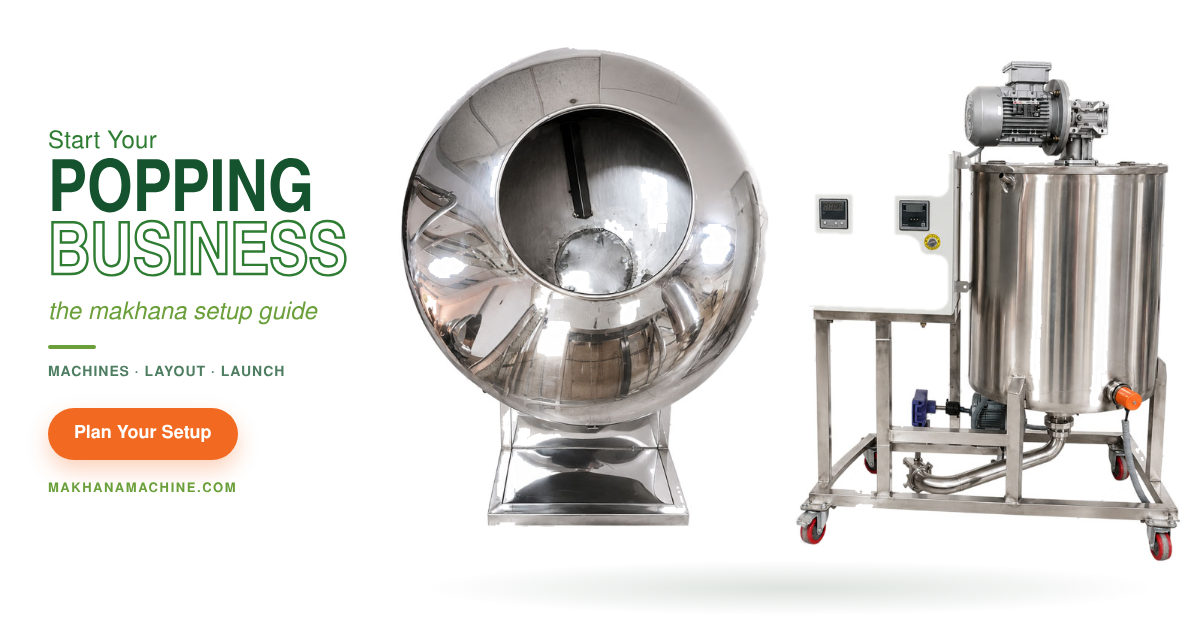
The makhana popping machine is also known as the equipment planning of the makhana popping machine. Various equipments are needed for established a running the a good making unit, production model, having guaranteed raw-seed supply, maximum popping capacity machine, food-safety measures, operators training and marketing plan for plain or flavoured makhana.
This makhana popping machine guide gives you information about starting a commercial makhana popping machine business in India; covers business model selecting a machine layout investment licensing staffing production process and profit calculations.
Choose Your Business Model First
Before selecting a machine, decide what you will sell. Your business model determines machine capacity, automation level, packaging needs, and working capital.
| Business model | What you sell | Machinery focus | Best for |
| Popping service | Popped makhana supplied to processors or brands | Popping machine, basic cleaning and grading | Farmers, FPOs, small processors |
| Bulk makhana supplier | Plain popped makhana in bulk packs | Popping, grading, polishing, bulk packing | Wholesalers and local traders |
| Packaged plain makhana | Retail packs of plain roasted makhana | Popping, roasting, grading, pouch packing | Small D2C or local retail brands |
| Flavoured makhana brand | Masala, cheese, chocolate, or other flavoured makhana | Popping, roasting, flavouring, cooling, pouch packing | Snack brands and private-label businesses |
| Complete processing unit | Raw-seed-to-pack makhana products | Cleaning, grading, drying, popping, polishing, packing | Medium and large processors |
A small setup can begin with a popping machine and basic packing, while a complete processing and packaging unit may require roasters, poppers, graders, seasoning drums, and automated packing machines.
Understand the Makhana Popping Process
Raw makhana seeds cannot be sold or eaten directly. They must be cleaned, dried, graded, pre-heated, tempered, roasted, and popped to release the white edible kernel.
A typical production flow is:
- Raw seed purchasing: Purchase clean seeds of the makhana, which are matured by known farmers, collectors, or aggregators.
- Cleanning: mud stone husk, damaged seeds and dirt.
- Drying: Decrease moisture content to ensure the seeds roast and pop evenly.
- Grading: for good heat transfer, use like sized seeds.
- Pre heating: Prepare seeds before final popping.
- Tempering: Rest seeds for a specific time to loosen the kernel from its shell.
- 3. Roasting and popping: take the makhana popping machine and pod the seeds in it.
- Separation: take out shells, unpopped seed and broken material.
- Polish: Boost whiteness and luster.
- Batch: grade popped makhana by size and quality.
- Flavouring: in case you are preparing flavoured items, you may include seasoning.
- Cooling: must be thoroughly cooled before packing to prevent loss of crispness.
- Packaging: pouches or bulk bags food grade with accurate labeling.
- 7. Storage and dispatch Store the completed goods in a dry warehouse, free of insects and pests.
Select the Right Popping Machine
The makhana popping machine is the core investment, but it should match your production target and business model. A 10–30 kg/hr machine can be sufficient for a new unit, while mid-scale operations may need 30–100 kg/hr capacity.
Machine capacity guide
| Business scale | Suggested capacity | Typical use |
| Startup or pilot unit | 10–30 kg/hr | Testing demand, local supply |
| Small commercial unit | 30–50 kg/hr | Regular bulk or retail supply |
| Mid-scale processor | 50–100 kg/hr | Consistent supply to brands and distributors |
| Large processing plant | 100+ kg/hr | Packaged snack brands and contract processing |
For a new entrepreneur, starting with a 10–30 kg/hr machine reduces risk while allowing you to test seed quality, popping yield, labour needs, and market response.
Machine selection checklist
- Confirm whether quoted capacity means raw-seed input or popped output.
- Ask for a live trial using your own makhana seeds.
- Check popping efficiency, broken-kernel percentage, and unpopped-seed percentage.
- Verify power load, phase requirement, and heating source.
- Ensure food-contact parts are made from suitable food-grade material.
- Ask about spare parts, warranty, installation, and operator training.
- Compare total landed cost, including GST, freight, and commissioning.
- Check whether the machine can integrate with roasting, grading, or packing equipment later.
Plan Your Factory Layout
A good layout reduces contamination risk, improves workflow, and lowers handling time. Even a small unit should separate raw-material storage, processing, packing, and finished-goods storage.
Recommended layout zones
- Raw material store: For makhana seeds, packaging film, seasoning, and other inputs.
- Cleaning and grading area: For removing impurities and sorting seeds.
- Drying and pre-heating area: For moisture control and seed conditioning.
- Popping area: For the makhana popping machine, roaster, and heat-control equipment.
- Cooling and separation area: For removing shells and cooling popped makhana.
- Polishing and grading area: For improving appearance and sorting quality.
- Flavouring area: Separate area for seasoned products to avoid cross-contamination.
- Packing area: Clean, dry, and protected from dust and pests.
- Finished-goods warehouse: For labelled, sealed stock ready for dispatch.
A complete automated line may include a vibro grader, sand roaster or popping machine, cooling conveyor, flavouring drum, polishing machine, multi-head weigher, and packing machine.
Estimate Your Setup Investment
Investment varies widely by scale and automation. A small semi-automatic unit may cost around ₹5–10 lakh, while a fully automated turnkey plant can cost ₹25–35 lakh.
Small to medium setup estimate
| Cost head | Estimated range |
| Makhana popping machine | ₹1.5–2.5 lakh |
| Size grading machine | ₹80,000–1.5 lakh |
| Roasting equipment | ₹1–1.5 lakh |
| Packaging unit | ₹1–2 lakh |
| Working capital | ₹2–5 lakh |
| Indicative small-unit total | ₹5–10 lakh+ |
These estimates align with published makhana business setup guides, which place popping machines at ₹1.5–2.5 lakh and small processing setups at ₹5–10 lakh including grading, roasting, and basic packing machinery.
Larger processing and packaging unit estimate
A medium-scale semi-automatic processing and packaging unit may require substantially higher investment. One industry estimate places processing machinery at ₹15–30 lakh, packaging machinery at ₹6.5–15 lakh, and total project investment at approximately ₹35.5–73 lakh or more, depending on scale and automation.
Working capital
Do not ignore working capital. You will need funds for:
- Raw makhana seed stock
- Packaging material and labels
- Seasoning ingredients, if applicable
- Electricity, fuel, and water
- Labour and operator salaries
- Freight and distributor margins
- Maintenance and spare parts
- Marketing and sales expenses
A medium-scale unit estimate includes ₹4–8 lakh for initial raw-seed stock and ₹1.5–3 lakh for packaging material and seasoning.
Licenses and Compliance
A makhana popping business is a food business, so compliance should be planned before production begins.
Essential registrations
- FSSAI registration or licence: Mandatory for manufacturing, processing, storage, distribution, or sale of food. FSSAI eligibility depends on annual turnover and business category; state licence applies where turnover is above ₹12 lakh per year.
- Udyam/MSME registration: Useful for MSME benefits and schemes such as PMFME.
- GST registration: Required if turnover crosses the applicable threshold; often needed for B2B sales.
- PAN and business registration: Required for proprietorship, partnership, LLP, or private limited company structures.
- Trade licence or local body registration: Required as per your state, district, or municipal rules.
- Pollution-related approvals: May be required for roasting operations, depending on local pollution-control requirements.
- APEDA and IEC code: Required if you plan to export makhana.
Label requirements
Every retail pack should carry clear product and traceability details, including:
- Product name
- Ingredient list
- Net quantity
- FSSAI logo and licence number
- Manufacturing and expiry/best-before dates
- Batch or lot number
- Manufacturer, packer, and marketer details
- Vegetarian declaration
- Nutritional information
- Allergen information, where applicable
- Storage instructions
Hire and Train the Right Team
A small unit can begin with a lean team, but popping requires skill and discipline. Machine popping reduces manual drudgery, yet operators must understand seed quality, temperature, feed rate, and quality checks.
Typical team structure
| Role | Responsibility |
| Owner or plant manager | Production planning, procurement, sales, and compliance |
| Machine operator | Feeding, temperature control, popping, and shutdown |
| Helper or labourer | Cleaning, grading, packing, and material movement |
| Quality checker | Checking popping yield, colour, moisture, and foreign matter |
| Packer | Weighing, sealing, labelling, and batch recording |
| Sales or distributor coordinator | Orders, dispatch, and customer communication |
Train operators on startup and shutdown procedures, safe handling of hot equipment, cleaning routines, temperature settings, and batch documentation.
Source Raw Makhana Carefully
Raw-seed quality directly affects popping yield and final product quality. Poor seed preparation cannot be fully corrected by a good machine.
Sourcing options
- Direct procurement from farmers or farmer producer organisations
- Local aggregators in makhana-producing regions
- Wholesale seed suppliers
- Contract farming arrangements
- Cooperation with FPOs or self-help groups
Bihar is a major makhana-producing state, and locating near production hubs can reduce transport cost and improve raw-material access.
Raw-material quality checks
- Uniform seed size
- Low foreign matter
- No rotten or damaged seeds
- Consistent moisture level
- Reliable supplier pricing
- Batch-wise traceability
- Adequate stock for continuous production
Production Planning and Yield
Before committing to large orders, run trial batches to calculate your actual yield. Popping yield depends on seed quality, moisture, tempering, roasting temperature, feed rate, and machine settings.
Track these metrics daily
- Kilograms of raw seed used
- Kilograms of popped makhana produced
- Popping percentage
- Unpopped seed percentage
- Broken-kernel percentage
- Shell and impurity percentage
- Power or fuel consumption per kg
- Labour cost per kg
- Rejection or downgrading percentage
- Packaging wastage
Maintain a production register for every batch. This helps identify whether quality issues come from raw material, machine settings, operator handling, or packaging.
Packaging and Product Positioning
Packaging is where a makhana processor becomes a brand. Plain popped makhana can be sold in bulk, but retail success usually requires attractive, moisture-protected packaging.
Packaging options
- Bulk bags: For wholesalers, processors, and HoReCa buyers.
- Stand-up pouches: For D2C, modern trade, and premium retail.
- Nitrogen-flushed packs: Useful for preserving crispness in premium snack packs.
- Jar packs: Suitable for premium gifting or repeat-purchase formats.
- Private-label packs: For supermarkets, wellness brands, and snack companies.
For flavoured makhana, invest in a flavouring drum or coating system, cooling conveyor, and accurate weighing and sealing equipment. A complete processing line may include a tumbling or flavouring drum, multi-head weigher, and automatic packing machine.
Marketing and Sales Channels
A popping machine business can sell through multiple channels. Start with one or two channels, prove consistent quality, then expand.
Sales channels
- Local grocery stores and supermarkets
- Wholesalers and makhana traders
- HoReCa buyers such as cafes, hotels, and caterers
- D2C website and social-media sales
- Marketplaces such as Amazon, Flipkart, and IndiaMART
- Private-label supply to wellness and snack brands
- Institutional supply to gyms, nutrition stores, and corporate gifting companies
- Export buyers, once compliance and quality systems are established
For retail packs, highlight clear benefits such as being light, crunchy, vegetarian, and suitable for healthy snacking without making unsupported medical claims.
Government Support and Financing
Small food processing enterprises may qualify for support through schemes like PMFME. A guide for establishing a makhana processing plant. Gives a projected total project cost of 2333 lakh, and mentions a PMFME subsidy support of 35%, up to 10 lakh, according to scheme requirements.
Common documents for loan or subsidy applications
- Aadhaar and PAN
- Bank details and statements
- Udyam/MSME registration
- FSSAI registration or licence
- Business registration documents
- Land ownership documents or rent agreement
- Detailed project report
- Machinery quotations from two or three suppliers
- Electricity connection proof
- GST registration, where applicable
- Bank loan application documents
A detailed project report should include machinery quotations, production projections, cost estimates, working-capital needs, and repayment plans.
Common Mistakes to Avoid
- Buying a machine based only on advertised capacity.
- Skipping a trial run with your own raw makhana.
- Underestimating working capital.
- Ignoring cleaning, drying, grading, and tempering before popping.
- Starting retail branding before stabilising popping quality.
- Not budgeting for packaging, labels, and compliance.
- Mixing raw and finished goods in the same storage area.
- Relying on one supplier or one sales channel.
- Neglecting operator training and maintenance.
- Making health claims that cannot be substantiated.
30-Day Launch Plan
Week 1: Research and planning
- Finalise business model and target customers.
- Decide whether you will sell bulk, plain retail, or flavoured makhana.
- Prepare a basic project report and budget.
- Shortlist three machine suppliers.
Week 2: Machine selection and site preparation
- Request quotations and machine specifications.
- Arrange a trial run using your seed sample.
- Finalise location, power load, water supply, and storage plan.
- Apply for FSSAI registration or licence and Udyam registration.
Week 3: installation and procurement
-
Put the machine order after comparison of total landed cost.
-
Coordinate electrical work, fuel infrastructure, and safety equipment.
-
Hire and equip initial team.
-
Procure raw seeds, film for packaging, labels, and consumables.
Week 4 : Trial run and launching on the market.
-
fly other people: trial run from the product to the market.
-
Run trial batches and note the yield, quality, and cost per kg.
-
Ratifies standard operating procedures.
-
Design sample packs and set prices.
-
Start the supply to local wholesalers, retailers, or D2C customers.
Conclusion
Manufacturing a makhana popping machine may amount to a good food processing business if it is built up with quality raw material, controlled popping, conforming packaging, and a sanctioned way to market. Develop it first with a modest machine capacity, confirm popping yield with trials and then work to develop grading, seasoning, and packaging with upwardly growing sale volume.
The best set-ups are those that put the popping machine in context overall. Starting with sourcing prepping popping QC packing and distributing all together, working towards a good and reliable makhana for sale.
FAQs
How much investment is needed for a makhana popping business?
A small unit will require an amount of about 510 lakh, for popping, grading, roasting, packing, and working capital.
Which makhana popping machine capacity is best for beginners?
A 10 30 kg/hr machine is generally appropriate for startups and pilot production.
Is FSSAI registration mandatory for a makhana popping unit?
Does it apply to FSSAI registration/license? Yes, for manufacturing, processing, storage, or sale.
Can I start with only a popping machine?
Yes, but you will still need to set up for cleaning grading roasting packing storing and quality-control.
Where should a makhana popping unit be located?
Ideal location for makhana dumps should include easy access to adequate power supply, convenient transportation, dependable transport medium and anticipated market.
What documents are needed for a makhana business loan?
A common listing of this documents, usually documents that are submitted for various official purposes. SAPF: PAN / Aadhaar / Udyam/ FSSAI / Bank Statement / project report / Quotation / land or rent document.
How can I improve makhana popping yield?
Standardize seeds; Ventilate with moist air; Temper; heat correctly; and Check each batch.