
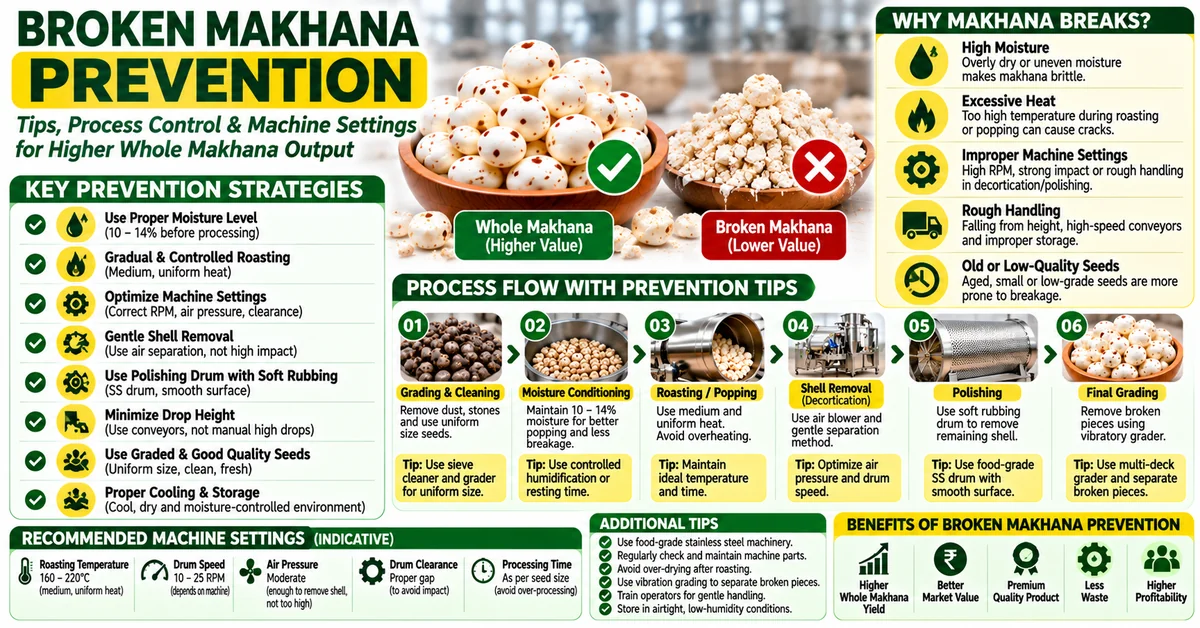
Broken makhana prevention is one of the most expensive problems in a fox nut processing business. Every cracked, chipped, or crushed piece reduces the share of premium whole makhana, lowers realised price, and creates extra work in sorting and repacking. The good news is that most breakage is preventable it usually comes from uneven raw-seed preparation, aggressive popping, rough transfers, excessive vibration, and careless packing.
This guide explains how to reduce breakage in popped makhana at every stage from raw seed selection to final dispatch. It is written for makhana processors, food-business founders, and anyone setting up a makhana processing plant in India. Regulatory and food-safety requirements vary by product, scale, and state, so verify the applicable FSSAI and local compliance requirements before finalising your process.
Why Breakage Matters
Makhana is light, crisp, and brittle after popping. A whole, well-expanded piece commands a better price than a fragmented one, especially in premium retail packs, export-oriented supply, and flavoured makhana products.
Breakage affects more than appearance:
- Lower grade and price: Whole makhana is sorted into size grades; broken pieces often move into lower-value categories.
- Higher labour cost: More manual sorting is needed to separate broken pieces from saleable stock.
- More customer complaints: Retail buyers expect uniform, clean, whole pieces in premium packs.
- Poorer packaging performance: Fines and fragments settle at the bottom of pouches and can affect perceived quality.
- Reduced yield: A batch may pop well but still lose commercial value if too much of it breaks during handling.
Breakage prevention is therefore not only a quality exercise. It is a margin-protection exercise.
Where Breakage Happens
Most breakage occurs after the makhana has popped, because the expanded kernel is delicate. The main risk points are:
- Popping or de-husking, where impact is unavoidable but must be controlled
- Transfer from popping equipment to cooling or collection trays
- Polishing and friction cleaning
- Grading screens, vibratory conveyors, and elevators
- Seasoning or coating drums
- Packing-machine hoppers, weighers, and filling heads
- Pouch sealing, carton packing, stacking, and transport
A practical way to reduce losses is to map every drop, slide, impact, and vibration point in your line. Then ask one question at each point: Can this makhana move more gently?
Start With Raw Seed Quality
Breakage prevention begins before popping. Raw fox nut seeds that are immature, uneven in size, over-dried, or poorly stored do not pop uniformly. Poor popping creates weak kernels, unpopped seeds, and fragments that are more likely to break later.
Select and clean properly
Remove mud, stones, plant material, and damaged seeds before processing. Clean raw material improves popping consistency and reduces wastage during roasting and popping.
Use washing and pre-cleaning equipment appropriate to your capacity. Even in smaller units, a simple washing and draining routine can remove surface impurities before the seeds enter drying or roasting.
Grade seeds by size
Size grading is one of the highest-impact steps for reducing breakage. Raw makhana seeds are commonly sorted into multiple size grades using sieves, which helps each seed receive more uniform heat during roasting.
If small and large seeds are roasted together, one group may overheat while the other remains under-processed. That inconsistency leads to uneven expansion, weak structures, and more breakage.
Practical rule: do not mix seed sizes in a popping batch unless your equipment and process are specifically designed for mixed-size feeding.
Control seed moisture
Moisture affects how the seed expands. Raw seeds are often conditioned and dried before processing, and pre-heating can reduce moisture to roughly 20 percent before tempering.
Avoid treating moisture as a guesswork parameter. Record the moisture condition of incoming lots, drying time, weather conditions, and popping results. Over time, you will identify the moisture range that gives the best expansion with the least breakage for your seed source.
Get Popping Right
Popping is the most critical operation in makhana processing. Traditional processing uses high-temperature roasting and controlled cracking to release the expanded kernel, while modern lines may use rotary roasters, controlled heating, and mechanical popping systems.
The goal is not simply to pop every seed. The goal is to produce a fully expanded, intact kernel with minimal shell contamination and minimal mechanical damage.
Use consistent heat
Raw seeds are commonly pre-heated at around 250–300°C, while final roasting and popping may occur at approximately 290–340°C depending on the process and equipment.
Avoid sudden temperature swings. Inconsistent heat causes some seeds to pop too early, others to remain under-popped, and some to become brittle or scorched.
Checklist for heat control:
- Preheat equipment before loading the first batch.
- Maintain a consistent seed layer; avoid overloading.
- Stir or rotate seeds continuously where required.
- Adjust temperature and residence time for seed size and moisture.
- Record settings for each seed grade.
- Remove popped makhana promptly once expansion is complete.
Do not chase speed at the cost of whole kernels
A faster line is only better if it produces more saleable whole makhana. If increasing feed rate increases broken percentage, the extra throughput may be false economy.
Track three numbers for every batch:
- Popping yield
- Whole-kernel percentage
- Broken or rejected percentage
A batch with slightly lower throughput but significantly fewer broken pieces may be more profitable.
Handle freshly popped makhana gently
Freshly popped makhana is hot and fragile. Avoid dropping it from height, sweeping it roughly, or piling it deeply in collection containers.
Use shallow trays, gentle chutes, soft landing zones, and controlled transfer speeds. Where possible, design transfers so makhana slides rather than falls.
Temper and Cool Before Further Handling
After popping, makhana needs time to stabilise. If it is polished, graded, seasoned, or packed while still hot, it can crack more easily and may also lose crispness later due to moisture condensation.
Cool popped makhana to ambient temperature before further processing. Proper cooling helps preserve crispness and prevents moisture build-up inside the final pack.
Cooling best practices
- Spread makhana in shallow layers for faster, more even cooling.
- Avoid blowing hot, humid air directly over the product.
- Use clean, dry ambient air or a controlled cooling system.
- Do not pack warm makhana.
- Keep cooling areas free from dust, pests, and excess humidity.
If you use forced-air cooling, keep air velocity low. High-velocity air can move lightweight makhana violently, causing collisions and breakage.
Polish Without Punishing the Product
Polishing removes residual husk and improves whiteness and lustre. In traditional processing, makhana may be rubbed between themselves for polishing.
But polishing is also a common source of breakage when the equipment is too aggressive or the residence time is too long.
Reduce polishing damage
- Use the minimum polishing time needed to achieve the desired appearance.
- Avoid sharp edges, rough surfaces, and excessive friction.
- Do not overload the polisher.
- Separate broken pieces before polishing where practical.
- Inspect output after every adjustment.
A useful test is to take a fixed sample before and after polishing. Count whole kernels and broken pieces. If breakage rises sharply, reduce speed, load, or polishing duration.
Grade With Gentle Machinery
Grading separates makhana by size and helps create consistent retail packs. Popped makhana is commonly graded into categories such as 4 suta, 5 suta, 6 suta, and larger jumbo grades.
However, grading equipment can damage makhana if vibration, screen speed, or drop height is excessive. Excessive vibration or rough transfer points can cause breakage in popped makhana.
Choose equipment carefully
Look for:
- Smooth, polished contact surfaces
- Controlled vibration rather than aggressive shaking
- Low drop heights between conveyors, screens, and collection bins
- Adjustable feed rate
- Easy cleaning and maintenance access
- Screens appropriate to the makhana grade being processed
Set up the line correctly
Even good machinery can break makhana if installed poorly. Check that:
- Conveyor belts are aligned and tensioned correctly.
- Chutes are angled smoothly, not steeply.
- Collection bins have baffles or soft landing areas.
- Vibratory motors are balanced and not set too high.
- Screens are not overloaded.
- Product does not bounce between metal surfaces.
Control Seasoning and Coating Damage
Flavoured makhana is a fast-growing category, but seasoning can increase breakage if the coating process is too aggressive. Coating systems are used to apply edible oil and seasoning blends uniformly, followed by cooling before packaging.
Avoid these mistakes
- Using excessive drum speed
- Adding seasoning before makhana has cooled
- Using overly large seasoning particles
- Overloading the coating drum
- Running the coating cycle longer than necessary
- Dropping seasoned makhana directly into packaging hoppers
For delicate premium makhana, use a gentle coating drum, controlled tilt, and shorter cycle times. Apply seasoning only after the product is dry, cool, and stable.
Pack of Broken Makhana Prevention, Not Just Presentation
Packaging is the final opportunity to protect your product. Popped makhana is commonly packed in polythene bags for distant markets, while local trade may use gunny bags. For retail and longer shelf life, laminated, airtight pouches are common, and nitrogen flushing may be used to support shelf stability.
Packaging practices that reduce breakage
- Use pouches with enough headspace so makhana is not compressed during sealing.
- Avoid overfilling packs.
- Use gentle filling systems; avoid high-speed free-fall filling where possible.
- Keep sealing jaws clean and correctly aligned.
- Use appropriate film thickness and seal strength for the pack size.
- Avoid sharp folds or tight compression in secondary cartons.
- Do not stack cartons too high during storage or dispatch.
Nitrogen flushing can help with freshness and shelf life, but it must be set correctly. Excessive gas flow or poorly matched packaging can create pouch ballooning, handling problems, or transport damage.
Store and Transport Carefully
Even perfectly packed makhana can break in storage or transit. Makhana should be kept in a cool, dry environment, away from direct sunlight and moisture.
Storage rules
- Store finished packs on pallets, not directly on the floor.
- Keep cartons dry and away from walls prone to dampness.
- Avoid heavy stacking that crushes lower cartons.
- Rotate stock using first-in, first-out practices.
- Keep raw and popped makhana in separate, dry storage zones.
Transport rules
- Use clean, dry vehicles.
- Secure cartons so they do not slide or topple.
- Avoid rough loading and unloading.
- Protect pallets from rain and humidity.
- Train drivers and loading staff to handle food cartons carefully.
Common Mistakes That Cause Breakage
Many processors lose whole-kernel yield because of small, repeated mistakes. These are the most common:
- Mixing different raw-seed sizes in one popping batch
- Using excessive roasting temperature or time
- Dropping makhana from conveyors into metal bins
- Running vibratory graders at maximum vibration
- Polishing for too long
- Packing makhana before it has cooled
- Overfilling pouches
- Using steep chutes and high drop heights
- Ignoring broken-percentage data between shifts
- Assuming breakage is normal rather than measurable and fixable
A Practical Broken-Makhana Checklist
Use this checklist daily or for every new batch.
Raw material
- Seeds are cleaned and free from mud, stones, and foreign matter.
- Seeds are graded by size before roasting.
- Moisture condition is recorded.
- Damaged or immature seeds are removed where practical.
Popping
- Equipment is preheated and stable.
- Temperature and time settings match the seed grade.
- Seeds are not overloaded.
- Popped makhana is removed promptly.
- Drop height from popper to collection point is minimised.
Cooling
- Makhana is cooled before polishing, grading, seasoning, or packing.
- Product is spread in shallow layers.
- Cooling area is dry, clean, and free from strong airflow.
Polishing and grading
- Polisher speed and residence time are optimised.
- Vibratory grader settings are not excessive.
- Screens and contact surfaces are smooth and clean.
- Drop points have soft landings or gentle chutes.
Seasoning
- Makhana is fully cooled before coating.
- Coating drum speed and load are controlled.
- Seasoning particle size is appropriate.
- Coated makhana is handled gently after discharge.
Packing
- Pouches are not overfilled.
- Filling height and drop distance are controlled.
- Sealing settings do not crush the product.
- Cartons are not overpacked or stacked too high.
Monitoring
- Whole-kernel percentage is recorded.
- Broken percentage is recorded.
- Breakage location is identified after each batch.
- Machine settings and operator practices are reviewed weekly.
How to Measure Broken Makhana
You cannot improve what you do not measure. Create a simple daily breakage log with these columns:
| Parameter | What to record |
| Batch number | Identifies the production run |
| Seed grade | Size and source of raw seed |
| Popping settings | Temperature, time, feed rate |
| Whole makhana | Weight or percentage of intact kernels |
| Broken makhana | Weight or percentage of fragments |
| Unpopped or poor pop | Weight or percentage rejected |
| Breakage point | Popping, transfer, polishing, grading, packing |
| Action taken | Adjustment made to reduce breakage |
Even a simple manual sample check can reveal patterns. For example, if breakage rises after grading, the issue may be vibration or drop height. If it rises after seasoning, the coating drum may be too aggressive.
When to Upgrade Equipment
Manual processing can produce good makhana, but as volume grows, inconsistent handling becomes a major source of loss. Modern makhana lines can include washing, grading, roasting, popping, polishing, flavouring, cooling, and packaging equipment.
Consider upgrading when:
- Manual sorting labour is rising.
- Whole-kernel yield is inconsistent between operators or shifts.
- You want to supply organised retail, e-commerce, or export buyers.
- You are launching flavoured makhana at scale.
- You need more consistent pack weights and presentation.
- Your current line has frequent product drops, jams, or excessive vibration.
A semi-automatic line may suit smaller volumes and tighter budgets, while fully automatic systems can improve consistency and reduce manual handling. The right choice depends on your target capacity, labour availability, product mix, and budget.
Who Can Help If You Are New?
If you are setting up your first makhana processing unit, do not try to solve breakage only after installation. Involve an experienced makhana machine manufacturer or processing-plant consultant early.
A good equipment partner should help you:
- Select the right capacity for your business plan
- Design a layout with minimal drops and transfers
- Match roasting, popping, grading, and packing equipment
- Train operators on gentle handling
- Set baseline quality parameters
- Provide spare parts and service support
- Help you plan for future capacity expansion
At MakhanaMachine.com, we help new and expanding makhana processors choose suitable machines, plan practical layouts, and reduce avoidable losses from popping to packing.
Frequently Asked Questions
- What causes broken makhana during processing?
Breakage is usually caused by uneven raw-seed size or moisture, excessive popping heat, rough transfers, high drop heights, aggressive polishing, excessive vibration in graders, and rough packing or transport.
- How can I reduce breakage in popped makhana?
Grade raw seeds by size, control moisture and popping temperature, avoid overloading equipment, cool makhana before further handling, and minimise drops between machines. Use gentle polishing, controlled vibration in graders, and soft transfer points throughout the line.
- Should makhana be cooled before packing?
Yes. Warm makhana is more fragile and can also create moisture problems inside the pack. Cool it to ambient temperature in shallow layers before polishing, seasoning, grading, or packing.
- Does grading raw makhana reduce breakage?
Yes. Sorting raw seeds by size helps them receive more uniform heat during roasting and popping. This produces more consistent expansion and reduces weak kernels, unpopped seeds, and broken pieces.
- Can polishing damage makhana?
Yes, if the polisher is overloaded, runs too long, or uses rough contact surfaces. Use the minimum polishing time needed for the desired whiteness and lustre, and check the whole-kernel percentage before and after polishing.
- What packaging helps prevent broken makhana?
Use clean, dry, appropriately sized pouches with enough headspace so the makhana is not compressed during sealing. Avoid overfilling, high free-fall filling, tight carton packing, and excessive stacking during storage or transport.
- Who can help me set up a low-breakage makhana processing line?
An experienced makhana machine manufacturer or processing consultant can help you select machines, design a layout with fewer drops and transfers, train operators, and set quality parameters.