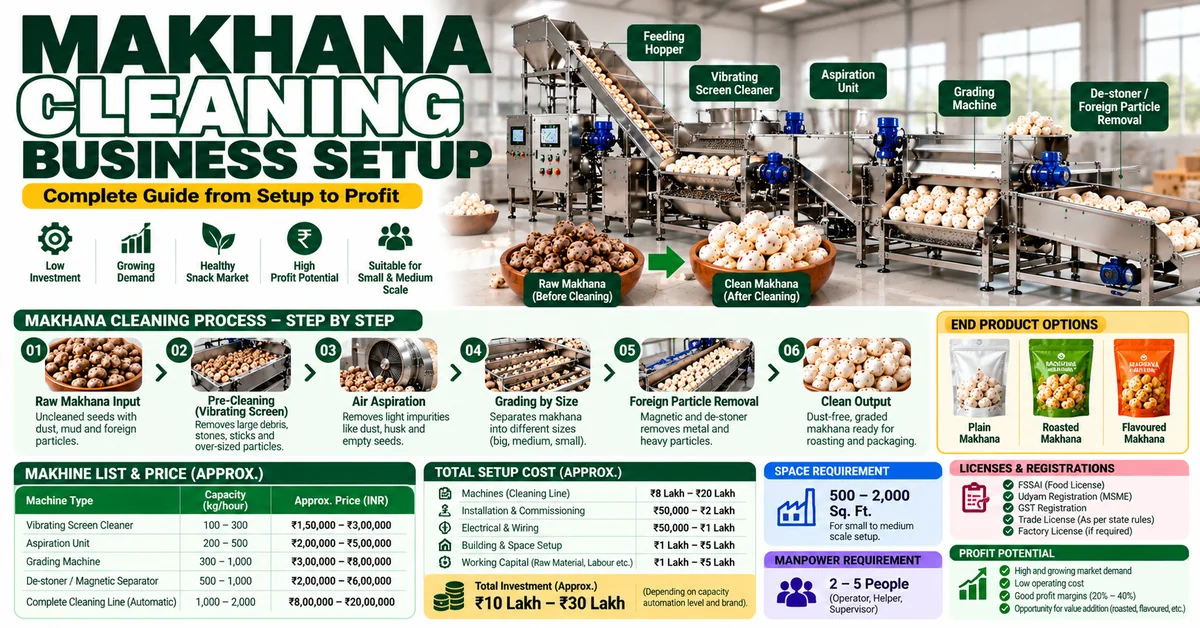
Makhana (pronounced as mak-uh-nah) is no longer a simple snack food to a rapidly expanding category of packaged snacks, health foods, flavours, and premium retail formats. For processors, aggregators, and food entrepreneurs, improved raw-material cleaning is one of the most important first steps toward establishing a reliable and scalable makhana operation.
A makhana cleaning and washing machine is used to remove mud, pond debris stones seed coats, plant fragments, damaged pieces, and other unwanted materials from raw makhana before the next processing stages. If you are planning a processing unit in India, this guide explains what to consider before investing, including workflow capacity space, utilities, compliance, and expected payback.
Why Cleaning Matters in Makhana Processing
Cleaning is not merely a visual-quality step. It affects the efficiency, hygiene, safety, and consistency of the complete production line.
Raw makhana can carry field-level contaminants and unwanted foreign matter. If these materials enter downstream equipment, they may lead to avoidable machine wear, product rejection, inconsistent batches, and higher sorting labour. A structured cleaning and washing step creates a more controlled starting point for subsequent processes such as drying, grading, roasting, popping, seasoning, packing, or value addition.
For a commercial operator, the goal is simple: receive raw material, remove unwanted matter efficiently, and send a cleaner, more uniform output to the next stage. Basic pre-cleaning and inspection are also recommended before material moves through a makhana processing line.
What Is a Makhana Cleaning and Washing Machine?
A commercial makhana cleaning and washing machine is a food-processing system used to clean raw makhana and separate contaminants before further processing. Depending on the machine configuration, it may combine washing, agitation, screening, water-based separation, impurity removal, and discharge functions.
The right machine should be selected according to your product condition, input quality, intended throughput, water availability, hygiene needs, and downstream processing setup. A cleaning machine used for a small regional unit will not necessarily suit a high-volume processing facility supplying multiple distributors or private-label brands.
When evaluating a makhana cleaning and washing machine manufacturer or supplier, do not focus only on the initial machine price. Ask how the equipment will perform with your actual raw material, operating conditions, target output, and available utilities.
Where It Fits in the Processing Line
A typical makhana-processing workflow can include the following stages:
- Raw-material receiving and lot inspection
- Manual pre-cleaning or inspection-table sorting
- Cleaning and washing
- Dewatering or moisture removal
- Drying, where required
- Grading and quality sorting
- Roasting, popping, flavouring, or further value addition
- Weighing, packing, and finished-goods storage
The exact sequence depends on the type of makhana being processed and the final product you plan to sell. For example, a unit focused on bulk raw material may require a different setup from a branded snack business selling flavoured, ready-to-eat makhana.
Who Can Start This Business?
A makhana cleaning and washing setup can be suitable for several business models:
- Makhana farmers’ groups and producer collectives
- Raw-makhana aggregators
- Local processors serving wholesalers
- Snack brands setting up backward integration
- Contract food manufacturers
- Food entrepreneurs launching packaged makhana products
- Processing units supplying grading, roasting, or packaging businesses
- Existing dry-fruit, snack, or healthy-food manufacturers expanding into makhana
The strongest business case usually comes when the machine supports a clearly defined revenue model. You may charge for cleaning services, process your own procured makhana, supply cleaned material to other processors, or use the machine as one step in a complete branded-snack operation.
Choosing the Right Capacity
Capacity is one of the most important buying decisions. A machine that is too small may slow production and increase labour dependence. A machine that is too large may create unnecessary capital cost, underutilisation, and higher utility requirements.
Before requesting a quote, calculate:
- Expected raw-material input per day
- Number of operating shifts
- Hours of production per shift
- Seasonal fluctuations in procurement
- Product loss during cleaning
- Required finished-output quantity
- Future expansion plans
A useful starting calculation is:
\text{Required hourly capacity} =
\frac{\text{Daily raw-material target}}{\text{Actual operating hours per day}}
For example, if your target is 1,000 kg of raw material per day and you expect eight productive operating hours, your baseline requirement is 125 kg per hour. However, practical planning should include downtime for cleaning, material movement, inspections, changeovers, and maintenance.
Do not select equipment based only on an advertised maximum capacity. Ask the supplier for expected capacity with your particular input condition. Wet, muddy, mixed, or highly contaminated material may behave differently from cleaner, pre-sorted input.
Makhana Cleaning and Washing Machine Specifications to Check
A serious purchase discussion should cover much more than motor size and machine dimensions. Request a detailed makhana cleaning and washing machine specifications sheet that covers the following points.
Material of Construction
For food-contact areas, assess the grade and finish of stainless steel used. Food-grade stainless steel construction can support hygiene, cleaning, and corrosion resistance when equipment is used and maintained properly.
Ask about:
- Food-contact material grade
- Frame material
- Weld finish
- Sharp edges or product-trapping areas
- Accessibility for cleaning
- Corrosion protection in wet operating conditions
Capacity and Output
Confirm:
- Input capacity per hour
- Expected output after impurity removal
- Suitable raw-material condition
- Batch or continuous operation
- Recommended loading level
- Expected product loss range
- Actual performance during a demo
Washing and Separation Mechanism
Understand how the system removes contaminants. Ask whether it is designed to handle:
- Mud and dust
- Pond debris
- Stones and heavy foreign particles
- Seed coats
- Plant fragments
- Floating impurities
- Damaged material
A supplier should explain where each impurity stream goes and how it is removed from the working area.
Water Requirement
Washing systems need a practical water-management plan. Ask for clarity on:
- Water consumption per hour or batch
- Recommended water quality
- Inlet connection requirements
- Drainage arrangement
- Whether water recirculation is possible
- Filter or sediment-management needs
- Cleaning-water requirement after production
Water should never become an afterthought. Inadequate drainage or poor wastewater handling can disrupt operations, create hygiene risks, and increase cleaning time.
Power Requirement
Ask for the machine’s:
- Connected electrical load
- Voltage requirement
- Phase requirement
- Motor rating
- Control-panel details
- Earthing needs
- Recommended backup arrangement
Most commercial food-processing equipment may require a stable industrial electrical supply, but the final power requirement must come from the manufacturer’s approved technical specificationnot a generic estimate.
Machine Footprint
A machine’s dimensions are not the same as its installation-space requirement. You need additional room for:
- Raw-material staging
- Operator access
- Water pipes and drainage
- Cleaning and maintenance access
- Waste collection
- Output collection
- Movement of trolleys, crates, or bins
How Much Space Does It Need?
The exact space requirement depends on machine dimensions, capacity, operator movement, raw-material storage, and auxiliary equipment. Therefore, always request a layout drawing from your makhana cleaning and washing machine supplier in India before finalising your site.
As a planning principle, divide the facility into functional zones:
- Raw-material receiving area
- Inspection and pre-cleaning area
- Washing and cleaning zone
- Dewatering or drying zone
- Clean-material holding area
- Packing or next-process area
- Utility area for water, drainage, and electrical panel
- Waste-handling area
- Finished-goods storage, if applicable
The wet-processing zone should have a washable floor, effective drainage, adequate lighting, ventilation, and easy access for sanitation. Avoid layouts where cleaned product must cross paths with raw material or waste. Keeping these flows separate supports better hygiene and simpler supervision.
Licences Needed in India
Based on your business activity size location, turnover, and employee type, as well as the number of approved food premises, you will require a certain number of licences and registrations. Still, the Food Business Operators are mandated to get registered and licensed per the Food Safety and Standards system.
If you are a small food business with annual turnover up to Rs. 12 lakh, then you might need FSSAI registration; if above that, then you need an FSSAI licence suitable to you. Food manufacturing and processing units are judged on the FoSCoS eligibility criteria like turnover and capacity to determine the licence required.
Common approvals and registrations to evaluate include:
- FSSAI registration or licence
- GST registration, where applicable
- Udyam registration for MSME classification and benefits
- Local trade licence or municipal permissions
- Shop and establishment registration, where applicable
- Factory licence, depending on the unit and state requirements
- Pollution-control permissions, if applicable
- Fire-safety compliance, depending on facility size and local rules
- Labour-law registrations, depending on employee count and operations
- Legal metrology compliance if products are packed and sold by weight
Use FoSCoS to determine the appropriate food-business category and license route. It is advisable to verify requirements with a qualified compliance professional and the relevant state or local authority before commissioning the unit.
Food Safety and Hygiene Setup
A machine alone does not make a unit food-safe. Food safety depends on the complete operating environment and the discipline of daily operations.
Build standard operating procedures for:
- Incoming raw-material inspection
- Water-quality checks
- Machine cleaning and sanitation
- Operator hygiene
- Pest-control monitoring
- Waste disposal
- Equipment maintenance
- Batch identification and traceability
- Quality checks before packing or transfer
Keep records of cleaning schedules, maintenance, incoming lots, rejected material, water usage, and output. These records help when scaling operations, training staff, troubleshooting quality issues, or preparing for customer audits.
People Required to Operate the Unit
The manpower requirement depends on automation level and throughput. A starter operation may need personnel for:
- Raw-material receiving
- Visual inspection and sorting
- Machine loading and unloading
- Water and drainage monitoring
- Quality checks
- Housekeeping and sanitation
- Packaging or material transfer
An operator should be trained not only to start and stop the machine, but also to identify abnormal vibration, drainage blockage, excess product loss, unusual noise, poor impurity separation, and inconsistent output.
The person supervising food production should also meet applicable technical-qualification requirements under the relevant FSSAI licensing framework.
What Does Payback Look Like?
There is no single “realistic payback period” for every makhana cleaning and washing business. Payback depends on your machine cost, facility investment, labour savings, production volume, raw-material procurement, selling price, yield, utility cost, finance cost, and market demand.
A simple payback calculation is:
Payback period=Annual net cash benefitTotal initial investment
Your total initial investment may include:
- Machine purchase
- Transport and installation
- Electrical work
- Plumbing and drainage
- Site preparation
- Water-treatment or wastewater arrangements
- Initial raw material
- Packaging material
- Labour training
- Working capital
- Licences and professional fees
Annual net cash benefit can include:
- Higher volume processed
- Reduced manual sorting costs
- Lower rejection or rework
- Better product quality
- Improved selling price for cleaner material
- Income from contract cleaning
- Margin on packaged or value-added products
For an accurate estimate, create three scenarios: conservative, expected, and high-utilisation. A machine operating at low utilisation can take much longer to recover its cost than the same machine used consistently with stable sales.
Questions to Ask Before Buying
Before you buy a makhana cleaning and washing machine, request clear answers to these questions:
- What raw-material condition is the machine designed to handle?
- What is the tested capacity with real makhana, not only theoretical capacity?
- What impurities can it remove?
- What is the expected product loss?
- How much water does it consume?
- What drainage arrangement is required?
- What electrical supply is needed?
- What are the installation dimensions and operating clearances?
- Is the machine easy to clean after each shift?
- Which parts require regular replacement?
- What service support is available in my state?
- Is installation included?
- Does the supplier provide operator training?
- Can the manufacturer share a demo video or live demonstration?
- Can the machine be integrated with our grading, drying, roasting, or packing line?
- What warranty and after-sales support are included?
A dependable manufacturer should discuss the entire process, not simply quote a machine price.
Building a Profitable Business Model
You can earn through several routes:
- Cleaning raw makhana for third-party processors
- Selling cleaned makhana in bulk
- Supplying raw material to snack manufacturers
- Creating a branded makhana product line
- Producing flavoured, roasted, or packaged makhana
- Offering contract processing for emerging brands
- Supplying institutional buyers, distributors, or online sellers
The key is to match your equipment capacity with sales demand. A high-capacity machine is valuable only when there is enough raw material entering the facility and enough market demand for the cleaned output.
Begin by identifying your buyer: wholesale trader, snack manufacturer, retail chain, private-label client, online customer, or regional distributor. Then decide whether you need only cleaning and washing or a broader processing line.
Conclusion
A good right makhana cleaning and washing machine supplier should assist you in choosing the right capacity to meet your utility layout clean-up, and interface requirements with downstream equipment. It is better to request a technical consultation rather than referring to specifications.
A new buyer will see the Makhana Cleaning and Washing Machine product page, be able to speak to the engineering team, get a demo video and download a personalised spec sheet and quote online. The best Makhana processing line begins with good understanding of inputs outputs space available and business model.
FAQs
- What does a makhana cleaning and washing machine do?
It clears off mud dirt stones, seed coverings, broken parts and other impurities from raw makhana.
- Who can start a makhana cleaning and washing business?
This can be established by any farmers aggregators snack brands, processors, entrepreneurs, and contract manufacturers.
- How do I choose the right machine capacity?
Determine daily quantity of raw-materials, shop hours, quantity of production downtime seasonal (off-shore) supply and future expansion.
- How much space is needed for machine installation?
Space is determined by capacity, machine size, raw-material storage drainage movement of operators, auxiliary equipment.
- Is FSSAI registration required for makhana processing?
Yes, all food businesses must have the proper FSSAI registration or license based on turnover and processing operations.
- What utilities does a cleaning and washing machine need?
Material generally needs a steady power source, water source drainage in-ground earthing, ventilation, and washable floor system.
- What affects the payback period of this business?
Machine cost usage labour savings, volume of output yield selling price, utilities, and demand in the market.