
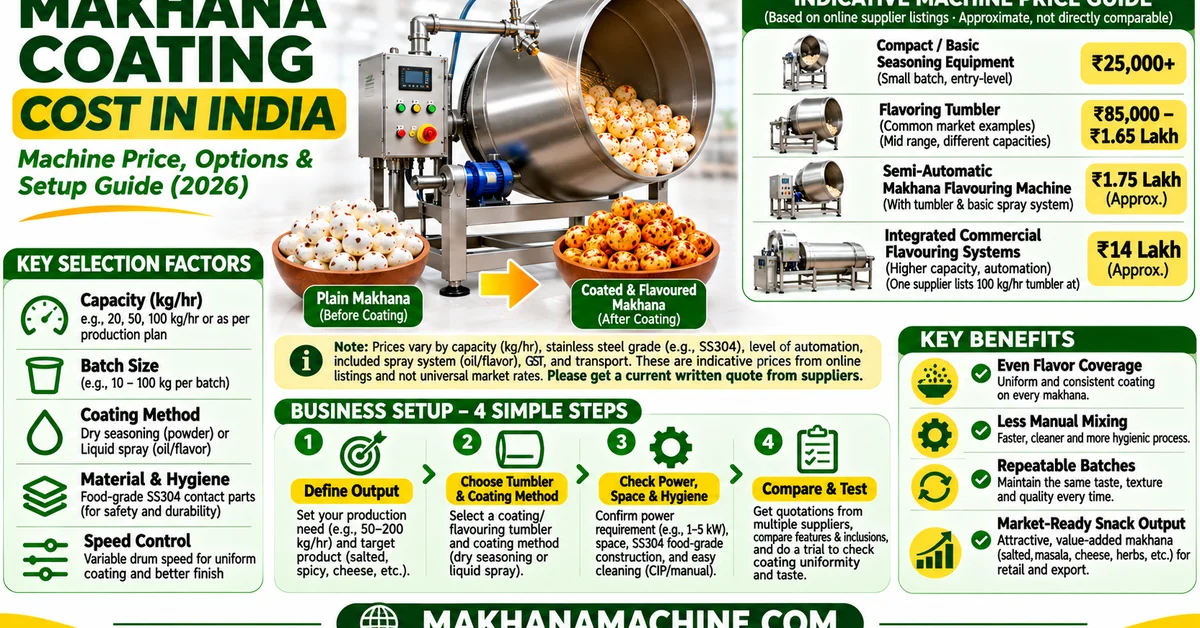
A makhana coating and caramelising machine in India can cost anything between Rs.60,000 to Rs.5 00 000 for a single unit, while semi-automatic or automatic roasting-and-coating equipment can cost anywhere between Rs. 1.5 lakh to Rs. 15 lakh or more based on capacity, level of automation, type of heating and customisation.
For makhana processors, this is the most important machine in their line up. It ensures uniform coating of caramel, jaggery syrup chocolate ghee oil cheese slurry or dry masala on makhanas. A good machine ensures taste consistency and a better quality of packs, with less breakage, and allows a brand to charge a premium price.
In this article, we’ll talk about the real cost of a makhana coating and caramelising machine in India, the usual prices, must-have specifications and operating expenses and the questions to ask before buying.
What Is a Makhana Coating and Caramelising Machine?
A makhana coating and caramelising machine applies liquid, semi-solid, or powder coatings to roasted or puffed makhana and mixes the product gently until the coating is evenly distributed. Depending on the design, it may handle caramel, jaggery syrup, honey, chocolate, butter, ghee, oil, cheese seasoning, peri-peri masala, or other flavour coatings.
In a standard makhana processing line, the machine sits after popping and roasting. The roaster develops crunch and removes excess moisture, while the coating unit adds flavour, shine, sweetness, or savoury seasoning. Some suppliers offer separate coating pans or drums, while others provide combined roasting and flavouring machines.
A typical machine may include:
- A stainless-steel coating pan or rotary drum
- Liquid spray, drip, or dosing system
- Heating arrangement for caramel or syrup
- Variable-speed motor and gearbox
- Temperature controller
- Food-grade contact surfaces
- Discharge chute or collection tray
- Optional seasoning-dosing attachment
- Control panel with timer and speed settings
For caramel makhana, temperature control is especially important. If the syrup is too hot, the makhana may become sticky, darken, or burn; if it is too cool, the coating may remain uneven and separate during storage or packing.
Makhana Coating and Caramelising Machine Price in India
There is no single fixed price because the term “coating and caramelising machine” covers everything from a basic stainless-steel pan to an automated industrial flavouring line. The table below gives indicative market ranges based on currently listed Indian equipment and comparable makhana processing machinery.
| Machine type | Typical capacity | Indicative price range | Best suited for |
| Basic SS coating pan | 5–25 kg/batch | ₹45,000–₹85,000 | Startups, R&D, small-batch production |
| Semi-automatic coating drum | 20–50 kg/hr | ₹1,00,000–₹2,50,000 | Small and growing makhana brands |
| Makhana roasting and flavouring machine | 50–100 kg/hr | ₹1,40,000–₹5,40,000 | Medium-scale processors |
| Dedicated caramelising/coating system | 25–100 kg/hr | ₹1,50,000–₹5,00,000+ | Caramel, jaggery, chocolate, and glaze coatings |
| Automatic makhana processing line | 50–100 kg/hr | ₹9,60,000–₹14,50,000+ | Large-scale commercial production |
| Complete turnkey makhana plant | Varies | ₹10,00,000–₹27,00,000+ | Integrated popping, roasting, coating, and packing operations |
A stainless-steel coating pan of around 25 kg capacity has been listed at approximately Rs 55,000. And a chocolate-coating machine of 10 kg per batch has been listed at close to Rs 85,000. These can give an idea of the price range for a basic coating machine.
At the commercial scale, a semi-automatic foxnut processing plant with a capacity of 50 kg per hour is listed at approximately 9.6 lakh, while an automatic model is listed at about 13.5 lakh. A makhana roaster combined with a flavouring machine is listed at 5.4 lakh, illustrating that prices increase as heating, mixing, dosing, and automation features are added.
A caramelising machine will cost more than a simple dry-seasoning drum. If you have a caramel jaggery chocolate or glaze coating then you need hot syrup flowing, easy cleaning and temperature stability which all pushes up manufacturing costs.
What Drives the Price?
The most common buying mistake is comparing machines only by their quoted price. Two machines with the same stated capacity can differ sharply in coating quality, power consumption, durability, cleaning time, and after-sales support.
1. Production capacity
Capacity is usually the first factor in pricing. A small coating pan handling 10–25 kg per batch costs far less than a rotary drum designed for 50–100 kg/hr.
However, capacity should be judged against real production needs, not just peak demand. If you process 30–50 kg daily, a semi-automatic drum may be more cost-effective than a fully automatic line that remains underutilised.
2. Automation level
Manual and semi-automatic machines are cheaper but need more operator attention. Automatic machines cost more initially but improve batch repeatability, reduce labour dependence, and support consistent output.
Automation features may include:
- Automatic syrup or oil dosing
- Programmable coating cycle
- Variable drum speed
- Digital temperature control
- Auto-stop or auto-discharge
- PLC or HMI control panel
- Continuous feeding and discharge
For caramel coating, automation is particularly useful because syrup quantity, drum rotation, and temperature must remain consistent across every batch.
3. Type of coating
A dry masala coating machine is simpler and cheaper than a caramelising machine. Dry seasoning mainly needs powder dosing and mixing, while caramel coating requires heated syrup, controlled viscosity, spray or drip application, and thorough cleaning.
Machines designed for caramel, jaggery, honey, chocolate, or glaze coatings generally cost more because they need heating jackets, temperature controls, syrup tanks, pumps, and food-safe material construction.
4. Material and build quality
Food-grade stainless steel, preferably SS 304 for all product-contact areas, is the preferred material for hygienic and durable machines. It resists corrosion, handles acidic or sugary coatings better, and is easier to clean.
Lower-priced machines may use thinner steel, weaker motors, or inferior contact materials. These machines may look similar online but can lead to higher maintenance costs, contamination risk, and shorter service life.
5. Heating system
Heating options include electric, gas, diesel, wood-fired, and steam-based systems. Electric machines are cleaner and easier to control, while gas or solid-fuel systems may have lower running costs in certain locations.
For caramelising, electric heating with a digital controller is often preferred because it gives more stable temperature control. For example, a 100 kg/hr makhana continuous roaster has been listed with 12 kW power, adjustable temperature, and an auto-cut digital controller.
6. Drum size and mixing design
Drum diameter, length, rotation speed, and internal flight design affect how gently makhana is tumbled. Puffed makhana is light and fragile, so aggressive mixing can cause breakage and reduce saleable yield.
Larger drums, geared motors, variable-speed drives, and better internal geometry increase the price but can improve coating coverage and reduce product damage. Some makhana flavouring machines use drum diameters from 24 to 36 inches and include seasoning and oil tanks.
7. Customisation
Standard machines cost less. Custom-built machines cost more because the manufacturer must modify drum size, syrup system, discharge height, control panel, heating source, or plant layout.
Customisation is worth considering if you need:
- Caramel, chocolate, and masala coating in one line
- Low breakage for premium makhana
- Integration with an existing roaster
- A specific batch size or hourly output
- Limited floor space
- Special electrical requirements
- Export-oriented hygiene standards
Key Specifications to Check
Before requesting a quote, prepare a clear specification sheet. This helps suppliers provide accurate pricing and avoids disputes after delivery.
| Specification | What to confirm |
| Capacity | Kg per batch and kg per hour |
| Machine type | Coating pan, rotary drum, or continuous system |
| Application | Caramel, jaggery, chocolate, oil, masala, or combined coating |
| Material | SS 304 contact parts; SS 202 may be offered at lower cost |
| Heating | Electric, gas, diesel, steam, or combination |
| Power load | kW requirement and single- or three-phase supply |
| Drum size | Diameter, length, and usable volume |
| Speed control | Fixed speed or variable-frequency drive |
| Temperature control | Thermostat, digital controller, or PLC |
| Coating system | Spray, drip, dosing pump, or manual pouring |
| Cleaning design | Removable parts, drainage, access panels, CIP readiness |
| Motor and gearbox | Brand, torque, service availability, and spare-part support |
| Dimensions | Length, width, height, and required floor space |
| Weight | Important for transport and installation |
| Warranty | Coverage for motor, heater, gearbox, and control panel |
A reliable supplier should provide these details in writing, along with a layout drawing, utility requirement, and expected output for your specific coating recipe.
Price Versus Production Economics
The purchase price is only one part of the total investment. Before finalising a machine, calculate the cost per kilogram of coated makhana.
For example, if a ₹2.5 lakh coating machine processes 50 kg/hr and operates for six hours daily, it can theoretically handle 300 kg per day. Actual output will be lower because of loading, coating, discharge, cleaning, and changeover time, but the machine cost spread across volume becomes manageable.
Include these operating costs in your calculation:
- Electricity or gas consumption
- Labour requirement
- Caramel, jaggery, ghee, oil, or chocolate cost
- Makhana breakage percentage
- Cleaning time and water consumption
- Maintenance and spare parts
- Packaging losses from sticky or uneven coating
A machine that costs ₹1 lakh more but reduces breakage by 3–5% can often pay for itself faster than a cheaper unit that damages premium makhana.
Installation, Training, and Hidden Costs
Many buyers ask whether the quoted price includes installation and training. The answer depends on the supplier. Some include basic installation and operator guidance, while others charge separately for transport, erection, commissioning, and training.
Ask the supplier to clarify whether the quotation includes:
- GST
- Transportation
- Unloading at site
- Installation and commissioning
- Electrical wiring and plumbing
- Trial run with your makhana
- Operator training
- Recipe-setting support
- Spare-parts kit
- Annual maintenance contract
- Warranty terms and response time
For caramelising machines, insist on a trial using your actual syrup recipe. A machine that works well with oil and masala may not deliver the same result with jaggery syrup, caramel, or chocolate coating.
How to Choose the Right Machine
For a new makhana brand
Start with a semi-automatic coating drum or a good-quality coating pan. It keeps the initial investment controlled while allowing you to test caramel, masala, cheese, and chocolate variants. A 25 kg SS coating pan around ₹55,000 can be a practical entry point for small-batch production.
For a growing regional brand
Choose a 50–100 kg/hr roasting and flavouring or coating system with variable speed, digital temperature control, and SS 304 contact parts. Machines in this category commonly fall between ₹1.4 lakh and ₹5.4 lakh depending on configuration.
For a large-scale manufacturer
Consider an automatic processing line with continuous roasting, coating, cooling, and packing integration. Complete foxnut processing plants have been listed from approximately ₹9.6 lakh to ₹14.5 lakh, while larger integrated plants can exceed ₹27 lakh.
For premium caramel or chocolate makhana
Prioritise gentle mixing, accurate temperature control, easy cleaning, and a reliable syrup or chocolate dosing system. Do not select only on the lowest quote; poor coating uniformity can damage brand perception quickly.
Questions to Ask Before Buying
Before finalising a supplier, ask these questions:
- What is the actual output for caramel-coated makhana, not just dry masala coating?
- What percentage of makhana breakage should I expect?
- Is the contact material SS 304 or SS 202?
- What is the power load, phase requirement, and expected electricity consumption?
- Can the machine handle jaggery syrup, caramel, chocolate, and oil-based coatings?
- How long does cleaning take between flavour changeovers?
- Is installation, commissioning, and operator training included?
- What warranty applies to the motor, gearbox, heater, and control panel?
- Can you provide a trial video or live demonstration with my recipe?
- What is the delivery time and spare-parts availability in my state?
Suppliers commonly offer machines for makhana, corn puffs, peanuts, cheese balls, and other snacks, so confirm that the design is suitable specifically for fragile puffed makhana.
Common Buying Mistakes
Buying only on price
The lowest-priced machine may use weaker motors, thinner steel, or poor temperature control. This can cause uneven caramel coating, higher breakage, and frequent downtime.
Ignoring caramel viscosity
Caramel and jaggery syrups behave differently from dry masala. Confirm that the machine can maintain the required syrup temperature and distribute it evenly.
Not planning for cleaning
Sticky coatings require frequent cleaning. A machine that is difficult to open or clean will slow production and increase hygiene risk.
Overbuying capacity
A large automatic line is not always the right first purchase. If orders are inconsistent, a semi-automatic system may deliver better cash-flow control.
Underestimating utilities
Check power load, phase, floor space, ventilation, water drainage, and operator availability before the machine arrives. Some industrial makhana systems require three-phase power and significant connected load.
Conclusion
A makhana coating and caramelising machine is a strategic investment, not just another piece of food-processing equipment. The right machine should deliver uniform coating, protect fragile makhana from breakage, support your desired flavour range, and remain easy to clean during daily production.
For most Indian makhana processors, a practical starting budget is ₹1 lakh to ₹3 lakh for a reliable semi-automatic coating system. Growing brands should evaluate machines in the ₹2.5 lakh to ₹5.5 lakh range with better heating, dosing, and build quality, while large-scale manufacturers should budget ₹10 lakh or more for an integrated processing line.
Before buying, compare at least three quotations on the same capacity, material, automation, heating, warranty, and after-sales terms. Most importantly, ask for a trial with your own caramel or coating recipe because the real measure of value is not the machine’s price, but the quality, shine, crunch, and consistency of the makhana it produces.
Frequently Asked Questions
- How much does a makhana coating and caramelising machine cost in India?
Most standalone machines cost ₹60,000 to ₹5 lakh, while integrated roasting-and-coating lines can cost ₹10 lakh to ₹15 lakh or more.
- Does the price include installation and training?
Sometimes. Always confirm whether transport, installation, commissioning, trial runs, and operator training are included in the quotation.
- What capacity machine should a small makhana brand buy?
A 10–25 kg batch coating pan or a 20–50 kg/hr semi-automatic machine is usually sufficient for a new or small brand.
- Can one machine handle caramel and masala coating?
Yes, if it has suitable heating, syrup dosing, variable speed, and easy cleaning arrangements for both liquid and powder coatings.
- Which material is best for a makhana coating machine?
Food-grade SS 304 is preferred for all surfaces that touch makhana, caramel, oil, or flavouring material.
- Does caramelising require a separate heating system?
Usually yes, because syrup temperature and viscosity must be controlled throughout the coating process.
- How long does delivery usually take?
Delivery commonly takes two to eight weeks, depending on machine customisation, production load, and the supplier’s location.