
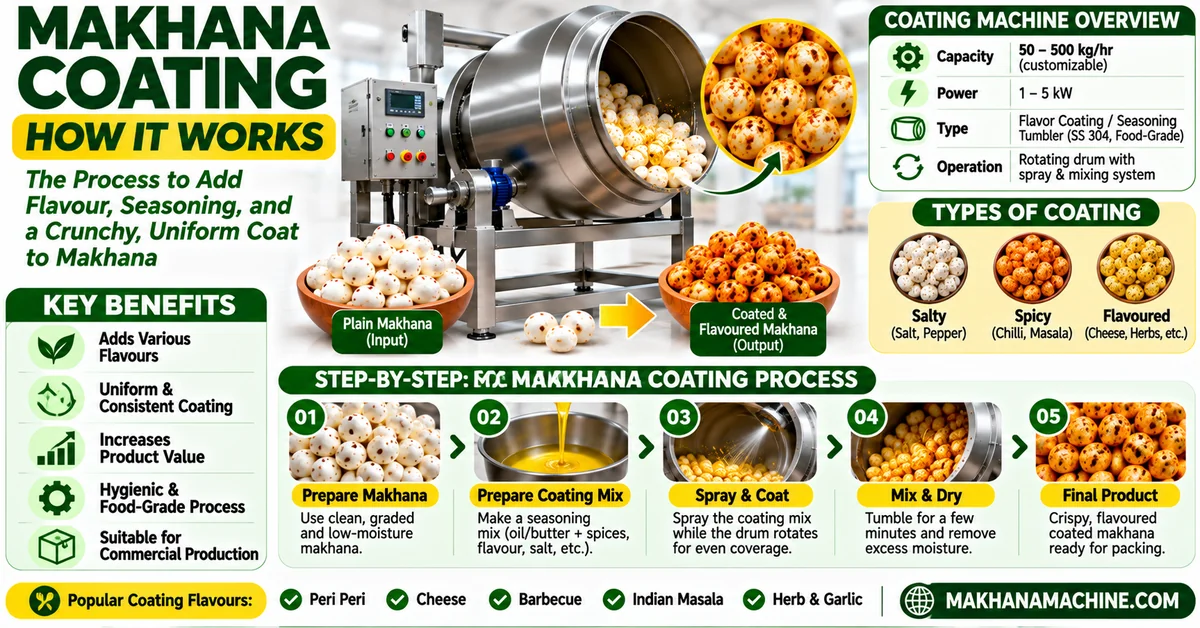
A makhana coating and caramelising machine is a specialised food-processing system that evenly applies oil, ghee, spices, syrups, chocolate, caramel or other coatings to roasted makhana. It uses controlled tumbling, spraying or pouring, and optional heating to create uniform, crunchy, ready-to-pack flavoured makhana with far less manual handling.
For Indian snack brands, FPOs, contract manufacturers and makhana exporters, this machine solves a major production challenge: manual coating often leads to uneven flavour, clumping, broken fox nuts, excess seasoning waste and inconsistent batches. A commercial makhana coating and caramelising machine makes the process repeatable, hygienic and scalable. This guide explains how the machine works, its main parts, coating and caramelising process, output capacity, automation options, applications and the key points to check before buying one.
What Is a Makhana Coating and Caramelising Machine?
A makhana coating and caramelising machine is used after makhana has been popped and roasted. Its main job is to coat roasted fox nuts with dry seasonings, oil or ghee, masala slurries, sweet syrups, caramel, jaggery syrup, chocolate or flavoured coatings. The machine generally works on the principle of rotary tumbling combined with controlled coating application.
Makhana moves inside a rotating drum or tilted coating pan, while the coating material is sprayed, poured or sprinkled over it.Continuous rotation ensures that every piece receives an even layer without excessive breakage. For caramel or sweet coatings, the machine may include a heated slurry kettle, syrup dosing system, hot-air blower and cooling section. These features help the coating spread smoothly, set properly and remain crisp after cooling.
Why Coating and Caramelising Matter
Makhana is naturally light, porous and fragile. That makes it an excellent carrier for flavours, but also means it can break or become soggy if coating is done incorrectly.
A properly designed coating and caramelising machine helps you:
- Apply seasoning uniformly across every batch.
- Reduce manual labour and human variation.
- Control oil, ghee, syrup or caramel dosage.
- Minimise makhana breakage during mixing.
- Maintain product crunch and appearance.
- Improve batch consistency for retail, export and private-label production.
- Scale from small trial batches to commercial volumes.
Indian makhana flavouring systems commonly use rotating drums or coating chambers with adjustable speed controls and efficient mixing mechanisms to achieve uniform seasoning without damaging the puffed snack.
Where It Fits in a Makhana Processing Line
A makhana coating and caramelising machine is usually not the first machine in the line. It works after raw makhana has been cleaned, graded, popped and roasted.
A typical makhana snack line follows this sequence:
- Raw makhana cleaning and grading – Removes impurities and sorts makhana by size.
- Roasting – Removes residual moisture and develops crunch.
- Cooling or conditioning – Prepares makhana for coating.
- Coating and caramelising – Applies oil, ghee, masala, syrup, caramel or flavour coating.
- Drying or setting – Helps wet coatings stabilise.
- Cooling – Restores crispness before packing.
- Packaging – Protects the finished product from moisture and contamination.
Seasoning coaters are generally positioned after roasting and drying, just before cooling and packaging.
Main Parts of a Makhana Coating and Caramelising Machine
The exact configuration varies by manufacturer, capacity and whether the machine is batch-type or continuous. However, most commercial systems include the following components.
1. Feeding Hopper
The feeding hopper holds roasted makhana before it enters the coating chamber. In semi-automatic machines, the operator loads makhana manually; in automatic systems, a conveyor or elevator transfers it from the roaster.
A controlled feed rate is important because overloading the drum can cause uneven coating and breakage.
2. Coating Drum or Coating Pan
This is the heart of the machine. It may be a horizontal rotating drum or a tilted rotating pan.
- Rotating drum: Suitable for continuous or higher-volume production.
- Tilted coating pan: Common in batch systems; makhana tumbles while coatings are added gradually.
Food-grade stainless steel, especially SS 304, is commonly used for product-contact surfaces because it is hygienic, durable and easier to clean.
3. Motor, Gearbox and Rotation Control
A motor and gearbox rotate the drum or pan at a controlled speed. Adjustable speed is essential because makhana requires gentle tumbling.
If rotation is too fast, makhana can break. If it is too slow, coating may remain uneven. Many machines offer variable speed control so operators can adjust the tumbling action for different coatings and batch sizes.
4. Spray, Dosing or Pouring System
This part applies the coating material.
Depending on the recipe, the system may include:
- Oil or ghee spray nozzles.
- Liquid flavour sprayers.
- Syrup or caramel dosing pumps.
- Slurry application system.
- Dry seasoning sprinkler or manual/add-on dosing point.
For masala makhana, oil or ghee is often applied first so the dry spice blend sticks properly. For caramel makhana, heated syrup or caramel is dosed onto the tumbling makhana before drying and cooling.
5. Slurry Kettle or Caramel Preparation Unit
For liquid coatings, a slurry kettle prepares the masala paste, sugar syrup, jaggery syrup, chocolate coating or caramel mixture. It maintains the required consistency and temperature so the coating flows evenly.
A seasoning kettle is especially useful in automatic lines because it allows controlled preparation and transfer of the coating mixture to the coater.
6. Heating and Hot-Air System
Caramelising requires controlled heat. A hot-air blower or heating arrangement helps the syrup or caramel coat evenly, reduce excess moisture and set on the makhana surface.
Temperature control is also important for preventing burning, stickiness or loss of crunch. Some makhana processing systems offer digital temperature control, with heating options such as electric, LPG or other fuel-based systems depending on the model.
7. Control Panel
The control panel lets the operator manage:
- Drum rotation speed.
- Coating time.
- Spray or dosing rate.
- Temperature.
- Hot-air blower operation.
- Batch timing.
- Emergency stop and safety functions.
Digital controls improve repeatability, which is critical when producing flavoured makhana for retail brands or export buyers.
8. Cooling Section
After coating or caramelising, makhana needs to cool before packaging. A cooling tray, cooling conveyor or air-cooling system helps set the coating and restore crisp texture.
Without proper cooling, caramel-coated makhana can stick together, lose crunch or develop moisture-related quality issues during storage.
9. Discharge Unit
Once coating is complete, the finished makhana is discharged into a collection tray, hopper or conveyor. From there, it can move to inspection, cooling or packaging.
How a Makhana Coating and Caramelising Machine Works
The working process can be understood in simple stages.
Step 1: Load Roasted Makhana
Roasted and cooled makhana is loaded into the hopper or directly into the coating drum. The makhana should already be crisp and reasonably dry, because excess moisture can affect coating adhesion and final texture.
Step 2: Start Controlled Tumbling
The drum or pan begins rotating at a set speed. The gentle tumbling motion keeps makhana moving continuously, exposing every piece to the coating material.
This is the main reason machine coating is more uniform than hand mixing. The rotating action ensures even distribution while reducing manual contact and product damage.
Step 3: Apply Oil, Ghee or Binding Liquid
For savoury makhana, a small quantity of refined oil, butter, ghee or flavoured liquid is usually sprayed first. This creates a thin binding layer that helps dry masala stick to the surface.
For caramel or sweet variants, a heated sugar syrup, jaggery syrup or caramel slurry is dosed into the drum. The quantity must be carefully controlled; too much liquid can make makhana sticky or soggy.
Step 4: Add Dry Masala or Flavour Powder
Once the binding liquid is distributed, dry seasoning such as peri-peri, cheese, tomato, pudina, salt, pepper or a custom spice blend is added.
The continuing tumbling action spreads the powder evenly. Some machines allow operators to add seasoning manually, while automatic systems use dosing equipment for more accurate repeat batches.
Step 5: Caramelise or Set the Coating
For caramelised makhana, the coating needs heat and time to set. The hot-air system or heated coating section helps evaporate surface moisture and form a smooth, glossy caramel layer.
The goal is not to re-roast the makhana, but to set the coating without damaging its crisp texture. Controlled temperature and tumbling time are therefore essential.
Step 6: Cool the Finished Makhana
The coated or caramelised makhana is transferred to a cooling section. Cooling helps the coating harden, prevents pieces from sticking together and prepares the product for packing.
This stage is especially important for caramel, chocolate, jaggery and other moisture-sensitive coatings.
Step 7: Discharge and Pack
The finished makhana is discharged and sent for quality checks and packaging. At this point, it should have:
- Uniform colour and coating.
- Consistent flavour.
- Good crunch.
- Minimal breakage.
- No wet or sticky patches.
- A clean, retail-ready appearance.
Dry Coating vs Caramel Coating
A makhana coating and caramelising machine can handle both savoury and sweet applications, but the process settings differ.
|
Aspect |
Dry Masala Coating | Caramel or Sweet Coating |
| Main coating material | Spice powder, cheese powder, seasoning blend | Sugar syrup, jaggery syrup, caramel, chocolate |
|
Binding agent |
Oil, ghee or flavoured liquid | Heated syrup or caramel |
|
Equipment focus |
Tumbling drum and spray/dosing system | Slurry kettle, dosing pump, hot-air system |
| Key control | Even powder distribution |
Temperature, viscosity and setting time |
| Main risk |
Uneven flavour or powder fallout |
Stickiness, clumping or burning |
|
Final texture |
Savoury, crisp and seasoned |
Glossy, sweet, crunchy and caramelised |
Dry coating focuses on distribution, while caramelising also depends heavily on heat control and coating viscosity.
Semi-Automatic vs Fully Automatic Models
Makhana coating and caramelising machines are available in both semi-automatic and fully automatic configurations. The right choice depends on production volume, labour availability, budget and product range.
|
Feature |
Semi-Automatic Machine | Fully Automatic Machine |
| Makhana loading |
Manual or partially assisted |
Conveyor/elevator-fed |
|
Coating addition |
Operator-controlled or semi-dosed |
Automated dosing and spraying |
| Best suited for | Startups, small units, recipe trials |
Medium and large commercial plants |
|
Labour requirement |
Higher | Lower |
| Batch consistency |
Good with trained operators |
Higher and more repeatable |
| Investment | Lower |
Higher |
|
Flexibility |
Easier for multiple small-batch flavours |
Better for standardised high-volume production |
Semi-automatic systems are often preferred by new makhana brands because they allow flexibility during recipe development. Fully automatic systems suit established manufacturers that need consistent output, lower labour dependence and integration with roasting, cooling and packaging lines.
Capacity and Output Explained
Machine capacity is usually expressed in kilograms per hour or kilograms per batch. The actual output depends on makhana size, coating type, drum size, batch time, moisture level and whether the line is batch-based or continuous.
Indian suppliers offer makhana flavouring and coating systems in a wide capacity range, from small batch units to larger industrial systems. Some listings mention capacities from around 50 kg to 2,000 kg, while coating pan systems may be specified in batch capacities such as 20–200 kg.
As a practical planning range:
- Small-scale units: Suitable for startups, SHGs and regional brands.
- Medium-scale units: Suitable for growing snack brands and contract manufacturers.
- Industrial-scale units: Suitable for large processors, exporters and private-label producers.
Rather than choosing capacity only by machine size, calculate your required finished output per shift. Also account for changeover time between flavours, cleaning time, coating preparation and packaging speed.
Applications of a Makhana Coating and Caramelising Machine
This machine is mainly used for flavoured and value-added makhana products, but similar coating systems can also handle other light snacks.
Common applications include:
- Peri-peri makhana.
- Cheese makhana.
- Masala makhana.
- Pudina makhana.
- Tomato makhana.
- Salt and pepper makhana.
- Chocolate-coated makhana.
- Caramel makhana.
- Jaggery-coated makhana.
- Honey or syrup-coated makhana.
- Premium gift-pack makhana.
- Private-label flavoured makhana.
The same tumbling and coating principle is also used for nuts, seeds, dry fruits, chips and other snack products, which can make the machine more versatile for a growing food business.
Key Specifications to Check Before Buying
Before requesting a makhana coating and caramelising machine quote, compare suppliers on more than price. The following specifications directly affect product quality, hygiene and long-term operating cost.
Material of Construction
Check that all makhana-contact parts are made from food-grade stainless steel, preferably SS 304. This is important for hygiene, cleaning and durability.
Drum Size and Design
Drum diameter and length affect batch volume, tumbling behaviour and coating uniformity. Common coating drum sizes in makhana systems include 24-inch to 36-inch drums, while larger processing lines may use longer drums.
Rotation Speed Control
Look for adjustable RPM or variable-speed control. Makhana is delicate, so the machine should tumble gently enough to avoid breakage while still ensuring complete coating coverage.
Heating System
For caramelising, confirm the heating method, temperature range, temperature controller and hot-air blower capacity. A wide temperature range and digital control are useful for handling different recipes.
Dosing Accuracy
Ask how oil, ghee, syrup, caramel or slurry is measured and applied. Accurate dosing reduces coating waste and keeps nutrition declarations and recipe costs consistent.
Cleaning and Maintenance
Choose a machine with accessible surfaces, removable or easy-clean components, minimal product traps and straightforward maintenance. This is especially important if you produce multiple flavours.
Power Load and Utilities
Confirm power requirement, phase, voltage, connected load, compressed-air requirement if applicable, and space needed for operation and maintenance. Makhana processing equipment may vary widely in power consumption depending on capacity and heating system.
Safety Features
Check emergency stop, guarding, stable mounting, electrical safety and operator-friendly controls. These matter as much as output capacity in a commercial food plant.
How to Choose the Right Machine for Your Business
Use this simple selection framework:
- Define your product range: Decide whether you will make mainly masala makhana, caramel makhana, chocolate makhana or multiple variants.
- Calculate target output: Estimate finished kilograms required per hour and per shift.
- Choose automation level: Select semi-automatic for flexibility or fully automatic for scale.
- Check coating type: Confirm whether the machine supports dry powder, oil/ghee, slurry, syrup and caramel coatings.
- Review hygiene standards: Insist on food-grade contact parts and easy cleaning.
- Assess integration: Ensure the machine can connect with your roaster, conveyor, cooling system and packaging line.
- Request a trial: Ask for a demo with your actual makhana and preferred recipe.
- Compare total cost: Consider machine price, installation, power, spares, labour, cleaning time and after-sales support.
A machine that looks economical upfront may become costly if it causes high breakage, uneven coating, frequent cleaning delays or poor after-sales support.
Common Production Problems and Machine Solutions
|
Production Problem |
Likely Cause | How the Right Machine Helps |
| Uneven flavour | Manual mixing or poor tumbling |
Controlled drum rotation and spray distribution |
|
Makhana breakage |
Excessive speed or rough handling | Adjustable, gentle tumbling speed |
| Sticky caramel makhana | Excess syrup or poor cooling |
Controlled dosing, hot-air setting and cooling |
|
Clumping |
Wet coating applied unevenly | Slurry control and uniform tumbling |
| Seasoning fallout | Insufficient oil/ghee binder |
Controlled liquid spray before powder addition |
|
Inconsistent batches |
Manual recipe variation | Timers, dosing controls and repeatable settings |
| Slow changeover | Difficult cleaning design |
Hygienic SS 304 construction and accessible parts |
Quality and Compliance Considerations in India
For commercial makhana production in India, machine selection should support food safety and labelling consistency.
- Use food-grade contact materials.
- Maintain proper cleaning schedules between flavours.
- Control oil, sugar, salt and seasoning addition for accurate nutritional declarations.
- Prevent cross-contamination between allergen-containing coatings, such as cheese, chocolate, nuts or milk-based ingredients.
- Keep coating and caramelising records for batch traceability.
- Ensure packaging happens only after the product is fully cooled and dry.
Food-grade stainless steel contact parts, controlled temperature and hygienic design are commonly highlighted as important requirements in Indian makhana processing equipment.
Who Should Buy a Makhana Coating and Caramelising Machine?
This machine is a strong investment for:
- Makhana snack manufacturers scaling beyond manual production.
- Food-processing units adding flavoured makhana to their portfolio.
- FPOs and makhana producer groups creating value-added products.
- Contract manufacturers serving D2C and retail brands.
- Exporters requiring consistent flavour and appearance.
- Brands launching premium caramel, chocolate or gourmet makhana variants.
- Private-label manufacturers handling multiple client recipes.
If your current process involves hand mixing, inconsistent flavour, high labour dependency or frequent product breakage, a dedicated coating and caramelising machine can improve both productivity and product quality.
FAQs
- What is a makhana coating and caramelising machine used for?
It coats roasted makhana with masala, oil, ghee, syrup, caramel or other flavours evenly.
- What are the main parts of a makhana coating and caramelising machine?
Main parts include hopper, coating drum, motor, spray system, heater, control panel and discharge unit.
- Is it available in semi-automatic and fully automatic models?
Yes, both semi-automatic and fully automatic models are available based on production capacity.
- Can it make caramel makhana?
Yes, with a syrup dosing system, controlled heating and proper cooling arrangement.
- What material is best for makhana coating machines?
Food-grade SS 304 stainless steel is preferred for all makhana-contact parts.
- What capacity should I choose for my makhana unit?
Choose capacity based on your hourly finished output, batch size, flavours and packaging speed.
- Does coating affect makhana crunch?
Yes, correct coating quantity, temperature and cooling help retain crunch and prevent sogginess.