
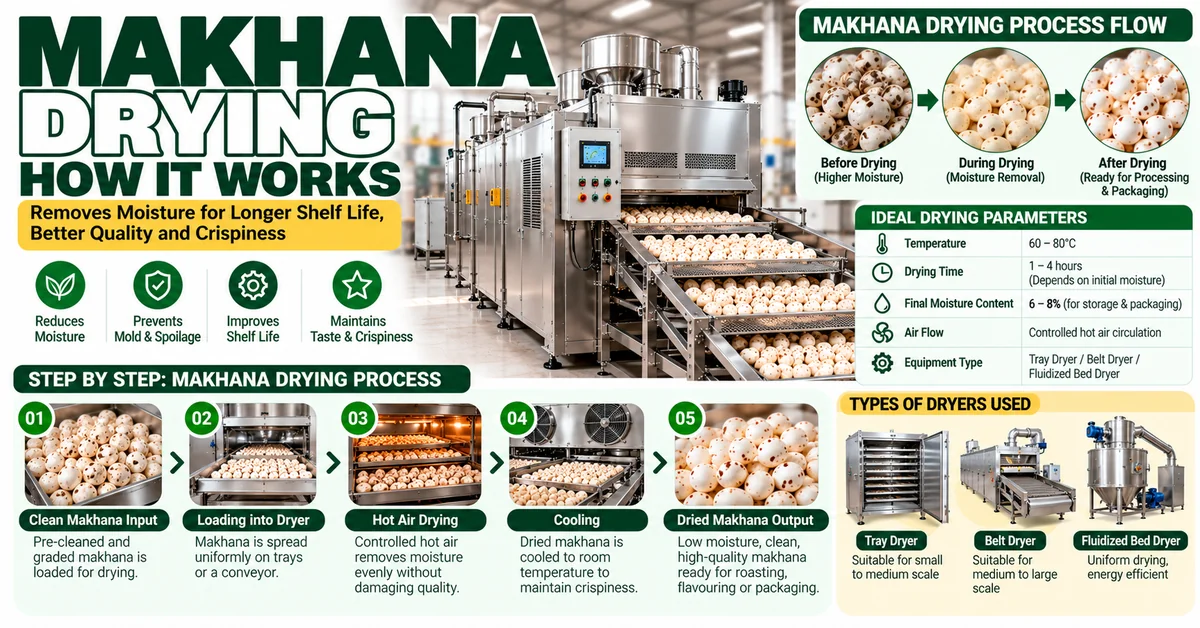
Makhana processing depends heavily on moisture control. Raw makhana seeds are harvested from ponds and water bodies, where they naturally carry high moisture along with dirt, plant residue, seed membrane, snails, stones, and other impurities. Makhana itself is the popped seed of the aquatic plant Euryale ferox, commonly known as gorgon nut.
After washing and grading, the seeds must be dried to a suitable moisture level before roasting, conditioning, popping, and further processing. This is where a makhana seed drying machine becomes an important part of a commercial makhana-processing line.
A commercial drying system helps processors reduce their dependence on sunlight, manage production during humid weather, and maintain more predictable processing conditions. Before publishing this page, confirm that the Makhana Seed Drying Machine is currently available or officially planned—for the MakhanaMachine.com catalogue. Product-specific capacity, power, heating system, dimensions, and automation claims should only be published after approval from the engineering team.
What Is a Makhana Seed Drying Machine?
A makhana seed drying machine is equipment used to remove surface and internal moisture from cleaned and graded raw makhana seeds. Its purpose is not simply to make the seeds look dry. The controlled reduction of moisture helps prepare the material for later stages such as roasting, tempering, popping, grading, and packing.
According to a NIFTEM makhana-processing handbook, a makhana seed dryer is designed to reduce the moisture content of graded raw seeds from approximately 35–40 percent to around 28–30 percent on a wet basis. This moisture reduction supports more controlled downstream handling compared with processing overly wet material.
In a typical line, the seed dryer comes after washing and grading. It is part of a wider mechanical system that can include raw-seed washing, seed grading, roasting, popping, popped-makhana grading, and packing.
What Is It Used For?
A makhana seed drying machine is mainly used to dry washed and graded raw makhana seeds before the roasting and popping stages. It can help processors manage seed moisture when weather conditions are unsuitable for sun drying or when higher production consistency is needed.
Common applications include:
- Drying cleaned raw makhana seeds after washing
- Reducing dependence on open sun drying
- Supporting processing during monsoon, winter, or high-humidity periods
- Preparing seeds for grading and roasting
- Improving workflow continuity in a commercial processing plant
- Supporting larger batches where manual drying becomes difficult
- Helping create a cleaner and more organised seed-handling process
Some commercial makhana-processing brochures describe seed driers as useful during rainy or winter periods, when sunlight is limited, using airflow from high-speed fans to surface-dry washed seeds.
The drying machine should not be viewed as a replacement for the entire processing line. It is one controlled step within a sequence that begins with proper washing and cleaning and continues through grading, roasting, conditioning, popping, sorting, and packing.
Where It Fits in the Makhana Process
A typical commercial workflow may follow this order:
- Raw makhana seed receiving
- Washing and cleaning
- Removal of mud, membrane, stones, floating matter, and damaged seeds
- Seed grading by size
- Seed drying
- Primary roasting
- Conditioning or tempering
- Secondary roasting and popping
- Popped makhana grading
- Flavouring, packing, and dispatch
Seed grading is especially important because different seed sizes can respond differently to heat during roasting and popping. NIFTEM guidance describes raw-makhana grading across multiple size ranges before further processing.
The exact process flow will vary with the raw material, machine design, buyer requirements, final product format, and production capacity. A processor selling cleaned seed in bulk may need a different setup from a company producing packaged, flavoured makhana snacks.
How Does a Makhana Seed Drying Machine Work?
The working principle is based on controlled airflow. The machine moves air across or through the makhana seed bed so that moisture evaporates from the seed surface and is carried away by the moving air.
A hot-air drying arrangement generally draws ambient air into a blower-and-heater system, filters it, raises its temperature as required, and directs it toward the product. Depending on the machine configuration, the drying process may use ambient-air circulation, heated-air circulation, or a combination of airflow and controlled heat.
The general working sequence is as follows:
1. Seed Loading
Cleaned and graded makhana seeds are loaded into the dryer’s designated loading section, tray area, chamber, bin, or material bed. The operator should avoid overloading because an excessively deep or crowded seed layer can restrict airflow and lead to uneven drying.
The right loading quantity depends on the approved batch capacity and the machine’s airflow design. Always follow the supplier’s operating guidelines rather than estimating capacity visually.
2. Air Generation and Movement
A blower or fan draws in air and creates the force needed to move that air through the drying chamber. The fan must provide enough airflow to carry moisture away without disturbing, damaging, or excessively moving the seeds.
In simpler seed-drying systems, high-speed fans can remove surface water after washing. In heated dryers, air passes through a heating section before reaching the seeds.
3. Controlled Moisture Removal
As air moves across the seeds, moisture begins to evaporate. The moisture-laden air must then leave the chamber through an exhaust or ventilation route. If humid air remains trapped inside, drying will slow down and moisture may become uneven across the batch.
The objective is gradual and uniform moisture reduction, not maximum heat. Excessive drying temperature or poor airflow balance can affect seed condition and may increase breakage, quality variation, or later processing losses.
4. Monitoring and Adjustment
Operators monitor the drying cycle based on the machine’s controls, seed condition, timing, airflow, and, where available, temperature or moisture indicators. They may adjust settings according to the condition of the incoming seeds, ambient humidity, batch size, and desired output.
A good operating practice is to take samples from more than one location in the seed bed. This helps identify uneven drying early rather than discovering variation during roasting or popping.
5. Discharge and Transfer
Once the target drying condition is reached, seeds are discharged or removed from the dryer and transferred for the next production stage. Depending on the plant layout, this may be seed grading, temporary holding, primary roasting, or conditioning.
Clean, dry handling equipment should be used after drying to prevent the material from picking up moisture, dust, or contamination again.
Main Parts of a Makhana Seed Drying Machine
The exact design of a commercial makhana seed drying machine will differ by manufacturer, capacity, and automation level. However, a typical system may include the following components.
Loading Section or Hopper
This is the entry point for washed and graded seeds. It should allow controlled feeding without product spillage or uneven distribution.
Drying Chamber or Product Bed
The drying chamber holds the seeds while air passes around or through them. In different machine designs, this may involve trays, perforated beds, bins, conveyors, or enclosed chambers.
Blower or Air-Circulation Fan
The blower is responsible for moving air through the system. Consistent airflow is essential for reducing moisture evenly across the batch.
Heating Unit
Where heated drying is used, the heating unit warms the air before it reaches the product. The heat source and operating range should be confirmed with the manufacturer because these details can differ widely between models.
Air Ducts and Distribution System
Ducts guide air from the blower and heater toward the drying chamber. A well-designed distribution system helps prevent areas of excessive or insufficient airflow.
Exhaust or Moisture-Removal Outlet
The outlet removes humid air from the drying chamber. Effective exhaust is essential because moisture needs a path to leave the system.
Control Panel
The control panel allows the operator to start, stop, monitor, and adjust the dryer. Depending on the model, controls may include fan operation, heating control, timer settings, temperature display, alarm functions, and safety interlocks.
Product Discharge Arrangement
Once drying is complete, the discharge mechanism enables seeds to be moved to the next stage. It may be manual, semi-automatic, or integrated with downstream conveyors or equipment.
Frame and Food-Contact Surfaces
Food-contact sections should be designed for hygiene, easy cleaning, and durability. When comparing a makhana seed drying machine manufacturer, ask about stainless-steel grade, weld finishing, access for cleaning, corrosion resistance, and product-contact material.
Makhana Seed Drying Machine Specifications to Check
When you request a quotation, do not compare suppliers only by price. Ask for a detailed technical specification sheet.
Key specifications to confirm include:
- Batch capacity or continuous throughput
- Drying method: air drying, hot-air drying, or hybrid configuration
- Input seed moisture range
- Expected output moisture range
- Airflow system and fan capacity
- Heating arrangement, if applicable
- Power consumption and electrical connection
- Machine dimensions and working footprint
- Required floor area and height
- Loading and unloading method
- Control-panel features
- Temperature-control range, where applicable
- Material of construction
- Cleaning and maintenance requirements
- Safety features
- Installation, operator training, and service support
Do not publish unverified technical specifications on a website. The final product page should use only machine data supplied and approved by the engineering team.
How to Choose the Right Capacity
Capacity selection depends on the amount of washed seed you plan to process each day and the hours available for drying.
Use this starting formula:
Required Drying Capacity per Hour = Daily Quantity of Washed Seeds ÷ Productive Drying Hours per Day
Required Drying Capacity per Hour = 600 kg ÷ 6 hours
Required Drying Capacity per Hour = 100 kg/hour
This is only a planning estimate. The final machine selection must account for batch cycle time, loading and unloading time, incoming moisture, ambient humidity, product-bed depth, cleaning time, expected downtime, and future expansion.
A small machine may cost less initially but can become a bottleneck if washing and grading capacity are higher. Conversely, an oversized dryer may remain underused and add unnecessary capital and energy costs.
Semi-Automatic vs Fully Automatic Models
A makhana seed drying machine in India may be supplied in different automation levels, depending on the manufacturer and processing requirement.
Semi-Automatic Drying Systems
Semi-automatic dryers generally require more operator involvement for loading, unloading, monitoring, material movement, or setting adjustments. They can be suitable for smaller processors, seasonal operations, or businesses where skilled labour is available.
Potential advantages include:
- Lower initial investment
- Simpler operating structure
- Suitable for moderate volumes
- Greater hands-on control for operators
However, semi-automatic systems may require more labour and closer supervision to maintain batch consistency.
Fully Automatic Drying Systems
Fully automatic systems may incorporate automated feeding, controlled drying cycles, sensors, programmed settings, automated discharge, or integration with conveyors and other machines. The actual level of automation must be confirmed from the product specification.
Potential advantages include:
- More consistent operation
- Lower dependence on manual monitoring
- Better integration with larger processing lines
- Improved production tracking possibilities
- Reduced handling between stages
The best choice depends on your daily volume, labour availability, investment budget, plant layout, and desired process control. “Fully automatic” should never be accepted as a generic label; ask exactly which functions are automated and which still require an operator.
Installation Space and Utility Planning
The dryer’s machine dimensions are only one part of the space requirement. A well-planned installation should include room for material handling, cleaning, service access, electrical panels, and safe airflow.
Plan separate zones for:
- Washed-seed holding
- Dryer loading
- Drying-machine operation
- Dried-seed discharge
- Temporary clean-material storage
- Electrical and control-panel access
- Maintenance access
- Waste or rejected-material handling
The site should have a clean, level floor, proper ventilation, adequate lighting, and suitable electrical infrastructure. If the dryer uses heated air, ensure that the installation area allows safe heat management and adequate exhaust.
Confirm the following with your makhana seed drying machine supplier in India:
- Required electrical load
- Voltage and phase requirement
- Earthing arrangement
- Ventilation and exhaust needs
- Heating-system requirement, if applicable
- Operating clearance around the machine
- Foundation requirement
- Recommended room height
- Installation and commissioning scope
Maintenance and Hygiene
Drying equipment must be maintained regularly to protect product quality and machine performance.
Daily operator checks can include:
- Removing seed residue and dust
- Checking airflow paths
- Inspecting screens, trays, or perforated surfaces
- Confirming fan performance
- Checking for unusual vibration or noise
- Verifying control-panel operation
- Cleaning product-contact areas
- Checking exhaust outlets for blockage
Planned maintenance should include inspection of motors, belts, bearings, fan assemblies, electrical connections, heating components, sensors, and controls. Always isolate power before maintenance and follow the manufacturer’s safety instructions.
Avoid using water aggressively around electrical sections. Cleaning methods should suit the machine design and the supplier’s sanitation recommendations.
Common Buying Mistakes to Avoid
Before you buy a makhana seed drying machine, avoid these common mistakes:
- Buying based only on low machine price
- Selecting capacity without calculating daily seed volume
- Ignoring moisture variation in incoming material
- Assuming every dryer includes a heating system
- Not planning ventilation and humid-air exhaust
- Overlooking the electrical load and power backup requirement
- Treating machine dimensions as the full space requirement
- Skipping a live demo or process video
- Not asking about drying uniformity
- Forgetting to ask about cleaning time and operator access
- Choosing a machine without considering downstream roasting capacity
- Relying on unverified claims about output or automation
A dryer should be selected as part of a complete process, not as an isolated purchase.
Questions to Ask a Manufacturer
Before finalising a supplier, ask:
- What seed moisture range can this dryer handle?
- What output moisture range is achievable under normal operating conditions?
- Is the machine intended for surface drying, controlled drying, or both?
- What is the capacity per batch or per hour?
- How long does a typical drying cycle take?
- What is the power requirement?
- Does the machine use ambient air, heated air, or both?
- Which functions are manual and which are automated?
- What is the required installation footprint?
- How is humid air exhausted?
- What cleaning access is provided?
- Can the dryer connect with seed washers, graders, roasters, or conveyors?
- Does the supplier provide installation, commissioning, training, and after-sales service?
- Can the manufacturer share a demo video using actual makhana seeds?
- What warranty and spare-parts support are included?
A dependable makhana seed drying machine manufacturer should help assess your raw-material condition, production target, utilities, and integration needs—not simply provide a standard quote.
Frequently Asked Questions
1. What is a makhana seed drying machine used for?
It reduces moisture in washed, graded makhana seeds before roasting, conditioning, and popping.
2. Where does the dryer fit in a makhana processing line?
It generally follows washing and grading, before roasting, conditioning, popping, and final grading.
3. What are the main parts of a seed drying machine?
Typical parts include a loading section, blower, drying chamber, ducts, controls, exhaust, and discharge system.
4. Does a makhana seed dryer always use heated air?
No. Some systems use airflow for surface drying, while others use controlled heated-air drying.
5. Can the machine operate during monsoon or winter?
Yes, mechanical drying can support operations when sunlight is limited by rain, winter, or humidity.
6. Is it available in semi-automatic and fully automatic models?
Availability depends on the manufacturer; confirm exactly which loading, control, and discharge functions are automated.
7. What should I check before buying a makhana seed drying machine?
Check capacity, drying method, moisture range, power, space, exhaust, hygiene design, warranty, and service support.