
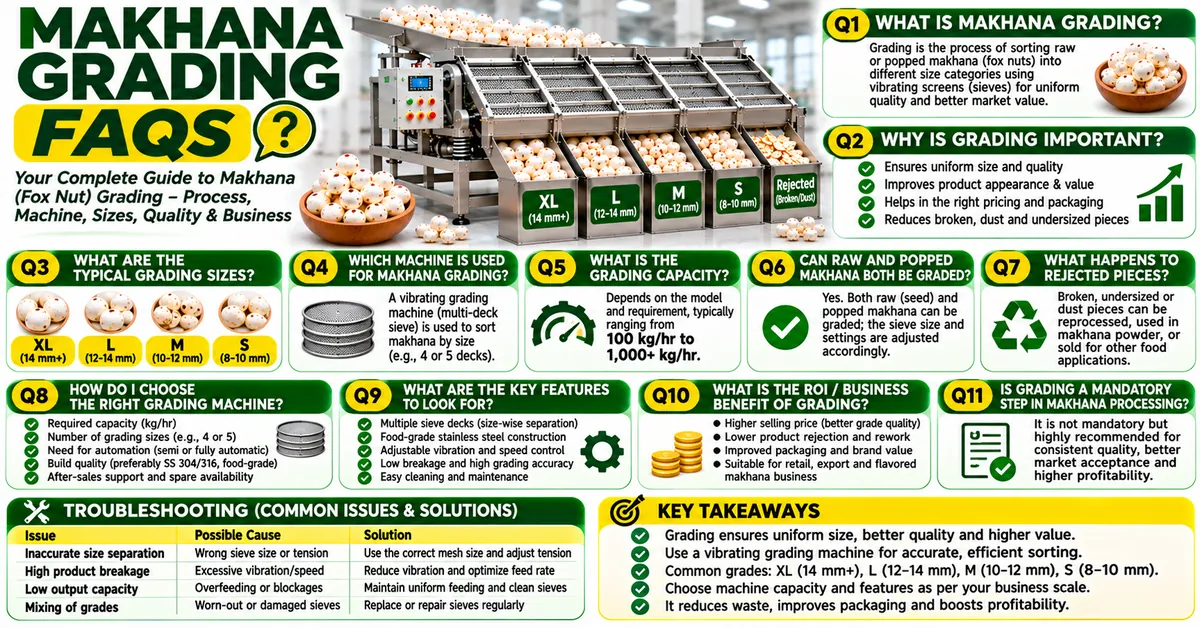
A makhana grading machine separates popped makhana (fox nuts) into consistent size grades, helping processors improve pack presentation, pricing, and buyer acceptance. Before buying one, Indian makhana businesses should focus on capacity, grade configuration, food-contact material, breakage control, power supply, cleaning access, and after-sales support.
This guide answers the most common questions from small processors, packers, snack brands, and commercial makhana units considering a grading machine for their line.
What is a makhana grading machine?
A makhana grading machine is a post-popping sorting machine that divides makhana into different size categories using vibrating screens, rotary sieves, or perforated decks. It does not roast, flavour, or pop makhana; its job is to create uniform batches for packing, further processing, or sale.
In a typical setup, popped makhana is fed from a hopper onto inclined screens. As the screens vibrate, smaller makhana falls through earlier sieve layers while larger makhana travels further before exiting through separate discharge outlets. Machines commonly use a vibratory or rotary sieving principle, with multiple perforated screens or cylinders classifying the product by size.
For a processor, this matters because makhana is not a uniform commodity. Size affects appearance, perceived premium quality, packing configuration, and the price a buyer is willing to pay. Consistent grading reduces manual sorting, improves batch consistency, and makes it easier to meet buyer specifications.
Why is grading important for makhana businesses?
Makhana is sold in several size-based grades, and buyers often specify the grade they want. A grading machine helps convert mixed output into saleable, standardised lots.
Key commercial benefits include:
- Better product presentation: Uniform packs look more professional on retail shelves and in export samples.
- Higher realisation for premium grades: Larger, uniform makhana can be separated and sold as a premium product.
- Reduced manual labour: Machine grading is faster and more repeatable than hand sorting.
- Improved buyer confidence: Consistent grading makes it easier to meet repeat-order specifications.
- Less downgrade risk: Proper separation prevents large and small makhana from being mixed unintentionally.
- Better planning for further processing: Flavouring, roasting, coating, and packing lines perform more predictably when input size is consistent.
Industry listings describe makhana graders as machines for separating fox nuts into different sizes or grades for quality control and market value, typically using vibratory or rotary sieving. Some commercial configurations offer three to four size-based discharge points, which suits businesses that need clear grade separation rather than only removing fines.
What capacity should a small makhana grading business start with?
For most small and growing Indian makhana businesses, a 100–200 kg/hr grading machine is a practical starting point. It provides enough throughput for daily commercial production without requiring the floor space, power, and investment of a large industrial line.
A simple way to choose capacity is to match it to your popping or roasting output—not your future ambition. If your current line produces around 80–120 kg/hr of popped makhana, a 100–150 kg/hr grader is usually sufficient. If you process 200–300 kg/hr, consider a 250–300 kg/hr machine so grading does not become the bottleneck.
| Business stage | Typical grading capacity | Suitable use case |
| Small unit / new processor | 50–100 kg/hr | Manual feeding, limited shifts, local packing |
| Growing commercial unit | 100–200 kg/hr | Regular daily production, multiple grades |
| Medium processor | 250–300 kg/hr | Continuous production, packing line integration |
| Large industrial plant | 300–500 kg/hr or more | High-volume processing, automation-ready lines |
Machines available in the Indian market range from around 100 kg/hr to 300 kg/hr in common commercial configurations, while some industrial vibratory graders are specified at 300–500 kg/hr. Larger processing setups may require custom capacity, additional decks, or an integrated feeding elevator.
Capacity is not the only number that matters
Do not choose a machine only by its stated kg/hr rating. Ask the supplier to clarify:
- Whether the capacity is based on popped makhana, raw makhana, or a particular grade mix.
- The required feed rate and whether manual feeding can sustain that rate.
- The number of grades produced at full capacity.
- Whether capacity drops when screens are fine, product is moist, or feed is uneven.
- The actual effective grading capacity, not just motor rating or machine size.
A 150 kg/hr machine that produces clean, low-breakage grades may be more valuable than a higher-capacity machine that creates mixed grades or excessive breakage.
How does a makhana grading machine work?
Most commercial makhana graders use one of two working principles:
Vibratory grading
Vibratory graders use an eccentric vibration motor to move makhana across inclined sieve decks. The vibration spreads the product evenly, while screens of different aperture sizes separate it into grades. This is a common design for popped makhana because it provides continuous, relatively gentle movement.
A typical vibratory grader includes:
- Feed hopper
- Vibratory motor or eccentric drive
- Multiple sieve decks
- Screen-cleaning arrangement
- Separate discharge outlets
- Control panel
- Support frame and access panels
One listed industrial makhana grader uses a top hopper feed, three grading decks, three size-based discharge points, and an eccentric vibration motor.
Rotary grading
Rotary graders pass makhana through rotating perforated cylinders or drums. As the drum rotates, makhana of different sizes exits through different screen sections. This design can suit certain raw-seed or high-volume applications, but the right choice depends on product condition, desired grades, and breakage tolerance.
What grades can the machine separate?
The number of grades depends on the number of sieve layers or discharge outlets. Common machines provide three or four grades, though custom configurations are possible.
For popped makhana, a practical configuration may include:
- Extra-small or broken makhana
- Small grade
- Medium grade
- Large or premium grade
Some processors also use grading terminology based on “suta,” a traditional size classification used in the makhana trade. One supplier configuration describes separation into 5 suta and above versus 5 suta and below, while another describes grades such as 6 suta and above, 5–6 suta, 4–5 suta, and below 4 suta.
Before ordering, provide the supplier with:
- Your current grade names and target size ranges
- Sample makhana from your process
- The percentage of each grade you expect
- Whether you need to remove broken pieces, dust, or undersized product
- Whether grade definitions may change seasonally
This helps the manufacturer recommend the correct screen combination rather than selling a standard machine that does not match your market requirement.
What specifications should you check before buying?
A good makhana grading machine should be specified around your product, not just its price. The following specifications deserve close attention.
| Specification | What to check | Why it matters |
| Capacity | kg/hr for your actual makhana mix | Prevents bottlenecks and overinvestment |
| Number of grades | Usually 3–4 discharge outlets | Determines how many saleable categories you can create |
| Machine type | Vibratory or rotary | Affects gentleness, cleanliness, and maintenance |
| Contact material | SS 304 food-contact parts preferred | Supports hygiene and durability |
| Body construction | SS or powder-coated MS frame | Balances corrosion resistance and cost |
| Motor power | Commonly around 0.5–2 HP for smaller units | Affects power load and operating cost |
| Power supply | Single-phase or three-phase | Must match your facility’s electrical setup |
| Screen type | SS perforated screens or mesh | Determines grading accuracy and changeover flexibility |
| Screen cleaning | Rubber-ball, brush, or automatic cleaning | Reduces clogging and downtime |
| Breakage control | Gentle vibration and correct screen speed | Protects premium whole makhana |
| Dust control | Optional aspiration system | Improves workplace cleanliness |
| Feeding system | Manual hopper or elevator | Affects labour requirement and throughput |
| Safety features | Emergency stop, overload protection | Important for operator safety |
Commercial machines commonly use stainless-steel contact parts, powder-coated mild-steel structures, electric drives, and multiple sieve decks. Some configurations include optional dust aspiration and a Z-type feeding elevator with feed control, which can be useful for continuous commercial operation.
Can the machine be customised for a specific product?
Yes. A reputable manufacturer should be able to customise the machine for your specific makhana variety, grade mix, capacity target, and layout.
Common customisation options include:
- Custom sieve sizes for local grade definitions
- Additional grading decks or outlets
- Stainless-steel contact parts
- Variable feed control
- Dust aspiration system
- Infeed elevator or conveyor
- Different hopper size
- Mobile frame with wheels
- Single-phase or three-phase electrical configuration
- Integration with packing, roasting, or flavouring lines
Customisation is especially important because “makhana” is not one standard product. Raw makhana seeds, popped makhana, roasted makhana, and flavoured makhana can behave differently on screens. Raw seed graders may be designed for sizes in the 7–14 mm range, while popped makhana graders focus on separating whole popped fox nuts into commercial grades.
Ask the supplier for a trial or demo using your own makhana sample. A machine that performs well with another processor’s product may still need screen or feed-rate adjustments for yours.
What after-sales support is typically included?
After-sales support can matter more than the initial machine price. A grading machine is a production asset, and downtime directly affects dispatch schedules and buyer commitments.
Typical support inclusions may include:
- Installation and commissioning guidance
- Operator training
- Operating and maintenance manual
- Warranty on manufacturing defects
- Availability of spare sieves, motors, belts, and vibration components
- Remote troubleshooting by phone or video call
- On-site service, depending on location and service policy
- Annual maintenance contract, optionally
- Help with screen changes and grade reconfiguration
Many Indian suppliers list a one-year warranty on makhana graders, but warranty terms vary significantly by manufacturer and model. Before purchase, ask for the exact warranty coverage in writing: what is covered, what is excluded, response time, travel charges, and spare-part availability.
A strong supplier should also provide:
- A clear spare-parts list
- Estimated spare-part prices
- Local or remote technical support
- Guidance on preventive maintenance
- Screen-change instructions
- Electrical drawings and installation requirements
How much does a makhana grading machine cost in India?
Prices vary widely with capacity, material of construction, automation level, number of grades, and customisation. As a market reference, Indian listings show popped makhana grading machines from roughly ₹1.25 lakh for a 100 kg/hr unit to around ₹1.95 lakh for a 300 kg/hr unit, while other configurations are quoted around ₹2.5–4.25 lakh.
However, price alone should not drive the decision. A lower-cost machine may cost more over time if it has:
- Poor screen availability
- High breakage
- Weak welding or frame quality
- Difficult cleaning
- No local service support
- Limited customisation
- Inconsistent grading accuracy
Request a detailed quotation that separates:
- Base machine price
- GST and freight
- Installation charges
- Optional accessories
- Spare-screen cost
- Warranty terms
- Delivery timeline
- Payment terms
What power supply and space are required?
Most small and medium makhana graders are electrically driven and may be available in single-phase or three-phase versions. Larger industrial machines more commonly require three-phase power.
Before finalising the order, confirm:
- Available voltage at your facility
- Phase requirement: single-phase or three-phase
- Connected load in HP or kW
- Starter, control panel, and wiring requirements
- Floor area needed, including feeding and bagging space
- Ceiling height for hopper loading or elevator integration
- Foundation or levelling requirements
- Access for cleaning and maintenance
A compact 100–200 kg/hr machine can often fit into a small processing room, but you should still allow space for safe operator movement, makhana bags, screened output collection, and periodic screen cleaning.
How do you maintain a makhana grading machine?
Routine maintenance is simple but essential. The goal is to keep screens clean, vibration consistent, and moving parts protected from makhana dust and product buildup.
Daily checks:
- Clean the hopper, screens, and discharge chutes after production.
- Remove trapped makhana, dust, and broken pieces.
- Inspect screens for damage, clogging, or loose fittings.
- Check that discharge outlets are clear.
- Listen for unusual vibration or noise.
Weekly checks:
- Inspect fasteners, clamps, and screen tension.
- Check motor mounting and vibration consistency.
- Clean dust from the motor and control panel area.
- Inspect electrical connections and safety switches.
Periodic maintenance:
- Replace worn screens.
- Lubricate bearings only as specified by the manufacturer.
- Check belt tension, if applicable.
- Verify emergency stop and overload protection.
- Review screen-cleaning components such as rubber balls or brushes.
Machines with easy-access panels, automatic sieve cleaning, and rust-resistant construction are generally easier to maintain. Avoid water ingress into motors, panels, and bearings during cleaning.
How do you avoid breakage during grading?
Breakage is one of the biggest concerns in popped makhana grading. Excessive vibration, incorrect screen angle, sharp screen edges, overfeeding, or overly aggressive screen cleaning can damage premium makhana.
To reduce breakage:
- Use a machine designed specifically for popped makhana, not a generic seed grader without validation.
- Start with a moderate feed rate and increase gradually.
- Ensure the makhana is properly dried and not fragile from excess moisture or poor popping.
- Use smooth, food-grade contact surfaces.
- Avoid excessive vibration intensity.
- Use correct screen aperture sizes.
- Train operators to avoid dumping product directly onto screens.
- Inspect screens for sharp edges or damage.
Some makhana grader specifications specifically highlight low breakage and accurate grading as design objectives. Ask the supplier to demonstrate breakage percentage with your sample before purchase.
Can one machine grade both raw and popped makhana?
Sometimes, but not always. Raw makhana seeds and popped makhana differ in size, density, fragility, and surface behaviour. A machine configured for raw seed grading may not deliver the same accuracy or low-breakage performance on popped makhana.
Raw makhana seed graders may be designed to separate three or four seed sizes across a 7–14 mm range. Popped makhana graders, by contrast, are generally intended to sort popped fox nuts into commercial grades with minimal breakage.
If you handle both materials, ask whether the supplier offers:
- Interchangeable screen sets
- Separate raw-seed and popped-makhana models
- Adjustable vibration or speed
- Different feed hoppers
- Separate validation trials for each product
Do not assume one machine will suit both applications without a sample trial.
What should a small business look for in its first machine?
For a first commercial makhana grading machine, prioritise simplicity, durability, and service support over unnecessary automation.
A sensible first-machine checklist:
- Capacity matched to current production, with modest headroom
- Three or four grades
- Stainless-steel contact parts
- Easy screen replacement
- Simple control panel
- Low-breakage vibratory design
- Clear discharge outlets for bagging
- Available spare screens
- Written warranty and service commitment
- Demo with your own makhana
- Installation and operator training
Avoid buying the largest machine available “for future growth” if your current line cannot feed it. It is usually better to buy a correctly sized machine now and add capacity later through a second machine, larger model, or integrated line upgrade.
What questions should you ask a makhana grading machine supplier?
Use this checklist before placing an order:
- What is the actual grading capacity for popped makhana?
- How many grades does the standard model produce?
- Can the screen sizes be customised to my grade requirement?
- Which parts are in food contact, and what material are they made from?
- What is the expected breakage percentage with my sample?
- Is the machine suitable for raw makhana, popped makhana, or both?
- What power supply and floor area does it need?
- What is included in installation and commissioning?
- What training do you provide for operators?
- What is the warranty period and exact coverage?
- How quickly can spare screens and motors be supplied?
- Can you share a demo video or arrange a live trial?
- What preventive maintenance schedule do you recommend?
- Can the machine be integrated with an elevator, dust collector, or packing line later?
- What is the delivery timeline and shipping arrangement?
Suppliers commonly offer grading machines with capacities from 100 to 300 kg/hr, multiple grades, electric operation, and optional accessories such as dust aspiration and feeding elevators. Getting these details in writing protects your investment and avoids mismatched expectations.
Common buying mistakes to avoid
Buying only on price
The cheapest machine may use inferior screens, weak motors, or poor welding. Focus on total cost of ownership: machine price, power use, spares, downtime, labour saving, and product recovery.
Ignoring grade definitions
“Small,” “medium,” and “large” are not enough. Share exact size ranges, sample photos, and target grade percentages with the manufacturer.
Overestimating capacity
A 300 kg/hr grader will not solve a feeding bottleneck if your popping line produces only 100 kg/hr. Match the machine to the real bottleneck.
Underestimating cleaning needs
Makhana dust and small broken pieces can accumulate around screens and discharge points. Choose a machine that can be cleaned quickly between batches.
Not confirming service support
A machine is only as good as the support behind it. Confirm spare-part availability, response time, and whether remote video support is offered.
Skipping a sample trial
A demo using your makhana is the best way to validate grade accuracy, breakage level, capacity, and screen configuration.
How a makhana grading machine fits into a processing line
A grading machine usually sits after popping or roasting and before packing or flavouring.
A typical flow is:
- Raw makhana cleaning and grading, if required
- Popping or roasting
- Cooling
- Popped makhana grading
- Dust or fines removal
- Packing or flavouring
In larger plants, grading may be connected to conveyors, elevators, dust aspiration, and packing machines. Some commercial configurations offer optional Z-type feeding elevators and dust aspiration systems for this purpose.
For smaller businesses, a standalone grader with manual feeding and bag collection is often enough. It delivers most of the quality benefit while keeping investment manageable.
Conclusion
A makhana grading machine is one of the most practical investments for an Indian makhana processor that wants consistent quality, better pack presentation, and improved pricing control. For most small businesses, a 100–200 kg/hr machine with three or four grades is a strong starting point, provided it is built for popped makhana and supported by reliable after-sales service.
Before buying, test the machine with your own makhana, confirm screen sizes against your buyer’s grade requirements, and get warranty, spares, and installation terms in writing. The right machine should reduce manual sorting, protect product quality, and make your makhana easier to sell in consistent, premium-looking batches.
FAQs
- What is a makhana grading machine?
A makhana grading machine is equipment that separates popped makhana (fox nuts) into different size grades using vibrating screens, perforated decks, or rotary sieves. It helps create uniform batches for packing, roasting, flavouring, or sale.
- Why is makhana grading important?
Grading improves pack appearance, helps separate premium large makhana from smaller or broken pieces, reduces manual sorting, and makes it easier to meet buyer specifications. Consistent grades can support better pricing and repeat orders.
- What capacity should a small makhana business choose?
For most small and growing processors, a 100–200 kg/hr grading machine is a practical starting point. Match the machine capacity to your current popping or roasting output, with modest headroom for growth.
- How many grades can the machine separate?
Most standard makhana graders can separate 3–4 grades, depending on the number of sieve layers and discharge outlets. Common grades include broken/undersized, small, medium, and large or premium makhana.
- Can the machine grade both raw and popped makhana?
Sometimes, but not always. Raw makhana seeds and popped makhana differ in size, density, and fragility, so confirm with the supplier whether the machine is designed for raw seed grading, popped makhana grading, or both. Raw-seed graders may handle sizes from 7–14 mm, while popped-makhana graders focus on low-breakage commercial sorting.
- How can I reduce breakage during grading?
Use a machine designed for popped makhana, feed it evenly, avoid excessive vibration, and use the correct screen aperture and smooth food-contact surfaces. A sample trial with your own makhana is the best way to check grading accuracy and breakage levels.
- What should I check before buying a makhana grading machine?
Check actual capacity for popped makhana, number of grades, SS 304 food-contact material, screen customisation, power supply, cleaning access, breakage performance, spare-screen availability, warranty, and after-sales support. Ask for a demonstration using your own makhana sample before ordering.