
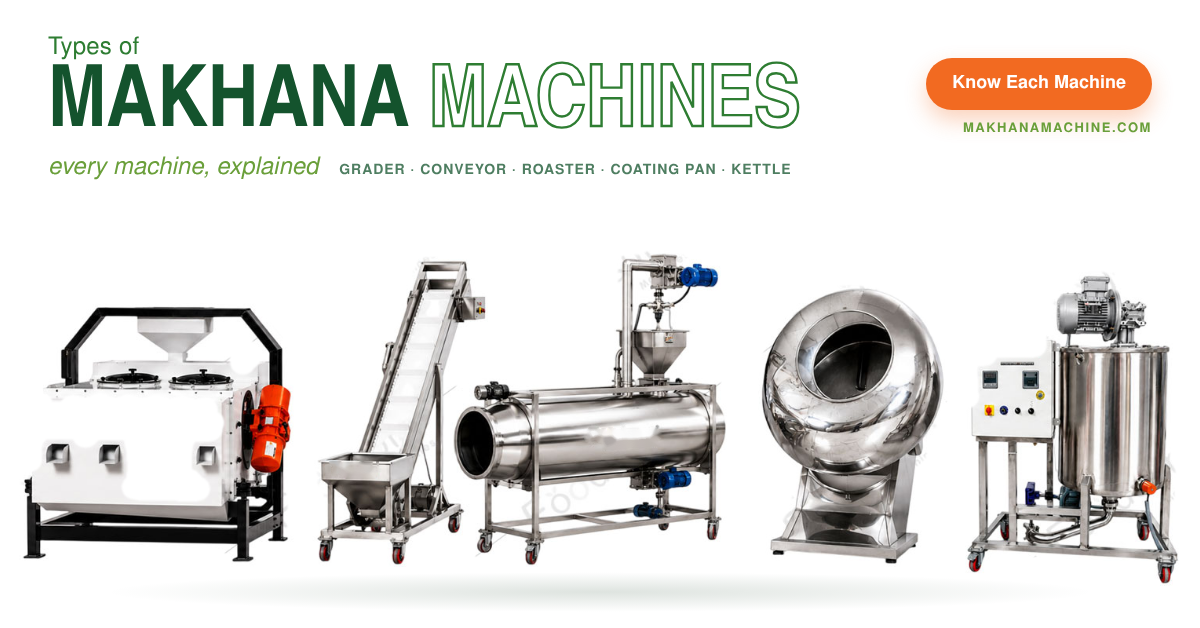
Makhana machine types is a way of proving to be a major product segment for snack companies, farmers’ cooperatives, food entrepreneurs, and traditional FMCG brand houses. The product’s light snack positioning and its roasted and versatile nature has increased the consumption of hygienically processed, well-packed, and consistently flavored varieties. But for a high-end makhana production it’s not just about the material and recipes. It’s also about having the correct makhana machinery at every level of the production process.
Different makhana processing machines assist manufacturers in improving yield and efficiency, less human intervention, product consistency – from cleaning, grading to roasting seasoning packing. With a detailed description of the various types of makhana machines, how they are applied during the processing, their approximate throughputs, and cost factors this article serves as an informative guide.
Understanding the Makhana Processing Process
Makhana processing is not a single operation. It is a sequence of carefully controlled steps that turns raw or puffed makhana into a retail-ready snack.
A typical processing flow includes:
- Raw-material receiving and inspection
- Cleaning and removal of dust or foreign particles
- Grading by size
- Roasting or puffing, depending on the starting material
- Cooling and inspection
- Seasoning or flavour coating
- Final cooling
- Weighing, filling, and packaging
The machinery requirement changes according to the business model. A unit processing raw makhana seeds needs equipment such as roasters, de-husking systems, and puffing machinery. A snack brand purchasing ready-puffed makhana may only require roasting, seasoning, cooling, and packaging equipment.
List of Makhana Machine Types
Makhana is proving to be a major product segment for snack companies, farmers’ cooperatives, food entrepreneurs, and traditional FMCG brand houses. The product’s light snack positioning and its roasted and versatile nature has increased the consumption of hygienically processed, well-packed, and consistently flavored varieties. But for a high-end makhana production it’s not just about the material and recipes. It’s also about having the correct makhana machinery at every level of the production process.
Different makhana processing machines assist manufacturers in improving yield and efficiency, less human intervention, product consistency – from cleaning, grading to roasting seasoning packing. With a detailed description of the various types of makhana machines, how they are applied during the processing, their approximate throughputs, and cost factors this article serves as an informative guide.
Makhana Cleaning Machine
A cleaning machine is used at the initial stage to remove dust, small particles, husk residue, and other foreign material from the incoming makhana. Clean raw material is essential for both product safety and better machine performance. This type of makhana processing equipment may use air flow, vibration, sieving, or a combination of these methods. It reduces the chance of contaminants entering the roasting, flavouring, or packaging process.
- Best suited for: Raw-makhana processors, bulk suppliers, and plants handling high volumes of incoming material.
- Typical capacity: Capacity depends on machine design and product flow, often ranging from small batch systems to several hundred kilograms per hour.
- Cost consideration: Cleaning equipment is generally a lower-investment component compared with roasting or fully automated packaging systems. Final cost depends on capacity, dust-control features, material grade, and automation.
Makhana Grading Machine
A grading machine separates makhana according to size and quality. This is one of the most important machines because makhana pieces vary in diameter and density. If large and small pieces are roasted together, smaller pieces may become over-roasted while larger pieces remain under-roasted.
A grading machine commonly uses vibratory or rotary sieves with multiple mesh sizes. This supports uniform batch processing and creates a more premium-looking final product.
- Best suited for: Manufacturers selling graded makhana, processors supplying to B2B buyers, and branded snack producers.
- Typical capacity: Grading machines can range from approximately 50 kg per hour to 1,000 kg per hour, depending on the machine configuration and number of grading decks.
- Indicative cost: A basic SS 304 makhana grading machine may start at around INR 1.5 lakh, although actual prices vary by capacity and customization.
Makhana Roasting Machine
A makhana roasting machine is used to develop the crunch, aroma, and appealing toasted character of the product. It is particularly important for ready-to-eat roasted makhana snacks.
Roasting machines may operate as batch or continuous systems. Heating may be electric, gas-based, or designed around another suitable industrial heating configuration. The machine should ensure controlled temperature and gentle product movement, since makhana is fragile and can break if handled aggressively.
A good roasting system helps manufacturers achieve:
- Uniform crunch and colour.
- Better flavour development.
- More controlled batch quality.
- Reduced dependence on manual roasting.
- Improved processing hygiene.
Best suited for: Roasted and flavoured makhana snack brands, contract manufacturers, and commercial food-processing facilities.
Typical capacity: Equipment listings show capacities around 100 kg per hour for a makhana roasting machine, while other roasting and popping configurations may operate between 50 kg and 300 kg per hour.
Indicative cost: A roasting machine with an 80–100 kg-per-30-minute capacity is listed at approximately INR 3.85 lakh.
Makhana Popping Machine
A makhana popping machine is relevant when a processor starts with raw fox nut seeds and needs to create expanded, edible makhana. This machine is part of the upstream process and is different from a final roasting machine used for ready-to-eat snacks.
The popping stage requires controlled heat and process conditions. Output quality can be affected by seed quality, moisture level, heating profile, operator skill, and the efficiency of subsequent shell separation.
Best suited for: Raw-makhana processors, farmer-producer organisations, and integrated makhana processing plants.
Typical capacity: Makhana popping systems are commonly listed in the 50 kg to 200 kg-per-hour range.
Cost consideration: The total investment is usually higher than a simple snack-roasting line because popping needs supporting equipment such as cleaning, de-husking, grading, and material-handling systems.
Makhana De-Husking or Huller Machine
De-husking machine or sometimes designated a huller machine, is used to deshell the makhana seeds in their fresh or semi-roasted state. The machine uses a certain extent of mechanical force and friction to dehusk the makhana, but to avoid damage to the coush.
This machine is more relevant for processing all of the raw material to the finished product. If it is operated with excessive pressure or is incorrectly calibrated then this can bring increased breakage and so such a machine should be operated with a high degree of accuracy and attention.
- Type of makhana to be processed: here the processing units have to decide types of raw makhana that have to be processed either in Hulled makhana or in shell makhana.
- The working rate: Shell remover machines are working on the commercial basis from 40 kg/hr to 200 kg/hr depending upon the constructional and raw material type.
- Pricing aspect: the price is determined by the separation method and scale automation, dust collecting facility, the expected degree of kernel breakage.
Makhana Flavouring and Seasoning Machine
A seasoning machine applies oil, ghee, spices, salt, cheese powder, sweet coatings, or other flavour blends to roasted makhana. It often works as a rotating drum, coating pan, or automated flavouring system.
For branded snacks, flavour consistency is not optional. Uneven seasoning can make one pack taste too salty while another tastes bland. A seasoning machine improves coating distribution and can help reduce wastage of expensive flavour ingredients.
- Best suited for: Brands making peri peri, cheese, pudina, tandoori, caramel, chocolate, or other flavoured makhana variants.
- Typical capacity: Seasoning and flavouring machines may range from 50 kg to 400 kg per hour.
- Indicative cost: An SS 304 flavouring and seasoning machine is listed at approximately INR 2.5 lakh, with a 0.75 kW power load and a sprinkler arrangement for more even distribution.
Makhana Cooling Conveyor and Inspection Conveyor
Makhana should be cooled before packaging. Packing hot or warm makhana can trap moisture inside the pouch, affecting crunch and shelf life. Cooling conveyors allow the product to cool gradually as it moves through the line.
An inspection conveyor is also useful for visual quality checks. Operators can identify burnt pieces, broken makhana, foreign particles, or unevenly coated product before it reaches the packaging section.
Best suited for: Commercial plants, premium snack brands, and units with multiple flavours or high output.
Typical capacity: Capacity is usually designed to match the output of the upstream roasting or seasoning machine.
Cost consideration: Conveyor cost depends on length, belt material, cooling method, frame design, speed control, and integration requirements.
Makhana Packaging Machine
Makhana is proving to be a major product segment for snack companies, farmers’ cooperatives, food entrepreneurs, and traditional FMCG brand houses. The product’s light snack positioning and its roasted and versatile nature has increased the consumption of hygienically processed, well-packed, and consistently flavored varieties. But for a high-end makhana production it’s not just about the material and recipes. It’s also about having the correct makhana machinery at every level of the production process.
Different makhana processing machines assist manufacturers in improving yield and efficiency, less human intervention, product consistency from cleaning, grading to roasting, seasoning, and packing. With a detailed description of the various types of makhana machines, how they are applied during the processing, their approximate throughputs, and cost factors this article serves as an informative guide.
Capacity Options for Makhana Processing Machinery
The right capacity depends on daily demand, product range, shifts, workforce, factory space, and available power supply. A business should avoid buying machinery based only on the highest possible output claim. Instead, calculate the required capacity from projected sales and actual operating hours.
Foodsure Machines lists complete makhana-machine configurations from 50 kg to 500 kg per hour.
| Plant capacity | Approx. power requirement | Approx. area required | Suitable for |
| 50 kg/hour | 12 kW | 800 sq. ft. | Small businesses and growing snack brands |
| 100 kg/hour | 26–27 kW | 3,500 sq. ft. | Commercial processing units |
| 200 kg/hour | 60 kW | 5,500 sq. ft. | Mid-sized manufacturers |
| 500 kg/hour | 75 kW | 10,000 sq. ft. | Large-scale automated plants |
These specifications should be treated as planning references. Actual output can change depending on raw-material grade, operator practices, product moisture, recipe complexity, cleaning time, and packaging format.
Makhana Machine Cost in India
There is no single cost for a makhana processing plant because every setup is different. The final investment depends on capacity, level of automation, machine material, process stages included, factory layout, power requirements, packaging type, and installation scope.
Machinery costs can range from around INR 1.5 lakh for selected individual units to approximately INR 25 lakh or more for higher-capacity, integrated setups.
A small unit may begin with a basic roaster, flavouring drum, and semi-automatic packaging system. In contrast, a full-scale line may include cleaners, graders, conveyors, roasting equipment, de-husking machinery, flavouring systems, cooling conveyors, and automated packaging machinery.
These are indicative figures, not fixed quotations. Buyers should request a detailed proposal that clearly states machine capacity, material of construction, power requirement, utilities, warranty, installation support, spare availability, and delivery timeline.
How to Choose the Right Type of Makhana Machine
The correct machine selection begins with the process requirement, not the machinery catalogue.
Choose based on the following factors:
- Starting material: Raw makhana seed requires upstream machinery; ready-puffed makhana needs a snack-processing line.
- Product portfolio: Plain roasted makhana needs a simpler setup than multiple coated, sweet, and savoury variants.
- Capacity requirement: Select capacity based on projected daily production, not only marketing targets.
- Automation level: Semi-automatic systems can suit smaller units, while automated lines support scale and consistency.
- Food-grade construction: SS 304 contact parts are generally preferred for hygiene, corrosion resistance, and easier cleaning.
- Available utilities: Verify electricity load, gas requirements, ventilation, and factory-floor space.
- Packaging format: Determine whether the business needs pouches, jars, bulk bags, nitrogen flushing, or multi-size packs.
- After-sales support: Installation, training, maintenance, and readily available spare parts can influence long-term productivity.
Conclusion
Essentially, your best bet is to go for the right kind of makhana machine per how far along in processing you are, your production size, and what your end-market needs are. A small flavoured-makhana company might probably start with machines for roasting, applying seasoning, cooling, and packaging. But a big facility with all parts of the operation being handled by the company will need an entire set of the equipment which is going to be used for makhana processing like cleaning equipment, grading machines, machines that can de-husk kernels, popcorn machines, roasting appliances, flavouring equipment and finally packing machines.
Your business can quite a bit benefit from using the right makhana processing equipment. Not only do you get a more uniform product, it will mean you spend less energy on things like cleaning and moving around the work, you will keep a better track of hygiene issues, and above all, you will end up with a delicious crunchy, tasty and fresh product which will meet the consumer’s expectations.
FAQ
What types of makhana machines are available?
The options include manual, semi-automated batch, and fully-automated continuous grading roasting popping, flavouring, and packing lines for efficient processing of makhana.
What is the typical capacity range for makhana machines?
The smallest units process only 10, 20 kg/hr whereas automated production lines, designed for mass output, have a much higher through-output capability of 200+ kg/hr.
How does the makhana popping process work in machines?
Machines use controlled dry heat or sand roasting at precise temperatures to pop raw seeds to ensure uniform puffing and higher yield.
What is the cost of a basic makhana machine?
Manual or semi-auto makhana machines are the cheapest starting from 1.5 lakh, though the price might go up to 5 lakh if there are additional features and capacity considerations.
How much does a fully automatic makhana processing line cost?
Automatic processing unit ranges from 18, 30+ lakh. Apart from being extremely efficient, it almost eliminates the need for any human workforce, thereby making it the most cost-effective for high-volume production of makhana.
Which machine is best for small-scale makhana producers?
Those working independently on small production should go for a semi-automated batch roaster or popping machine that will have an hourly capacity of 20, 40 kg/hour and an initial outlay of about 4, 7 lakh.
Do makhana machines improve yield compared to manual processing?
Definitely! Machines offer an average yield around 90, 95%, which is much higher than a manual method’s 65- 70% yield only, not to mention saving a labor force by up to 40, 60% and raising marketable volume of production by almost the double.