
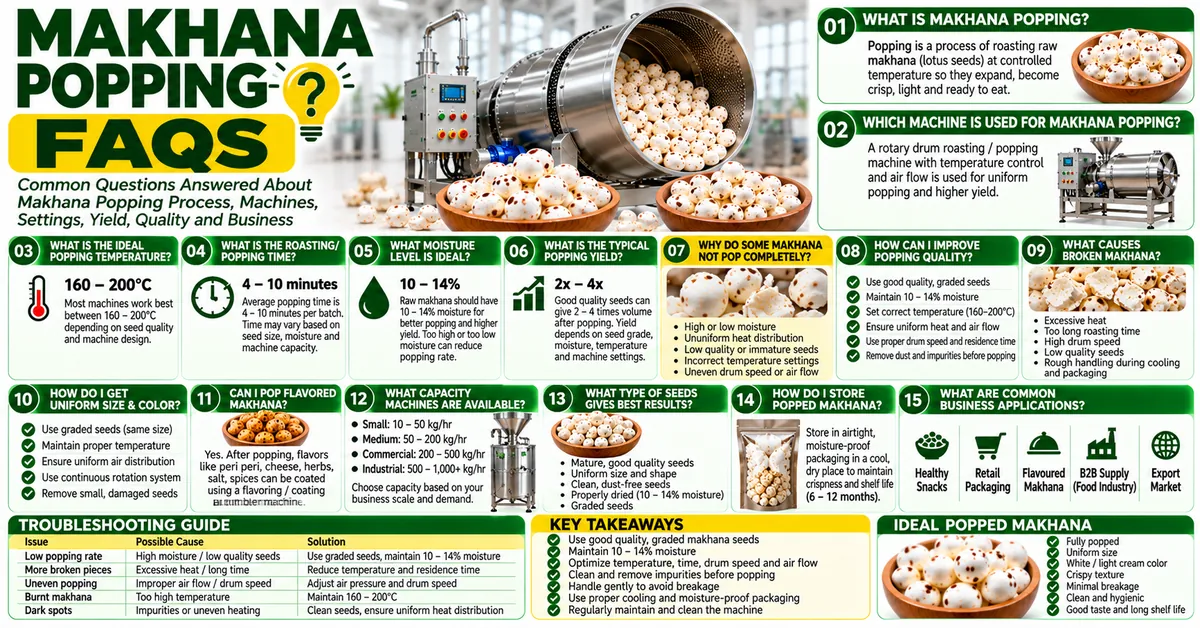
A makhana popping machine helps processors convert conditioned fox nuts into light, white, ready-to-pack popped makhana with better consistency and far less manual effort than traditional pan roasting. Before buying one, it is important to understand how it works, what capacity suits your business, what a complete setup requires, and which specifications affect output quality.
This guide answers the most common buyer questions about makhana popping machines in India, especially for small, medium, and commercial processing units.
What Is a Makhana Popping Machine?
A makhana popping machine is food-processing equipment that roasts, conditions, and pops makhana seeds. In traditional processing, workers roast seeds in hot sand or pans and manually break the hard outer shell. A machine replaces much of this labour-intensive process with controlled heating and mechanical impact.
Most machines have two core sections:
- Roasting or preheating unit: Prepares the seed by reducing moisture and heating it uniformly.
- Popping or decorticating unit: Uses an impeller or impact mechanism to crack the shell and expand the kernel.
ICAR-CIPHET’s developed makhana popping and decorticating machine, for example, combines a thermic roasting system with an impeller-based popping unit. Hot seeds strike a hard impact surface, the shell breaks, and the sudden pressure drop causes the kernel to pop.
How Does a Makhana Popping Machine Work?
The exact process varies by manufacturer, but a typical workflow is:
- Cleaning and grading: Raw makhana seeds are cleaned and sorted by size.
- Conditioning or tempering: Seeds are rested or pre-roasted so moisture and temperature are suitable for popping.
- Roasting: The machine heats the seeds under controlled temperature and time settings.
- Popping: Hot seeds pass into a popping chamber where impact breaks the shell.
- Separation: Popped makhana and shells are discharged and separated.
- Grading and packing: Finished makhana is polished, sorted, weighed, and packed.
A field-tested prototype operated satisfactorily at a 10 kg/h feed rate and 2,600 rpm impeller speed, achieving 80–85% popping efficiency. Its roasting chamber temperature ranged from 230°C to 310°C.
What Capacity Should a Small Business Choose?
Capacity should be based on your daily sales volume, working hours, labour availability, and growth plans not just the lowest price.
Common capacity ranges include:
| Business stage | Typical capacity | Suitable for |
| Mini / pilot unit | 8–10 kg/h | Testing, local sales, very small units |
| Small commercial unit | 20–30 kg/h | Regular local supply and small brands |
| Medium processor | 50 kg/h | Growing brands and institutional supply |
| Large processor | 100 kg/h or more | Bulk supply, multi-shift operations |
A 20–25 kg/h commercial popping machine is commonly positioned for dedicated popping operations, while 100 kg/h automatic machines are available for larger processors. Capacity should always be confirmed in writing as kg per hour of input seed, not merely described as “high capacity.”
Is a 30 Kg/Hour Machine Good for Starting?
Yes. For many new processors, a 30 kg/hour makhana popping machine is a practical starting point. It provides enough output for a serious commercial operation while keeping investment, power demand, and floor-space requirements more manageable than a large automatic line.
The CIPHET machine, for instance, was designed for 25–30 kg/h of conditioned nut, with more than 90% popping efficiency and less than 3% undecorticated nuts under optimum conditions.
However, do not judge a machine by capacity alone. Ask the supplier for:
- Input capacity in kg/hour
- Popping efficiency percentage
- Unpopped or undecorticated seed percentage
- Power consumption
- Required labour
- Floor area
- Whether capacity is continuous or intermittent
What Is Popping Efficiency?
Popping efficiency is the percentage of makhana seeds that successfully pop into usable kernels. Higher efficiency means less raw-material waste and better profitability.
A good machine should deliver consistently high popping efficiency when operated with properly graded and conditioned seeds. The CIPHET design reports more than 90% popping efficiency at optimum conditions. Another field-tested prototype achieved 80–85% efficiency at around 10 kg/h.
Efficiency depends on several factors:
- Seed size and grading
- Moisture content
- Pre-roasting or conditioning quality
- Machine temperature control
- Feed rate
- Impeller speed and chamber design
- Operator training
Does the Machine Popping Process Need Roasting First?
Yes, in most cases. Makhana seeds usually need conditioning and pre-roasting before final popping. This prepares the seed internally so that it expands properly when subjected to heat and impact.
The CIPHET machine includes a roasting unit for both initial conditioning and final roasting, with electronically controlled temperature and roasting duration. Feed rate is controlled mechanically.
A complete processing line may therefore include:
- Cleaning and de-stoning
- Size grading
- Roasting or tempering
- Popping
- Polishing or whitening
- Final grading
- Packing
Treating popping as one part of a full line is important; a popping machine alone does not replace cleaning, grading, roasting, sorting, or packaging equipment.
What Materials Should the Machine Be Made From?
For any part that touches makhana, insist on food-grade stainless steel, preferably SS 304. This helps maintain hygiene, resist corrosion, and simplify cleaning.
Non-product-contact structural parts may use other grades, but product-contact surfaces should not be compromised. Buyers should also check weld quality, ease of cleaning, insulation, and whether the machine prevents contamination during loading, popping, and discharge.
What Power Supply Does a Makhana Popping Machine Need?
Power requirements vary by capacity and heating method.
- Small machines may run on single-phase power.
- Larger commercial machines often require three-phase power.
- Many industrial lines use a 415 V, three-phase, 50 Hz connection.
The CIPHET 25–30 kg/h machine uses two 1 hp electric motors and has overall dimensions of 1.5 m × 0.75 m × 2.0 m. Before ordering, confirm:
- Connected load in kW
- Phase requirement
- Voltage and frequency
- Heater load
- Motor load
- Recommended starter or control-panel configuration
- Backup power needs, if any
How Much Space Is Required?
Space depends on machine size, feeding arrangement, discharge area, maintenance access, and whether you add roasting, grading, or packing equipment.
The CIPHET popping machine itself measures approximately 1.5 m × 0.75 m × 2.0 m. But a practical production area needs extra room for raw-seed storage, pre-conditioning, operator movement, cleaning, finished-goods handling, and packaging.
As a rule, plan for more space than the machine footprint alone. A cramped layout can slow production and make cleaning and maintenance difficult.
Can One Machine Handle Different Seed Sizes?
Many machines can process different grades, but performance is best when seeds are graded before popping. Different seed sizes may require different temperature, residence time, and feed-rate settings.
Some commercial machines allow operators to adjust temperature and time settings for different seed sizes. Ask the supplier whether the machine includes:
- Variable frequency drive (VFD)
- Temperature controller
- Digital timer
- Adjustable feed rate
- Multiple popping settings
- Changeable impeller or chamber parts, if required
What Is the Difference Between Semi-Automatic and Fully Automatic Machines?
| Feature | Semi-automatic machine | Fully automatic machine |
| Labour requirement | Higher | Lower |
| Operator involvement | Feeding, monitoring, handling | More automated feeding and discharge |
| Initial investment | Usually lower | Usually higher |
| Output consistency | Depends more on operator | More consistent with proper settings |
| Best for | Small units and startups | Medium and large commercial processors |
Automatic machines reduce manual handling and can improve consistency, but they require better power supply, trained operators, and a more organised workflow. Semi-automatic machines can be more suitable where capital is limited or production is not continuous.
How Much Does a Makhana Popping Machine Cost in India?
Prices vary widely by capacity, automation, material, heater type, brand, and included accessories. Public listings should be treated as indicative rather than fixed transaction prices.
Reported indicative ranges include:
- Mini popping machine, 8–10 kg/h: around ₹76,700
- Small-to-mid mechanised popping machines: around ₹1.08–1.4 lakh
- Higher-spec popping machines: around ₹1.95 lakh
- Industrial machines around 30 kg/h: ₹7–7.6 lakh
- Commercial 20–25 kg/h automatic machines: around ₹12–13.5 lakh
- 100 kg/h automatic machines: around ₹13.5–14.5 lakh
The wide range exists because “makhana popping machine” can refer to anything from a compact mechanised unit to a full industrial popping system. Always request an itemised quotation covering machine price, GST, freight, installation, commissioning, training, warranty, and spare parts.
What Else Should I Budget For?
A common mistake is budgeting only for the popping machine. A workable makhana processing setup usually needs supporting equipment.
Typical additional equipment includes:
- Cleaning and de-stoning machine
- Raw-seed grading machine
- Roasting or tempering equipment
- Popping machine
- Polishing or whitening unit
- Finished-product grading machine
- Flavour coating machine, if making branded snacks
- Weighing and packing machine
- Nitrogen-flush packaging system, if shelf life is a priority
Indicative machinery budgets for a smaller setup include ₹1.5–2.5 lakh for a popping machine, ₹80,000–1.5 lakh for grading, ₹1–1.5 lakh for roasting equipment, and ₹1–2 lakh for packaging.
What After-Sales Support Should I Expect?
After-sales support can matter more than a small difference in purchase price. Before buying, ask the supplier to confirm:
- Installation and commissioning support
- Operator training
- Warranty period and exclusions
- Availability of spare parts
- Response time for breakdowns
- Remote troubleshooting support
- Annual maintenance requirements
- Whether local technicians are available in your region
Many commercial suppliers offer installation, training, and a one-year warranty, but the exact scope should be verified in the purchase agreement.
Can a Makhana Popping Machine Be Customised?
Yes. Many Indian manufacturers offer customisation based on production capacity, available power supply, floor space, material preference, and whether the machine must handle other products.
Suppliers commonly offer options across stainless steel, mild steel, and cast iron, as well as single-phase or three-phase configurations. Customisation may include capacity upgrades, multi-product compatibility, automation level, discharge systems, and integration with roasting or packing lines.
Before approving customisation, get written confirmation of:
- Final capacity
- Machine dimensions
- Material of construction
- Power load
- Warranty terms
- Delivery timeline
- Installation responsibility
- Spare-parts pricing
What Quality Checks Should I Do Before Purchase?
Ask for a live demonstration using your own makhana seeds where possible. Evaluate:
- Popping percentage
- Kernel expansion and whiteness
- Burnt or under-popped seeds
- Shell separation
- Noise and vibration
- Ease of cleaning
- Temperature stability
- Actual production rate over at least one hour
- Labour required
- Power consumption during the trial
Do not rely only on a short demonstration. A one-hour trial gives a much better indication of real-world performance than a few minutes of operation.
Is a Makhana Popping Machine Suitable for Branded Snack Production?
Yes, but popping is only the first stage. For branded roasted or flavoured makhana, you will also need equipment for roasting, seasoning, coating, cooling, weighing, and packing.
A complete branded-snack line may include cleaning, grading, roasting, popping, polishing, flavour coating, and nitrogen-flush pouch packing. If you plan to sell through modern retail or e-commerce, packaging quality and shelf life become especially important.
What Are the Main Benefits of Using a Popping Machine?
A well-selected makhana popping machine can offer:
- Higher output than manual processing
- More uniform roasting and popping
- Reduced dependence on skilled manual labour
- Better hygiene through controlled handling
- Lower seed wastage when properly operated
- Improved capacity for commercial supply
- Better scope for consistent branded production
Traditional processing is labour-intensive; one field study noted that hot roasted seeds required two to three labourers to process only 8–9 kg of popped makhana per day. Mechanisation addresses this bottleneck.
What Are the Common Buyer Mistakes?
Avoid these frequent errors:
- Buying capacity without checking actual kg/hour input
- Ignoring seed grading and conditioning requirements
- Budgeting only for the popping machine
- Choosing a machine that does not match your power supply
- Not confirming food-grade material for product-contact parts
- Skipping a live trial with your own seeds
- Not clarifying installation, training, warranty, and spare-parts support
- Assuming the cheapest machine will deliver the lowest cost per kg
Final Buying Checklist
Before finalising a makhana popping machine, get written answers to these questions:
- What is the actual input capacity in kg/hour?
- What popping efficiency can I expect with my seed grade?
- Does the price include installation, commissioning, and training?
- What is the power load, phase, and voltage requirement?
- Which parts are food-grade stainless steel?
- What are the machine dimensions and recommended floor area?
- What is the warranty coverage and exclusion list?
- How quickly are spare parts and service available?
- Can the machine handle different seed sizes?
- What additional machines will I need for a complete line?
Conclusion
A makhana popping machine is a valuable investment for processors who want consistent output, reduced manual labour, and better control over popping quality. The right choice depends on seed grading, required capacity, power supply, available space, and after-sales support not price alone. Start with a realistic capacity such as 20–30 kg/hour, insist on food-grade stainless steel for product-contact parts, and request a live trial using your own seeds. With the correct machine and supporting equipment, a makhana processing unit can improve efficiency, reduce wastage, and build a dependable commercial or branded snack business. Contact MakhanaMachine.com for a tailored quotation and consultation.
FAQs
- What capacity makhana popping machine should a new business buy?
A new commercial unit can usually start with a 20–30 kg/hour machine. It balances investment, power needs, and production capacity while leaving room to scale. - Does a makhana popping machine need pre-roasting?
Yes. Most processes require conditioning or pre-roasting before final popping so the seeds expand properly and popping efficiency remains high. - What popping efficiency is considered good?
Look for consistently high efficiency; CIPHET’s developed machine reports more than 90% popping efficiency at optimum conditions. - Can the machine process all sizes of makhana seeds?
Many machines can, but seeds should be graded first. Different sizes may need different temperature, time, and feed-rate settings. - Is stainless steel necessary?
Yes, for all product-contact parts. Food-grade stainless steel, preferably SS 304, is recommended for hygiene and durability. - How much does a makhana popping machine cost?
Prices range from roughly ₹76,700 for mini units to ₹13.5–14.5 lakh for larger automatic machines, depending heavily on capacity and automation. - What other machines are needed with a popping machine?
A complete line may need cleaning, grading, roasting, polishing, sorting, flavour coating, weighing, and packing equipment.