
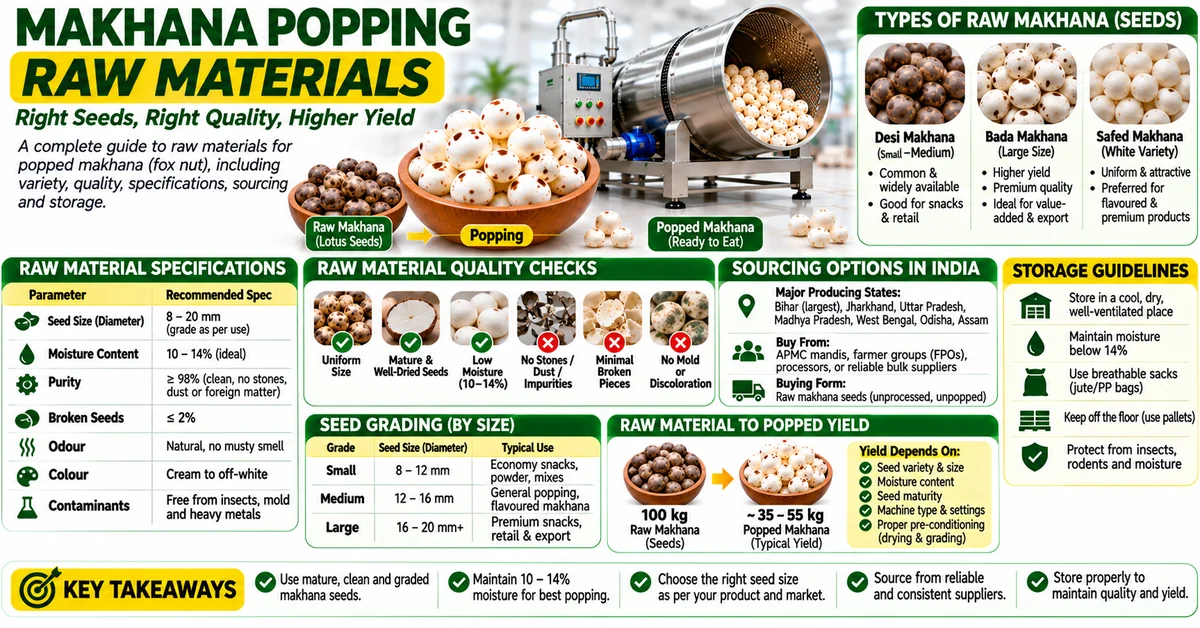
A makhana popping machine converts hard, raw gorgon nut seeds into the light, white, crunchy fox nuts sold as phool makhana. But the machine is only one part of the operation: raw-material quality, cleaning, drying, grading, moisture control, and pre-popping preparation largely decide your popping rate, kernel size, breakage, and profitability.
This guide explains exactly what you need before loading seeds into a makhana popping machine in India, including where to source raw material, how quality affects output, and how to store inputs correctly.
What Is a Makhana Popping Machine?
Makhana, also called fox nut or gorgon nut, comes from Euryale ferox, an aquatic crop grown mainly in ponds, lakes, and wetlands of eastern India. The harvested seed is cleaned, dried, roasted, and popped to create the familiar expanded white kernel.
A makhana popping machine automates this heat-and-pressure transformation. Instead of relying entirely on manual pan roasting, it uses controlled heating, rotation, and controlled discharge to pop seeds more consistently, reduce labour dependence, and support commercial production.
A typical machine includes:
- A raw-seed feeding hopper
- A cleaning or pre-cleaning arrangement
- A heating or roasting chamber
- Temperature and speed controls
- A popping chamber or impeller system
- A discharge outlet for popped makhana
- Separation arrangements for unhopped seeds, shells, and broken kernels
The important point is that a popping machine does not magically turn poor-quality raw seed into premium makhana. It amplifies the results of good preparation—and exposes the weaknesses of bad preparation.
The Main Raw Material: Raw Gorgon Nut Seeds
The primary input is raw makhana seed, often called raw gorgon nut seed or black makhana seed. These are the hard, dark seeds collected after the mature fruit bursts underwater and the seeds settle at the pond bottom.
India is the world’s leading makhana producer, and Bihar alone accounts for roughly 80–85% of global output. Major producing districts include Darbhanga, Madhubani, Saharsa, Purnia, Katihar, Supaul, Araria, Madhepura, and Sitamarhi.
For a popping unit, you need raw seed that is:
- Clean and free from mud, pond debris, stones, and foreign material
- Uniform in size
- Properly dried to a stable moisture level
- Free from fungal infection, insect damage, and foul odour
- Sorted by grade before popping
- Consistent from batch to batch
Raw seed quality matters because popping depends on the seed’s internal moisture, density, shell strength, and size. If seeds vary too much, some may burn while others remain unpopped.
Pre-Popping Inputs and Preparation
Before popping, raw makhana seeds require several preparation steps. Skipping or rushing these steps is one of the most common reasons processors get low popping efficiency, excess breakage, or uneven kernels.
1. Cleaning and Washing
Freshly collected or purchased raw seeds often contain mud, sand, plant residue, and other impurities. Seeds should first be cleaned and washed to remove surface contamination.
Clean seed protects the machine as well as the final product. Grit and hard foreign particles can damage heating surfaces, contaminate popped makhana, and create food-safety risks.
2. Drying
After washing, seeds must be dried to a suitable moisture level before storage and popping. Research on makhana popping machines specifically notes that seeds are cleaned, washed, dried for storage, and graded before first and second roasting.
Moisture is the central processing variable. Too much moisture can cause poor expansion, sticking, uneven heating, and storage problems. Too little moisture can make seeds brittle and increase breakage. The right drying and conditioning routine helps the seed pop uniformly.
3. Grading by Size
Grading separates seeds into similar size bands before roasting and popping. This is essential because smaller and larger seeds do not respond identically to heat.
In the Indian trade, makhana is commonly graded using the “suta” system. Larger grades command higher value: 4 suta is generally economical, 5 suta is popular for regular snacking, 6 suta is premium, and 7 suta is extra-large and export-oriented.
For popping, uniform batches help you:
- Set more accurate temperature and time parameters
- Reduce burnt or under-popped seeds
- Improve kernel uniformity
- Reduce manual sorting after popping
- Achieve more predictable yield
4. First Roasting and Conditioning
Many commercial processes use a first roasting or conditioning stage before final popping. This pre-treatment helps prepare the seed internally for expansion.
In some mechanised systems, primary roasted and conditioned seed can be stored for longer periods before popping, while some processes call for popping after a defined conditioning period such as 48 hours. The exact routine depends on the machine design, seed grade, and local raw material.
5. Second Roasting and Popping
The final popping stage applies controlled high heat. A research-scale makhana popping machine reported chamber temperatures of about 230–310°C, with satisfactory popping efficiency of 80–85% at a 10 kg/hour feed rate and 2,600 rpm impeller speed.
Commercial machines vary in design, but the principle remains the same: controlled heat, controlled residence time, and consistent seed preparation produce better expansion and fewer rejects.
Supporting Materials and Utilities
Besides raw makhana seeds, a practical popping setup needs several supporting inputs.
| Input or utility | Why it matters |
| Raw makhana seeds | The core raw material for popped makhana |
| Clean water | Used for washing seeds before drying |
| Drying space or dryer | Reduces seed moisture before storage and popping |
| Grading screens or grader | Separates seeds by size for uniform popping |
| Electricity | Powers motors, heaters, blowers, and controls |
| Suitable power connection | Many commercial lines require three-phase power |
| Food-grade stainless-steel contact parts | Supports hygiene and easier cleaning |
| Packaging material | Needed for storing and selling popped makhana |
| Labour and operator training | Ensures correct feeding, temperature control, and inspection |
Food-grade stainless steel is widely recommended for product-contact parts because it supports hygienic processing and is easier to clean.
Power requirements vary by capacity. Small machines may run on single-phase supply, while larger commercial systems commonly require three-phase industrial power. Before purchase, confirm the machine’s voltage, connected load, heater capacity, and site electrical readiness.
Where Can Raw Makhana Seeds Be Sourced in India?
The most reliable sourcing region is Bihar, especially the Mithilanchal belt. Bihar contributes about 90% of India’s production and nearly 80–85% of global supply, making it the natural base for bulk raw-material procurement.
Key sourcing areas include:
- Darbhanga
- Madhubani
- Saharsa
- Purnia
- Katihar
- Supaul
- Araria
- Madhepura
- Sitamarhi
You can source raw seed through:
- Local makhana growers and farmer producer organisations
- Mandi traders and aggregators in Bihar
- Makhana processing clusters
- Wholesale seed suppliers
- Contract farming arrangements
- Direct procurement during the harvest season
Makhana is harvested primarily between August and December, although supply and pricing vary through the year. Buying during the main harvest window can improve availability and may reduce procurement cost, but you must have proper drying and storage capacity before committing to bulk purchases.
For a commercial makhana popping machine, do not rely on a single supplier. Build at least two or three approved sources, define quality specifications in writing, and inspect every lot before payment.
How Raw Material Quality Affects Output
Raw-material quality directly affects popping efficiency, yield, kernel appearance, operating cost, and customer acceptance.
Popping Percentage
Better-quality, uniformly dried, properly graded seed generally pops more consistently. A research machine achieved 80–85% popping efficiency under controlled conditions, but real-world results depend heavily on seed preparation and operator discipline.
Poor seed can produce:
- More unpopped seeds
- More burnt kernels
- More broken makhana
- Lower expansion
- Higher rejection rates
- More manual sorting labour
Kernel Size and Grade
Larger, uniform raw seed is more likely to produce larger popped kernels. Since larger makhana grades fetch better prices, seed selection can directly influence revenue.
If you buy mixed-size seed, you may still pop it, but you will need stronger grading and separate machine settings for each size band. Otherwise, smaller seeds may overheat while larger seeds remain under-popped.
Moisture and Breakage
Moisture control affects both popping behaviour and storage life. Makhana absorbs moisture easily; damp stock becomes chewy, loses crispness, and may develop stale or musty odours.
For raw seed, excess moisture can cause inconsistent expansion and storage risk. For popped makhana, moisture pickup after popping reduces shelf appeal and crispness.
Conversion and Yield
Makhana processing involves substantial weight loss. APEDA estimates the seed-to-popped-makhana conversion at approximately 42–43%, while industry sources commonly describe roughly 3.5 kg of raw seed yielding about 1 kg of popped makhana.
This means your raw-material cost, drying losses, popping losses, and grading losses must all be calculated before setting a selling price. A machine with excellent capacity will still be unprofitable if raw-material wastage is high.
Storage Conditions for Raw Materials
Storage is not an afterthought. Makhana is sensitive to humidity, pests, and poor handling, so both raw seed and popped makhana need controlled storage.
Raw Makhana Seed Storage
Store raw seed only after proper cleaning and drying. Keep it in a dry, ventilated store away from direct moisture, damp floors, and walls. Use pallets or raised platforms to prevent contact with the floor.
Best practices include:
- Dry seeds thoroughly before storage
- Use clean, dry jute bags or food-safe woven bags
- Keep bags off the floor on pallets
- Maintain ventilation to prevent moisture build-up
- Avoid storing near wet walls, leaking roofs, or open windows
- Inspect lots regularly for insects, mould, and odour
- Follow first-in, first-out stock rotation
- Keep different grades separately labelled
Avoid stacking bags too high if it crushes seed or prevents air circulation. Also avoid storing raw seed beside strong-smelling materials, as makhana can absorb odours.
Popped Makhana Storage
Popped makhana is even more moisture-sensitive than raw seed. It should be cooled completely after popping, then packed quickly in airtight, moisture-proof packaging.
For best texture:
- Cool popped makhana before packing
- Use food-grade, sealed pouches or containers
- Store in a cool, dry area
- Avoid repeated opening of bulk packs
- Keep desiccants only where permitted and appropriate for food packaging
- Rotate finished stock on a first-in, first-out basis
Fresh popped makhana should be white to off-white, crisp, neutral in smell, and mostly whole. Yellow, grey, chewy, or musty makhana usually indicates age or moisture exposure.
Machine Capacity and Production Planning
Makhana popping machines are available in a wide capacity range. Small startup units may process around 8–10 kg per hour, while standard commercial machines are commonly listed at 20–25 kg per hour. Larger plants can reach 40–80 kg per hour, and some industrial configurations are designed for 100 kg per hour or more.
When choosing capacity, do not select a machine based only on its hourly rating. Calculate:
- Raw seed available per month
- Seasonal procurement capacity
- Drying capacity
- Grading capacity
- Labour availability
- Electricity load
- Packaging capacity
- Target sales volume
- Working shifts per day
For example, a 20–25 kg/hour popping machine may look adequate on paper, but if your cleaning, drying, or packaging line cannot keep pace, the popping machine will sit idle. A balanced line is more profitable than an oversized popping machine with weak upstream preparation.
Quality Control Checklist Before Popping
Use this simple checklist for every raw-material lot:
- Check supplier identity, lot number, and purchase record.
- Inspect for mud, stones, husk, insects, and foreign matter.
- Smell the lot; reject musty, sour, or chemical odours.
- Check seed colour and uniformity.
- Measure or assess moisture before storage and popping.
- Grade seed by size before roasting.
- Run a small trial batch before full-scale popping.
- Record temperature, feed rate, and popping results.
- Separate unpopped seed, broken kernels, and premium whole kernels.
- Pack cooled popped makhana immediately in moisture-proof packaging.
Maintaining a batch record helps you identify which supplier, grade, moisture level, and machine setting gives the best yield.
Common Mistakes to Avoid
- Buying mixed-grade seed without a grading plan
- Popping seed with unstable moisture
- Skipping cleaning and washing
- Using excessive heat to compensate for poor seed quality
- Ignoring first roasting and conditioning requirements
- Storing raw seed directly on a damp floor
- Packing popped makhana before it cools
- Buying a high-capacity machine without matching drying and packaging capacity
- Choosing non-food-grade contact surfaces to reduce cost
- Not testing a trial batch before large procurement
A makhana popping machine is a production system, not just a single device. The best results come from controlled raw material, disciplined pre-processing, and consistent operating parameters.
Conclusion
A makhana popping machine can be a strong foundation for a commercial fox nut business, but its performance depends as much on raw-material management as on the machine itself. Clean, properly dried, uniformly graded gorgon nut seeds produce better popping efficiency, larger kernels, lower breakage, and fewer rejects. In India, Bihar’s makhana-producing districts remain the most practical sourcing base, especially when buyers inspect lots, verify moisture, and maintain reliable supplier relationships.
Equally important are pre-popping inputs such as washing water, drying capacity, grading systems, stable electricity, trained operators, and moisture-proof packaging. Raw seed should be stored in a dry, ventilated area on raised pallets, while popped makhana must be cooled and sealed quickly to preserve crispness. Before buying, assess your daily seed availability, target output, power supply, and downstream processing capacity.
FAQs
What raw material does a makhana popping machine need?
It needs clean, dried, graded raw gorgon nut or makhana seeds.
Where can I buy raw makhana seeds in India?
Buy mainly from Bihar’s makhana belts, including Darbhanga, Madhubani, Saharsa, and Purnia.
Does seed moisture affect makhana popping?
Yes. Incorrect moisture causes poor expansion, breakage, burning, and storage problems.
Why is grading important before popping makhana?
Grading ensures uniform heating, better popping, fewer rejects, and consistent kernel size.
What is the usual seed-to-popped-makhana conversion?
Approximately 42–43%, or about 3.5 kg raw seed per kg popped makhana.
How should raw makhana seeds be stored?
Store cleaned, dried seed in ventilated, moisture-free storage on raised pallets.
Can a makhana popping machine handle mixed seed sizes?
It can, but mixed sizes reduce uniformity and usually require separate grading and settings.