
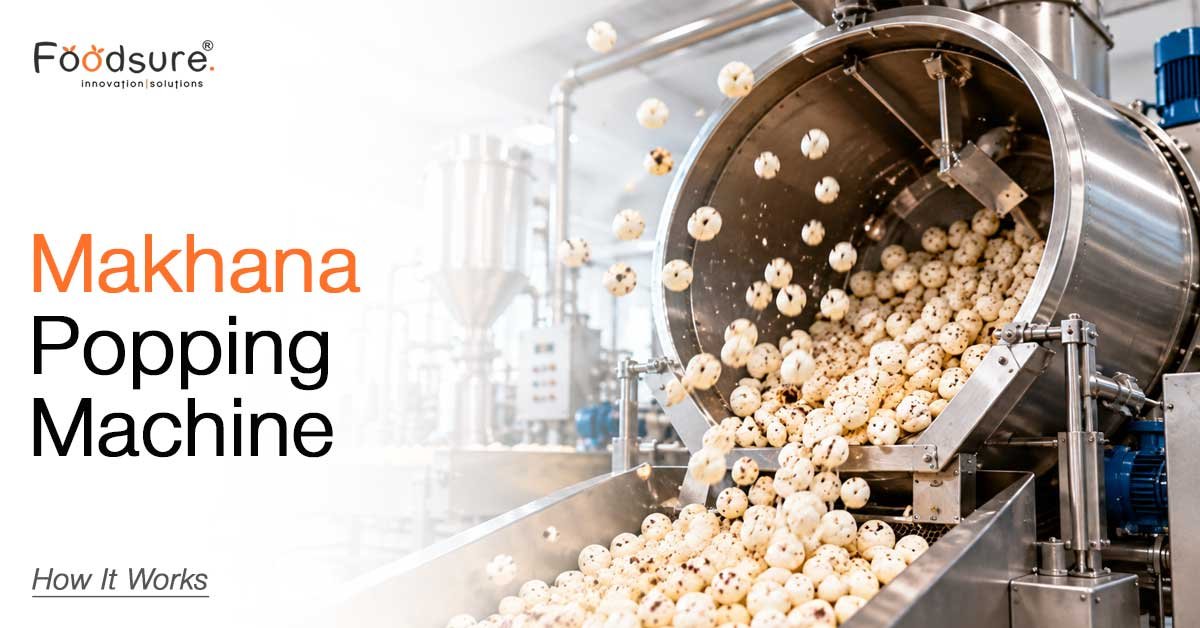
A makhana popping machine functions by heating the tender raw fox nut seed to a high temperature and then peaking a sudden drop in pressure conditions, which results in the inside of the seed kernel expanding and the seed itself becoming light, white, and fluffy makhana. This machine is replacing the conventional practice of pan-roasting and hammer-popping the makhana manually in a very time consuming process.
This makhana popping machine guide explains how a commercial makhana popping machine works, its machine parts, process flow diagram, capacity considerations, operating controls, and buying considerations.
Why Popping Is the Critical Step
Unpopped makhana seeds are dark in colour and very hard and are also not edible in raw format. Edible makhanas are obtained only after the seed has been roasted and popped. The heated moisture inside the conditioned seed turns into superheated vapour and the sudden release of the stem pressure causes the kernel to expand rapidly in size and shape as the popular puffed makhanas.
Popping is a skill-intensive and arduous process. Workers roast shelled seeds in hearth-shelled earthen pots or cast-iron pans at high temperature after, which they use some of the cast to hit the already hot-shelled seeds with the result that the shell actually bursts open enabling the kernel to separate easily. ICAR describes the process as ‘tedious, time-consuming, energy-consuming, and requiring skilled all-round manpower’. A makhana popping machine essentially automates or semi-automates this heat-impact cycle for less direct worker exposure to heat and more consistent batch performance.
What Is a Makhana Popping Machine?
A makhana popping machine is a food processing equipment, which roasts, by way of impact, the condition makhana seeds and mechanically cracks the makhana seed so that the inner kernel pops out. It generally consists of two operational parts:
- A roasting device, which heats the seeds to the correct temperature.
- Decortication or popping pup (popper). An appliance that cracks the hard shell and causes kernel heating.
They range from compact single-phase units for small processors to commercially available systems are integrated with cleaning, grading, drying, roasting, polishing, and packaging equipment. ICAR-CIPHET have developed and commercially launched a fully mechanised threshing cleaning seed grading, drying, roasting, and popping system.
How a Makhana Popping Machine Works
The working principle is simple: heat the seed, build internal vapour pressure, then suddenly release that pressure through impact. The shell breaks, the pressure drops instantly, and the white kernel expands into popped makhana, also called lawa.
Step-by-step working process
- Feed conditioned seeds
Cleaned, dried, graded, pre-heated, and tempered makhana seeds are fed into the machine’s hopper or roasting chamber. Seeds should be of similar size for uniform heat transfer. - Roasting or final heating
The roasting unit heats seeds at high temperature. ICAR reports machine roasting temperatures of 200°C to 300°C, while other machine designs report chamber temperatures around 230°C to 310°C. - Controlled residence time
A conveyor, rotating drum, screw feeder, or agitation system keeps seeds moving so they receive uniform heat. The feed rate and heating time determine whether seeds are properly conditioned for popping. - Transfer to popping chamber
Hot seeds move directly into the decortication or popping section. In mechanised systems, this transfer happens within seconds, avoiding manual handling of extremely hot seeds. - Impact cracking
The popping unit contains a casing, impeller assembly, and hard impact surface. Hot seeds strike the impact surface at speed, breaking the hard outer shell. - Sudden pressure release and expansion
When the shell breaks, internal pressure drops suddenly. The heated moisture inside the seed expands rapidly, causing the white kernel to puff out. This is the actual popping action. - Discharge and separation
Popped makhana, shells, husk, and unpopped seeds exit through the discharge outlet. They are then separated using sieves, air classification, manual sorting, or a dedicated grading system.
Main Components of a Commercial Makhana Popping Machine
A typical commercial makhana popping machine includes the following parts:
| Component | Function |
| Feed hopper | Holds and regulates the flow of raw or conditioned seeds |
| Roasting chamber or barrel | Applies controlled high heat to the seeds |
| Heating system | May use electric heaters, LPG, gas, diesel, or thermic oil depending on the design |
| Agitator, drum, or conveyor | Moves seeds for even roasting and prevents burning |
| Temperature controller | Monitors and regulates roasting temperature |
| Timer or variable-speed drive | Controls residence time and feed rate |
| Popping chamber | Houses the impeller and impact surface |
| Impeller assembly | Accelerates hot seeds toward the impact surface |
| Hard impact surface | Breaks the seed shell and initiates popping |
| Discharge outlet | Releases popped makhana, shells, and unpopped seeds |
| Control panel | Allows operators to set temperature, speed, time, and motor operation |
ICAR’s popping and decorticating machine design includes a roasting unit and a decortication/popping unit with a casing and impeller assembly featuring a hard impact surface.
The Science Behind Popping
Makhana popping works similarly to popcorn, but with an important difference: the seed has a very hard outer shell and a starchy kernel inside.
When the conditioned seed is heated:
- Remaining moisture inside the kernel turns into steam.
- Steam pressure builds within the hard shell.
- The shell becomes brittle due to high heat.
- A sudden impact fractures the shell.
- Pressure is released instantly.
- The starchy kernel expands and becomes light, white, and crunchy.
This is why popping depends on more than heat alone. The seed must have suitable moisture, adequate pre-heating, proper tempering, and uniform size before it enters the popping machine.
Role of Pre-Processing Before Popping
A popping machine cannot correct poor raw-material preparation. For high popping efficiency, seeds must be prepared correctly before machine feeding.
1. Cleaning and washing
Raw seeds are washed to remove mud, aquatic debris, stones, shells, and other foreign matter. Washing machines may also remove seed membranes, snails, and other contaminants.
2. Drying
Seeds are dried to a suitable moisture level. If moisture is too low, the kernel may not generate enough internal pressure. If it is too high, roasting becomes uneven and popping quality suffers.
3. Size grading
Seeds are graded before roasting and popping. Uniform seed size ensures uniform heat penetration and reduces the mix of burnt, under-popped, and unpopped kernels.
4. Pre-heating
Pre-heating conditions the seed and begins internal changes in starch and protein. Machine-based roasting systems can be used for both initial conditioning and final popping.
5. Tempering
After pre-heating, seeds are stored for 48–72 hours at ambient conditions. This tempering period loosens the kernel inside the hard seed coat, improving later popping performance.
Traditional vs Machine Popping
| Factor | Traditional manual popping | Makhana popping machine |
| Heat source | Fire, earthen pot, or cast-iron pan | Electric, LPG, gas, thermic oil, or other heating systems |
| Temperature control | Based on operator skill | Adjustable through controls and sensors |
| Popping method | Manual mallet striking | Mechanical impact through impeller and casing |
| Worker safety | High heat exposure and burn risk | Reduced direct contact with hot seeds |
| Consistency | Varies by operator and batch | More repeatable when calibrated |
| Labour requirement | High | Lower |
| Throughput | Limited by manual capacity | Higher, scalable output |
| Traceability | Limited | Easier with batch records and process settings |
Traditional processing involves roasting seeds at roughly 250°C to 320°C, tempering them for two to three days, roasting again, and manually popping them with a mallet. Mechanised systems reduce direct human intervention between roasting and popping, improving safety and process control.
Capacity and Performance
Machine capacity varies by model, seed grade, moisture level, heating method, and desired popping quality. ICAR’s popping and decorticating machine is reported to handle 35–40 kg of raw wet nuts per hour with popping efficiency above 90%.
Other machine designs have been reported at around 10 kg/hour with 80–85% popping efficiency, while commercial suppliers offer machines in ranges such as 10–15 kg/hour and up to 100 kg/hour.
What affects machine capacity?
- Raw seed size and grade
- Initial moisture content
- Pre-heating and tempering quality
- Roasting temperature
- Residence time
- Impeller speed
- Operator settings
- Desired kernel expansion
- Percentage of unpopped or broken kernels
A higher capacity machine is not automatically better. The right machine is one that maintains popping quality at your required throughput.
Heating Options in Indian Machines
Commercial makhana popping machines in India may use different heating sources:
| Heating option | Advantages | Considerations |
| Electric heating | Clean operation, easy control, suitable where power supply is stable | Higher electricity demand |
| LPG or gas heating | Fast heating and familiar operation for many processors | Requires safe gas handling and ventilation |
| Thermic oil heating | Even heat distribution; used in closed-barrel systems | Higher system complexity |
| Diesel or other fuel-based systems | Useful where electricity is limited | Emissions, fuel storage, and maintenance need attention |
ICAR-CIPHET’s mechanised system uses electrically heated thermic oil in a closed, thermally insulated barrel, though the institute notes that other heating sources can be used depending on availability.
Operating a Makhana Popping Machine Safely
Popping makhana is at very high temps, moving parts and very hot discharge material. Its a safety issue and should be included in the daily standards procedures.
- Safety checklist: this lists the hazards identified from the software version and hardware version benchmarks and the device driver benchmarks.
- Implement to train operators on startup shutdown emergency stop and cleaning procedures.
- Keep on guards, covers, and safety interlock.
- Avoid coming into contact with the roasting chamber, impeller area, or discharge outlet while the system is on.
- Avoid with insulation gloves, safety suit, etc. When dealing with heat resistant gloves and/or personal protective equipment.
- Ensure adequate clearance all around for gas, cylinders, burners, electric, boards, and hot surfaces.
- Wiring earthing motors and control panels should be checked regularly.
- The machine will not operate unless it has been cooled down. So allow the machine to cool before attempting to undertake the necessary cleaning or maintenance.
- Have a fire extinguisher accessible that is appropriate for the fuel and electrical installations.
- Ventilate well, in particular if heating by gas, oil, or solid fuel.
Mechanized popping. When using a mechanized means of popping like the Fujiyama machine the workers did not have to touch the hot seeds themselves or to use a mallet. This is a significant safety benefit.
How to Get Consistent Popping Quality
Consistency depends on controlling the complete input-to-output chain, not just the machine.
Set the right seed preparation standard
- Use clean, mature, uniformly graded seeds.
- Maintain the correct drying and pre-heating routine.
- Follow the 48–72 hour tempering period before final popping.
Calibrate temperature and time
- Start with the manufacturer’s recommended settings.
- Adjust temperature and residence time based on seed size and moisture.
- Avoid raising temperature simply to increase speed; it can increase burnt kernels.
Monitor output quality
Check each batch for:
- Popping percentage
- Whiteness and colour
- Kernel expansion
- Broken-kernel percentage
- Unpopped seeds
- Shell contamination
- Burnt smell or dark kernels
- Crispness after cooling
Maintain batch records
Record seed grade, batch number, moisture status, temperature, feed rate, roasting time, operator name, and output yield. This helps identify the exact cause of quality variation.
Common Problems and Troubleshooting
| Problem | Likely cause | Corrective action |
| Low popping percentage | Inadequate tempering, poor drying, low temperature, or short residence time | Review seed preparation, increase heat exposure within safe limits, and verify settings |
| Burnt or dark makhana | Excess temperature, long residence time, or uneven seed grading | Lower temperature, reduce time, and grade seeds properly |
| Hard or semi-popped kernels | Insufficient heat, poor tempering, or immature seeds | Improve pre-heating, tempering, and seed selection |
| Excessive breakage | High impeller speed, overly hard impact, or fragile kernels | Adjust speed and impact settings; check seed quality |
| Shell contamination | Poor separation after popping | Improve sieving, air separation, or manual sorting |
| Uneven popping | Mixed seed sizes or inconsistent feed rate | Grade seeds and stabilise feed rate |
| Machine overheating | Blocked airflow, faulty thermostat, or excessive load | Stop operation, inspect heating system, and service the machine |
Choosing a Commercial Makhana Popping Machine in India
When evaluating a commercial makhana popping machine, compare suppliers on more than price.
Key selection factors
- Capacity: set the machine capacity to the needs of your typical daily raw-seed quantity and sales program.
- Popping efficiency: Request a tested popping percentage, not just rated capacity.
- Heating source: electric / LPG / gas / thermic-oil, based on cost and source of energy locally available.
- Material quality: Food-contact surfaces shall be durable, easily cleanable and suitable for operation at high temperatures.
- Temperature control: make sure you have reliable thermostats and controllers and safety cut-offs.
- Cleaning: Openable panels, accessible chambers and easy discharge arrangements keep the time when equipment is not running to a minimum.
- Power requirement: make sure single phase or three phase power.
- Spare-part support: availability of heaters motors impellers belts bearings, control parts.
- Installation /training: find out if the supplier offers commissioning, training of operators, and process setting training.
- Premiere seed grading: Try the machine with your seed grade and moisture levels.
Commercial machines are available in different capacities, including 10–15 kg/hour models and larger systems up to around 100 kg/hour. However, actual performance should always be validated through a trial with your raw material.
Where the Popping Machine Fits in a Full Plant
A popping machine is one part of a complete makhana processing line. A typical commercial setup includes:
- Raw seed receiving and storage
- Washing and cleaning
- Drying
- Seed grading
- Pre-heating or first roasting
- Tempering
- Final roasting and popping
- Shell and impurity separation
- Polishing
- Popped makhana grading
- Roasting or flavouring, if required
- Cooling
- Packaging
- Storage and dispatch
ICAR-CIPHET’s commercialized mechanized system covers threshing, cleaning, grading, drying, roasting, and popping, showing how popping fits into a broader mechanised processing chain.
ROI: Why Processors Consider Mechanization
The profit can be better by producing more in less time, by reducing labour requirements, increasing popping efficiency, and reducing rejections. As ICAR mechanization can increase the capacity of popping eight to ten times and reduce the duration of the process from two or three days to approximately 20 hours.
However, return on investment depends on:
- Machine cost and installation cost
- Energy cost per kilogram
- Labour savings
- Popping yield improvement
- Reduction in burnt and unpopped material
- Consistency of premium-grade output
- Machine utilisation rate
- Maintenance and spare-part costs
- Selling price of graded makhana
For a small processor, a semi-automatic machine may be enough. For a retail brand, private-label manufacturer, or exporter, a higher-capacity machine with better controls and integration may deliver stronger long-term value.
Conclusion
A makhana popping machine works by combining controlled high-temperature roasting with sudden mechanical impact. The heat builds internal steam pressure inside the conditioned seed, while the impeller and impact surface break the shell. The sudden pressure release expands the white kernel into popped makhana.
For Indian processors, the machine’s real value is not only speed. It offers safer operation, reduced manual drudgery, better process control, higher throughput, and more consistent makhana quality provided seed preparation, temperature settings, and post-popping separation are managed properly.
FAQs
How does a makhana popping machine work?
Roasts the conditioned seed at high temperature before bin impact to break shells and k-virate.
What temperature does a makhana popping machine use?
Machine roasting usually takes place between the temperatures of around 200C and 310C.
Can a makhana popping machine replace manual popping?
Yes, it could be used as a substitute or besides manual mallet popping, with the added benefit of increased safety and uniformity.
What capacity does a commercial makhana popping machine have?
Commercial machinery is often anywhere from 1015kg/hr up to 100kg/hr.
Why is seed tempering important before popping?
The importance of tempering for 4872 hours is to loosen the kernel that would equate to good popping.
What heating source is best for makhana popping machines?
Three values are several electric LPG gas and thermic-oil. It is up to you to select, as the price and the availabilities.
Does a popping machine improve makhana yield?
Yes, using a controlled heat and pounding helps the popping efficiencyand minimises wastage.