
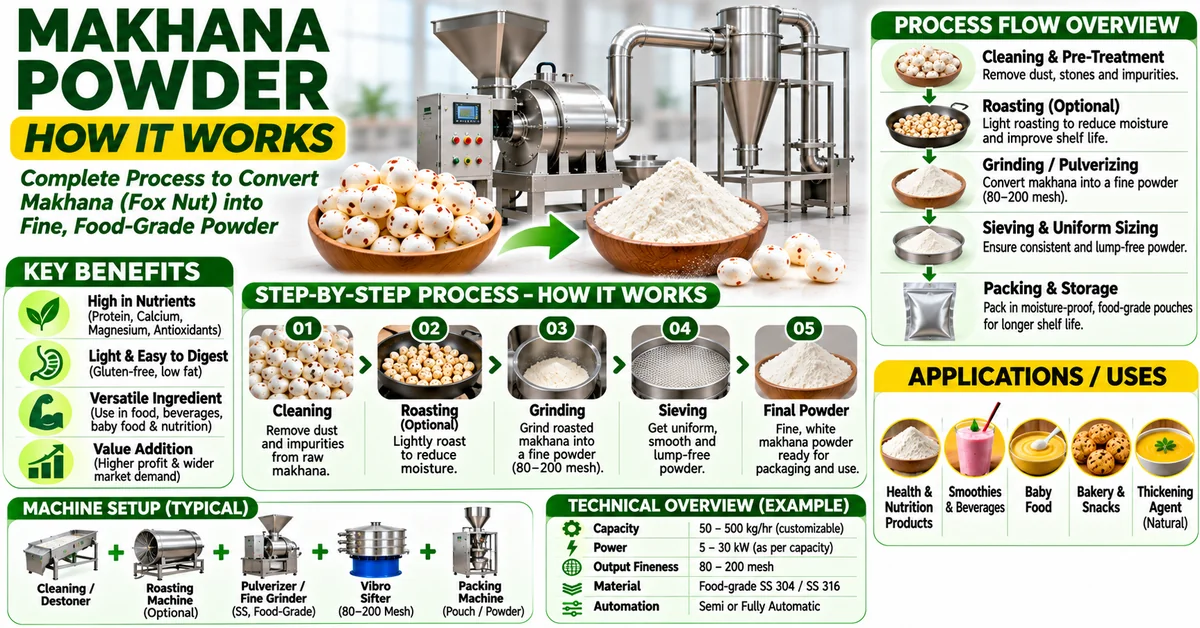
A makhana powder grinding machine helps processors convert roasted or dried makhana into uniform powder for food, beverage, bakery, nutraceutical, and instant-mix applications. For businesses building value-added fox nut products, grinding can open opportunities beyond whole roasted makhana packs.
Before publishing this page, confirm that the makhana powder grinding machine is availableor officially plannedin the MakhanaMachine.com catalogue. Final capacity, material grade, motor power, automation level, screen size, and output quality should be confirmed through the machine specification sheet and product trial.
A commercial makhana powder grinding machine is not simply a crushing unit. It is part of a controlled processing system that can affect powder texture, product yield, hygiene, flavour retention, and final product consistency. Whether the goal is fine makhana flour for baby-food-style mixes, coarse powder for snack blends, or ingredient powder for bakery products, the machine and process must match the intended application.
What Is a Makhana Powder Grinding Machine?
A makhana powder grinding machine is designed to reduce roasted or dried makhana into powder or granules of a controlled size. Depending on the machine type, it may use impact grinding, hammer milling, pin milling, pulverising, or another size-reduction mechanism.
The output may range from coarse crumbs to fine powder. The exact result depends on several factors:
- Initial makhana condition
- Product moisture level
- Feed rate
- Machine speed
- Grinding chamber design
- Screen or sieve size
- Number of grinding passes
- Required final particle size
For example, a coarse makhana powder may work well in snack seasoning blends, cereal mixes, energy bars, or granola products. A finer powder may be more suitable for beverage mixes, bakery premixes, porridge products, nutrition blends, or food formulations where a smoother texture is required.
The machine helps improve productivity compared with manual crushing or basic domestic grinding. It can also support better batch consistency when operators use documented settings and controlled raw materials.
Why Grind Makhana into Powder?
Whole makhana is a popular snack ingredient, but powdering creates additional product-development possibilities. It allows processors to use smaller makhana pieces, broken material, and selected lower-grade fractions more effectivelyprovided the raw material remains safe, clean, and suitable for food use.
Makhana powder can be used in products such as:
- Instant porridge mixes
- Breakfast cereal blends
- Beverage premixes
- Protein and nutrition mixes
- Baby-food-style formulations
- Bakery premixes
- Cookies and biscuits
- Energy bars
- Extruded snack formulations
- Sweet mixes
- Kheer or dessert premixes
- Halwa premixes
- Soup and savoury mix formulations
- Health snack blends
- Traditional food products
For a makhana processor, this can help create a better value proposition. Instead of selling only whole roasted makhana, the business can develop multiple product formats from the same ingredient category.
However, it is important to understand that not every broken makhana lot should automatically become powder. Poor-quality, stale, burnt, contaminated, or moisture-affected material should not be used just to reduce wastage. Raw-material inspection remains essential.
How the Grinding Process Works
The working process of a makhana powder grinding machine generally follows a sequence: preparation, feeding, grinding, separation, collection, and packing.
Step 1: Prepare the Makhana
The makhana should be clean, dry, and suitable for the intended food application. Grinding wet or high-moisture material can create clogging, poor flow, uneven powder, and microbial shelf-life risks.
Before feeding the machine, inspect for:
- Stones and foreign particles
- Excessively burnt pieces
- Dust and loose impurities
- Packaging fragments
- Damaged or stale material
- Excess moisture
- Insect infestation
Depending on the factory setup, processors may use a sieve, aspirator, magnetic separator, or manual inspection table before grinding. The aim is to protect the machine and improve powder quality.
If the makhana has been roasted, ensure it has cooled adequately before grinding. Hot material may create condensation during packing and can affect powder flow.
Step 2: Feed the Material
The operator introduces makhana into the feeding hopper. In a small semi-automatic setup, this may be done manually. In larger systems, feeding may be controlled through screw feeders, vibratory feeders, or automated material-transfer arrangements.
Uniform feeding matters because overloading can reduce grinding efficiency. If too much material enters the chamber at once, the machine may produce an uneven grind, consume more power, or experience blockages.
A controlled feed rate helps maintain:
- More uniform particle size
- Stable machine performance
- Better throughput
- Lower risk of overheating
- Reduced wear on grinding components
Step 3: Size Reduction Inside the Chamber
Inside the grinding chamber, makhana is broken down through a mechanical action such as impact, cutting, shearing, crushing, or high-speed collision.
The exact mechanism depends on the machine design. A hammer mill, for example, uses rapidly moving hammers to break material against internal surfaces or screens. A pulveriser may use high-speed grinding components to reduce particle size further.
The resulting particles continue moving within the chamber until they are small enough to pass through the selected screen or sieve.
This stage determines much of the final powder quality. Operators need to balance speed and fineness. Running the machine at unsuitable settings can create too much heat, excessive fines, poor texture, or loss of desirable product characteristics.
Step 4: Screening and Particle Control
A screen or sieve is often used to control the maximum particle size of the output. Larger particles remain in the grinding zone until further size reduction occurs, while smaller particles pass through for collection.
Screen selection is important because different applications require different powder textures.
For instance:
- Coarse particles may suit snack mixes and energy bars.
- Medium powder may suit bakery and cereal products.
- Fine powder may suit beverage blends and instant mixes.
A single machine may not always achieve ultra-fine powder in one pass. For very fine applications, a processor may need multiple passes, a finer grinding system, or an integrated sieving arrangement.
Do not select a machine only by its stated kilogram-per-hour capacity. Ask what particle size that capacity is based on. A machine may achieve a higher output for coarse grinding and a lower output for fine grinding.
Step 5: Powder Collection
After grinding, the powder is discharged or collected through an outlet, collection bin, cyclone separator, bag filter, or enclosed collection system, depending on the configuration.
Powder handling should be planned carefully because fine food powders can create dust. Dust management helps improve cleanliness, reduce material loss, and create a more comfortable production environment.
A well-designed setup may include:
- Covered transfer points
- Powder collection bins
- Dust extraction system
- Bag filters
- Easy-to-clean surfaces
- Proper ventilation
- Food-grade containers for powder storage
The collected powder should be checked for consistency before it moves to blending or packaging.
Step 6: Quality Checks and Packing
Before packing, operators should examine the powder for texture, colour, aroma, flow, and visible foreign matter. The batch should meet the company’s internal product specification.
Typical checks may include:
- Particle-size consistency
- Moisture level
- Colour uniformity
- Odour and taste
- Foreign matter
- Bulk density
- Flow characteristics
- Microbiological suitability
- Packaging seal quality
The final powder should be packed in packaging that protects it from moisture, contamination, odour absorption, and handling damage. The best packaging structure depends on the intended shelf life, storage conditions, distribution channel, and product formulation.
Main Parts of a Makhana Powder Grinding Machine
A commercial makhana powder grinding machine may vary by model, but most systems include several common components.
Feeding Hopper
The hopper is the entry point for makhana. It should be designed to support safe and controlled feeding while preventing material spillage.
A properly sized hopper can improve operator convenience and minimise feeding interruptions. Some systems may include a cover or safety grille to prevent accidental access to moving parts.
Grinding Chamber
The grinding chamber is where makhana is broken down into powder. It is a key food-contact area, so material selection, finish quality, and cleanability matter.
For food applications, stainless-steel food-contact surfaces are generally preferred. Confirm the grade and food-contact design with the machine manufacturer.
Grinding Mechanism
The grinding mechanism may include hammers, blades, pins, beaters, discs, or other components, depending on the machine type. These parts create the mechanical action needed to reduce makhana size.
Wear parts should be easy to inspect and replace. Overused grinding elements can reduce output, create uneven powder, and increase energy consumption.
Screen or Sieve
The screen controls the size of particles leaving the grinding chamber. Different screen sizes can help create different powder grades.
When discussing specifications with a supplier, ask which screens are included, how quickly they can be changed, and whether custom mesh sizes are available for your product requirement.
Motor and Drive System
The motor powers the grinding mechanism. Motor size and design affect grinding performance, capacity, energy use, and operating stability.
The drive system may include belts, pulleys, couplings, gear systems, or direct-drive arrangements. Each design has different maintenance requirements.
Control Panel
A control panel allows operators to start, stop, and monitor the machine. Depending on the level of automation, the panel may include motor controls, overload protection, speed settings, safety interlocks, timers, and emergency-stop controls.
For a new processing unit, easy operation is important. Sophisticated controls are only useful if the production team is trained to use them consistently.
Powder Collection Unit
The collection unit receives the finished powder. It may be a simple outlet with a container or a more enclosed system with cyclone separation and dust collection.
For higher-volume commercial production, enclosed collection can support better hygiene and reduce powder loss.
Frame and Safety Guards
The frame supports the complete machine assembly. Safety guards protect operators from belts, rotating shafts, and other moving components.
Never operate a grinding machine with guards removed. Proper safety measures protect both workers and the equipment.
Semi-Automatic vs Fully Automatic Models
Makhana powder grinding machines may be available in semi-automatic or more automated configurations. The correct choice depends on production volume, labour availability, budget, and desired process control.
A semi-automatic machine may involve manual feeding, manual powder collection, and operator-controlled cleaning. It can be suitable for small businesses, pilot production, product-development kitchens, and early-stage brands.
A more automated system may include controlled feeding, enclosed material transfer, automated discharge, dust collection, interlocked controls, and integration with downstream sieving or packing equipment.
| Feature | Semi-Automatic System | More Automated System |
| Feeding | Usually manual | Controlled or automated |
| Labour requirement | Higher | Lower per batch |
| Initial investment | Lower | Higher |
| Output consistency | Depends more on operator | More standardised |
| Cleaning | Usually manual | May include easier enclosed handling |
| Best suited for | Start-ups and smaller units | Growing or larger processors |
Automation can improve consistency and reduce handling, but it does not replace good manufacturing practices. Raw-material inspection, cleaning, preventive maintenance, and batch documentation remain essential in every type of unit.
Capacity and Output Considerations
Machine capacity should be assessed based on real production conditions, not only brochure figures. The output can change based on raw-material quality, moisture, particle-size requirement, screen selection, feeding rate, and operator practices.
When comparing a commercial makhana powder grinding machine, ask:
- What is the output for coarse powder?
- What is the output for fine powder?
- What is the recommended feed rate?
- What is the motor power?
- What screen sizes are available?
- Is output measured in continuous or batch operation?
- Does the stated capacity include downtime for cleaning?
- Can the machine handle roasted makhana without clogging?
- What powder collection method is provided?
- Is a trial possible using your own makhana sample?
The right machine is one that can consistently produce your required powder grade at a viable operating cost.
Setting Up a Makhana Powder Unit in India
A powder-processing line requires more than a grinder. Plan space for raw material storage, cleaning, grinding, sieving, blending, packaging, finished-product storage, and worker hygiene.
A practical process flow may look like this:
- Raw makhana receiving
- Cleaning and sorting
- Roasting, if required
- Cooling
- Grinding
- Sieving
- Blending or formulation
- Metal detection, where applicable
- Packaging
- Finished-goods storage and dispatch
Keep raw material and finished powder separate to minimise contamination and mix-up risks. The grinding room should be dry, clean, ventilated, and designed for easy cleaning.
Food businesses in India must obtain the applicable FSSAI registration or licence before operating. Other registrations and approvals can depend on the business structure, location, factory size, local authority requirements, packaging format, and turnover.
Typical business and compliance requirements may include:
- FSSAI registration or licence
- Business registration
- GST registration, where applicable
- Udyam registration
- Local trade permissions
- Factory-related approvals, where applicable
- Fire-safety permissions, where applicable
- Pollution-control approvals, where applicable
- Legal Metrology and packaging-label compliance
- Trademark registration for the brand name
Always verify legal and regulatory requirements with a qualified professional before setting up the unit.
Hygiene, Cleaning and Maintenance
Powder processing demands strong hygiene because fine material can settle on surfaces and move through the facility. A cleaning schedule should cover the hopper, grinding chamber, screen, collection unit, floor area, surrounding surfaces, and packaging zone.
Key hygiene practices include:
- Use clean, dry food-contact equipment.
- Remove leftover powder between batches.
- Clean screens carefully to prevent blockages.
- Control insects and pests in storage areas.
- Avoid water exposure in the dry powder-processing area.
- Use hair restraints, gloves where appropriate, and clean uniforms.
- Keep batch records for traceability.
- Separate allergen-containing formulations where needed.
Preventive maintenance should include regular inspection of screens, bearings, belts, motors, grinding elements, fasteners, safety guards, and electrical systems.
If the machine starts producing uneven powder, unusual noise, vibration, excess heat, or reduced output, stop production and inspect the unit before continuing.
Common Mistakes to Avoid
Many new processors make avoidable mistakes while setting up a makhana powder business.
- Grinding makhana with excess moisture
- Ignoring pre-cleaning and foreign-matter control
- Choosing capacity without considering particle-size requirements
- Selecting a machine without product trials
- Overfeeding the grinding chamber
- Using unsuitable screens for the intended product
- Not planning for dust collection
- Packing powder while it is still warm
- Ignoring storage humidity
- Failing to document machine settings
- Delaying preventive maintenance
- Assuming all powder applications need the same grind size
A successful operation depends on repeatability. The goal is not only to make powder once; it is to produce the same quality powder across every batch.
Questions to Ask Before Buying
Before you buy a makhana powder grinding machine in India, request clear answers from the manufacturer or supplier.
- What type of grinding mechanism is used?
- What is the actual output for my required fineness?
- What motor power and electrical connection are needed?
- Which parts come in contact with food?
- What stainless-steel grade is used?
- Which screens are supplied with the machine?
- Can the machine be customised for my target powder size?
- Is a dust-collection system available?
- Can I test my own makhana sample?
- What are the machine dimensions and space requirements?
- What cleaning procedure is recommended?
- Which spare parts are commonly required?
- Does the supplier provide installation and operator training?
- What warranty and service support are available?
- Can the system integrate with a sieve, blender, or packing machine?
Do not select a machine based only on price. Consider output quality, hygiene design, ease of cleaning, service availability, power consumption, spare-part access, and compatibility with your long-term product plans.
Build a Value-Added Makhana Business
A makhana powder grinding machine can help turn makhana into an ingredient for multiple food categories. With the right raw material, controlled grinding process, suitable packaging, and reliable quality checks, processors can create powder products for retail, institutional supply, foodservice, and ingredient markets.
Start with a product trial. Define the required texture. Test the powder in its final application, whether it is a beverage mix, bakery item, cereal blend, or nutrition product. Then select a commercial makhana powder grinding machine based on real product requirements not assumptions.
Looking for a commercial makhana powder grinding machine? Request a technical specification sheet, discuss capacity options, share your powder requirement, and get a machine recommendation from the engineering team.
- Get a Free Quote
- Request a Demo Video
- See the Makhana Powder Grinding Machine Product Page
- Talk to Our Engineering Team
- WhatsApp for Machine Details
- Book a Free Consultation Call
FAQs
What is a makhana powder grinding machine used for?
It converts roasted makhana into powder for food mixes, bakery, beverages, and snacks.
What are the main parts of this grinding machine?
Main parts include hopper, grinding chamber, motor, screen, control panel, and collection unit.
Is it available in semi-automatic and fully automatic models?
Yes, configurations can range from manual feeding systems to automated integrated processing lines.
Can the machine produce different makhana powder sizes?
Yes, screen size, grinding settings, and repeat processing influence the final powder fineness.
What capacity should I choose for commercial production?
Choose capacity based on daily demand, target fineness, batch time, and planned business growth.
Does makhana need roasting before grinding?
Roasted, cooled, low-moisture makhana generally grinds better and produces a more stable powder.
Can the machine be connected with packing equipment?
Yes, suitable systems can integrate with sieving, blending, powder transfer, and packaging machines.