
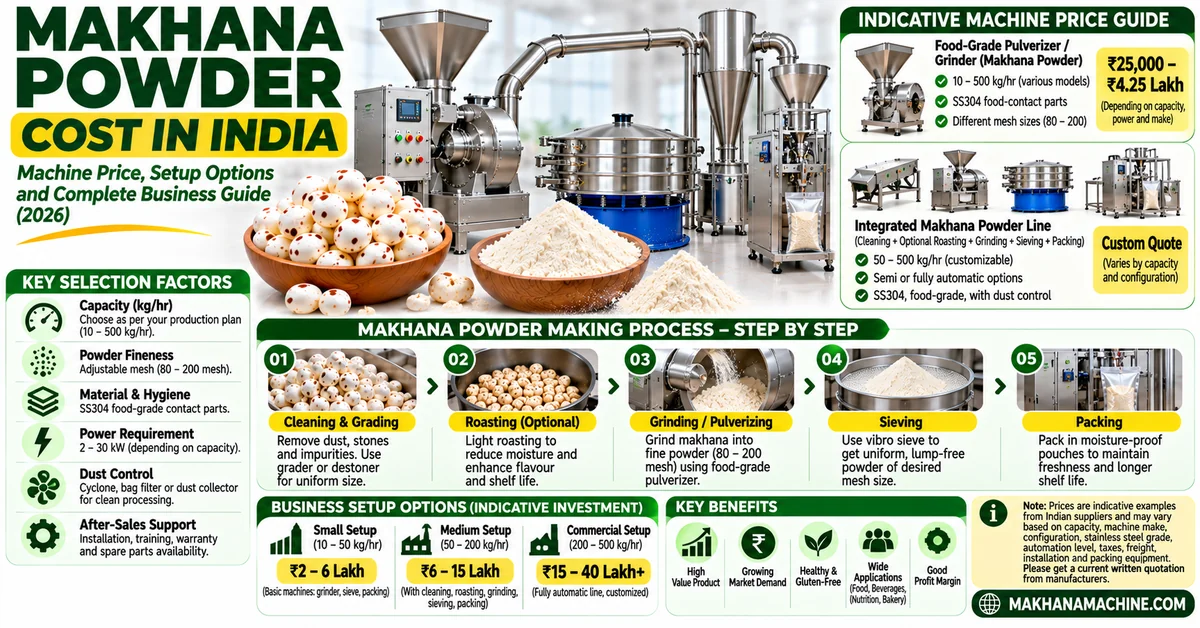
A makhana powder grinding machine price in India can cost anywhere from roughly ₹20,000–₹60,000 for a small commercial pulverizer to ₹1.5 lakh–₹5 lakh or more for a stainless-steel, higher-capacity, dust-controlled grinding system. The final price depends mainly on capacity, construction material, powder fineness, automation, dust collection, motor power, and whether installation, training, and after-sales support are included.
If you are buying your first makhana powder grinding machine, do not compare quotations on machine price alone. Two machines with similar advertised capacity can perform very differently if they differ in grinding chamber design, screen options, material contact parts, dust control, and service support. This guide explains what a makhana powder grinding machine does, what drives its cost, and how to choose the right configuration for your business.
What Is a Makhana Powder Grinding Machine?
A makhana powder grinding machine converts roasted or popped makhana into a fine, uniform powder. The powder can be used in health foods, instant mixes, bakery products, baby-food formulations, protein blends, laddus, soups, thickening applications, and other value-added food products.
In practice, most makhana powder machines are adapted food-grade pulverizers, hammer mills, or impact grinders. These machines use rotating hammers, blades, or impact elements to break the makhana into smaller particles, while a screen or sieve controls the final powder size.
A typical setup may include:
- Feed hopper
- Grinding chamber
- Motor and drive system
- Screen or mesh for particle-size control
- Collection bin or bag
- Blower or cyclone separator for dust control
- Control panel
- Optional pre-crusher, sieve, or packaging connection
The exact design depends on whether you need a small batch machine for trial production or a continuous commercial line for regular supply.
Typical Price Range in India
Because “makhana powder grinding machine” is a specialised application, many suppliers quote based on a standard pulverizer or spice-grinding machine configuration. Prices vary widely by capacity, material, and accessories.
| Machine type | Typical capacity | Indicative price range | Best suited for |
| Small commercial pulverizer | 10–30 kg/hr | ₹20,000–₹60,000 | Startups, trial batches, small brands |
| Mid-size commercial grinder | 30–80 kg/hr | ₹60,000–₹1.5 lakh | Growing processors and local suppliers |
| Stainless-steel pulverizer with dust control | 50–150 kg/hr | ₹1.5 lakh–₹3 lakh | Food brands needing better hygiene and consistency |
| Higher-capacity hammer mill or impact pulverizer | 100–300+ kg/hr | ₹2 lakh–₹5 lakh+ | Larger processors and contract manufacturers |
| Complete grinding line with pre-crusher, cyclone, sieve, and packing | Varies | ₹5 lakh+ | Industrial-scale makhana powder production |
These figures are indicative market ranges. Commercial spice and pulverizer machines listed in India commonly fall between about ₹20,000 and ₹2 lakh for smaller and mid-size units, while larger stainless-steel, cyclone-equipped, or high-capacity systems can move into the ₹2 lakh–₹8.5 lakh range
For makhana specifically, the right machine must handle its light, brittle, low-density nature without excessive heating, dust generation, or inconsistent particle size. A general-purpose grinder may be cheaper, but a machine configured for food-grade makhana powder can save money through better yield, cleaner operation, and fewer maintenance problems.
What Drives the Price?
1. Grinding capacity
Capacity is the biggest cost driver. A machine rated for 20–30 kg/hr costs far less than one designed for 100–300 kg/hr.
However, do not buy capacity only for today’s requirement. If you expect demand to grow, a slightly larger machine may be more economical than replacing a small unit within a year. At the same time, oversizing can increase power consumption, floor-space needs, and initial investment.
Ask the supplier for capacity under your actual conditions:
- Roasted or raw makhana
- Whole makhana or broken makhana
- Required powder fineness
- Continuous or batch operation
- Expected daily production hours
A machine’s advertised capacity may be based on spices, grains, or other materials, not makhana. Always request a trial or demo with makhana.
2. Material of construction
Material choice has a major impact on both price and food safety.
| Construction option | Cost impact | Suitability |
| Mild steel | Lowest | Suitable for non-contact parts, structural frames, and some non-food applications |
| Stainless-steel contact parts | Moderate to high | Preferred where powder touches the grinding chamber, hopper, screens, and collection areas |
| Full stainless-steel construction | Highest | Suitable for premium food brands, export-oriented operations, and frequent washdown requirements |
For a food business, prioritise stainless steel or food-grade contact surfaces for all parts that touch makhana powder. Mild steel may be acceptable for the frame or external body, but powder-contact areas should be easy to clean, corrosion-resistant, and free from rust risk.
3. Powder fineness requirement
Finer powder generally requires more grinding time, better screen control, and sometimes a more powerful motor or multi-stage grinding.
If your customer needs coarse makhana powder, a standard pulverizer may be enough. If you need fine powder for instant mixes, health drinks, or premium formulations, you may need:
- Finer mesh screens
- A more efficient grinding chamber
- Better airflow or dust extraction
- A sieve or classifier after grinding
- Possibly a second grinding pass
The finer the required particle size, the more important it becomes to test the machine with your actual makhana before purchase.
4. Motor power and electrical configuration
Motor power affects grinding speed, heat generation, and ability to handle continuous operation. Small commercial machines may use 2–3 HP motors, while larger commercial grinders may use 5 HP, 10 HP, 15 HP, or more
Also confirm:
- Single-phase or three-phase power requirement
- Voltage and frequency compatibility
- Starter, VFD, or control-panel inclusion
- Estimated power consumption per kg of powder
- Whether the quoted price includes the motor
Some listings mention machines “without motor,” which can make the headline price look lower. Always compare the total cost including motor, starter, wiring, and control panel.
5. Dust collection and cyclone system
Makhana powder is light and can create significant dust during grinding. A dust-collection system improves worker comfort, cleanliness, and powder recovery.
A basic machine may discharge powder into a bag or bin. A better commercial setup may include:
- Blower-type discharge
- Cyclone separator
- Dust bag or filter
- Closed transfer piping
- Easy-clean collection container
Cyclone-equipped systems generally cost more, but they can reduce dust in the work area and improve powder collection. Industrial pulverizer systems with cyclones are available at higher price points, reflecting the added fabrication, airflow design, and equipment involved.
6. Automation level
Manual or semi-automatic machines are cheaper and simpler to operate. Automatic systems cost more but can improve consistency and reduce labour.
Automation options may include:
- Variable-speed feed control
- Automatic feeding
- Temperature monitoring
- Timer-based operation
- PLC or control-panel integration
- Connection to sieving and packing systems
For a new business, a robust semi-automatic machine is often the best starting point. For larger volumes, automation becomes more valuable because it reduces operator variation and improves throughput.
7. Screens, spare parts, and accessories
The quoted machine price may exclude items you will actually need, such as:
- Extra screens or sieves
- Spare hammers, blades, or grinding elements
- Collection bags
- Trolley or stand
- Dust filter
- Feed regulator
- Magnetic trap or pre-cleaner
- Installation kit
- Spare belts or bearings
Ask for a complete bill of materials. A low quote that excludes screens, spares, and dust-control accessories may become expensive later.
8. Installation, commissioning, and training
Many buyers assume installation and operator training are included. They are not always included.
Before ordering, confirm whether the quotation covers:
- Delivery to your location
- Unloading and placement
- Electrical connection guidance
- Machine alignment and trial run
- Operator training
- Trial grinding with makhana
- Commissioning report
- Warranty registration
- Service visit charges
A supplier that includes installation support and operator training may quote slightly higher initially, but can reduce downtime and early mistakes.
Machine Specifications to Check
Before comparing prices, prepare a clear specification sheet. This helps suppliers quote accurately and prevents misunderstandings.
Ask for these details:
| Specification | Why it matters |
| Recommended input material | Confirms suitability for roasted/popped makhana |
| Input size | Tells you whether pre-crushing is needed |
| Output capacity | Should be stated for makhana, not only spices |
| Powder fineness | Determines screen mesh and grinding configuration |
| Motor power | Affects performance and electricity cost |
| Power supply | Single-phase or three-phase |
| Contact material | Food-safety and cleaning requirement |
| Dust-control system | Workplace cleanliness and powder recovery |
| Machine dimensions | Floor space and installation planning |
| Weight | Transport and foundation requirements |
| Noise level | Operator comfort and workplace compliance |
| Spare-part availability | Long-term running cost |
| Warranty terms | Coverage for motor, chamber, and wear parts |
| Installation and training | Total project cost |
Applications of Makhana Powder
Makhana powder is increasingly used by food startups and processors because it is versatile and can be incorporated into many product formats.
Common applications include:
- Makhana flour for laddus and traditional sweets
- Health drink and protein-mix bases
- Instant porridge and soup mixes
- Bakery and biscuit formulations
- Baby-food and nutrition-product bases, subject to applicable product regulations
- Thickening and binding applications
- Gluten-free or millet-based product blends
- Flavoured makhana powder for seasoning and ready-to-cook mixes
If you plan to sell makhana powder as a food product, confirm the applicable FSSAI product category, labelling, claims, and licensing requirements before commercial launch. This blog is general purchasing guidance, not legal or regulatory advice.
How to Choose the Right Machine
For a new makhana brand
If you are testing the market, start with a compact commercial pulverizer in the approximate ₹20,000–₹60,000 range, provided it has food-safe contact parts and reliable service support
Focus on:
- Easy operation
- Simple cleaning
- Replaceable screens
- Local spare-part availability
- Trial grinding before purchase
For a growing processor
If you already process makhana and want to add powder as a product line, consider a stainless-steel contact-part machine with a dust-collection system, typically in the ₹1 lakh–₹3 lakh range depending on capacity and configuration
Prioritise:
- Consistent powder fineness
- Lower dust generation
- Higher uptime
- Better hygiene
- Compatibility with sieving and packing
For industrial-scale production
If you plan to supply powder regularly to food manufacturers or run a dedicated powder line, consider a higher-capacity hammer mill or impact pulverizer with cyclone separation, pre-crushing, sieving, and packing integration. Larger systems can cost ₹2 lakh–₹5 lakh or more, and complete plants may exceed that range.
Prioritise:
- Continuous-duty performance
- Motor and chamber durability
- Dust containment
- Easy maintenance
- Spare-parts support
- Integration with existing processing lines
Hidden Costs to Budget For
The machine price is only part of the total investment. Budget for:
- Freight and insurance
- GST, as applicable
- Electrical wiring, starter, and control panel
- Foundation or platform, if required
- Dust-extraction ducting
- Sieves and spare grinding parts
- Operator labour
- Electricity
- Maintenance and lubrication
- Cleaning and hygiene consumables
- Packaging machinery, if selling retail packs
- Trial material and quality testing
A practical rule is to keep a contingency of 10–20 percent above the quoted machine price for installation, accessories, and early operating needs.
Questions to Ask Before Buying
Before you finalise a supplier, ask these questions:
- Can you provide a trial grinding video or live demo using makhana?
- What powder fineness can the machine achieve with my input material?
- Is the stated capacity for makhana or another material?
- Which parts are in food contact, and what material are they made from?
- Does the price include motor, starter, control panel, screens, and dust collector?
- What is the delivery, installation, and commissioning scope?
- Is operator training included?
- What warranty applies to the motor, grinding chamber, and wear parts?
- How quickly can spare parts be supplied?
- What maintenance is required daily, weekly, and monthly?
- Can the machine connect to a sieve, cyclone, or packing system later?
- What is the expected electricity consumption per kilogram of powder?
Common Buying Mistakes
Avoid these mistakes when purchasing a makhana powder grinding machine:
- Buying only on the lowest quoted price
- Assuming advertised capacity applies to makhana
- Ignoring powder-fineness requirements
- Choosing mild-steel contact parts to save cost
- Forgetting dust control
- Not confirming single-phase or three-phase power needs
- Ordering without a trial run
- Ignoring spare-part availability
- Not budgeting for installation and training
- Buying a machine too small for planned growth
Maintenance Tips
Regular maintenance protects powder quality and extends machine life.
Daily:
- Clean the hopper, chamber access areas, and collection bin.
- Remove residual powder after production.
- Check for unusual noise, vibration, or heating.
- Inspect screens for blockage or damage.
Weekly:
- Check belts, bearings, and fasteners.
- Inspect hammers, blades, or grinding elements.
- Clean dust bags, filters, and cyclone areas.
- Verify electrical connections and safety guards.
Monthly:
- Lubricate bearings as per the manufacturer’s manual.
- Check motor temperature and alignment.
- Replace worn screens or grinding parts.
- Record output, power use, and downtime.
Always disconnect power and follow lockout/tagout or equivalent site safety procedures before opening or servicing the machine.
Why Buy From MakhanaMachine.com?
At MakhanaMachine.com, we understand that makhana behaves differently from spices, grains, and other powders. We help food businesses select a grinding solution based on actual makhana characteristics, required powder fineness, available power supply, hygiene needs, and production volume.
We can support you with:
- Machine selection and capacity planning
- Makhana-specific grinding configuration
- Food-contact material guidance
- Dust-control and collection options
- Installation and operator-training support
- Spare parts and after-sales service
- Integration with roasting, sieving, and packing equipment
Frequently Asked Questions
1. How much does a makhana powder grinding machine cost in India?
A small commercial makhana powder grinding machine may cost around ₹20,000–₹60,000. Mid-size machines commonly fall in the ₹60,000–₹1.5 lakh range, while stainless-steel, dust-controlled, or higher-capacity systems can cost ₹1.5 lakh–₹5 lakh or more
2. What factors change the price the most?
Capacity, stainless-steel construction, powder fineness, motor power, dust collection, automation, screens, and installation support are the main cost drivers. A cyclone or dust-collection system and food-grade contact parts usually increase the price but improve cleanliness and powder recovery.
3. Does the price include installation and training?
Not always. Some suppliers include delivery, installation, commissioning, and operator training, while others charge separately. Always request a written scope covering freight, unloading, electrical connection, trial run, training, warranty, and service charges.
4. Can one machine grind both makhana and spices?
Some multipurpose pulverizers can grind multiple dry materials, but makhana has a light, brittle structure and different grinding behaviour. If you want consistent makhana powder, ask for a trial with makhana and confirm the recommended screen mesh and operating settings.
5. What capacity should a new business buy?
A 10–30 kg/hr machine is often suitable for market testing and small-scale production. If you expect regular B2B supply or retail growth, consider a 50–150 kg/hr machine with better dust control and stainless-steel contact parts
6. Is stainless steel necessary?
For commercial food production, stainless steel or food-grade contact surfaces are strongly recommended for the hopper, grinding chamber, screens, and powder-collection areas. Mild steel may be acceptable for non-contact structural parts, but it is not the best choice where powder directly contacts the machine.
7. How do I compare two quotations fairly?
Compare the complete package, not just the base machine price. Check capacity for makhana, powder fineness, contact material, motor inclusion, dust-control system, spare parts, installation, training, warranty, delivery terms, and after-sales service.