
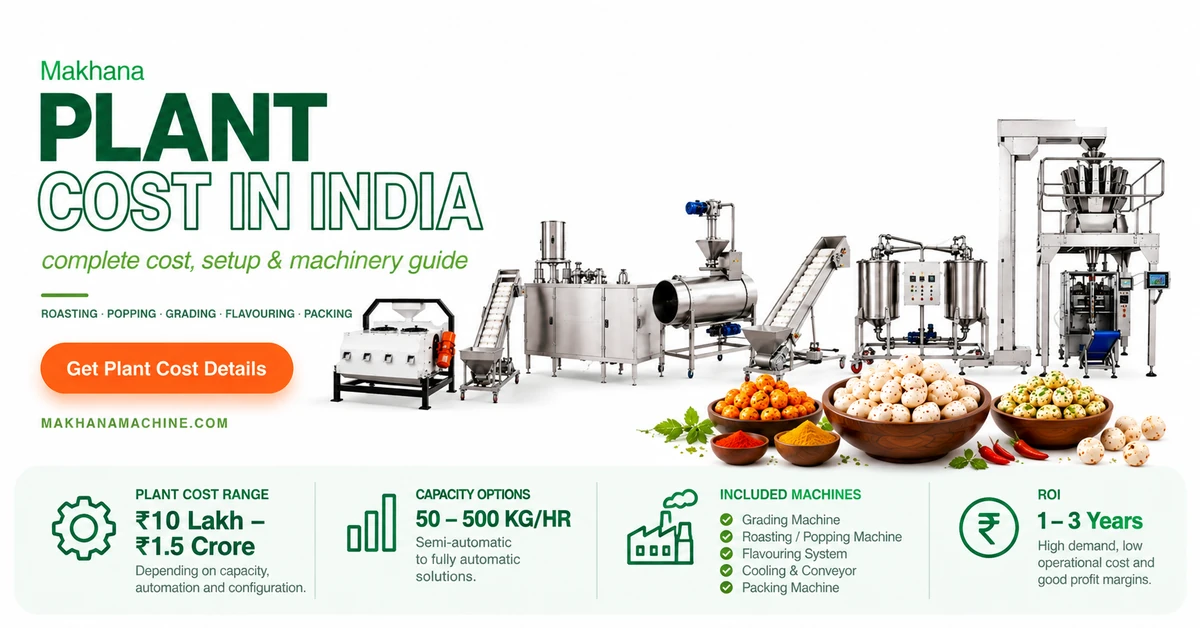
The makhana processing plant price for makhana depends on what you are preparing, how much capacity you have and what kind of automation you are looking for. A small line might be able to just process makhana, and a commercial line can roast, flavor, and pack. Request an itemised quote for a specific configuration from different suppliers.
The equipment listing isn’t necessarily a full plant quotation. The equipment pack will have a different capacity, automation, and coverage so note clearly what is actually covered with the rest left to enquire about including taxes, delivery, set, up, and more.
This guide covers, which equipment is included in a makhana processing line, how much you will need to invest in it, and what you need to know about installation and training before making a purchase.
What does a plant include?
A makhana plant can cover anything from one operation, such as roasting, to a connected line that prepares, seasons and packs the finished snack. The first step is deciding exactly where your process begins and ends: are you buying already-popped makhana to flavour and pack, or raw seeds that need processing?
A fuller line may include:
- Cleaning and grading: Removes debris and separates material by size or quality.
- Roasting or popping equipment: Applies controlled heat to process the product. Confirm the machine’s intended input; equipment for roasting popped makhana is not automatically a raw-seed popping system.
- Cooling equipment: Brings the roasted product to a suitable temperature before further handling.
- Flavouring or coating equipment: Applies oil and seasonings, if you plan to sell flavoured variants.
- Packing equipment: Weighs, fills and seals pouches. More automated systems may also include coding or labelling.
- Controls and ancillary equipment: Electrical panels, conveyors, hoppers and other components that connect the process.
A supplier’s product description may list these stages as part of an integrated process, but the actual quotation may include only some machines. For example, one listed semi-automatic plant requires manual transfer between roasting, flavouring and packaging, while the supplier describes its automatic plant as a 100 kg/hour line.
Indicative price ranges
There is no single official rate for a makhana processing plant. Online supplier listings show examples, but the numbers are not directly comparable unless capacity, process scope, materials, tax and delivery terms match.
|
Equipment or configuration |
Advertised example | What to check |
| Roaster | ₹2.75 lakh, listed at 100 kg/hour |
Confirm what the capacity measures and whether the price covers only roasting. |
|
Semi-automatic plant |
₹9.6 lakh, listed at 50 kg/hour |
Check which process stages are included and how much handling is manual. |
| Automatic plant | ₹13.5 lakh, listed at 100 kg/hour |
Confirm the line’s included equipment, utilities and commissioning scope. |
| Roasting and flavouring unit | ₹14.5 lakh, listed at 100 kg/hour |
The listing states the price excludes taxes; confirm packing and other exclusions. |
Treat these as supplier-specific asking prices, not a guaranteed budget for a complete operating facility. A plant quote may omit freight, installation, electrical work, building modifications, packaging equipment or working capital. Ask the supplier to state the exact machine list and exclusions in writing.
When comparing commercial makhana processing plant price quotes, compare like with like: daily or hourly capacity, operating hours, input material, automation, included process stages and warranty. A ₹10 lakh quote for a roasting-and-flavouring setup cannot be fairly compared with a ₹10 lakh quote for a line that also grades and packs.
What drives the price?
1. Capacity and production targets
Capacity is one of the biggest cost drivers. A machine designed for small batches generally has a different price and operating arrangement from a continuous line intended for higher throughput. But stated capacity alone can be misleading: a listing may specify kilograms per hour without explaining the product condition, shift length or whether the rate applies to one machine or the whole line.
Before requesting quotes, estimate how much finished product you need per day, how many shifts you will run and how much raw material you can reliably source. Ask vendors to specify expected output under your intended operating conditions, and whether the quoted capacity is for each machine or the integrated line.
2. Process scope
The price changes depending on whether you need only a roaster, a roasting-and-flavouring setup, or a complete line from cleaning and grading through to packing. Each additional stage can require a separate machine, conveyor or control component.
Decide whether the plant will handle raw makhana seeds, already-popped makhana, or both. Also specify whether you need flavoured products, retail pouches, bulk packs or several pack sizes. Vague requirements often produce quotes that appear cheaper but exclude operations you expected to be included.
3. Automation level
A semi-automatic line can cost less upfront, but it may require workers to transfer product between process stages and operate equipment manually. An automatic line can reduce manual handling and connect more operations, but it may raise the initial purchase price and require more attention to utilities, controls and maintenance.
One supplier, for instance, lists a semi-automatic 50 kg/hour plant at ₹9.6 lakh and an automatic 100 kg/hour plant at ₹13.5 lakh. These examples differ in both automation and stated capacity, so they do not isolate the price effect of automation alone.
4. Materials and construction
Equipment construction and food-contact materials can affect the specification and cost. Supplier listings include machines described as stainless steel or SS 304, but descriptions vary by model. Ask which parts that contact food use the specified material, which parts use other materials, and what documentation or warranty applies.
5. Packing requirements
Packaging can be a significant part of the budget if you want an in-house retail-ready product. A basic sealing arrangement is not the same as a system that automatically weighs, fills and seals pouches at a specified speed.
Tell the vendor your pack sizes, packaging material and target packs per minute. Confirm whether the quotation includes a weighing system, filler, sealing unit, date or batch coding, and any change parts required for different pouch sizes.
6. Power and utilities
Electricity requirements vary by machine and line. One listed 100 kg/hour roasting and flavouring unit specifies 40 kW and 440 V; those figures are particular to that listing, not a universal requirement for makhana plants.
Ask for the connected load, operating load, phase, voltage, fuel requirements if applicable, compressed-air needs and utility connection details. Confirm whether site electrical work, cabling, safety systems or utility upgrades are your responsibility.
7. Installation, commissioning and training
Installation and commissioning may be included, charged separately or excluded. The same applies to operator training, trial runs and post-installation support. Do not infer that a machine price includes these services simply because the supplier calls it a plant.
Ask the vendor to specify how many installation visits are included, what site preparation is required, who pays travel and accommodation, and whether training covers routine operation, cleaning, changeovers and basic troubleshooting. Get the answers written into the quotation or order document.
8. Freight, taxes and site work
The final amount can differ from the listed equipment price because of freight, packaging, taxes, unloading and site preparation. One supplier listing explicitly states that its advertised ₹14.5 lakh price excludes taxes.
Building work, flooring, drainage, ventilation and electrical installation may also be outside the machinery supplier’s scope. Request a landed-cost breakdown so you can distinguish the price of the equipment from the cost of making the facility ready to operate.
9. Service, spares and warranty
A lower purchase price may not represent the lower long-term cost if spare parts are difficult to source or service is slow. Ask how long the warranty lasts, which parts it covers, what routine maintenance is required, and how quickly the supplier can provide service in your location.
Also request a recommended spares list and prices for wear parts. A written service commitment is more useful than a general verbal assurance that support is available.
How to estimate your project budget
Separate the budget into machinery and other project costs. Machinery may be only one part of the investment, especially if you need to prepare a facility, install utilities, buy packaging material and maintain working capital.
Create a simple estimate with these headings:
- Core machinery: List every machine and its capacity.
- Integration and controls: Include conveyors, electrical panels, feeders and related components.
- Delivery and installation: Show freight, unloading, erection and commissioning separately.
- Site readiness: Budget for any electrical, flooring, ventilation or other work required before installation.
- Packing and quality equipment: Include these only if required for your product and sales channel.
- Initial operating funds: Account for raw material, packaging, labour, power and routine expenses.
For context, a project-report website estimates a 50 kg/day unit’s total investment at ₹10–15 lakh, while its example allocates ₹5.9 lakh to plant and machinery including installation. This is an illustrative project estimate, not a supplier quotation or a guaranteed cost for every location and configuration.
Do not apply a subsidy percentage directly to a vendor’s machinery quote without checking scheme eligibility and the approved project-cost basis. MoFPI’s PMFME information describes a credit-linked capital subsidy of 35% of eligible project cost, subject to a maximum of ₹10 lakh per individual unit; eligibility, application status and current scheme provisions should be confirmed with the relevant implementing authority or bank.
How to compare supplier quotes
Ask each supplier to quote against the same written brief. That makes differences visible and reduces the risk of comparing a complete line with a partial one.
Include these points in your request:
- Product input: raw seeds, popped makhana, or both.
- Target capacity, including whether it means kilograms per hour or per day.
- Process stages required: cleaning, grading, roasting or popping, cooling, flavouring and packing.
- Preferred automation level and expected manual handling.
- Packaging formats, pack sizes and target packing speed.
- Material specifications for food-contact components.
- Power, fuel, compressed-air and space requirements.
- Price split for machinery, freight, taxes, installation and commissioning.
- Training, warranty, service response and spare-parts details.
- Exclusions, payment schedule and delivery timeline.
Request a demonstration or a product trial using your own raw material, if possible. A trial can help you assess whether the machine’s handling, output and finished-product quality suit your process. Make sure the vendor documents the test conditions so you know what the results actually represent.
Common mistakes to avoid
- Choosing by price alone: A low quote may exclude packing, installation, freight or essential process stages.
- Confusing different capacities: Check whether capacity applies to a single machine, a batch or the complete line.
- Assuming advertised capacity equals actual output: Ask the supplier to define the material, operating conditions and output basis.
- Buying automation before confirming demand: More automation can increase upfront cost, so match it to realistic sales and throughput needs.
- Overlooking utilities and layout: A machine may not fit or operate as expected if power, space or handling arrangements are insufficient.
- Treating a subsidy as a guaranteed discount: Scheme support has eligibility and project-cost rules; confirm them before building the financing plan.
A sensible purchase decision weighs price against usable capacity, product quality, service access and the cost of running the line. A written scope and a site-specific quotation are better foundations than a single headline price.
FAQs
How much does a makhana processing plant cost in India?
A basic setup may cost a few lakh rupees; commercial lines commonly carry higher, configuration-specific quotations.
What factors change the price?
Capacity, process stages, automation, materials, packaging, utilities, installation, freight, taxes and after-sales support affect price.
Does the price include installation and training?
Not always; request written confirmation covering installation, commissioning, operator training, travel costs and site-preparation responsibilities.
Is a semi-automatic plant cheaper than an automatic plant?
Often, but compare capacity and included equipment too; unlike configurations make direct price comparisons unreliable.
What should I check in a supplier quotation?
Check machine scope, capacity basis, materials, utilities, freight, taxes, installation, warranty, training and exclusions.
Should I buy a complete line or individual machines?
Choose based on required process stages, production volume, available labour, integration needs and supplier support.
Can a subsidy reduce my investment?
Eligible PMFME applicants may receive 35% of eligible project cost, capped at ₹10 lakh per individual unit.