
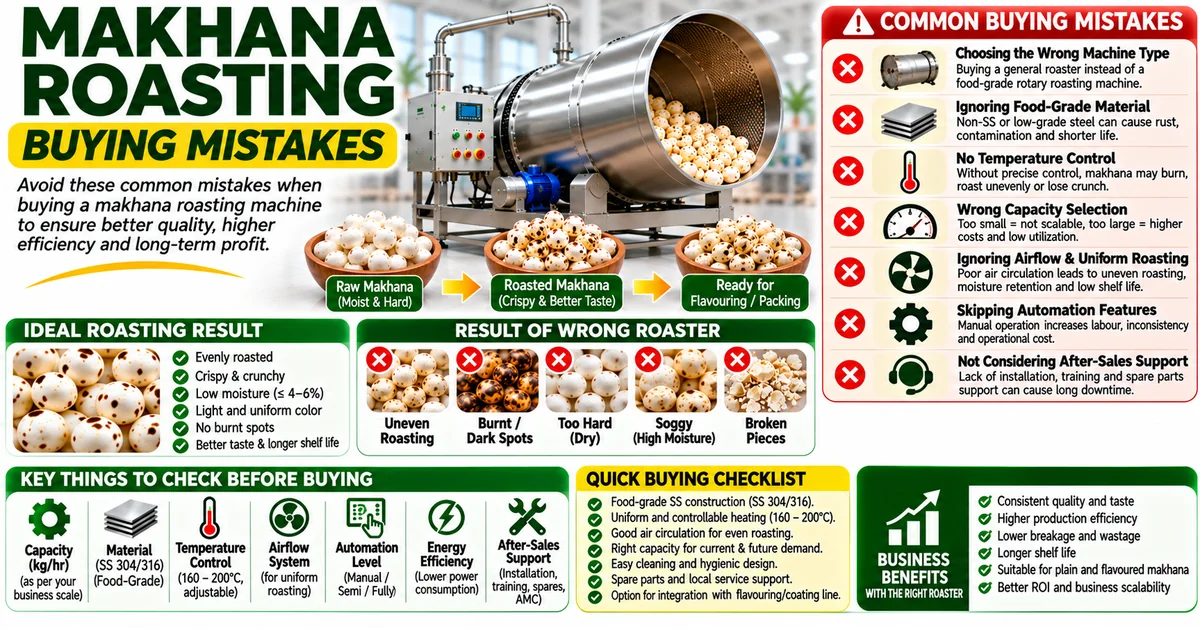
A makhana roasting machine can improve consistency, reduce manual labour, and help a small processor scale into commercial production. But many first-time buyers in India choose a machine based only on price or advertised capacity and later face uneven roasting, high power bills, poor service support, or a machine that does not match their raw material.
This guide explains the most common buying mistakes, how to choose between semi-automatic and fully automatic models, and what to verify before paying an advance.
What Is a Makhana Roasting Machine?
A makhana roasting machine is used to heat raw or conditioned makhana seeds evenly before popping or further processing. Typical designs use a rotating drum or tray system, a heating source, a motor and gearbox, temperature controls, and a discharge door for removing roasted makhana.
Heating may be electric, LPG/gas, or a combination, depending on the model and site infrastructure. Electric systems are generally easier to control, while gas systems may be economical where fuel is readily available and operating costs are lower.
A good commercial makhana roasting machine should offer:
- Uniform heat distribution
- Adjustable drum speed
- Reliable temperature control
- Food-grade contact surfaces
- Easy loading and unloading
- Simple cleaning and maintenance
- Suitable capacity for your daily production target
Mistake 1: Buying on Price Alone
The cheapest machine is rarely the lowest-cost machine over time. A low upfront price may mean thinner material, weak temperature control, poor insulation, non-food-grade contact parts, or limited after-sales support.
Instead of comparing only the quoted price, compare:
- Drum material and thickness
- Heater quality and type
- Motor and gearbox quality
- Temperature-control system
- Actual energy consumption
- Warranty coverage
- Spare-parts availability
- Installation and operator training
- Service response time
Food-grade stainless steel, especially SS304, is commonly recommended for makhana-contact parts because it supports hygiene and is easier to clean.
Mistake 2: Trusting Advertised Capacity
Many buyers see “100 kg/hour” on a listing and assume that is their guaranteed daily output. In practice, actual output is usually lower because of loading time, cleaning, warm-up, batch changeovers, seed quality, and operator skill.
Ask the supplier for real output under normal operating conditions, not just the maximum specification. A realistic planning figure may be around 70–80% of rated capacity, depending on the machine and process.
Before buying, calculate:
- Kilograms of makhana to roast per day
- Number of working hours and shifts
- Batch size and cycle time
- Required output per hour
- Drying, grading, popping, and packaging capacity
- Seasonal fluctuations in raw-material supply
A roaster should match your complete line. If your cleaning, drying, or packaging systems cannot keep up, a larger roaster will simply create a bottleneck elsewhere.
Mistake 3: Ignoring Temperature Control
Temperature control is one of the most important specifications in makhana roasting. Makhana seeds need consistent heat to roast evenly; poor control can cause burning, under-roasting, colour variation, and inconsistent popping later.
Look for:
- A digital temperature controller
- PID or equivalent precise control, where available
- Adjustable temperature range
- Clear display and simple controls
- Stable heat distribution across the drum
- Timer or automatic shut-off features
Some machines are listed with operating temperatures up to 300°C, while industrial roasters may offer control up to 350°C. However, higher maximum temperature is not automatically better-stable, repeatable control matters more than a high peak reading.
Mistake 4: Choosing the Wrong Automation Level
First-time buyers often either overspend on full automation or buy a machine too basic for their growth plans. The right choice depends on daily volume, labour availability, budget, and product plans.
| Factor | Semi-automatic roasting machine | Fully automatic roasting machine |
| Best for | Startups and small processors | Growing units and larger plants |
| Operation | Operator loads/unloads; machine controls heat and rotation | Automated feeding, roasting, and discharge in many models |
| Labour need | Higher | Lower |
| Initial cost | Lower | Higher |
| Skill required | Moderate operator attention | Training and process discipline |
| Flexibility | Often easier to adapt for small batches | Better for consistent larger volumes |
| Maintenance | Generally simpler | May require more technical support |
Semi-automatic machines are usually a sensible starting point for small businesses because the operator handles loading and unloading while the machine manages rotation and heat. Fully automatic systems suit growing units that need repeatable output and reduced labour dependence.
For a new processor, a 5–20 kg-per-batch semi-automatic unit that is easy to clean and operate is often sufficient.
Mistake 5: Overlooking Power and Fuel Requirements
Do not assume every roaster will run on your existing electrical connection. Machines vary widely in voltage, phase, heater load, and fuel type. Some smaller models run on single-phase power, while larger commercial machines may require three-phase supply.
Before ordering, confirm:
- Required voltage and phase
- Connected load in kW
- Heater load separately from motor load
- Gas consumption, if LPG-fired
- Local electricity tariff and gas cost
- Backup power or fuel arrangement
- Wiring, earthing, and safety requirements
Ask the supplier for actual hourly power or gas consumption not vague claims such as “energy efficient.” This allows you to calculate real operating cost per kilogram of roasted makhana.
Mistake 6: Ignoring Hygiene and Cleaning
Makhana is a food product, so cleaning access is not optional. A roaster that is difficult to open, brush, or wash will slow down production and increase contamination risk.
Check whether:
- Food-contact surfaces are SS304 or another approved food-grade material
- The drum can be opened or accessed easily
- Corners and joints are easy to clean
- The machine avoids unnecessary crevices where dust can collect
- The discharge door is practical for daily use
- The design supports routine hygiene checks
Ask for photographs or a video showing the drum interior, heater arrangement, control panel, and cleaning points—not only exterior marketing images.
Mistake 7: Not Testing With Real Makhana
A machine may look impressive in a catalogue but perform poorly with your seed grade, moisture level, and batch size. Always request a trial with real makhana before finalising the purchase.
During the trial, observe:
- Colour uniformity after roasting
- Burnt or under-roasted percentage
- Roasting time per batch
- Temperature stability
- Ease of loading and unloading
- Noise, vibration, and smoke
- Actual batch weight and output
- Cleaning time after the trial
If an in-person visit is not possible, request a live video demonstration using makhana similar to your intended raw material.
Mistake 8: Skipping Warranty and Service Terms
Downtime during peak season can be expensive. A machine without clear warranty coverage, spare-parts availability, and responsive technical support can quickly become a liability.
Before paying, get these details in writing:
- Warranty period and exclusions
- Whether warranty covers heater elements, motors, controllers, and labour
- Spare-parts price list
- Expected spare-part delivery time
- Technician visit charges and response time
- Installation, commissioning, and training terms
- Freight, GST, and civil-work responsibilities
A one-year warranty on manufacturing defects is a common baseline, but the real test is whether the supplier can provide parts and service quickly when needed.
Mistake 9: Not Matching the Machine to Your Product Plan
Your roasting machine should support your intended end product. If you plan only to roast and supply raw processed makhana, your requirements differ from a brand producing flavoured, packaged snack makhana.
Consider whether you will need:
- A separate popping machine
- Flavouring or seasoning system
- Cooling arrangement
- Grading and sorting equipment
- Packaging machine
- Dust extraction or ventilation
- Quality-control records
Some roasting systems can be paired with flavouring drums, while others require separate equipment. If flavoured makhana is part of your plan, confirm the coating method—dry tumbling, spray coating, or a combined system before purchase.
What to Check Before Paying an Advance
Use this checklist before transferring money:
- Confirm the exact model, capacity, dimensions, and weight.
- Get a written specification sheet with material grades.
- Confirm food-contact material, preferably SS304.
- Verify voltage, phase, heater load, and fuel consumption.
- Ask for actual output, not only maximum capacity.
- Request a live trial with real makhana.
- Clarify installation, training, freight, and GST costs.
- Review warranty, spare parts, and service response terms.
- Ask for references from existing buyers.
- Make the advance payment only against a formal quotation and invoice.
Conclusion
Choosing a makhana roasting machine is not just a purchase decision it is an investment in product quality, production efficiency, and long-term business growth. First-time buyers should avoid selecting a machine based only on price or advertised capacity, because hidden costs related to energy use, maintenance, spare parts, and downtime can quickly outweigh initial savings.
The right machine should offer uniform roasting, reliable temperature control, food-grade construction, easy cleaning, and a capacity that matches actual daily production needs. A live trial with real makhana, clear written specifications, and strong after-sales support are essential before paying an advance. By focusing on total cost of ownership rather than the lowest quotation, buyers can select a machine that delivers consistent quality, supports future expansion, and provides dependable returns.
FAQs
What is the most common mistake first-time buyers make?
Buying only on price while ignoring capacity, material quality, service, and energy costs.
Semi-automatic or fully automatic: which should I start with?
Start semi-automatic for small volumes; choose fully automatic for consistent larger-scale production.
What should I check before paying an advance?
Check written specifications, trial results, warranty, spare parts, installation, and total delivered cost.
Which material is best for a makhana roasting machine?
Food-grade SS304 stainless steel is preferred for hygienic, easy-to-clean makhana-contact surfaces.
How much capacity should a new makhana business buy?
Choose based on daily sales target; 5–20 kg per batch is often enough initially.
Is electric or gas roasting better for makhana?
Electric offers easier control; gas may cost less where fuel supply and pricing are favourable.
Should I see a machine trial before buying?
Yes. A live trial with your makhana grade reveals real roasting quality and output.