
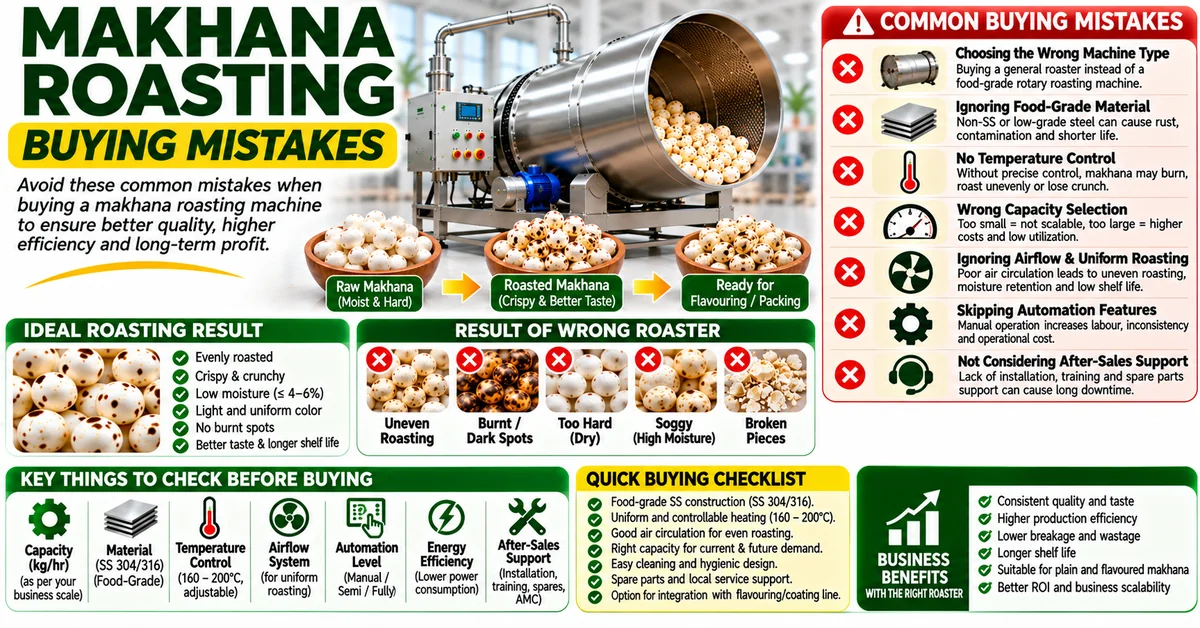
A makhana roasting machine is only as good as the inputs you feed it. To produce clean, crisp, saleable popped makhana, an Indian processor needs correctly graded raw makhana seeds, controlled moisture, a reliable heating source, and disciplined storage before and after roasting.
This guide explains the raw materials and heating inputs required for a commercial makhana roasting machine, where they can be sourced in India, how quality affects output, and what storage conditions protect your yield and shelf life.
What a Makhana Roasting Machine Actually Does
A makhana roasting machine heats raw foxnut seeds so their hard outer shell becomes brittle and the kernel inside can expand during popping. Traditional processors roast seeds in earthen pots or cast-iron pans at roughly 250–320°C, temper them, roast again, and then pop them manually with a mallet.
A modern roasting machine replaces much of that open-fire, labour-intensive work with controlled heat, insulated barrels or drums, and more consistent roasting. ICAR-CIPHET has commercialised a mechanised system covering threshing, cleaning, grading, drying, roasting, and popping; its roasting stage uses a closed barrel heated by electric thermic oil, though other heating sources can be used where available.
The important distinction is this: a roasting machine prepares and conditions makhana seeds for popping; it does not replace the need for good raw seed, correct moisture, and a popping stage. Commercial machine listings commonly describe the raw material as raw foxnut seeds and the process as heat roasting.
Raw Material 1: Raw Makhana Seeds
The primary input is raw makhana seed, also called foxnut seed or gorgon nut seed. These are the hard, dark seeds harvested from the makhana plant; after cleaning, grading, roasting, tempering, and popping, they become the white, airy popped makhana sold as a snack or food ingredient.
For a roasting machine, buy seeds that are:
- Clean, with minimal mud, husk, sand, stalks, and foreign matter.
- Uniform in size, because uneven seeds roast unevenly.
- Physically sound, without cracks, insect damage, mould, or discolouration.
- Correctly dried before roasting, since excess or insufficient moisture affects expansion.
- Graded by diameter, commonly in the 7–12 mm range for processing.
Cleaning and grading are not optional quality steps. Cleaner raw seeds reduce wastage during roasting and popping, while grading helps the machine deliver more uniform heat exposure.
Seed Size and Grade
Seed size affects popping behaviour, final makhana size, and commercial value. Research on roasted makhana seeds used 9–10 mm seeds and found that properly conditioned seeds could achieve popped makhana recovery above 47%, average popped diameter above 16 mm, and acceptable colour up to 120 days of storage.
For a commercial unit, avoid mixing very small, broken, and oversized seeds in one batch. Instead, maintain separate grades and adjust roasting time, temperature, and feed rate for each grade. This is especially important in batch roasters, where a mixed batch can produce burnt small seeds and under-roasted large seeds at the same time.
Raw Material 2: Controlled Moisture
Moisture is the most important hidden raw material in makhana processing. It is not an ingredient you buy separately, but it determines whether the seed pops properly.
The usual sequence is:
- Wash and clean harvested seeds.
- Dry raw seeds to roughly 30% moisture.
- Grade the seeds.
- Carry out primary roasting.
- Temper or condition the roasted seeds for 24–48 hours.
- Bring roasted seed moisture to about 15% dry basis before final popping.
Research indicates that the optimum moisture range for maximum popping of roasted makhana seeds is approximately 15–15.53% on a dry basis. In one study, roasted seeds were tempered for 48 hours to reach about 16% dry-basis moisture before storage and popping trials.
If moisture is too high, seeds may not pop cleanly and may develop poor texture. If it is too low, expansion can fall and breakage can rise. A processor should therefore treat moisture measurement as part of raw-material quality control, not as an afterthought.
Heating Inputs for the Roasting Machine
Your second major input category is heat. The right heating input depends on your machine design, production capacity, local fuel availability, operating cost, and food-safety requirements.
Electric Heating
Electric heating is common in modern commercial roasters because it offers controllable, repeatable heat and avoids open flames near the product. ICAR-CIPHET’s mechanised system uses electrically heated thermic oil in a closed roasting barrel.
Electric systems are generally suitable where:
- You have a stable industrial power supply.
- You want precise temperature control.
- You need cleaner operation with less smoke and ash.
- Your unit is located in an urban or semi-urban food-processing premises.
Machine specifications vary widely. Indian listings show capacities from around 10–100 kg/hour, with some automatic systems rated at 100 kg/hour, 415 V, 50 Hz, and around 12 kW power requirement. Larger commercial lines may require substantially more connected load; one buyer guide lists 30–35 kW for a 100 kg/hour cleaning-and-processing setup.
LPG or Gas Heating
LPG is another common heating input, particularly for semi-automatic machines and units that need fast, responsive heat. Some Indian makhana processing machines list LPG as the fuel source.
Gas heating can be practical when:
- Electricity tariffs or load availability are constraints.
- You already have safe LPG handling infrastructure.
- Your machine is designed with proper burners, controls, and safety interlocks.
However, gas systems require careful installation, ventilation, leak detection, flame-failure protection, and trained operators. Do not treat fuel compatibility as a minor specification; confirm it with the machine manufacturer before purchase.
Thermic Oil Heating
Thermic oil heating is used in some mechanised roasting systems because it can provide steady, controlled heat in a closed barrel. ICAR-CIPHET specifically describes electrically heated thermic oil as the heating method in its mechanised makhana popping system.
This approach can help reduce direct flame exposure and improve operator safety, especially when combined with insulation and automated seed movement.
Biomass, Diesel, or Other Fuels
Some roasting systems can be adapted to alternative fuels depending on availability. ICAR notes that any heating source can be used depending on availability, but the machine design, heat distribution, emissions, and food-contact safety must be suitable.
Before choosing biomass, diesel, furnace oil, or other fuels, ask the manufacturer:
- Is the burner certified for food-processing use?
- Does combustion gas contact the makhana?
- What are the emissions and ventilation requirements?
- What is the fuel consumption per kilogram of popped makhana?
- Can temperature be held stable during continuous production?
Other Operating Inputs
Beyond seeds and heat, a makhana roasting line needs supporting materials and utilities.
Cleaning Water
Raw makhana seeds often require washing to remove mud and impurities before processing. Use clean water and provide drainage, filtration, and hygiene controls appropriate for a food-processing facility.
Packaging Material
If you are storing roasted seeds before popping, packaging becomes a critical raw material. Research shows that roasted makhana seeds at about 15.53% dry-basis moisture can be stored in airtight polypropylene packets of 100-micron thickness for up to 150 days without significant loss in popped makhana recovery or popping quality.
For shorter storage periods, studies have found that 80-micron LDPE, BOPP, PP, and silver-laminate packets maintained popping efficiency, recovery, and expansion for up to 135 days, while thin 15-micron LDPE maintained quality for only about 60 days.
Labour and Quality-Control Tools
Even a semi-automatic roasting machine needs trained operators, batch records, moisture checks, cleaning schedules, and inspection of output. A roasting machine reduces manual heat exposure and improves consistency, but it does not remove the need for process discipline.
Where to Source Raw Materials in India
India’s makhana supply chain is concentrated around the eastern Indo-Gangetic belt, particularly Bihar, where makhana cultivation and processing have traditionally been concentrated. For commercial procurement, processors generally source through:
- Makhana growers and farmer producer organisations (FPOs) in Bihar and neighbouring production belts.
- Local mandis and agricultural markets where raw foxnut seeds are traded.
- Makhana traders and aggregators who can supply graded volumes.
- Makhana processing clusters, where cleaning, grading, roasting, and popping services may be available.
- Packaging and industrial suppliers for food-grade PP, LDPE, BOPP, or laminate pouches.
For a roasting-machine business, the most reliable sourcing model is usually a mix: establish a base supplier for consistent seed grade, maintain a secondary supplier for continuity, and specify moisture, cleanliness, and size-grading requirements in your purchase agreement.
Before finalising a supplier, ask for:
- Recent photographs or samples of the seed grade.
- Moisture content and grading details.
- Price per kilogram for each grade.
- Delivery frequency and seasonal availability.
- Replacement terms for contaminated or damaged lots.
- Documentation supporting food-safety and traceability requirements.
How Raw Material Quality Affects Output
Raw-material quality directly affects popping recovery, appearance, texture, breakage, labour cost, and customer complaints.
Popping Recovery
Popping recovery is the proportion of usable popped makhana obtained from roasted seeds. Poor seed quality, uneven grading, or incorrect moisture reduces recovery. Research shows that well-conditioned roasted seeds can achieve more than 47% popped makhana recovery and more than 16 mm average popped diameter under controlled storage and processing conditions.
Expansion and Crunch
Uniform seeds with the right moisture expand more consistently. If moisture is outside the optimum range, expansion may fall, the kernel may not open properly, or the final product may become tough or brittle. The identified optimum roasted-seed moisture range is 15–15.53% dry basis.
Colour and Appearance
Over-roasting darkens makhana and can create burnt notes. Under-roasting leaves seeds difficult to pop and reduces yield. Controlled roasting temperature and residence time help preserve the light colour expected in commercial popped makhana. Machine suppliers highlight adjustable temperature settings as a way to prevent burning and maintain consistent quality.
Breakage and Wastage
Mixed seed sizes, damaged seeds, and poor handling increase broken kernels and unpopped seed. This raises effective raw-material cost because you pay for input weight but recover less saleable output.
Food Safety
Mud, mould, insects, and foreign matter in raw seed create downstream food-safety risks. Clean, dry, pest-free storage and proper cleaning before roasting are essential. APEDA guidance calls for dry, ventilated, pest-free storage areas, protection from sunlight and rain, and provisions for fumigation where required.
Storage Conditions for Raw and Roasted Makhana
Storage requirements differ depending on whether you are holding raw seed, roasted seed awaiting popping, or finished popped makhana.
Raw Makhana Seeds
Store raw seeds in a clean, dry, ventilated area away from direct sunlight, rain, and pests. Use pallets rather than placing bags directly on the floor, and keep stock rotated so older lots are used first.
Avoid storing raw seed near wet walls, leaking roofs, open drains, or areas with high humidity. Moisture uptake before roasting makes process control harder and can reduce popping performance.
Roasted Seeds Before Popping
Roasted seed storage is more sensitive. Research supports storing roasted seeds at about 15–15.53% dry-basis moisture in airtight packaging. ICAR-CIPHET’s protocol found that roasted makhana seeds in this moisture range, packed in 100-micron airtight polypropylene packets, could be stored for 150 days and popped without significant change in recovery or popping quality.
Practical storage rules:
- Temper roasted seeds for 24–48 hours before popping or storage.
- Measure moisture before packing.
- Use airtight, food-grade packaging of adequate thickness.
- Keep packets away from heat, sunlight, and humidity.
- Follow FIFO stock rotation.
- Test popping recovery periodically during long storage.
Popped Makhana
Popped makhana is highly hygroscopic, meaning it absorbs moisture from the air quickly. Once it absorbs humidity, the crisp texture becomes chewy.
For finished popped makhana:
- Cool completely before packing.
- Use airtight, food-grade packaging.
- Store in a cool, clean, dry area away from sunlight and steam.
- Keep relative humidity low; processor guidance commonly suggests below about 60% RH and temperatures below about 25–30°C, adjusted to local conditions and product specification.
- Avoid sealing warm product, because trapped steam softens the makhana.
Well-controlled plain popped makhana can commonly be labelled for 9–18 months depending on moisture, packaging, and storage conditions, while packaged flavoured snacks are often given a 6-month shelf life.
Machine Selection: Match Inputs to Capacity
Before buying a makhana roasting machine, define your daily input requirement. A machine rated at 100 kg/hour does not necessarily mean 100 kg/hour of finished popped makhana; capacity may refer to seed input, roasting throughput, or popping output depending on the supplier.
Typical Indian machine listings show:
|
Machine type |
Typical capacity range | Heating input | Best suited for |
|
Manual or basic roaster |
Up to 15 kg/hour | Electric, gas, or other local fuel |
Small units, trials, local supply |
| Semi-automatic roaster/popper |
Around 50 kg/hour |
Electric or LPG |
Growing processors, regional brands |
|
Automatic roasting and popping line |
50–150 kg/hour |
Electric, thermic oil, or gas |
Commercial snack manufacturers |
|
High-capacity continuous line |
150–500 kg/hour | Electric or multi-fuel systems |
Large processors and contract manufacturers |
These capacity bands reflect publicly listed Indian machine configurations and market guides. Always ask the supplier to state whether capacity is based on raw seed input, roasted seed throughput, or finished popped makhana output.
Specifications to Confirm Before Buying
When requesting a quotation, ask for these details in writing:
- Raw material compatibility: raw makhana seed sizes and moisture range.
- Heating source: electric, LPG, thermic oil, biomass, or dual-fuel.
- Connected load and phase: single-phase or three-phase; voltage and frequency.
- Capacity definition: kg/hour of input seed or output popped makhana.
- Temperature range and control: thermostat, PID control, digital display, alarms.
- Material of construction: food-grade SS 304 for product-contact parts.
- Roasting chamber design: batch, continuous, insulated, closed barrel, or drum.
- Safety features: emergency stop, overload protection, insulation, gas leak detection if applicable.
- Utilities required: power, water, drainage, ventilation, and fuel connection.
- Cleaning access: removable trays, inspection doors, and easy-clean surfaces.
- Trial terms: whether the supplier will run your seed grade and share yield data.
Food-contact surfaces should be food-grade stainless steel. Industry guidance commonly specifies SS 304 for parts touching makhana, while non-contact structural parts may use other suitable grades.[
Operating Checklist for Consistent Output
Use this checklist for every production batch:
- Inspect raw seed for cleanliness, colour, damage, and foreign matter.
- Confirm seed grade and avoid mixing incompatible sizes.
- Check moisture before roasting and after tempering.
- Preheat the roasting machine to the recommended temperature.
- Run a small trial batch before full production.
- Record seed grade, batch weight, temperature, time, fuel or power use, and output.
- Cool popped makhana fully before packing.
- Check final texture, colour, breakage, and unpopped seed percentage.
- Pack only completely cooled product in airtight food-grade material.
- Store packaged stock in a dry, ventilated, pest-free area.
A simple batch record helps you identify whether quality problems come from seed supply, moisture, roasting temperature, machine settings, or storage.
Common Problems and Their Raw-Material Causes
|
Problem |
Likely cause | Corrective action |
|
Low popping recovery |
Wrong seed moisture, poor grading, weak heating | Check moisture, grade seed, validate temperature and residence time |
| Burnt or dark makhana |
Excessive temperature, long roasting time, uneven feed |
Reduce temperature or time; ensure uniform feed |
| Many unpopped seeds |
Under-roasting, oversized seeds, low moisture |
Increase heat exposure gradually; use matched seed grade |
| High breakage |
Over-drying, rough handling, excessive roasting |
Adjust moisture and discharge handling |
|
Chewy packed makhana |
Packing before cooling, humid storage, weak packaging |
Cool fully, use airtight packs, control store humidity |
|
Insect or mould risk |
Wet storage, damaged bags, poor housekeeping |
Use pallets, dry storage, pest control, FIFO rotation |
Compliance and Facility Requirements
For a commercial Indian makhana-processing unit, plan for food-safety compliance, hygienic layout, and documentation. A suitable facility should separate raw-material storage, processing, flavouring, and packing areas; maintain ventilation and dry conditions; and use food-grade contact surfaces.
Depending on your scale and product category, you may need FSSAI registration or licensing, periodic quality testing, and records for moisture, hygiene, pest control, and batch traceability. Machine construction and food-contact materials should also support your compliance requirements.
FAQs
1. What is the main raw material for a makhana roasting machine?
The main raw material is raw makhana seed, also called raw foxnut seed. It must be cleaned, graded, and dried before roasting. After roasting and conditioning, the seed is popped to produce white popped makhana.
2. Can a makhana roasting machine directly produce ready-to-eat popped makhana?
It depends on the machine configuration. A roasting machine primarily heats and conditions seeds; a complete processing line may also include cleaning, grading, drying, popping, cooling, grading, flavouring, and packaging. Mechanised systems developed for makhana include threshing, cleaning, grading, drying, roasting, and popping operations.
3. What heating input is best for a commercial makhana roasting machine?
Electric heating is widely used because it provides controlled, repeatable heat and cleaner operation. LPG is also used where gas infrastructure is available. ICAR-CIPHET’s mechanised system uses electrically heated thermic oil, while noting that other heating sources can be used depending on availability.
4. What moisture level should roasted makhana seeds have before popping?
The optimum range is approximately 15–15.53% moisture on a dry basis. Roasted seeds are commonly tempered for 24–48 hours to reach this range before popping or airtight storage.
5. Where can I source raw makhana seeds in India?
Raw makhana seeds are commonly sourced from makhana-growing belts, especially Bihar, through farmers, FPOs, mandis, traders, and processing clusters. For commercial production, use suppliers who can provide consistent grading, moisture control, cleanliness, and reliable volumes.
6. How should roasted makhana seeds be stored before popping?
Store them in airtight, food-grade packaging at about 15–15.53% dry-basis moisture. Research supports storage in 100-micron airtight polypropylene packets for up to 150 days without significant loss in popping recovery or quality.
7. How do I keep popped makhana crisp after roasting?
Cool it completely, then pack it immediately in airtight food-grade packaging. Store it in a cool, dry, ventilated place away from sunlight, steam, and humidity. Popped makhana absorbs moisture quickly and can turn chewy if exposed to humid air.