
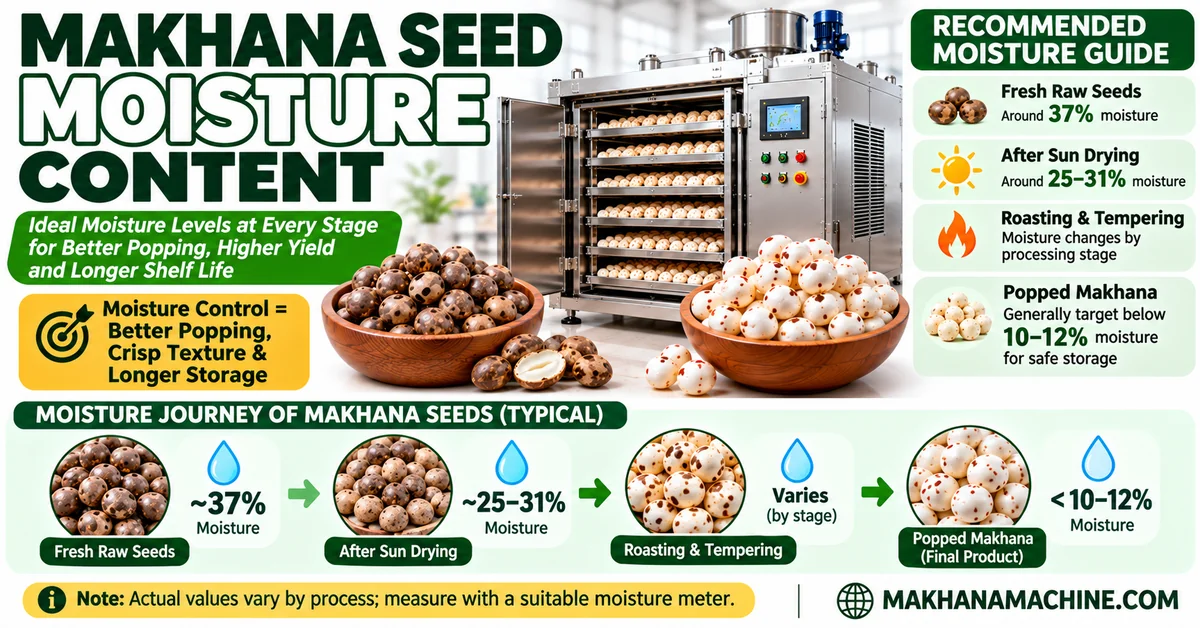
For most Indian makhana processing lines, seeds should be dried to roughly 25–30% moisture before primary roasting, then conditioned or tempered so they reach about 15% moisture (dry basis) before final popping. Getting this range right is one of the biggest differences between a high-expansion, uniformly popped batch and a batch full of hard centres, broken kernels, or poor yield.
This guide explains makhana seed moisture content in practical terms for processors, food-business founders, and anyone planning a makhana processing plant setup in India. It also includes a moisture-control checklist, common mistakes, and the points to verify with your machine supplier or technical consultant before production.
Why moisture is the heart of makhana popping
Makhana, also called fox nut or Euryale ferox seed, does not pop like popcorn simply because it is heated. The seed must hold the right balance of internal moisture, starch structure, and heat transfer. When heated correctly, moisture inside the seed turns to steam, internal pressure builds, and the hard outer layer ruptures to create the light, expanded makhana kernel.
If the seed is too wet, the outer layer may soften or scorch before sufficient pressure develops. If it is too dry, the seed may crack, brown excessively, or fail to expand fully. In both cases, the processor loses yield, uniformity, and product value.
Traditional makhana processing follows a sequence of cleaning, sun drying, size grading, pre-heating, roasting, popping, and polishing. Research and official processing guidelines describe sun drying fresh cleaned seeds for around 2–3 hours to bring moisture down to approximately 25%, followed by pre-heating and tempering for 48–72 hours before final roasting and popping.
That may sound like a narrow technical detail, but moisture control affects nearly every commercial outcome: popping percentage, kernel size, labour requirement, fuel consumption, breakage, shelf life, and packaging performance.
The practical moisture range for Indian processors
Makhana moisture requirements vary slightly by seed size, variety, harvest condition, equipment type, and whether the processor uses traditional roasting or mechanised popping. However, a practical working range for Indian processors is:
|
Processing stage |
Practical moisture target | Why it matters |
|
Fresh cleaned seed |
Often above 30% |
Seed is usually too wet for direct roasting and needs controlled drying. |
|
After sun drying / before primary roasting |
Around 30% ± 1% | A common starting point for primary roasting in mechanised systems. |
| After primary roasting | Around 25% |
Guidelines describe moisture reducing to approximately 25% after pre-heating or primary roasting. |
| After tempering / conditioning | Around 15% dry basis |
Conditioning for 24–48 hours is reported to bring seed moisture to about 15% dry basis before popping. |
| Final popped makhana | Roughly 8–12% |
Popped makhana is reported with moisture values around 10.4–12.8%, depending on the study and drying condition. |
A useful way to remember it is dry the raw seed to around 30%, roast or pre-heat toward 25%, temper, then pop after conditioning. The exact set point should be validated on your own seed lot and machine, because seed size, ambient humidity, and roasting temperature all influence the result.
What happens when moisture is too high
High seed moisture is one of the most common reasons new makhana processors get inconsistent results. It is especially common during humid weather, early-season processing, or when seeds are not dried uniformly after washing.
Poor expansion
When moisture is too high, the seed may not develop the right internal pressure profile during roasting. Instead of expanding into a large, light kernel, it may remain dense or split unevenly.
More breakage and blackening
Excess surface moisture can cause uneven heat transfer. The outer layer may overheat while the inside remains under-processed. This can lead to dark spots, scorched patches, cracked shells, and more broken makhana.
Longer roasting time and higher fuel cost
Wet seeds take longer to reach popping condition. That means more fuel, more machine time, and lower throughput. For a commercial makhana plant, this directly increases cost per kilogram of finished product.
Storage and microbial risk
Seeds held at high moisture for too long can deteriorate, develop off-odours, or face microbial and mould-related risks. This is why drying and tempering should be controlled rather than left entirely to weather conditions.
What happens when moisture is too low
Many processors focus on removing moisture, but over-drying creates its own problems.
Reduced popping pressure
If the seed loses too much internal moisture, there may not be enough steam pressure to expand the kernel properly. The result can be small, hard, or incompletely popped makhana.
More cracks and fines
Over-dried seeds can become brittle. During handling, grading, roasting, or popping, they may crack and create fines. Fines reduce saleable yield and can create cleaning and packaging issues.
Uneven colour
Very dry seeds may brown faster on the outside before the internal structure has properly expanded. This can produce an uneven colour and a roasted, sometimes bitter taste.
Lower perceived quality
Buyers often judge makhana by expansion, whiteness, uniformity, and crunch. Even if the seed is safe, poor moisture management can make the final product look less premium.
The role of drying, pre-heating, and tempering
Moisture control is not one single step. It is a sequence.
1. Cleaning and grading
Remove mud, damaged seeds, leaves, and foreign material. Grade seeds by size before drying or roasting, because smaller and larger seeds heat and lose moisture at different rates. Research-based processing descriptions commonly include grading in the 7–12 size range before primary roasting.
2. Controlled sun drying or mechanical drying
Fresh cleaned seeds are often sun dried for 2–3 hours to reduce moisture to around 25%, while some mechanised process references use around 30% ± 1% as the starting point for primary roasting. The difference reflects process variation, seed condition, and the specific roasting method.
For a commercial setup, mechanical drying gives more consistency than relying only on open sun drying. It reduces dependence on weather and helps maintain repeatable moisture levels across batches.
3. Pre-heating or primary roasting
Pre-heating prepares the seed for final popping by reducing moisture and initiating structural changes. NIFTEM processing material notes that moisture may reduce to approximately 20% after nut pre-heating, while other mechanised-process references describe primary roasting taking seed moisture from about 30% to 25%. These figures should be treated as process references, not universal rules.
4. Tempering or conditioning
Tempering allows moisture to redistribute inside the seed. Instead of having a dry surface and wet core, the seed becomes more uniform. Traditional guidelines describe storing pre-heated seeds under ambient conditions for 48–72 hours for moisture equilibration.
Research descriptions also mention conditioning for 24–48 hours to about 15% moisture on a dry basis before popping. The exact duration depends on ambient temperature, humidity, seed size, and the desired popping behaviour.
5. Final roasting and popping
At final roasting, the seed is exposed to high heat. Traditional guidance describes roasting at around 300°C before cracking to obtain popped makhana. At this stage, even small moisture differences become visible in expansion and breakage.
How to measure makhana seed moisture
Visual judgement alone is risky. Experienced operators can assess seed condition by sound, feel, and roasting behaviour, but a growing processing business needs repeatable measurement.
Moisture meter
A calibrated seed or grain moisture meter is the fastest option for routine floor-level checks. Use it to track moisture at receiving, after drying, after pre-heating, and before final popping.
Oven-drying method
For calibration and periodic verification, a laboratory oven method is more reliable. One published makhana study used a representative 10 g sample dried at 105 ± 2°C for 24 hours, then calculated moisture content after cooling in a desiccator.
Record moisture at fixed checkpoints
A simple batch record should include:
- Seed lot number and source
- Seed size grade
- Initial moisture
- Moisture after drying
- Moisture after pre-heating or primary roasting
- Tempering duration
- Moisture before final popping
- Popping yield and breakage percentage
- Operator, machine settings, and weather conditions
Over time, this data helps you identify the moisture range that gives the best expansion and lowest wastage for your specific raw material and equipment.
Makhana seed moisture content checklist
Use this checklist before every popping batch.
- Clean and grade seeds before moisture adjustment.
- Check initial moisture as soon as the seed lot arrives.
- Dry seeds gradually; avoid aggressive heating that cracks the outer layer.
- Target approximately 25–30% moisture before primary roasting, based on your validated process.
- Pre-heat or primary-roast seeds uniformly.
- Temper seeds for the validated duration, commonly 24–72 hours depending on the process.
- Recheck moisture after tempering, especially during monsoon or high-humidity conditions.
- Avoid mixing seed lots with very different moisture levels.
- Pop a small trial sample before committing the full batch.
- Record popping percentage, breakage, colour, and kernel size.
- Adjust drying time, roasting temperature, or tempering time based on results.
- Store dried seeds in a clean, dry, ventilated area away from direct moisture exposure.
Common mistakes to avoid
Treating all seed sizes the same
Larger seeds generally need more time to lose internal moisture and reach uniform temperature. If you process mixed sizes together, expect uneven popping.
Skipping tempering
Tempering may look like idle time, but it is essential for moisture equilibration. Skipping or shortening it can create seeds with a dry exterior and wet core, causing poor expansion or breakage.
Relying only on appearance
A seed can look dry on the outside while retaining excess internal moisture. Use a meter and periodic oven checks rather than relying only on touch or visual assessment.
Drying too aggressively
High heat or extended exposure can overdry the surface, create cracks, and reduce final expansion. Controlled drying is better than fast drying.
Ignoring seasonal humidity
A moisture setting that works in dry winter conditions may fail during humid monsoon processing. Adjust drying and tempering practices seasonally.
Not recording batch data
Without batch records, you cannot tell whether a low yield came from seed quality, moisture error, machine setting, or operator variation. Documentation turns trial and error into process control.
How moisture affects yield, cost, and quality
For a makhana business, moisture is not only a quality parameter; it is a profitability parameter.
Popping yield
Well-conditioned seeds generally pop more uniformly and produce more saleable expanded kernels. Poor moisture control increases un-popped seeds, broken kernels, and fines.
Energy consumption
Wetter seeds require longer drying and roasting. That increases fuel or electricity consumption and slows machine throughput.
Labour efficiency
Uniformly popped makhana is easier to grade, polish, and pack. Poorly popped batches require more manual sorting and rework.
Shelf life
Finished makhana with excess moisture can lose crispness faster and may face quality issues during storage. Popped makhana moisture values reported in processing literature are commonly around 10.4–12.8%, though the ideal final specification depends on your product format, packaging, and distribution conditions.
Brand perception
Premium makhana is judged by size, colour, crunch, and consistency. Consistent moisture control helps deliver the same eating experience batch after batch.
Setting up a moisture-controlled makhana plant
If you are planning a makhana processing plant setup, build moisture control into the layout from day one.
Recommended process flow
A practical commercial flow is:
- Raw seed receiving and lot identification
- Cleaning and destoning
- Size grading
- Controlled drying
- Pre-heating or primary roasting
- Tempering or conditioning
- Moisture verification
- Final roasting and popping
- Cooling
- Polishing and grading
- Packaging
Each stage should have a defined operating parameter, responsible person, and record format.
Equipment that supports moisture control
Depending on scale and budget, relevant equipment may include:
- Seed cleaner and grader
- Mechanical dryer or drying trolley system
- Roasting or pre-heating machine
- Tempering storage bins or conditioned storage area
- Moisture meter
- Popping machine or roasting-popping line
- Cooling conveyor
- Polishing and grading system
- Packaging machine with appropriate sealing control
A reliable makhana machine manufacturer or makhana processing machine supplier in India should be able to explain how their equipment handles seed size variation, heat distribution, moisture reduction, and batch consistency. Ask for trial results, not only machine specifications.
Who should help with moisture control?
If you are processing makhana for the first time, work with someone who understands both the seed and the machine. That may include an experienced makhana processor, a food-technology consultant, a machine manufacturer with pilot-trial support, or a processing plant consultant.
The right partner should help you:
- Validate moisture targets for your seed source
- Design drying and tempering steps
- Select suitable roasting and popping equipment
- Train operators on measurement and batch records
- Troubleshoot low expansion, breakage, and colour issues
- Build a repeatable production process
Moisture control is learnable, but it should be treated as a core production discipline not an afterthought.
Conclusion
Makhana seed moisture content is one of the most decisive factors in achieving high-quality popped makhana. It directly influences expansion, kernel size colour breakage, popping yield, fuel consumption, labour efficiency, and final shelf life. Seeds that are too wet may fail to develop adequate internal pressure, leading to dense kernels, uneven roasting, scorching, and higher processing costs. But, over-dried seeds can crack easily, produce fines, brown excessively, and expand poorly during final popping.
In Indian conditions, a reasonable practice would be to clean dry the seed to about 25-30 % moisture and pre-heat to about 25 % before primary roasting and then give the seed final temper/condition to about 15% dry basis before popping. These figures need to be validated for each seed lot, size grade, ambient humidity and equipment used. Seed grading conditioning dry moisture, well controlled uniform pre-heat and temper and measurement of moisture should be regarded as cyclical rather than individual steps.
FAQs
- What moisture level should makhana seeds have before popping?
Makhana seeds should have around 25–30% moisture before primary roasting. After pre-heating and conditioning, the moisture should be reduced to about 15% on a dry basis for proper expansion and uniform popping. - Can I pop makhana seeds directly after washing?
No. Freshly washed seeds contain excess moisture and should not be popped directly. They must first be cleaned, graded, and dried under controlled conditions to reach the suitable moisture level. - Why is tempering important for makhana seeds?
Tempering allows moisture to redistribute evenly from the surface to the core of the seed. This improves internal pressure during roasting, resulting in better expansion, fewer un-popped seeds, and lower breakage. - How long should makhana seeds be tempered?
Makhana seeds are commonly tempered for 24–72 hours. The exact duration depends on seed size, initial moisture, ambient temperature, humidity, and the specific roasting or popping process used. - What happens if makhana seeds are overdried?
Overdried seeds lose the internal moisture needed to generate steam pressure. As a result, they may crack easily, expand poorly, darken quickly during roasting, and produce more broken kernels and fines. - How do I measure makhana seed moisture accurately?
Use a calibrated seed or grain moisture meter for regular floor-level checks. For accuracy, periodically verify the readings using the laboratory oven-drying method at around 105°C. - Does seed size affect moisture requirements?
Yes. Larger seeds take longer to lose internal moisture and heat uniformly. They generally require longer drying and tempering times, while smaller seeds may dry and pop faster if processed together.