
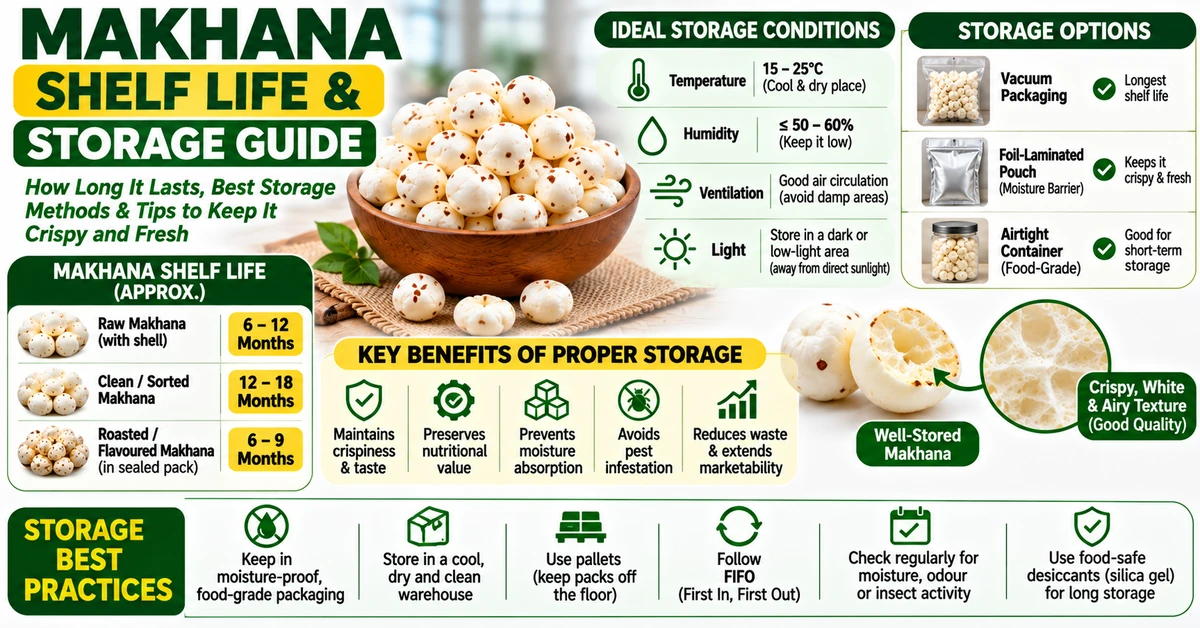
Makhana shelf life storage depends on correctly dried, packed, and stored popped makhana should usually be good for 6-12 months, and in airtight packaging can last over a year at room temperature. In packaged snack items (e.g. roasted or flavoured), most Indian brands give a 6-month shelf life for packaged snacks, while well-controlled plain popped makhana is commonly labeled 9 to 18 months given moisture, packaging, and storage conditions.
This guide is for Indian makhana processors, co-packers, snack brands, and food-business founders. It covers what impacts your makhana shelf life, how to store raw seeds and popped makhana, how you can avoid the mistakes that compromise quality, and how to create a storage checklist for your plant.
Why Shelf Life Matters in Makhana Processing
Makhana is a low-fat, lightweight, porous popped product. That makes it attractive for healthy snacking, but it also makes it highly sensitive to moisture. Popped makhana absorbs humidity quickly, loses crispness, and can develop stale flavours if exposed to air, heat, or poor packaging.
For a processor, shelf life is not only about the “best before” date printed on a pouch. It affects:
- Product crunch and consumer experience
- Return, replacement, and complaint rates
- Bulk-storage losses before packing
- Retailer acceptance and distributor confidence
- Export readiness and transit stability
- Working capital tied up in finished-goods inventory
- The cost of rework, re-roasting, or rejection
ICAR/NIFTEM guidance notes that makhana, when properly stored, may last more than a year under room-temperature and airtight conditions, provided packages are kept away from sun, rain, and moisture in covered premises. In practice, your actual shelf life will depend on how consistently you control drying, cooling, packing, warehouse humidity, and distribution conditions.
Typical Shelf Life of Popped Makhana
There is no single universal shelf-life number for every makhana product. The right claim depends on the product format, moisture content, packaging barrier, storage temperature, and whether the makhana is plain, roasted, flavoured, or coated.
|
Product / storage situation |
Practical shelf-life range | Key deciding factors |
|
Plain popped makhana, well dried, sealed pack |
9–18 months |
Low moisture, airtight pack, cool dry storage |
| Plain popped makhana, properly stored bulk pack | 6–12 months or more |
Packaging integrity, humidity control, handling hygiene |
|
Roasted or flavoured makhana snack |
Often 6 months | Seasoning, oil/coating, aroma retention, packaging barrier |
| Opened retail pack | Best consumed within 2–4 weeks |
Repeated humidity exposure after opening |
|
Nitrogen-flushed or vacuum-packed makhana |
Often 8–12 months or longer | Oxygen removal, barrier film, seal quality |
| Raw makhana seeds before popping | Product- and process-specific |
Drying, insect control, ventilation, contamination prevention |
Some suppliers and market references report shelf lives from 6 months to 24 months, and export-oriented suppliers may claim longer periods when using advanced barrier packaging and controlled logistics. However, a processor should never copy another brand’s shelf-life claim. Your own batch data, packaging trial, and storage study should support the date you print.
What Determines Makhana Shelf Life?
1. Moisture content
Moisture is the biggest driver of makhana quality loss. Popped makhana naturally contains around 10.4% moisture according to the ICAR/NIFTEM processing reference, but commercial suppliers commonly target lower moisture levels—often below 5–6%—to maintain crispness and improve storage stability.
Lower moisture generally supports:
- Better crunch
- Reduced risk of softening
- Lower microbial risk
- Better flow in packing machines
- Longer acceptable shelf life
But over-drying can create its own problems: excessive breakage, burnt notes, colour darkening, and loss of expansion quality. The target should be a controlled, repeatable moisture range validated for your popping, cooling, and packing process.
2. Cooling before packing
A common processing error is packing makhana while it is still warm. Warm makhana can release moisture vapour inside the pack. As the product cools, that moisture can condense on the inner film or soften the makhana.
Before packing:
- Allow popped makhana to cool completely to ambient temperature.
- Avoid stacking hot product in closed containers.
- Do not seal bulk bags immediately after roasting or popping.
- Use clean, dry handling equipment and avoid long exposure to open factory air.
Cooling is a low-cost step, but it can have a major impact on shelf life.
3. Packaging material and seal integrity
Makhana needs protection from three enemies: moisture, oxygen, and physical damage. A simple poly pouch may be adequate for short-distance, quick-turnover sales, but it may not protect product through monsoon storage, long transport, or retail shelf display.
Common packaging options include:
- Food-grade poly pouches
- Metallized laminates
- Multi-layer barrier films
- Vacuum packaging
- Nitrogen-flushed pouches
- Rigid containers for premium retail formats
- PP bags with inner liners for bulk supply
For longer shelf life, nitrogen flushing or vacuum sealing can reduce oxygen exposure and help preserve texture and flavour. The packaging must also seal properly: a good film with a weak seal will still allow moisture ingress.
4. Storage temperature and humidity
Makhana should be stored in a cool, clean, dry area away from direct sunlight, rain, and humid conditions. Industry guidance commonly recommends storage below about 25–30°C and relative humidity below about 60%, although the exact target should be based on your product specification and local climate.
In Indian conditions, seasonal humidity is a major risk. During monsoon months, even a well-sealed pack can face challenges if warehouse air is humid, cartons are stored on damp floors, or finished goods are kept near open doors.
5. Product format and added ingredients
Plain popped makhana is relatively stable because it is low in fat. But flavoured makhana introduces additional variables:
- Oil or ghee coatings can oxidise and create off-notes.
- Spice mixes may absorb moisture.
- Cheese, tomato, chocolate, jaggery, or other coatings may change water activity.
- Herbs and seasonings can lose aroma faster than the base makhana.
- Added nuts, seeds, or dried fruits may have different shelf-life behaviour.
This is why many roasted and flavoured makhana products use a shorter shelf-life claim, often around six months. If you are launching a flavoured range, conduct a separate shelf-life evaluation for each recipe and packaging format.
Raw Makhana Seed Storage
Shelf-life management begins before popping. Raw makhana seeds must be cleaned, dried, graded, and stored carefully to avoid mould, insect infestation, and quality deterioration. The ICAR/NIFTEM makhana processing flow includes cleaning and washing, sun drying, storage of seeds, grading, roasting, separation, grading of makhana pop, and packing.
For raw seed storage, processors should focus on:
- Drying seeds adequately before storage
- Using clean, dry, ventilated storage areas
- Keeping seeds off the floor on pallets or raised platforms
- Protecting stock from rain, leakage, pests, and direct sunlight
- Rotating stock using first-in, first-out (FIFO) discipline
- Inspecting bags regularly for moisture, insects, or odour
- Avoiding mixing old and new stock
Poor drying and storage at the raw-material stage can create losses before processing even begins. Market research references note that spoilage between harvest and puffing can account for significant raw makhana losses in some producing regions due to inadequate drying and storage facilities.
Recommended Storage Conditions for Popped Makhana
For most Indian processors, a practical storage specification should include the following:
|
Parameter |
Practical target |
|
Storage area |
Clean, covered, dry, pest-controlled |
|
Temperature |
Cool ambient storage; ideally below 25–30°C where feasible |
| Relative humidity |
Preferably below 60%; lower is better for long storage |
| Light exposure |
Avoid direct sunlight |
| Floor contact |
Store cartons and bags on pallets |
|
Packaging |
Sealed, food-grade, moisture-protective packaging |
| Stock rotation |
FIFO or FEFO |
|
Inspection |
Regular checks for softness, seal failure, pests, odour, or damage |
| Opened bulk packs |
Reseal or repack quickly; avoid leaving product exposed |
The simplest rule is: keep makhana dry, sealed, cool, and away from sunlight. That principle appears consistently across supplier, industry, and processing references.
Common Storage Mistakes Processors Should Avoid
Packing warm makhana
Warm product sealed immediately after popping can trap moisture and soften the batch. Always cool makhana fully before weighing, filling, or sealing.
Using weak packaging for long distribution
A thin, non-barrier pouch may work for immediate local sale but can fail during monsoon transport, warehouse holding, or e-commerce fulfilment. Match packaging to your actual distribution channel and intended shelf life.
Ignoring monsoon conditions
Humidity is often higher during monsoon, and makhana is hygroscopic—it absorbs moisture from the surrounding air. Increase inspection frequency, avoid overstocking, improve palletisation, and consider better barrier packaging during high-humidity periods.
Storing cartons directly on the floor
Floor contact can expose stock to dampness, cleaning water, pests, and temperature fluctuations. Use pallets, racks, or raised platforms.
Mixing batches
Mixing older and newer makhana makes quality issues difficult to trace. Maintain batch codes, production dates, packing dates, and clear FIFO rotation.
Not checking seal quality
A packaging line can produce visually acceptable pouches with weak seals. Check seals periodically for wrinkles, leaks, contamination in the seal area, and inconsistent sealing pressure or temperature.
Assuming one shelf life fits all products
Plain makhana, roasted makhana, flavoured makhana, and makhana mixes do not necessarily have the same shelf life. Treat each product format as a separate shelf-life case.
Practical Shelf-Life Storage Checklist
Use this checklist as an internal operating reference. Adapt it to your plant layout, product range, packaging machinery, and distribution model.
Before packing
- Confirm popped makhana is fully cooled.
- Check product for off-odour, discolouration, burnt particles, un-popped material, or foreign matter.
- Verify moisture is within your internal specification.
- Inspect packaging film, liners, pouches, and containers for damage.
- Confirm batch code, manufacturing date, and best-before details are ready.
- Ensure packing-area surfaces, scoops, trays, and weighing equipment are clean and dry.
During packing
- Avoid leaving makhana exposed to open humid air for long periods.
- Check pouch seals at defined intervals.
- Record machine settings, batch number, operator name, and packing time.
- Use food-grade desiccants only where appropriate and permitted for your product and packaging format.
- For nitrogen flushing or vacuum packing, verify seal integrity and pack firmness.
- Do not overload cartons in a way that crushes fragile popped makhana.
In the warehouse
- Store finished goods on pallets, not directly on the floor.
- Maintain distance from walls to allow air circulation.
- Keep the storage area covered, clean, and protected from rain and sunlight.
- Monitor temperature and humidity, especially during monsoon.
- Keep heavy or strong-smelling materials away from makhana.
- Follow FIFO/FEFO stock rotation.
- Inspect older stock for softness, leakage, pests, or packaging damage.
Before dispatch
- Check carton condition, sealing, labelling, and batch traceability.
- Avoid dispatching damaged or soft packs.
- Use dry vehicles and avoid exposing stock to rain during loading.
- Keep transport time and exposure to heat and humidity as low as practical.
- Retain retention samples from each batch for internal quality review.
How to Validate Your Shelf-Life Claim
A shelf-life claim should be based on evidence, not assumption. A practical approach for a small or mid-sized makhana processor is to run internal storage trials under realistic conditions.
A basic validation process can include:
- Define the product specification: plain, roasted, flavoured, coated, or mixed.
- Select representative packaging: the exact film, pouch size, seal settings, and closure method intended for sale.
- Prepare test batches: use normal production conditions, not an ideal laboratory-only batch.
- Store samples realistically: ambient warehouse conditions, including seasonal humidity where possible.
- Test at defined intervals: for example, at packing, 1 month, 3 months, 6 months, 9 months, and 12 months.
- Assess quality parameters: moisture, texture/crunch, sensory attributes, appearance, odour, seal integrity, and packaging performance.
- Document results: photographs, test records, batch details, storage conditions, and observations.
- Set a conservative claim: choose a shelf life your product can reliably meet across seasons and distribution conditions.
- Review periodically: update the claim if you change recipe, packaging, supplier, process, or storage conditions.
For regulatory and commercial purposes, consult a qualified food technologist, NABL-accredited laboratory, and compliance professional. FSSAI methods and requirements should be checked before finalising any product claim.
Storage Cost Considerations
Storage cost is often underestimated by first-time makhana entrepreneurs. It includes more than warehouse rent.
Major cost elements include:
- Pallets, racks, and storage bins
- Dehumidifiers or humidity-control equipment, where required
- Temperature monitoring devices
- Packaging film, liners, desiccants, and nitrogen-flushing systems
- Higher-specification barrier packaging
- Labour for inspection, rotation, and repacking
- Losses from soft, broken, infested, or rejected stock
- Working capital blocked in slow-moving inventory
- Rework costs, such as re-roasting product that has lost crunch
Better packaging may increase cost per pack, but it can reduce spoilage, complaints, and retailer rejections. For a growing brand, the right question is not only “What is the cheapest pouch?” but “Which packaging protects my product through my actual supply chain?”
When to Consider Nitrogen Flushing or Vacuum Packing
Nitrogen flushing or vacuum packaging becomes especially relevant when:
- You sell through e-commerce or modern trade.
- Your product must survive long transit or monsoon conditions.
- You want a longer shelf-life claim.
- You supply bulk makhana to distributors or exporters.
- You use oil, seasoning, or coated variants.
- Consumer complaints show loss of crunch before the printed date.
Nitrogen-flushed and vacuum-sealed formats are widely used to limit oxygen exposure and support longer shelf stability. However, they do not replace good drying, hygienic handling, proper cooling, and humidity-controlled storage. Packaging improves shelf life only when the upstream process is already consistent.
How Long Can Popped Makhana Be Stored? A Practical Answer
For planning purposes:
- Plain popped makhana, properly dried and sealed: commonly 9–18 months.
- Bulk popped makhana in good storage: often 6–12 months, sometimes longer with airtight conditions.
- Roasted or flavoured makhana snacks: frequently around 6 months, depending on recipe and packaging.
- After opening a retail pack: best consumed within a few weeks, ideally 2–4 weeks, because humidity exposure begins immediately.
If your makhana becomes soft but shows no off-odour, discolouration, or spoilage, light dry-roasting can sometimes restore crunch for immediate consumption. This is not a substitute for proper storage or a way to extend a printed shelf-life date.
Conclusion
For makhana processors, shelf life is not simply a number printed on a pouchit results from controlled drying, thorough cooling, hygienic handling, moisture control, and suitable packaging. Plain popped makhana that is properly dried and sealed typically stays acceptable for 918 months, while bulk stock often remains suitable for 6-12 months if kept in airtight, dry storage. Roasted and flavoured varieties usually require a more conservative estimate, often around six months, since oils, seasonings, coatings, and added ingredients can speed up aroma loss, oxidation, and texture changes.
FAQs
How long can popped makhana be stored?
Popped makhana stored in a sealed bag after drying should normally be fine for 6 to 12 months and for more than a year with air-tight storage. This date can be confirmed with the moisture, packaging, and storage-trial data of your product.
What is the ideal storage condition for makhana?
How to Store makhana Store makhana in a cool clean dry covered place for avoid exposure to sun light, rain, and moisture. Store in an air-tight, food-grade pack. Keep carton/bag off the ground.
Why does makhana lose crunch?
Makhana is porous and hygroscopic, it absorbs moisture from the environment moisture also affects the texture and reduces consumer acceptability.
Should makhana be refrigerated?
Refrigeration is typically not necessary for commercial pack shelf-stable plain makhana products, but they must be stored in a dry, controlled environment. Refrigeration might be needed for some specialty or coated products, and this may condensation if multiple openings occur when refrigerated. Please follow your product-specific validation and packaging recommendations.
Does flavoured makhana have a shorter shelf life?
Yes, usually. Aroma texture oxidation, and moisture behavior can all be influenced by oils spices coatings, and other ingredients. Many roasted or flavoured makhana products have a shelf life of approximately six months.
Can I increase shelf life by adding preservatives?
Never assume preservatives are the answer. Shelf life of makhana is largely controlled by methods like drying cooling hygienic handling, moisture control, barrier packaging and proper storage practices. Any additive use is subject to product appropriateness and required regulatory approval.
What packaging is best for makhana?
In retail, multi-layer barrier pouches, metallized laminates, vacuum packs, or nitrogen-flushed packs are the most popular options for shelf life. For bulk, food-grade PP bags with inner liners are widely used.
Who can I get help from if I am establishing a makhana plant for the first time?
A makhana machine manufacturer and makhana processing-plant consultant will be valuable in planning these: popping, grading, cooling, packing, storage, and workflow. Makhana machine.com aids makhana processors in the right choices of equipment and needs, plant setup, and designing a working process.