
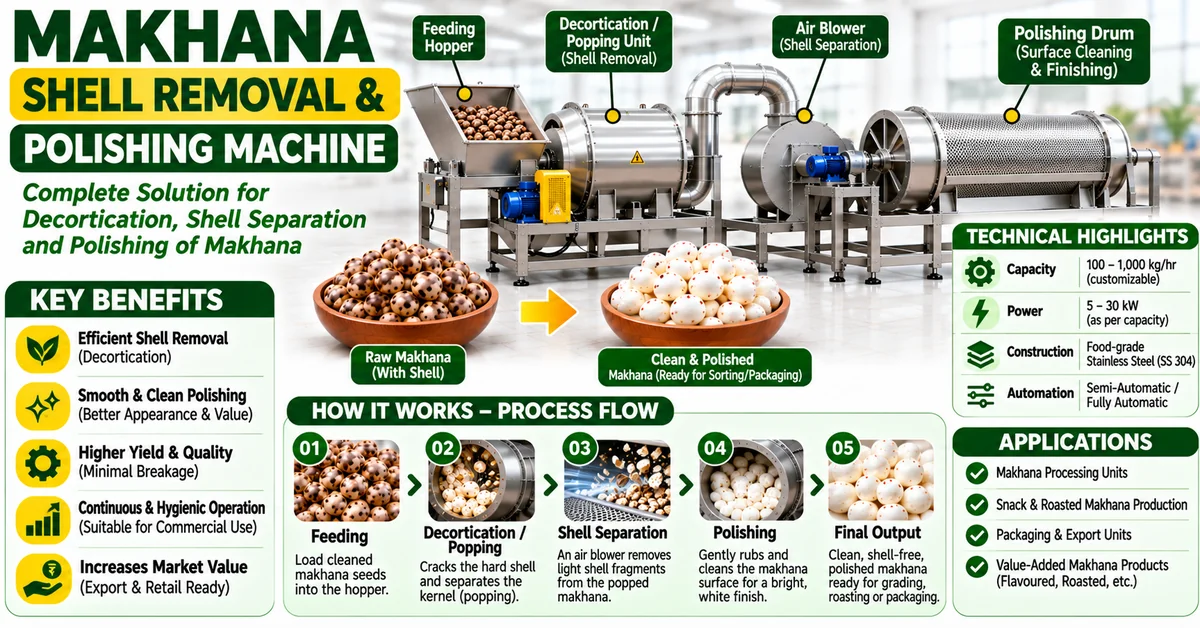
A makhana shell removal and polishing machine helps processors convert raw popped makhana into a cleaner, brighter, more saleable finished product. For entrepreneurs in India, it can become the core of a profitable makhana processing business provided you plan capacity, power, hygiene, licensing, and sales channels before buying equipment.
This guide explains what the machine does, what to check before purchase, how to set up a commercial unit, the licenses required, realistic investment and payback considerations, and the questions to ask a makhana shell removal and polishing machine manufacturer or supplier in India.
What Is a Makhana Shell Removal and Polishing Machine?
A makhana shell removal and polishing machine is designed to remove loose husk, shell fragments, unpopped particles, and surface impurities from popped makhana, while polishing the kernels to improve their appearance and uniformity.
In a typical makhana processing flow, raw seeds are cleaned and graded, roasted or popped, then separated from shells and impurities. The shell removal and polishing stage is important because buyers especially retail brands, exporters, and packaged-snack companies expect clean, uniform, visually appealing makhana.
A commercial makhana shell removal and polishing machine may include:
- A feeding hopper or inlet conveyor
- Shell and husk separation mechanism
- Air aspiration or dust-removal system
- Polishing drum or abrasive polishing section
- Grading or discharge outlet
- Collection trays or bags for cleaned makhana
- Dust extraction points and safety guards
The exact configuration varies by manufacturer, capacity, and whether the machine is standalone or part of a complete makhana processing line.
Why This Machine Matters in Makhana Processing
Manual cleaning and polishing can be labour-intensive, inconsistent, and difficult to scale. A machine-based system helps standardise output and reduce dependence on skilled manual labour.
Key business benefits
- Better product appearance: Polished makhana looks whiter, cleaner, and more uniform.
- Improved buyer acceptance: Retailers, snack brands, and bulk buyers prefer low-shell, low-dust material.
- Higher throughput: Mechanised cleaning supports larger daily production volumes.
- Reduced manual handling: This can improve hygiene and reduce product contamination risk.
- Consistent quality: Machines help maintain more uniform cleaning and polishing across batches.
- Scope for value addition: Clean polished makhana can be roasted, flavoured, packed, or supplied to snack manufacturers.
Makhana processing generally includes cleaning, grading, roasting, popping, polishing, and packaging; polishing is therefore a value-adding step rather than an optional afterthought.
Who Should Buy This Machine?
A makhana shell removal and polishing machine is suitable for several business models:
|
Business model |
How the machine is used |
|
Makhana processor |
Cleans and polishes popped makhana before grading or packing |
|
Makhana trader or aggregator |
Improves quality before selling to brands, wholesalers, or exporters |
| Packaged snack brand |
Prepares makhana for roasting, flavouring, and retail packing |
| Contract processor |
Offers shell removal and polishing as a service to nearby farmers or traders |
|
Export-oriented unit |
Produces cleaner, more uniform makhana for quality-sensitive buyers |
| Farmer producer organisation |
Adds value locally before selling processed makhana |
If your business only sells raw makhana without processing, this machine may not be essential. But if you plan to supply cleaned, polished, roasted, flavoured, or packaged makhana, it becomes a strong foundation machine.
Machine Specifications to Check Before Buying
Before requesting a quote, prepare a clear requirement sheet. Do not select a machine only on price; compare capacity, build quality, power consumption, ease of cleaning, and after-sales support.
Capacity
Capacity is usually expressed in kilograms per hour or kilograms per day, depending on the machine design and raw-material condition.
For planning purposes:
- Small or semi-automatic unit: Often suitable for roughly 100–200 kg/day processing setups.
- Medium commercial unit: Suitable for growing processors supplying local brands or wholesalers.
- Large automatic line: Required for high-volume, continuous production and export-oriented operations. Fully automatic makhana plants are often planned in the 1,500–2,500 kg/day range, though the polishing machine capacity must match the upstream popping and downstream packing capacity.
Ask the supplier to specify capacity for popped makhana input, not just theoretical machine throughput. Moisture level, shell content, kernel size, and feeding method can all affect real output.
Power requirement
Confirm the following before installation:
- Single-phase or three-phase power requirement
- Connected load in kW or HP
- Recommended starter or control panel
- Voltage fluctuation tolerance
- Average power consumption per hour
- Need for a generator or inverter backup
Automated makhana machinery commonly requires a three-phase electricity connection, so verify your local power availability before finalising the site.
Construction and hygiene
Because makhana is a food product, the machine should be easy to clean and maintain.
Check:
- Food-contact material quality
- Rust-resistant or stainless-steel contact parts, where applicable
- Smooth surfaces and accessible cleaning points
- Dust extraction arrangement
- Removable trays, screens, or panels
- Safety guards around moving parts
- Emergency stop and electrical protection
FSSAI licensing requirements also expect food businesses to maintain hygiene and safety standards, and the application process requires details of equipment, installed capacity, and horsepower used.
Output quality
Ask for a demo using makhana similar to your raw material. Evaluate:
- Percentage of shell removal
- Amount of broken or damaged kernels
- Dust and husk separation efficiency
- Polish uniformity
- Final kernel appearance
- Ease of adjusting the machine for different makhana sizes
- Losses during processing
A machine that polishes aggressively may improve shine but increase breakage. The best machine balances cleanliness, polish, and kernel integrity.
Space, Utilities, and Layout
A practical makhana processing setup needs space not only for the shell removal and polishing machine but also for raw-material storage, popping or roasting, cooling, grading, packing, finished-goods storage, and staff movement.
As a broad planning benchmark, small makhana processing operations are often planned in approximately 500–800 sq. ft., though your exact requirement will depend on capacity, automation, storage volume, and packaging line.
Suggested layout zones
- Raw makhana storage area: Dry, ventilated, pest-proof storage.
- Cleaning and grading area: For pre-cleaning and size grading.
- Roasting or popping area: With heat management and ventilation.
- Cooling area: Allows kernels to stabilise before polishing.
- Shell removal and polishing area: Main machine zone with dust control.
- Packing area: Separate from dusty processing areas.
- Finished goods store: Clean, dry, and organised for dispatch.
- Utilities area: Electrical panel, water supply if needed, and waste collection.
Keep a clear material-flow direction raw material in, processing, polishing, packing, and dispatch out. Avoid backtracking, as it increases contamination risk and slows production.
Licenses and Compliance in India
Before starting commercial operations, confirm the licenses applicable to your state, premises, turnover, and product category. Food businesses in India generally need FSSAI registration or licensing, and other local registrations may also apply.
FSSAI registration or license
FSSAI requirements depend mainly on production capacity and annual turnover.
|
Business scale |
Typical FSSAI requirement |
|
Small food business with annual turnover up to ₹12 lakh and/or production capacity up to 100 kg/day |
Basic FSSAI Registration |
| Mid-sized manufacturing or processing unit |
State FSSAI License |
| Larger manufacturing or processing operations |
Central FSSAI License, depending on eligibility and activity |
FSSAI’s eligibility framework distinguishes between basic registration, State License, and Central License based on production capacity and turnover; the applicable category should be confirmed on the FoSCoS portal or with a food-safety consultant.
For a makhana processing unit, the machine manufacturer’s specification sheet will be useful because FSSAI applications require a list of machinery, installed capacity, and horsepower used.
Other registrations commonly required
Depending on your business structure and location, you may also need:
- Udyam/MSME registration
- GST registration, if applicable
- Trade license or municipal corporation license
- Shops and Establishments registration, where applicable
- Local body or gram panchayat NOC, where required
- Legal metrology registration for packaged products, where applicable
- Pollution-control or local environmental compliance, depending on the scale and location of the unit
Food manufacturing guidance also lists municipal/trade licenses, Shops and Establishments compliance, and Legal Metrology registration as requirements that may apply at the manufacturing location.
Labeling and packaging
If you plan to sell packaged makhana, ensure your labels meet applicable FSSAI labeling requirements. At a minimum, review:
- Product name
- Ingredient list
- Net quantity
- FSSAI logo and license number
- Manufacturing date and best-before/use-by date
- Storage instructions
- Manufacturer or packer details
- Batch number
- Country of origin, where applicable
Compliance requirements can change, so validate the latest labeling rules before printing packaging.
Investment Planning
The cost of a makhana shell removal and polishing machine depends on capacity, automation level, material of construction, dust-control system, and whether it is integrated into a larger processing line.
Published industry estimates suggest that small semi-automatic makhana processing setups of around 100–200 kg/day may require roughly ₹5–10 lakh, while fully automatic plants can cost substantially more depending on capacity and configuration. These figures are indicative; obtain machine-specific quotations before preparing a bankable project report.
Sample investment framework
|
Cost head |
What it includes |
|
Makhana shell removal and polishing machine |
Base machine, motor, controls, and standard accessories |
|
Upstream equipment |
Cleaner, grader, roaster, popping equipment, conveyor |
| Downstream equipment |
Cooling system, grader, flavouring drum, packaging machine |
|
Civil work |
Shed modification, flooring, drainage, ventilation |
| Electrical work |
Wiring, panel, three-phase connection, backup power |
|
Installation and training |
Erection, commissioning, operator training |
|
Working capital |
Raw makhana, packaging material, salaries, fuel/power |
| Compliance and branding |
FSSAI, GST, Udyam, label design, sample testing |
Do not allocate your entire budget to machinery. Keep funds for working capital, installation, utilities, and at least three months of operating expenses. Industry setup guides similarly recommend budgeting separately for shed work, electrical connection, licensing, and working capital.
How to Choose the Right Manufacturer or Supplier
When comparing a makhana shell removal and polishing machine manufacturer or supplier in India, focus on proven performance not just catalogue claims.
Ask these questions
- What is the machine’s actual output for popped makhana?
- What is the connected load and recommended power supply?
- What percentage of shell and husk removal can it achieve?
- How much kernel breakage occurs during polishing?
- Is the machine suitable for different makhana grades?
- What materials are used for food-contact parts?
- How easy is daily cleaning and maintenance?
- What spare parts are required and how easily are they available?
- Do you provide installation, commissioning, and operator training?
- What is the warranty period and response time for service?
- Can you share a demo video or arrange a factory visit?
- Can the machine integrate with my existing roaster, grader, or packing line?
- What is the delivery timeline and installation requirement?
A reliable supplier should provide a written specification sheet, layout drawing, power details, utility requirements, and a clear scope of supply.
Production Process: From Raw Makhana to Polished Product
A typical commercial makhana processing flow is:
- Raw makhana receipt: Procure graded raw makhana from farmers, mandis, or aggregators.
- Pre-cleaning: Remove stones, dust, and foreign matter.
- Grading: Separate seeds by size for uniform roasting or popping.
- Roasting or popping: Heat treatment opens the seed and creates popped makhana.
- Cooling: Reduce temperature before further handling.
- Shell removal: Separate shells, husk, and unpopped material.
- Polishing: Improve surface finish and remove residual dust.
- Final grading: Sort polished makhana by size or quality.
- Packing: Pack for bulk supply or retail sale.
- Storage and dispatch: Store in a dry, hygienic area.
Makhana processing commonly follows this sequence of cleaning, grading, roasting, popping, polishing, and packaging.
Staffing and Operations
A small unit may begin with a lean team:
- 1 owner or production supervisor
- 1–2 machine operators
- 1–2 helpers for feeding, packing, and material handling
- Part-time accountant or compliance support
- Sales/distribution support as volumes grow
Train operators on:
- Safe machine startup and shutdown
- Correct feeding rate
- Adjustment of polishing intensity
- Dust extraction maintenance
- Cleaning schedules
- Recording batch details
- Identifying defective or contaminated material
- Basic electrical and mechanical safety
Maintain daily records for raw-material quantity, output, power consumption, breakage, downtime, and quality complaints. These records help you calculate actual cost per kg and improve profitability.
Quality Control Checklist
Quality control protects your brand and reduces rejection from buyers.
Check every batch for:
- Shell or husk remnants
- Dust and foreign matter
- Broken kernels
- Unpopped seeds
- Moisture or clumping
- Insect infestation
- Off-odour
- Uniform polish
- Correct pack weight
- Seal integrity
- Label accuracy
For retail or export supply, consider periodic testing for moisture, microbiological parameters, and contaminants through an accredited laboratory.
Marketing and Sales Channels
A polishing machine improves product quality, but revenue depends on securing buyers.
Potential sales channels
- Local makhana wholesalers
- Grocery stores and supermarkets
- Online marketplaces
- Direct-to-consumer brand website
- HoReCa buyers: cafés, restaurants, hotels
- Snack manufacturers
- Private-label brands
- Institutional buyers
- Exporters and import houses
For retail branding, position polished makhana around cleanliness, crunch, natural nutrition, and premium appearance. For B2B sales, emphasise consistent supply, low shell content, uniform grading, and reliable packaging.
Realistic Payback Period
There is no single payback period for a makhana shell removal and polishing machine because profitability depends on raw-material cost, selling price, capacity utilisation, labour savings, power cost, breakage, and market access.
A practical way to estimate payback is:
{Payback period} = {Total project investment}/{Average monthly net profit}
For example, if your total project investment is ₹12 lakh and your average monthly net profit after all expenses is ₹50,000, the simple payback period is:
{12,00,000}/{50,000} = 24 { months}
That is a simplified calculation. In real operations, also account for seasonal raw-material price movements, machine downtime, working-capital needs, and buyer payment cycles.
A machine becomes more attractive when it helps you move from selling low-margin raw or semi-processed makhana to supplying clean, polished, packed, or branded makhana at a better realised price.
Common Mistakes to Avoid
- Buying a machine without testing it on your actual makhana grade
- Ignoring three-phase power availability
- Underestimating dust-control requirements
- Not keeping enough working capital for raw material
- Choosing capacity far above realistic market demand
- Neglecting cleaning and maintenance schedules
- Starting packaging sales before confirming labeling compliance
- Relying on one buyer or one sales channel
- Comparing machines only on purchase price
- Not collecting written specifications before making an advance payment
Is This Business Right for You?
A makhana shell removal and polishing machine business is suitable if you have access to raw makhana, a reliable power supply, a clean processing space, and a clear buyer segment. It is especially attractive for entrepreneurs located near makhana-producing belts, existing food processors, trader-aggregators, and brands wanting control over quality.
Start with a realistic capacity, validate the machine with a demo, secure compliance documentation, and build at least two or three sales channels before scaling.
FAQs
What does a makhana shell removal and polishing machine do?
It removes shells, husk, dust, and loose impurities from popped makhana and polishes the kernels to improve cleanliness, appearance, and uniformity.
What capacity machine should I buy?
Choose capacity based on your expected daily sales volume, not the largest machine available. For a new business, many entrepreneurs begin with a small or semi-automatic setup and scale after establishing buyers. Small makhana processing units are often planned around 100–200 kg/day.
How much space is required?
A compact commercial setup may need roughly 500–800 sq. ft., but the final requirement depends on storage, processing equipment, packing area, and material flow.
Does it need three-phase power?
Many automated makhana machines require a three-phase connection. Confirm the exact connected load, voltage, and starter requirements with the machine supplier before installation.
What licenses are needed to run a makhana shell removal and polishing machine business?
You will typically need FSSAI registration or licensing, along with applicable business registrations such as Udyam, GST, trade license, and local body approvals. The exact FSSAI category depends on turnover and production capacity.
How much does a makhana shell removal and polishing machine cost?
Machine cost varies by capacity, automation, construction, and configuration. As broader context, small semi-automatic makhana processing setups are often estimated at ₹5–10 lakh, while larger automated plants can cost much more. Request a machine-specific quotation for accurate budgeting.
What is a realistic payback period?
Payback depends on capacity utilisation, selling price, raw-material cost, and operating expenses. Calculate it using total investment divided by average monthly net profit, and revisit the estimate after the first few months of actual production.
Can I use the machine for roasted or flavoured makhana?
Yes, polished makhana can be further roasted, seasoned, or flavoured before packaging. Ensure the polishing stage is completed before flavouring so that coating adheres evenly and the final product remains clean.