
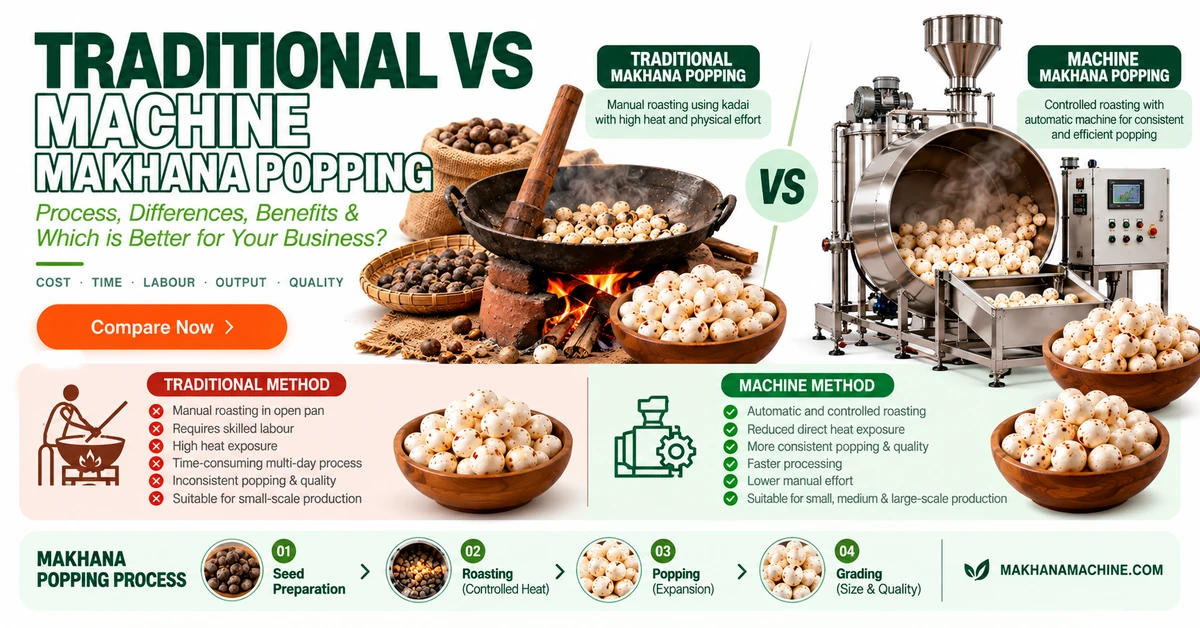
Makhana popping is the step that decides whether raw foxnut seeds become premium, white, crisp popped makhana—or a low-grade lot with broken kernels, unpopped seeds and poor market value. Traditionally, processors roast seeds in earthen pots or cast-iron pans at very high temperatures and then strike them manually with a wooden mallet; mechanised systems automate roasting and popping to reduce heat exposure, labour dependency and quality variation.
This guide compares traditional vs machine makhana popping across yield, labour, quality, cost, scalability and suitability for different business models. It is written for farmers, FPOs, makhana processors, snack brands and first-time entrepreneurs evaluating whether to continue manual popping or invest in mechanisation.
Why the popping stage matters
Makhana, also called foxnut or gorgon nut, is mainly cultivated in Bihar, Assam, West Bengal, Tripura and Odisha. Bihar alone accounts for a major share of India’s makhana economy, with lakhs of families involved in cultivation, harvesting, popping and sale.
Popping is not simply “heating the seed.” The raw makhana seed has a hard outer shell and a kernel inside. Correct roasting expands the kernel, while controlled impact breaks the shell and releases the popped makhana, known locally as lawa. If the roasting temperature, seed moisture, timing or malleting force is wrong, the kernel may not expand fully or may break into small pieces.
The commercial difference is significant. Depending on raw-material quality and process control, makhana yield is commonly reported at around 35–40% of raw seed weight, meaning 100 kg of raw seed may produce roughly 35–40 kg of popped makhana under traditional processing conditions.[agrifarming]
Traditional makhana popping: how it works
Traditional popping is a skilled, multi-stage manual process. Seeds are cleaned, graded and dried, then pre-heated and tempered. They are roasted in small batches in an earthen pot or cast-iron pan, often with continuous stirring, before being transferred quickly to a hard surface for malleting.
The roasting stage uses very high temperatures—reported in the range of 250°C to 320°C in traditional systems. Workers must judge the exact moment when the seed is ready; even a delay of a few seconds before malleting can reduce pop quality.
Main steps in traditional popping
- Cleaning and grading: Remove mud, damaged seeds and foreign matter; segregate seeds by size for uniform roasting.
- Drying and tempering: Reduce moisture and condition the seeds so they respond consistently to heat.
- Pre-heating: Prepare seeds for roasting and minimise sudden thermal shock.
- Roasting: Roast small batches in a pan or earthen pot while stirring continuously.
- Malleting: Strike hot roasted seeds with a wooden mallet so the shell breaks and the kernel pops.
- Sorting and polishing: Separate unpopped seeds, broken makhana and impurities before grading for sale.
This method has survived because it requires relatively low fixed investment and can be operated close to production clusters. However, it depends heavily on skilled labour, exposes workers to intense heat, and makes output quality difficult to standardise.
Machine makhana popping: how it works
Machine popping replaces much of the manual roasting-and-malleting sequence with controlled equipment. A mechanised system may include cleaning, grading, drying, roasting and popping operations in a connected line. ICAR-CIPHET has developed and commercialised a complete mechanised system for these operations.
In one mechanised approach, roasting takes place in a closed barrel using electrically heated thermic oil. The thermally insulated barrel reduces worker exposure to heat, while roasted seeds automatically hit a closed casing within seconds, breaking the hard shell without manual malleting.
What a machine-based setup may include
- Seed cleaner and grader
- Dryer or moisture-conditioning unit
- Roasting unit with temperature control
- Popping or impact-breaking unit
- Cooling and sorting arrangement
- Polishing, grading and packing line, depending on scale
The exact configuration varies by capacity, budget and the level of automation. A small processor may mechanise only roasting and popping, while a larger unit may build a complete line from raw-seed cleaning to packed popped makhana.
Yield comparison: traditional vs machine popping
Yield is one of the strongest reasons processors consider mechanisation. But it is important to distinguish between raw-seed-to-popped-makhana conversion and popping efficiency among roasted seeds.
Traditional processing commonly delivers a makhana yield of about 35–40% on raw seed weight, though the figure varies with seed variety, moisture, grading and operator skill. Improved varieties can show pop recovery in the range of 50–55%, indicating that raw material quality and agronomic practices also influence results.
Machine systems can achieve higher popping recovery under optimum conditions. PMFME material reports popped makhana recovery of more than 90% with less than 3% undecorticated nuts under optimum conditions. Field performance studies of makhana popping machines have also reported popping efficiency of about 80–85% at a capacity of around 10 kg per hour.
| Parameter | Traditional popping | Machine popping |
| Core method | Pan/earthen-pot roasting followed by manual malleting | Controlled roasting and mechanical impact/popping |
| Typical raw-seed conversion | About 35–40% of raw seed weight, depending on seed quality and skill | Can be higher when roasting, moisture and grading are controlled; optimum-condition recovery is reported above 90% |
| Popping consistency | Varies by worker skill and batch timing | More repeatable when temperature, feed rate and seed grading are controlled |
| Unpopped seeds | More likely if roasting or malleting timing is wrong | Lower under optimum operation; reported below 3% in ideal conditions |
| Best suited for | Small volumes, household units, low-capital operations | Commercial processing, FPOs, brands and export-oriented units |
The practical takeaway is that machines do not automatically create yield. They create the conditions for repeatable yield: uniform roasting, consistent impact, reduced handling delays and better control over seed quality.
Labour comparison: skill, safety and output
Labour is where the difference between traditional and machine popping becomes most visible.
In the traditional system, two to three labourers may process only about 8–9 kg of popped makhana per day, according to a field-performance study on makhana popping machines. The work involves standing near high-temperature roasting equipment, handling hot seeds and applying precise mallet force immediately after roasting.
Machine popping reduces direct labour requirement and shifts the workforce toward operating, monitoring, feeding, sorting and packing. ICAR notes that mechanisation eliminates human intervention between roasting and popping, protecting operators from intense heat and burns associated with manual malleting.
Labour advantages of machine popping
- Lower dependence on highly skilled malleting workers
- Reduced exposure to extreme roasting heat
- More consistent output across shifts
- Easier supervision and production planning
- Better suitability for larger, continuous processing volumes
- Reduced physical strain and occupational-safety risk
However, mechanisation does not remove the need for trained people. Operators must understand seed moisture, roasting temperature, feed rate, machine cleaning and quality checks. A poorly trained machine operator can still produce burnt, under-popped or broken makhana.
Quality comparison: appearance, texture and grading
Quality is not only about how many seeds pop. Buyers assess popped makhana on size, whiteness, uniformity, crispness, broken-kernel percentage, unpopped-seed percentage and absence of burnt or discoloured pieces.
Traditional popping can produce excellent makhana when handled by experienced workers. The limitation is consistency: a few seconds’ delay between roasting and malleting can reduce quality, and results vary from worker to worker and batch to batch.
Machine popping offers better process control. Because roasting and popping occur in a controlled sequence, the system reduces delays and helps maintain more uniform expansion. ICAR reports that the quality and market value of makhana produced through the mechanised process is better than manually popped makhana, fetching at least ₹50 per kg more than the traditional method.
Quality factors to monitor
- Expansion ratio: Larger, well-expanded makhana generally commands a better price.
- Colour: White or cream-white pops are preferred; dark spots suggest overheating.
- Breakage: Excess broken kernels reduce grade and packaging appeal.
- Unpopped seeds: These increase wastage and sorting labour.
- Moisture: Excess moisture affects crispness, shelf life and packaging.
- Foreign matter: Sand, shell fragments and damaged seeds damage brand trust.
- Uniformity: Consistent size and shape are essential for premium retail packs.
For brands selling roasted, flavoured or ready-to-eat makhana, machine popping provides a more dependable base material. Uniform raw popped makhana makes seasoning, roasting, packing and quality claims easier to manage.
Cost comparison: traditional vs machine makhana popping
The right choice depends on whether you are optimising for low upfront cost or lower cost per kilogram at scale.
Traditional popping has low capital cost but higher recurring dependence on skilled labour. Machine popping requires higher upfront investment but can reduce labour cost, improve saleable yield and support higher daily throughput.
ICAR estimates the fixed cost of a mechanised makhana system at about ₹15 lakh, with working capital of about ₹5 lakh per month. It also estimates a breakeven point within about six months, subject to capacity utilisation, raw-material availability and selling price.
These figures should be treated as indicative, not universal. Actual cost depends on machine capacity, automation level, power connection, building requirements, transport, installation, spare parts and whether the unit includes cleaning, drying, grading and packaging.
Cost heads to calculate
| Cost head | Traditional popping | Machine popping |
| Capital investment | Low to moderate | High; ICAR cites about ₹15 lakh for a mechanised system |
| Labour | High dependence on skilled malleting workers | Lower direct labour, but trained operators needed |
| Energy/fuel | Firewood, biomass or other heating fuel | Electricity and/or thermic-fluid heating |
| Yield loss | Higher risk from timing errors and manual handling | Lower risk when process parameters are controlled |
| Maintenance | Low equipment cost, but tool and pan replacement | Periodic servicing, spares and technical support |
| Quality premium | Limited by inconsistency | Potential premium; ICAR reports at least ₹50/kg higher market value |
| Scalability | Limited by skilled labour availability | Better suited to commercial volumes |
For a small household or village-level unit handling limited volumes, traditional popping may remain viable. For an FPO, processor or brand planning consistent daily supply, machine popping is usually easier to justify because it improves throughput, quality control and labour planning.
Traditional vs machine makhana popping requirements
Before choosing a system, assess your raw material, market, capital and operating capability.
Requirements for traditional popping
- Access to skilled malleting workers
- Reliable supply of graded raw makhana seeds
- Roasting pans or earthen pots
- Safe heating arrangement and ventilation
- Hard malleting surface
- Sorting, grading and storage space
- Strong quality-control supervision
Traditional popping is appropriate when volumes are small, capital is limited and skilled labour is available. But the business must accept greater variation in output and more difficult working conditions.
Requirements for machine popping
- Adequate working capital and installation budget
- Stable power supply
- Sufficient raw-seed volume to utilise machine capacity
- Clean, graded and moisture-controlled seeds
- Trained machine operator and maintenance support
- Space for roasting, popping, cooling, sorting and packing
- Food-safe material contact surfaces and hygienic handling practices
- A plan for maintenance, spares and downtime
Machine popping is most effective when the unit can source consistent raw material and run at reasonable capacity. A machine that remains idle due to poor seed supply or power interruptions will struggle to deliver the expected return.
Traditional vs machine makhana popping tips
Whether you use manual or machine popping, the fundamentals remain the same: control moisture, heat, timing and handling.
Tips for traditional popping
- Grade seeds before roasting so similar sizes roast evenly.
- Dry and temper seeds properly; uneven moisture causes uneven popping.
- Roast in small batches to maintain control.
- Stir continuously to avoid localised burning.
- Train workers to recognise the cracking sound and correct roasting stage.
- Mallet immediately after roasting; delay reduces pop quality.
- Keep a record of seed lot, roasting time, worker, yield and rejection rate.
- Sort popped makhana promptly to prevent quality mixing.
Tips for machine popping
- Do not feed mixed seed sizes without grading; uniform feed improves popping consistency.
- Check seed moisture before processing.
- Start with a trial batch and adjust temperature and feed rate gradually.
- Avoid overloading the roasting or popping chamber.
- Clean the machine at scheduled intervals to prevent residue build-up.
- Maintain a log of input weight, popped output, unpopped seeds, broken kernels and power consumption.
- Train at least two operators so production does not stop when one person is absent.
- Inspect bearings, heating elements, belts and impact components as per the manufacturer’s schedule.
- Use food-grade contact surfaces and follow hygienic handling practices.
Common mistakes to avoid
Many makhana processing losses come from avoidable errors rather than the choice between manual and machine popping.
- Skipping seed grading: Mixed seed sizes roast unevenly and produce inconsistent pops.
- Ignoring moisture content: Wet seeds may not pop properly; overly dry seeds may break or burn.
- Overheating: This causes dark colour, burnt aroma and brittle kernels.
- Under-roasting: Seeds remain hard, produce low expansion or fail to pop.
- Delaying malleting: In traditional popping, even a short delay after roasting can reduce quality.
- Using excessive mallet force: This increases breakage and reduces premium-grade output.
- Feeding ungraded seeds into machines: This disrupts temperature transfer and impact consistency.
- Neglecting cleaning: Residue, dust and broken shell pieces affect food safety and final quality.
- Buying a machine without a raw-material plan: Capacity without a steady seed supply leads to poor utilisation.
- Judging only machine price: Installation, power, labour, spares, drying and packing costs also determine profitability.
Which method should you choose?
Choose based on your business stage, not on the assumption that machines are always better.
Choose traditional popping if:
- You process small, seasonal volumes.
- Capital availability is limited.
- Skilled local labour is accessible.
- You sell into local or informal markets where manual processing is accepted.
- You want to test the business before larger investment.
Choose machine popping if:
- You need consistent daily output.
- You supply retail packs, exporters, snack brands or organised buyers.
- Skilled malleting labour is scarce or expensive.
- Worker safety and heat exposure are major concerns.
- You want better control over grade, colour and breakage.
- You can maintain steady raw-material supply and machine utilisation.
A hybrid approach can also work. Some processors begin with manual sorting, grading and packing while mechanising the most labour-intensive and heat-exposed steps: roasting and popping.
Is machine-popped makhana better than hand-popped makhana?
Machine-popped makhana is of better quality and consistency, suitable for processing, safer, and easier for workers, and more scaleable and amenable to quality control than traditional, manually roasted poppers if seed grading, moisture, and roasting parameters are controlled appropriately, as ICAR. Market value for machine-popped makhana is at least Rs 50 a kg higher than traditional, manually roasted, per the ICAR report.
But there is nothing necessarily worse about hand-popped makhana. Traditional processors with care and expertise can achieve a high standard, mostly if only a few kilos are produced and individual care can be given. The problem of repeatability is that popping on the hand depends on worker judgement, timing, and handling.
At major retail brands, machine popping is a more reliable option, as the buyer will be expecting all the product to be a consistent size colour with the desired crunch. For small local producers, old style popping may still be a viable option with tight quality control.
What are the most common mistakes to avoid?
The most common mistakes are poor seed grading, incorrect moisture management, overheating, under-roasting, delayed malleting and inadequate cleaning. In traditional popping, delayed malleting is especially damaging because the seed must be struck at the right moment after roasting.
In machine popping, common errors include feeding ungraded seeds, overloading the machine, ignoring temperature calibration, skipping maintenance and assuming that mechanisation alone will fix poor raw material. Machines improve consistency, but they cannot compensate for low-quality seeds or poor operator training.
Who can help with this if I’m doing it for the first time?
First-time processors can seek help from agricultural research institutions, food-processing machinery suppliers, FPOs, local makhana processors and government food-processing support schemes. ICAR-CIPHET has developed and commercialised a mechanised makhana processing system covering threshing, cleaning, seed grading, drying, roasting and popping.
Before purchasing equipment, visit an operating unit, request a trial run with your own raw material, and compare yield, breakage, colour, power consumption and labour needs. Also consult a food-technology consultant or machinery supplier about layout, utilities, hygiene, maintenance and packaging requirements. For subsidy or enterprise-development support, explore schemes such as PMFME, which includes makhana processing material and guidance for entrepreneurs.
Conclusion
The conventional method of makhana popping needs little investment and is well established culturally, but it is labour-intensive, exposes workers to heat, and is difficult to standardise. In contrast, machine popping takes more investment but brings better control over yield quality labour safety, and scalability.
Machine popping is typically the better choice if, over time, a processor or brand intends to build a volume program that can be shipped in the traditional retail packages. For a small-scale starter, traditional popping still makes sense. The best makhana business balances tradition and technology without making a premature choice. It implements the appropriate amount of mechanisation to match its volume and its quality and market targets.
FAQs
Is machine-popped makhana better than hand-popped makhana?
Machine-popped makhana is more uniform, safe, and closer to a commercial grade.
What are the most common mistakes to avoid?
Avoid ungraded seeds, incorrect moisture overheating delayed malleting, and poor machine maintenance.
Who can assist me with this if I have never done this before?
Where to get help from ICAR institutes, machinery suppliers FPOs food consultants and PMFME-supported experts.
What yield can traditional makhana popping achieve?
Most popping methods typically yield an estimated 3540% of raw seed weight in popped makhana.
Does machine popping reduce labour requirements?
Yes, machine popping lessens manual labour, reduces heat exposure, and decreases dependence on skilled malleting workers.
Which method gives better makhana quality?
Machine popping tends to give a better quality, as manual popping is very much based on the skills of the operator.
Is machine makhana popping suitable for small businesses?
It is suitable for small firms only if raw material power capital, and trained operators are always available.